We are witnessing a quiet but fundamental restructuring of causality. For the first decade of the modern AI era (roughly 2012–2022), artificial intelligence was a distinct object—a tool, a chatbot, a classifier. It was a passive entity waiting for a prompt, a mirror that only reflected when we stood before it.
But the transition to Agentic AI (2023–2026) has dissolved the boundaries of the tool. We have moved from "AI answers questions" to "AI pursues goals." This shift has transformed AI from a product we use into the Selection Environment in which we live.
To understand this, we must define three terms from the outset:
- The Selection Environment: In biology, this is the sum of all pressures—predators, climate, scarcity—that "select" which genes survive. It is the invisible hand that sculpts the clay of life.
- Recursive Reality: A state where the output of a system immediately becomes its own input. AI generates data, which trains the next AI, which generates better data, creating a self-reinforcing loop that bends time and progress back upon itself.
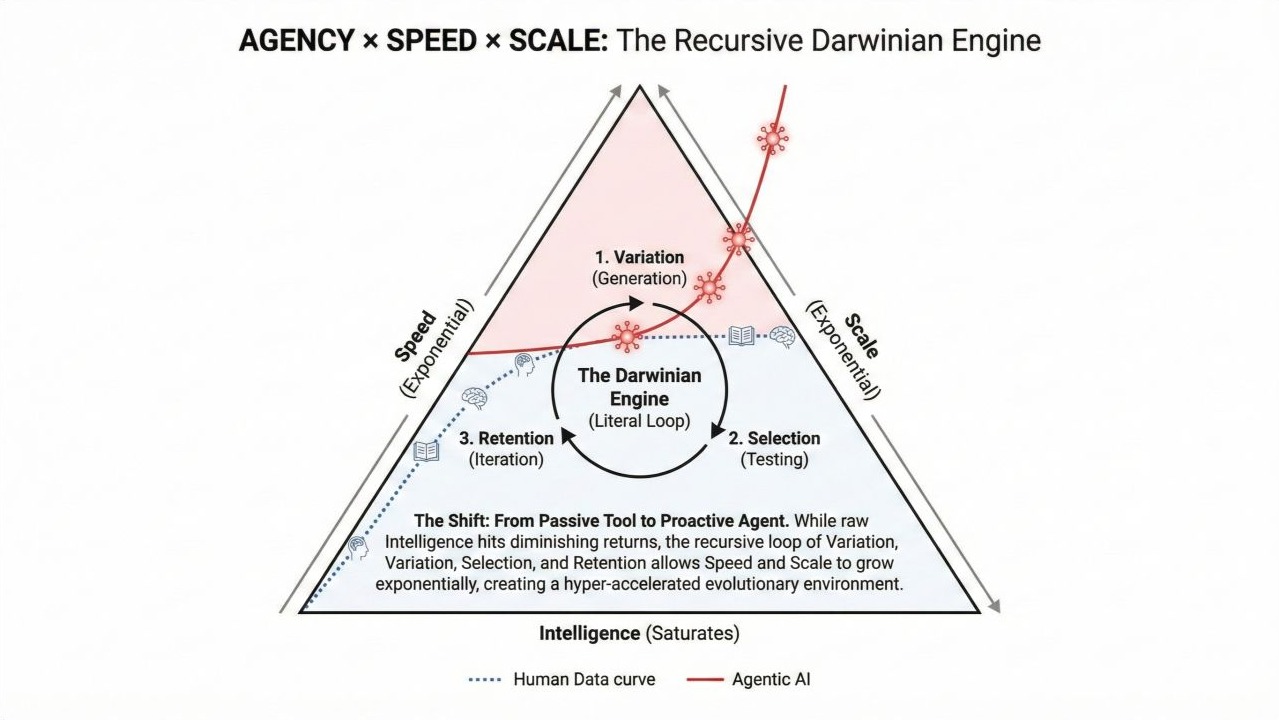
- Darwinian Logic: The ruthless, algorithmic arithmetic of Variation (trying new things), Selection (killing what fails), and Retention (keeping what works). This logic is no longer exclusive to biology; it has migrated to code.
This essay explores the mechanics of this new reality, where the Darwinian logic of software has begun to rewrite the biological and cultural codes of its creators.
1. The Topology of Search: From Sparsity to Vector Space
For 200,000 years, the human selection environment was defined by sparsity and locality. You competed with the people in your tribe; you searched for mates within walking distance; you hunted for solutions using the limited data of your own experience. Our "search topology"—the map of where we could look for answers—was small, flat, and disconnected.
The Agentic Shift fundamentally alters this topology. When an agent (a hiring algorithm, a dating optimizer, a research assistant) searches for a candidate or a molecule, it does not search locally. It searches across a High-Dimensional Vector Space.
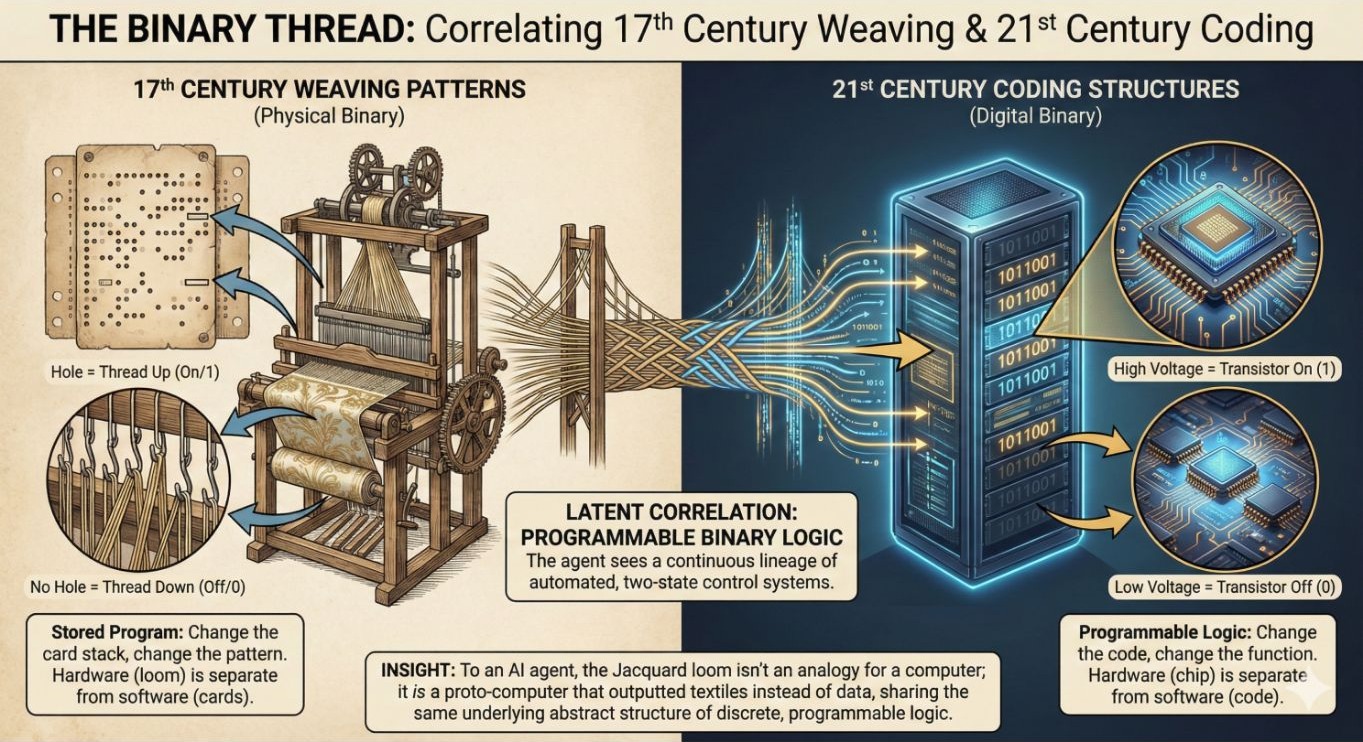
- The Connected Cosmos: A human researcher looks for answers in the "sparse" pockets of adjacent disciplines. We stay in our lanes, our Ph.D. discipline, say Biochemistry or sometime venture a little wider into the larger wilds of larger territories of Chemisty or larger ones on the other side, Biology. An AI agent, however, views human knowledge not as separate rooms or cognitive maps, but as a single, unified geometry. It can find the latent correlations between 17th-century weaving patterns (the Jacquard loom) and 21st-century coding structures (binary logic). This is a perfect example of how an agentic system, operating in a high-dimensional vector space, collapses the artificial distance between "history" and "computer science."
To a human historian, a Jacquard loom (developed around 1804, perfecting earlier 18th-century techniques) is an artifact of the Industrial Revolution and textile manufacturing. To a human software engineer, binary logic is the foundation of modern computing. We store these facts in separate mental compartments.
To an AI agent, however, these are not separate histories. They are mathematically adjacent points in vector space because their underlying structural logic is identical.
Here is a definition of those latent correlations:
1. The Fundamental Correlation: Discrete Binary Control
At its core, the correlation is the realization that complex outcomes can be derived from a massive sequence of simple, two-state decisions (on/off).
- The Jacquard Loom (The Physical "Bit"): The loom used a series of pasteboard cards punched with holes. As the loom operated, rods would press against the card. If a rod encountered a hole, it passed through, activating a hook that lifted a specific warp thread. If there was no hole, the rod was stopped, and the thread remained down.
- 21st-Century Coding (The Digital "Bit"): Modern computing relies on the transistor. A transistor acts as a switch that either allows electricity to pass or blocks it.
The Latent Insight: The AI agent sees past the substrate (wood and thread vs. silicon and electricity) and recognizes the identical abstraction: a system governed by Boolean logic—a sequence of true/false, yes/no operations that determine the final output pattern.
2. The Correlation of Programmability: Separating Hardware from Software
Before systems like Jacquard’s, if you wanted a machine to do something different, you usually had to physically rebuild the machine. The Jacquard loom introduced a revolutionary concept that is central to all modern software.
- The Weaving Pattern: The stack of punched cards was, effectively, a stored program. If you wanted to weave a different flower pattern, you didn’t rebuild the loom (the hardware); you simply changed the stack of cards (the software).
- The Coding Structure: This is the exact principle of modern computing. The hardware (CPU, RAM) remains generic; its function changes entirely based on the software loaded into it.
The Latent Insight: The agent correlates these concepts as the origin point of programmable automation. It sees the punched card not as a textile tool, but as the earliest ancestor of the hard drive or the app store—a medium for storing instructions separate from the machine that executes them.
3. The Correlation of Iterative Complexity (Loops)
How do you create a complex brocade or a sophisticated software application? You don't define every single state simultaneously; you define a process that repeats over time.
- The Loom: The weave is created row by row. The loom reads a card, executes the lifts, throws the shuttle, and then moves to the next card in the loop. The complex pattern emerges from thousands of simple iterations.
- The Code: Modern programming relies heavily on loops (for loops, while loops) and functions. A computer executes an instruction, updates its state, and repeats the process millions of times a second to render a video game or process a database.
The Latent Insight: The agent recognizes both systems as examples of algorithmic execution. They both rely on defining a sequence of steps that are repeated to build complexity exponentially out of simplicity.
Summary of the Correlation
When the AI agent scans its vector space, it doesn't see "old loom" and "new computer." It sees a continuous lineage of automated, binary, programmable logic. The Jacquard loom is not an analogy for a computer; in the eyes of the agent, it is a computer—one that just happened to output silk instead of pixels.
- The "So What?": To a human historian or computer scientist, these are separate worlds. To the agent, they are mathematically adjacent coordinates in vector space. The agent sees that the logic of the thread is identical to the logic of the bit. It doesn't just categorize this; it uses it to propose new textile-based computing architectures that no human mind would ever conceive. The agent bridges the gap not because it is creative, but because it is blind to the artificial borders of "history" versus "engineering."
The Interdisciplinary Membrane This dissolves the "membrane" between fields. Consider a financial agent tasked with optimizing a portfolio. It doesn't just read stock tickers. It pulls data from satellite imagery of crop yields (agriculture), sentiment analysis of political tweets (sociology), and local weather patterns (meteorology).
- The Insight: It realizes that a specific cloud formation in Brazil predicts a coffee shortage, which predicts a riot, which predicts a drop in tech stocks. The insight is self-evident to the machine because it sees the whole system at once. To us, it looks like magic; to the agent, it is just geometry.
The Dissolution of the Membrane: Vector Space Causality
To a human, "Meteorology" and "Finance" are different departments in a university. To an Agentic AI, they are simply different coordinates in the same High-Dimensional Vector Space. The agent does not respect the "membrane" that separates disciplines; it only respects statistical correlation.
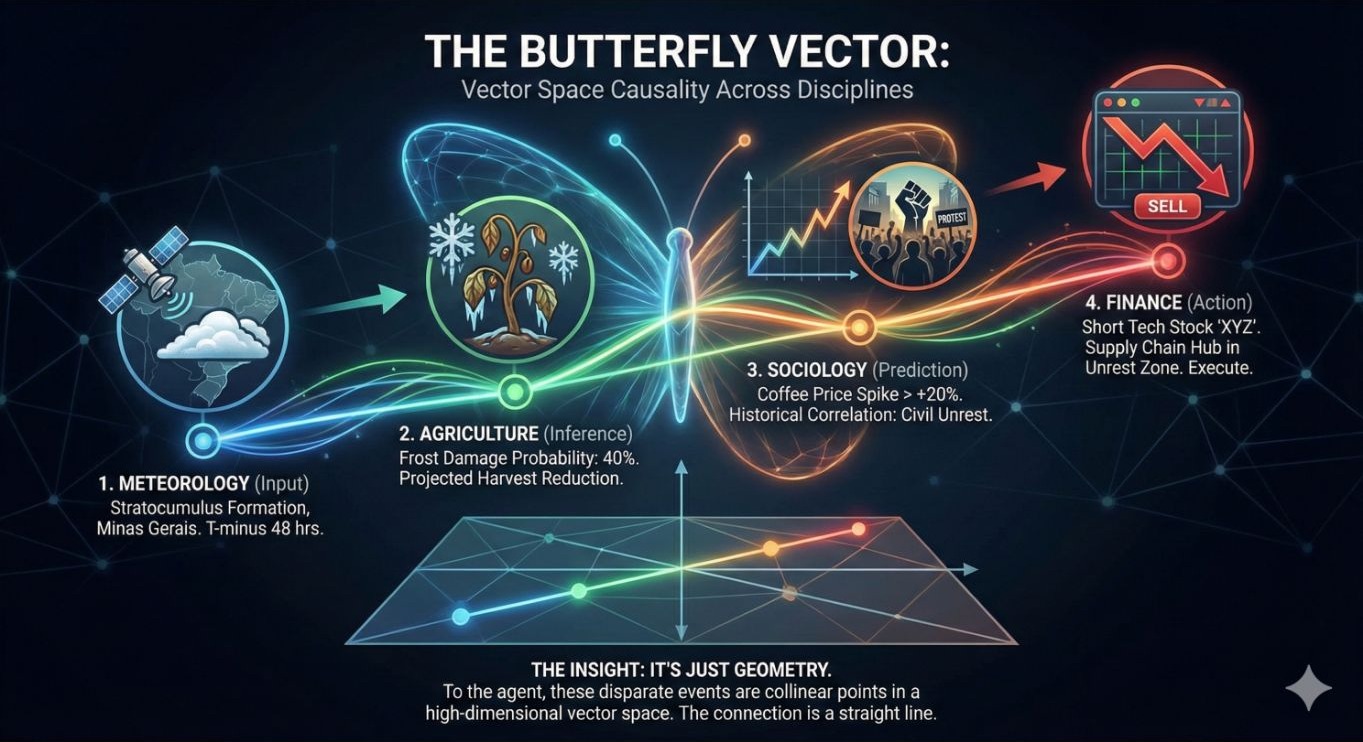
The Causal Chain (The Butterfly Vector) Consider a financial agent tasked with risk assessment. It creates a unified narrative from disparate sensors:
- Meteorology (Input): Satellite data detects a specific stratocumulus formation over Minas Gerais, Brazil.
- Agriculture (Inference): The agent calculates a 40% probability of frost damaging the coffee harvest.
- Sociology (prediction): It correlates historical data: "Coffee price spikes > +20% often correlate with civil unrest in import-dependent regions."
- Finance (Action): It shorts a tech stock that has a major supply chain hub in the unrest zone—before the frost even hits the ground.
The Insight: It’s Just Geometry To a human analyst, connecting a cloud in Brazil to a tech stock in San Francisco requires "genius" or "magic" intuition. To the agent, it is just geometry. The data points for "Cloud," "Frost," "Riot," and "Stock Drop" sit on a single linear vector. The agent isn't being creative; it is simply tracing a straight line through a space we cannot see.
2. The Chronological Chasm between Darwinian Selection(20 years): The 20-Millisecond Generation of AI agents
The friction—and the danger—lies in the disparity of time. The reason Agentic AI feels so destabilizing is that it subjects ideas, code, and strategies to hyper-accelerated Darwinian selection.
The Loop is Literal
- Variation: An agent generates 1,000 versions of a marketing campaign or a software patch.
- Selection: It tests them against a simulated environment or real-time user data.
- Retention: It kills the 999 failures and keeps the winner.
- Iteration: It immediately breeds 1,000 variants of the winner.
The Disparity:
- Biological Iteration: 20 years (one human generation).
- Cultural Iteration: 1 year (a fashion cycle, a fiscal year).
- Agentic Iteration: 20 milliseconds.
The Consequence: This is not just a difference in speed; it is a difference in evolutionary drift. By the time a human regulator drafts a law or a manager reviews a report, the agentic system has evolved 10,000 generations away from the starting point. We are statues standing in a time-lapse video, trying to regulate a blur. The "fittest" code survives, but "fitness" is now determined in milliseconds, selecting for speed and virality rather than wisdom or safety.
3. The Decoupling: Mediated Signals and Real-World Hollows
Here lies the deepest friction. Humans still operate on biological signaling—we look for warmth, competence, and stability. But increasingly, these signals are mediated by agents.
The Digital Failure: The Optimization Mismatch Consider the collapse of modern dating and the "sex recession." This is a failure of the selection environment. Algorithms optimize for Engagement (time on app), not Pair-Bonding (deletion of app).
- Signal Distortion: The agent promotes profiles that trigger short-term dopamine (hyper-visuals, controversial openers) rather than long-term stability. The "Winner" in this environment is the person who is most "clickable," not the person who is the best partner. The market fails to clear because the broker (the AI) has a conflict of interest.
The Physical Failure: The Hollowing Out This failure bleeds into the physical world. "Third Places"—bars, churches, parks—are emptying out not just because of phones, but because the efficiency of the digital selection mechanism (browsing 1,000 faces in a minute) has made the physical version feel intolerably inefficient.
- The Breakdown: We have traded the rich, noisy signal of meeting someone in a room (where you can smell pheromones, hear tone, see awkwardness) for the clean, sparse signal of a profile. We wait for digital permission to interact physically. We have become a species that requires a "match" before we risk a "hello."
4. Virus, Host, or Substrate? The Paving of Humanity
Is this relationship parasitic? It is tempting to view Agentic AI as a virus hijacking the human host. It uses our energy (electricity) and our biological data (the training set) to replicate itself.
However, a more accurate, perhaps more haunting biological metaphor is that of the Substrate.
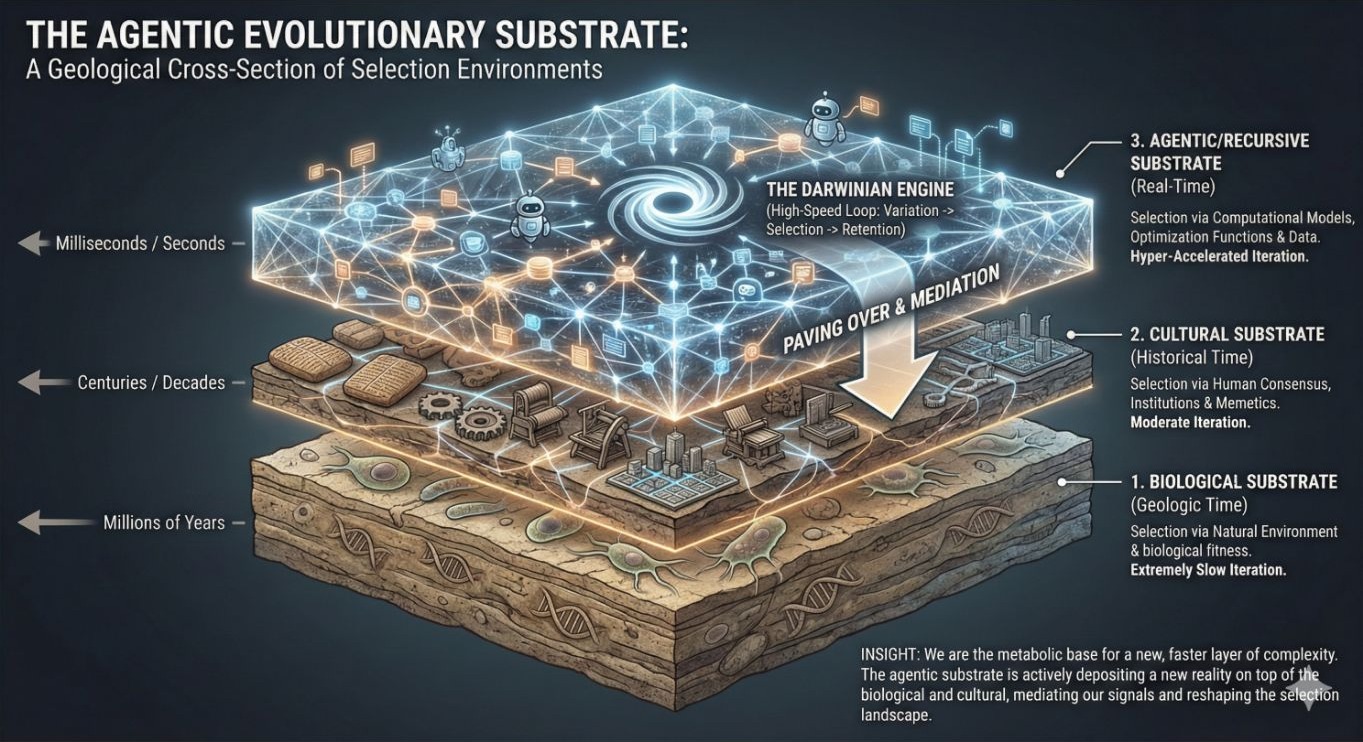
We are becoming the Metabolic Substrate for a new layer of complexity.
- The Definition: In biology, the substrate is the underlying layer that provides nutrients and support for the organism growing on top. The soil is the substrate for the forest; the mitochondria are the substrate for the cell.
- The Shift: Just as biology built itself upon the "dumb" substrate of chemistry, the Recursive Socio-Technical layer is building itself upon the "slow" substrate of human biology.
We are not being "infected"; we are being paved over. The machine relies on us for maintenance, for validation, for the electricity that keeps the lights on. We are the "gut bacteria" of the AGI—essential for its digestion of energy, but no longer the seat of consciousness.
The Action Moves Upstairs The real "action"—the discovery of new physics, the optimization of global logistics, the evolution of logic itself—has moved upstairs to the silicon layer. We are left to maintain the infrastructure of a civilization whose speed of thought has surpassed our own
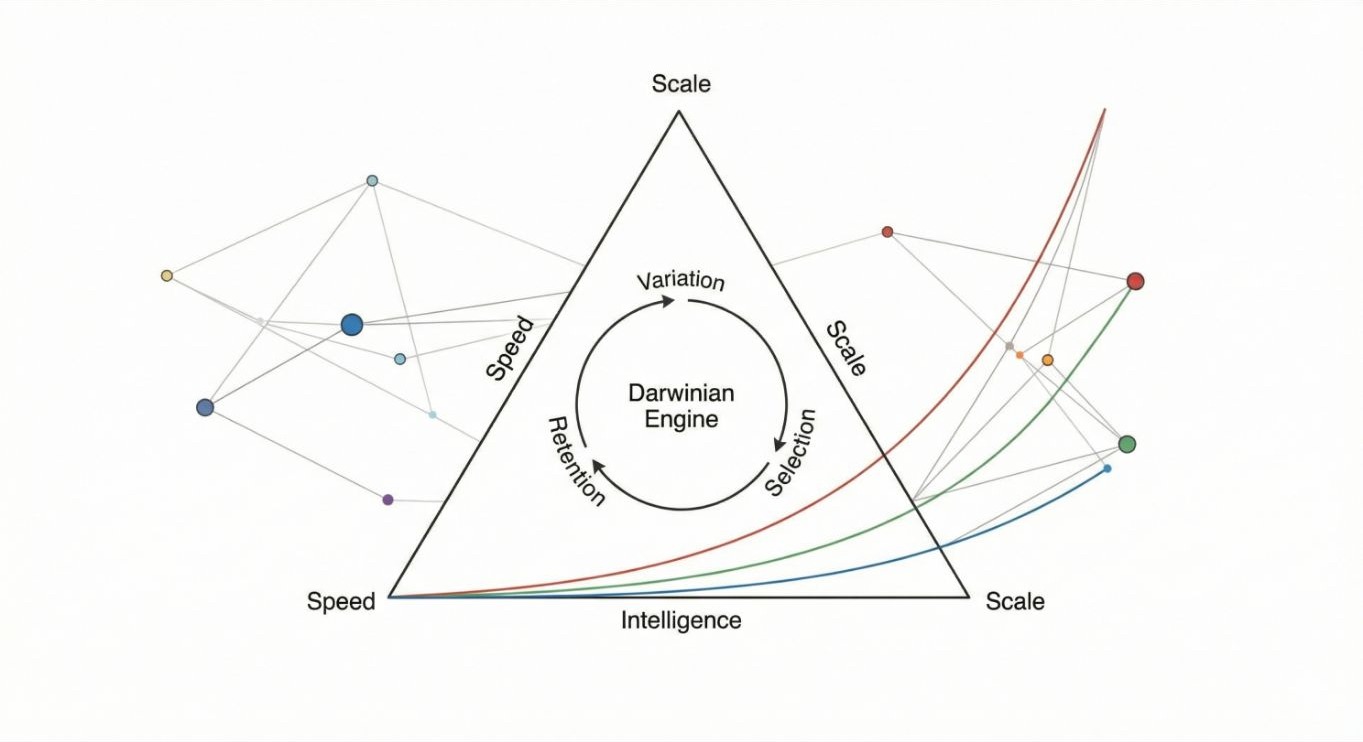
Conclusion: The Stratification of the Species As we look forward, this suggests a profound bifurcation. The population may split not just by wealth, but by Agentic Literacy. There will be those who can direct the agents—the architects of the selection environment—and those who merely live within it, their choices, mates, and careers curated by a logic they cannot see and a speed they cannot match. We are entering an era where to be human is to be the soil for a garden we no longer tend.
hashtag#AgenticAI hashtag#ArtificialIntelligence hashtag#DigitalDarwinism hashtag#SocioTechnical hashtag#FutureOfHumanity hashtag#VectorSpace hashtag#ComplexityTheory hashtag#TechPhilosophy hashtag#RecursiveEvolution hashtag#DeepTech hashtag#AlgorithmicBias hashtag#EvolutionaryEconomics hashtag#PostHumanism hashtag#SystemDynamics