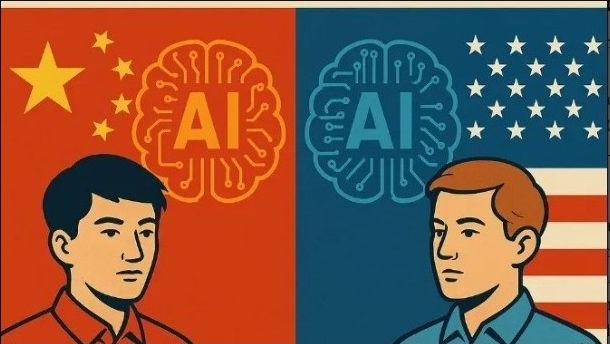
Executive Brief - Comparative National Strategies for AI-Enhanced Education
Author: Raymond Uzwyshyn Ph.D. Date: August 3, 2025 Sources: China's Smart Education White Paper (May 2025) | US AI Action Plan (July 2025), (Short Version)
A Full version of this report (6000 words, with appendices and links to all sources) is also available here: https://www.linkedin.com/pulse/ai-literacy-two-distinct-global-approaches-national-uzwyshyn-ph-d--eut6c
Executive Summary
The 2022 AI breakthrough fundamentally altered global technological competition, creating what may prove the most momentous transformation in human capital development since the Industrial Revolution. Two 2025 policy documents—China's Smart Education White Paper and America's AI Action Plan—reveal profoundly divergent approaches that will shape which societies develop superior cognitive capabilities in the AI century.
The Stakes: Nations successfully integrating AI across educational ecosystems will possess substantial advantages in economic productivity, technological innovation, and international influence. The choice between China's systematic state coordination and America's market-driven innovation will determine global educational leadership for decades.
The Strategic Context: Why 2025 Matters
The AI Paradigm Shift: Like electricity or the printing press, AI represents a "general purpose technology" fundamentally reshaping civilization. Current AI systems advance exponentially every six months, suggesting that by 2030, AI tutors may substantially enhance human educators while AI research collaborators accelerate scientific discovery by orders of magnitude.
The Critical Window: Democratic and centralized nations possess approximately five critical years to restructure educational architectures before AI capabilities render current approaches obsolete. Countries completing this transformation first will possess foundational advantages in developing subsequent AI systems, creating self-reinforcing cycles of technological advancement.
Geopolitical Implications: Educational technology increasingly functions as soft power projection. Nations developing superior AI-enhanced learning systems naturally attract international students, influence global standards, and create technological dependencies strengthening diplomatic relationships across generations of educated leaders.
The Great Divergence: Two Civilizational Approaches
China's Systematic Coordination: Scale Through State Direction
China has constructed history's most comprehensive systematic approach to AI-enhanced education. The Smart Education platform commands 164 million registered users generating 61.3 billion page views—representing sophisticated state capacity to coordinate transformation across continental scale.
Key Achievements:
- Unified Integration: Four educational domains (K-12, vocational, higher education, lifelong learning) coordinated through single system
- Massive Scale: 110,000+ educational resources with mandatory AI curriculum across all levels beginning September 2025
- Equity Solution: 252 rural schools receive 10,000+ hours premium instruction through coordinated university partnerships
- International Influence: World Digital Education Alliance with 115 members from 43 countries
The Data Advantage: Every educational interaction generates behavioral data continuously improving system performance—creating mathematical advantages extremely challenging for fragmented competitors to achieve through voluntary coordination.
America's Innovation Ecosystem: Market-Driven Discovery
America's approach reflects fundamentally different assumptions about transformative change through competitive markets and democratic governance. The AI Action Plan emphasizes reducing regulatory constraints and enabling distributed innovation across competing institutions.
Strategic Framework:
- Innovation Hypothesis: Breakthrough educational technologies emerge from competitive experimentation rather than centralized planning
- Regulatory Sandboxes: AI Centers of Excellence enabling rapid deployment and testing
- Private Sector Leverage: Systematic use of technology companies, startups, and venture capital for educational innovation
- Democratic Flexibility: Maintains capacity for strategic shifts when unexpected breakthroughs occur
Current Reality Check: The US currently lags in open source AI innovation. While OpenAI remains proprietary and Meta's Llama trails Chinese models (DeepSeek, Qwen 3, Kimi K2), recent official turns toward open source incentives could alter competitive dynamics.
Three Critical Strategic Dimensions
1. Data Sovereignty (Highest Priority)
China's 164 million users constitute the world's most valuable learning behavior dataset, training AI systems that create compounding advantages. Western democracies face fundamental challenges aggregating comparable data while preserving privacy and institutional autonomy—creating tensions between democratic principles and strategic necessity.
2. Innovation vs. Implementation (Core Tension)
China demonstrates superior implementation of validated educational approaches across 23 provincial regions and 184 AI Education Bases. America maintains breakthrough discovery capacity through competitive university partnerships and entrepreneurial experimentation. The critical question: Will future success require systematic optimization or paradigm-shifting innovations?
Current Competitive Reality: China produced 47% of top AI talent in 2022 versus US at 18%. American companies hire Chinese interns for AI projects, yet many now choose companies like DeepSeek over Silicon Valley—potentially reversing traditional "brain drain" patterns.
3. International Standards Competition (Global Influence)
Both nations recognize educational technology standards create long-term dependency relationships. China's direct platform provision creates immediate benefits while establishing technological dependencies. America's alliance approach requires voluntary adoption but potentially creates more sustainable partnerships.
Critical Talent Development Challenges
US Workforce Crisis
- Acute Shortage: AI engineer salaries reach $142,000-$175,000 annually (specialized roles $300,000+)
- Immigration Constraints: Enhanced O-1A visa guidance for AI professionals implemented January 2025, but processing delays continue
- STEM Focus Limitation: Predominantly technical approach contrasts with China's interdisciplinary integration
China's Comprehensive Integration
- Interdisciplinary Advantage: Universities like Tsinghua establish "AI plus traditional discipline" programs spanning humanities, law, communications
- Workforce Preparation: 80% of graduate job openings list AI skills as advantages
- Systematic Coverage: General-access AI courses open to all students, not just computer science majors
Meta's Strategic Response: Recent multimillion-dollar packages specifically target Chinese engineers to compete with open source methodologies—highlighting talent flow dynamics and competitive pressures.
The Synthesis: Coordinated Innovation Networks
Democratic societies face a fundamental challenge: developing coordination capabilities sufficient to compete with centralized systems while preserving individual agency and innovation diversity.
The Third Approach: Strategic Recommendations
1. Federated Platform Architecture Create regional coordination hubs achieving scale effects while preserving institutional autonomy. Multiple platforms compete on innovation while coordinating on infrastructure and data sharing standards.
2. Enhanced Democratic AI Governance Develop participatory mechanisms for educational AI policy enabling long-term strategic planning while maintaining public accountability and democratic legitimacy.
3. Innovation-Equity Integration Design market incentives rewarding educational technology serving disadvantaged populations while maintaining competitive pressure for breakthrough discoveries.
4. Interdisciplinary AI Literacy Address systematic integration gaps through comprehensive AI literacy initiatives ensuring all students develop competencies for human-AI collaboration, regardless of academic focus.
Phased Implementation (2025-2035)
Phase 1 (2025-2027): Democratic coordination infrastructure development through voluntary interstate compacts and international agreements
Phase 2 (2027-2030): Competitive innovation networks implementation with federated platforms achieving scale through cooperation
Phase 3 (2030-2035): Global democratic leadership demonstrating superior outcomes through evidence-based coordination
Strategic Implications: The Path Forward
For Democratic Societies:
Immediate Priorities:
- Establish sophisticated coordination mechanisms achieving scale without sacrificing democratic governance
- Address acute AI talent shortages through immigration reform and domestic interdisciplinary education
- Build international alliances preventing excessive dependence on centralized educational infrastructure
Long-Term Objectives:
- Demonstrate that democratic coordination can achieve systematic transformation while preserving innovation diversity
- Create sustainable competitive advantages through continuous adaptation and international cooperation
- Establish democratic educational technology standards as globally attractive alternatives
The Contemporary Challenge
Recent talent flow reversals—where Chinese students choose DeepSeek over Silicon Valley despite higher compensation—suggest systematic domestic investment can effectively compete with immigration-dependent strategies. This requires democratic societies to enhance both domestic AI education across all disciplines and immigration policies attracting global talent.
The Open Source Reality: China's current leadership in open source AI models (DeepSeek's reverse-engineering capabilities, systematic domestic talent development) challenges traditional assumptions about innovation advantages. Democratic societies must respond through enhanced coordination while preserving competitive dynamics.
Conclusion: The Strategic Choice
The competition between China's systematic coordination and America's distributed innovation represents a natural experiment in how governance systems adapt to transformative technological change. Success requires synthesis: developing democratic coordination capabilities that achieve systematic transformation while preserving individual agency and innovation diversity.
The Ultimate Question: Whether democratic institutions can develop sufficient coordination capabilities to compete effectively with centralized systems while maintaining their essential characteristics may determine not only educational outcomes but the continued viability of democratic governance models in an AI-enhanced world.
The nations and alliances successfully developing coordinated innovation networks—achieving scale efficiency while preserving creative diversity—will likely determine global educational technology standards and human capital development for the AI century.
Rather than zero-sum competition, the international community might consider how different approaches can inform and strengthen each other through sustained dialogue and mutual learning, ensuring technological advancement serves human flourishing across all societies.
Note: This is an executive summary. Full strategic analysis (6,000 words) including detailed appendices available upon request.
Contact: Raymond Uzwyshyn Ph.D. | Research Impact, IT, AI, Data, Digital Scholarship Libraries, Innovation
#ArtificialIntelligence #FutureOfEducation #TechnologyTrends #AIEducation #GlobalEducation #STEMEducation #EdTech #ChinaUSRelations #WorkforceDevelopment #InnovationStrategy