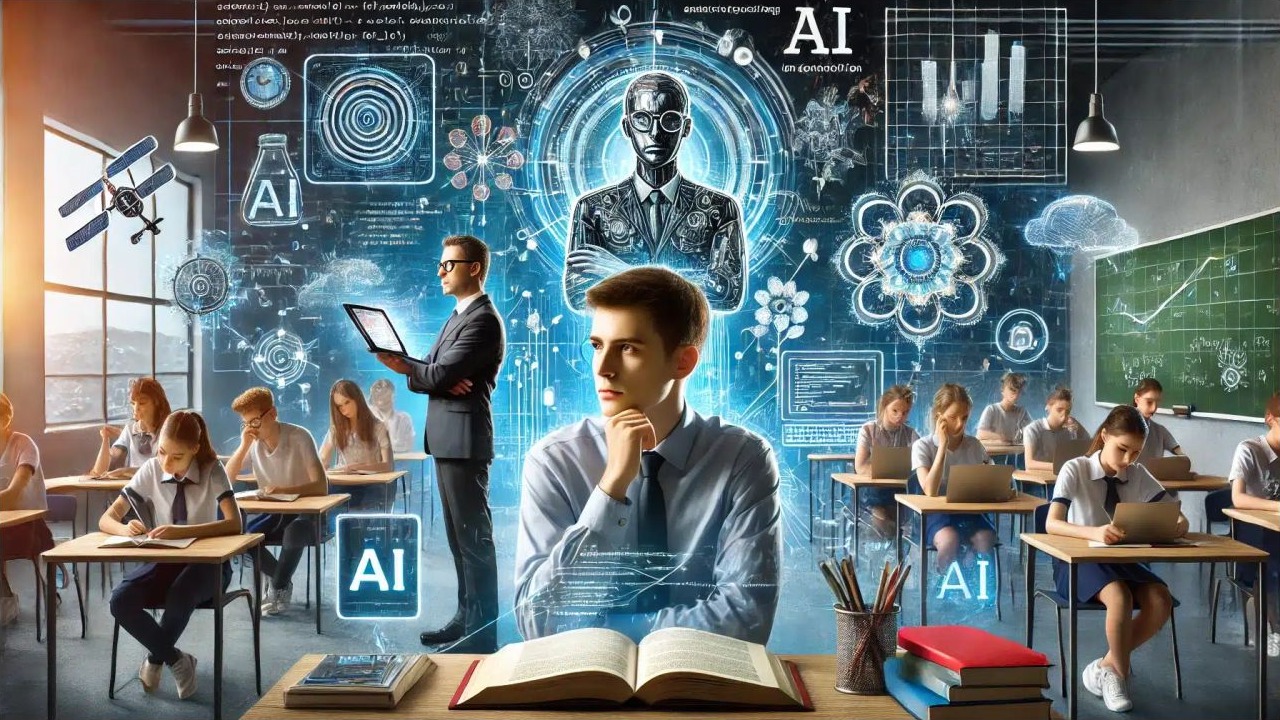
Opening A Dialogue on Education in the Age of AI
In a recent leading academic online forum, a panel of educators and technologists engaged in a dialogue reminiscent of Socratic exchanges, revealing the sharp fundamental tensions reshaping education in the age of artificial intelligence:
Professor: "I've spent the last five days marking essays and dissertations. Most students are using AI to complete their assignments; the use is visible in the language, layout, and sourcing. Some revise the AI output, many do not. This reality fundamentally changes how we grade and undermines our trust in students. If students are allowed to use AI tools to 'research' and structure arguments, they're not reading, researching, reflecting, or thinking. If they're not developing these high-level intellectual skills because AI can do all this (badly in my view), what are we assessing? What is the purpose of a university education?"
Technologist: "This speaks directly to how curricular methodology needs to be rewritten from the ground up to accommodate these new paradigms. The assignments here are designed for a 19th century early industrial system when we have moved generations forward—first to knowledge workers and now to AI synthesis. The professor is working within an outdated paradigm that reveals its inadequacy completely when confronted with new technological affordances. New skills and methods are desperately needed even at the instructor level."
Educational Researcher: "Truly correct. It is very difficult to mentor and teach students who over-rely on AI though it has its own benefits. We need to change our syllabi, curriculum, teaching methods, evaluation methods, and classroom interaction. Recently I was disappointed to see a student generating an entire essay with AI but when asked about explaining the contents, the student had zero understanding of the concepts."
Technologist: "This student may be the only one economically enfranchised in the future. Those who understand the affordances of technology and society will survive, while the rest walk willingly blind to their own obsolescence. The gap exists at the faculty level too. The self-analysis is working on the Darwinian level—those who adapt will thrive. It's similar to how the first tools separated humans from animals, continuing through hammers and backhoes to build skyscrapers. Previous methodologies become obsolete, like teaching proper shovel technique when machines have replaced 100 workers."
This exchange captures a pivotal moment in educational history. Just as the transition from oral tradition to literacy transformed learning, and the industrial revolution standardized education, the integration of artificial intelligence necessitates a profound reimagining of how societies transmit knowledge. This essay examines the medium specificity of AI—its unique properties and possibilities—and proposes a comprehensive reform of educational systems from kindergarten through post-doctoral studies, drawing on historical precedents and theoretical frameworks that illuminate the relationship between technology and education.
I. Historical Evolution of Educational Paradigms
A. Oral Tradition and Greek Education
In pre-literate societies, education centered entirely on oral transmission. In Homeric Greece, extensive memorization of cultural narratives formed the basis of education. The epic poems themselves served as mnemonic devices, with meter and rhythm enabling vast memorization. Within this context, knowledge was inseparable from the knower—to know something was to have internalized it completely.
The Socratic method emerged as a form of critical dialogue that, while still oral, moved beyond mere memorization toward analytical thinking. The dialectical approach emphasized questioning and probing assumptions rather than transmitting fixed content. As Plato preserved these dialogues in written form, a tension emerged between the lived experience of dialogue and its textual representation—an early example of how medium shifts transform educational practice.
The Greek educational ideal of paideia—the holistic development of the individual for citizenship—established a model that valued both intellectual and character development. Yet this approach remained firmly embedded in oral culture, with the living presence of the teacher as essential to the educational process.
B. Medieval Education and Memory
Medieval education, centered in monastic and cathedral schools, continued to rely heavily on memorization but increasingly outsourced memory to written texts. The classic medieval trivium (grammar, logic, rhetoric) and quadrivium (arithmetic, geometry, music, astronomy) structured learning into discrete categories. Students frequently memorized entire texts verbatim, yet the growing availability of manuscripts began shifting education toward interpretation.
Biblical exegesis became a central educational practice, with scholars developing sophisticated methods for textual interpretation. Memorization remained critical, but now served interpretation rather than being education's primary goal. The manuscript's physical limitations—scarcity, cost, and limited reproducibility—maintained the centrality of memory even as writing technology began transforming cognitive processes.
C. The Gutenberg Revolution and Renaissance Learning
The invention of the printing press around 1440 triggered what Harold Innis and Marshall McLuhan would later identify as a profound media revolution. As McLuhan observed, "The invention of typography confirmed and extended the new visual stress of applied knowledge, providing the first uniformly repeatable commodity, the first assembly line, and the first mass production."
The educational implications were revolutionary. Knowledge, previously concentrated in monasteries and universities, became increasingly available to broader populations. This democratization of information catalyzed the Renaissance and the development of civil society, as literacy gradually extended beyond elites.
The printing press initiated what Elizabeth Eisenstein called a "knowledge explosion" that transformed educational practices. Schools increasingly emphasized literacy and interpretation over memorization. The Renaissance educational model focused on recovering and synthesizing classical Greek and Roman knowledge, often through direct engagement with newly accessible texts rather than medieval commentaries.
This period witnessed the emergence of the citizen-scholar ideal—the educated individual participating in civic life through reasoned discourse. Textual interpretation, previously focused primarily on religious texts, expanded to encompass classical literature, history, and philosophy. The rise of humanism centered education on texts that addressed human experience, creating a more secular educational orientation.
D. Scientific Revolution and the Enlightenment
The scientific revolution of the 16th-17th centuries introduced empirical methods that further transformed education. Francis Bacon's emphasis on inductive reasoning, Descartes' rationalism, and Newton's mathematical explanations of natural phenomena created new approaches to knowledge acquisition.
Universities transformed from primarily religious institutions to centers of scientific inquiry. The experimental method complemented textual learning with firsthand observation and testing of hypotheses. This period established the modern conception of the professor as expert—an authority in a specific domain of knowledge who guided students in disciplinary methods.
The Enlightenment's emphasis on reason further shaped education toward critical thinking. Knowledge became increasingly specialized and compartmentalized, laying the groundwork for the modern disciplinary structure of academia. The encyclopedic impulse to systematize all knowledge reflected print technology's capacity for organizing information into discrete, alphabetically-arranged units—a cognitive structure directly influenced by the medium of the book.
E. Industrial Revolution and Mass Education
The 19th century industrial revolution brought perhaps the most enduring educational paradigm—the factory model of education. This system, designed for efficiently processing large numbers of students to meet industrial labor needs, introduced:
- Age-graded classrooms
- Standardized curricula and assessments
- Bell schedules dividing the day into discrete subjects
- Hierarchical authority structures
- Cartesian classroom design with students in rows facing the teacher
This model, as noted in our opening dialogue, persists as the dominant educational paradigm despite subsequent technological revolutions. Mass education democratized basic literacy but standardized learning processes in ways that often prioritized compliance and basic skill development over creativity or deep understanding.
The factory model reflected the medium specificity of industrial technology—standardization, interchangeable parts, assembly line production, and hierarchical management. Education adopted these characteristics, creating a system optimized for the industrial era but increasingly misaligned with subsequent knowledge-based and digital economies.
II. Medium Specificity of AI: A McLuhanesque Analysis
A. AI's Unique Affordances
Marshall McLuhan's tetrad—a four-part analytical model examining what a medium enhances, obsolesces, retrieves, and reverses into—provides a valuable framework for understanding AI's educational implications.
1. Computational Knowledge Processing
Enhances: Information synthesis, pattern recognition, and the ability to process vast datasets simultaneously. Obsolesces: Rote memorization, basic information retrieval, and routine cognitive processing. Retrieves: Ancient ideal of having comprehensive knowledge accessible (like the Alexandrian Library), but at unprecedented scale. Reverses into: Potential cognitive atrophy in areas where humans cede thinking to machines; paradoxical increase in value of uniquely human cognition.
Traditional education prized memorization because information was scarce and difficult to access. When knowledge becomes instantly accessible and processable by AI, education must shift focus from information retention to higher-order skills like critical evaluation, creative application, and ethical reasoning about AI-processed information.
2. Personalization at Scale
Enhances: Ability to customize learning pathways for individual needs while maintaining consistent standards. Obsolesces: One-size-fits-all curriculum pacing and standardized assessment timing. Retrieves: Ancient tutor-pupil relationship (personal attention) within mass education systems. Reverses into: Potential isolation of learners in individual "filter bubbles" without shared educational experiences.
The personalization affordances of AI challenge the industrial model's standardized approach. Where mass education treated students as interchangeable units progressing at uniform rates, AI enables responsiveness to individual learning patterns. However, this personalization risks fragmenting shared cultural knowledge if not balanced with collaborative experiences.
3. Real-time Feedback Loops
Enhances: Continuous assessment and immediate guidance in learning processes. Obsolesces: Delayed feedback cycles and periodic high-stakes testing. Retrieves: Socratic dialogue's immediate responsiveness within scalable systems. Reverses into: Potential dependency on external validation rather than internalized self-assessment.
AI's capacity for real-time feedback transforms assessment from discrete events to continuous processes. This shift makes visible the learning journey itself rather than simply measuring endpoints, potentially addressing one of industrial education's fundamental limitations—its linear, batch-processing approach to complex cognitive development.
4. Multi-modal Learning
Enhances: Integration of text, visual, audio, and interactive elements in seamless learning experiences. Obsolesces: Text-dominated educational content and single-modality instructional approaches. Retrieves: Pre-literate oral/visual holistic learning within digitally mediated environments. Reverses into: Potential sensory overload and attention fragmentation without careful design.
AI's multimodal capabilities align with cognitive science findings that humans learn through multiple sensory channels. This affordance challenges the print-dominated paradigm that has shaped formal education since Gutenberg, potentially making learning more accessible to diverse cognitive styles.
5. Pattern Recognition Across Disciplines
Enhances: Ability to identify connections across traditionally siloed knowledge domains. Obsolesces: Rigid disciplinary boundaries and specialized expertise isolated from other fields. Retrieves: Renaissance polymathic approaches to knowledge within computational systems. Reverses into: Potential superficiality if breadth comes at the expense of depth.
AI excels at finding patterns across disparate datasets, challenging the compartmentalized knowledge approach of industrial education. This affordance aligns with increasing recognition that complex real-world problems rarely respect disciplinary boundaries, suggesting educational models that emphasize connections rather than categories.
6. Simulation Capabilities
Enhances: Experiential learning through virtual environments and modeled complex systems. Obsolesces: Abstract learning divorced from application contexts. Retrieves: Apprenticeship models through virtual mentorship and guided practice. Reverses into: Potential confusion between simulated and physical reality; ethical challenges in simulation design.
AI-powered simulations enable learning-by-doing in contexts where physical experience would be impossible, dangerous, or prohibitively expensive. This affordance challenges educational approaches that prioritize abstract knowledge over applied understanding and potentially democratizes access to experiences previously available only to privileged few.
7. Collaborative Intelligence
Enhances: Human-AI partnerships leveraging complementary capabilities. Obsolesces: Complete human autonomy in information processing; solo knowledge work. Retrieves: Ancient conception of tools as extensions of human capability in cognitive domain. Reverses into: Potential loss of certain cognitive skills through atrophy; dependency on AI systems.
The collaborative nature of AI transforms education from knowledge transfer to developing effective symbiosis between human and machine intelligence. This shift requires redefining expertise from "knowing things" to "knowing how to work with AI to accomplish complex cognitive tasks"—a profound change in educational philosophy.
B. McLuhan: AI Restructuring Human Thinking and Social Relationships
McLuhan's insight that "we shape our tools and thereafter our tools shape us" applies profoundly to AI. Unlike previous media that extended sensory perception, AI extends cognitive processes themselves, becoming not just tools we use but thinking partners we collaborate with. This relationship fundamentally restructures both individual cognition and social organization.
AI systems introduce what McLuhan might call a "cognitive environment"—an invisible context that shapes thinking patterns. Just as literacy created sequential, categorical thinking patterns that differed from oral cultures, AI interaction potentially fosters more networked, non-linear cognitive approaches.
The social implications are equally profound. Educational institutions have traditionally organized social hierarchies around knowledge accessibility—teachers knowing what students don't. When AI democratizes access to information and information processing, these hierarchies face fundamental challenges, requiring new justifications for educational authority based on wisdom, judgment, and ethical reasoning rather than information possession.
C. Ong: From Literacy to AI Consciousness
Walter Ong's analysis of the transition from orality to literacy provides a valuable framework for understanding AI's potential cognitive impact. Ong described how writing transformed human consciousness, enabling abstract thinking, categorical organization, and sequential logic unavailable to purely oral cultures.
AI potentially represents a similar cognitive watershed—moving from literacy-based sequentiality to a more networked, associative form of thinking that integrates human and machine cognition. Just as literacy didn't eliminate speech but transformed its role, AI won't eliminate literacy but will recontextualize it within a broader cognitive ecosystem.
Ong noted that writing created a sense of distance between knower and known—an objectification of knowledge that enabled analytical thinking. AI might similarly transform our relationship with knowledge by externalizing certain cognitive processes while potentially retrieving elements of oral culture's immediacy through conversational interfaces.
The shift from "reading" information to "conversing" with information systems represents a retrieval of dialogic elements from oral cultures within technologically advanced systems. This hybridization of orality and literacy within AI interaction suggests new cognitive possibilities that transcend previous historical stages rather than simply replacing them.
D. Negroponte: Being Digital in an AI World
Nicholas Negroponte's vision in "Being Digital" anticipated the transformation from atom-based to bit-based information exchange. His prediction that digital technologies would evolve from tools we use to environments we inhabit foreshadowed today's AI landscape.
Negroponte emphasized that personalization would be a defining feature of digital environments—a prediction realized through AI's ability to create increasingly tailored experiences. This personalization challenges the standardization fundamental to industrial education models.
The seamless integration between digital and physical environments that Negroponte envisioned is accelerating through AI systems that continuously mediate our experience of the world. Education designed for clear boundaries between "using technology" and "not using technology" becomes increasingly obsolete as AI becomes ambient and pervasive.
Negroponte's distinction between synchronous (time-dependent) and asynchronous interaction foreshadowed AI's transformation of educational temporality. When learning can happen anywhere, anytime, through AI systems, traditional educational scheduling loses its justification, suggesting more fluid approaches to learning time.
E. Illich: Convivial Tools and AI
Ivan Illich's critique of institutionalized education and his concept of "convivial tools" provide crucial perspectives on AI's educational potential. Illich distinguished between industrial tools that create dependency and convivial tools that enhance human autonomy and creativity.
AI could exemplify either paradigm depending on implementation. Systems designed to maximize student agency and self-direction could realize Illich's vision of "learning webs" that connect learners without institutional mediation. Conversely, AI could reinforce institutional control through surveillance, standardization, and credentialing gatekeeping.
Illich's concept of "radical monopoly"—when institutional solutions crowd out more human-scale alternatives—warns against potential AI implementation that further centralizes educational authority. The challenge is designing AI systems that deschool rather than hyper-school society, creating what Illich called "tools for conviviality" that expand rather than contract human freedom.
The dialogue that opened this essay reflects Illich's concerns about educational institutions mistaking means for ends—focusing on credentials and assessment rather than authentic learning. AI intensifies this tension by challenging conventional assessment approaches while potentially enabling more meaningful evaluation of learning.
III. Information Scarcity vs. Information Abundance
A. Historical Education Design for Scarcity
Traditional educational systems developed during periods of information scarcity. When books were rare and access to knowledgeable teachers limited, education necessarily emphasized information transfer and retention. The medieval scholar, Renaissance humanist, and even industrial-era teacher served as essential gatekeepers to knowledge that students couldn't easily access elsewhere.
This scarcity paradigm shaped fundamental educational practices:
- Lectures as one-to-many information broadcast
- Memorization as necessary knowledge storage
- Testing as verification of information retention
- Expert authority based on superior access to information
- Hierarchical knowledge structures with clear prerequisites
These approaches reflected the medium specificity of scarce, physically-embodied information. When knowledge primarily existed in human minds and limited physical artifacts, educational design logically centered on transferring information from these rare sources to students' memories.
B. Abundance Paradigm
We now inhabit what Peter Diamandis and Ray Kurzweil describe as an era of information abundance characterized by exponential rather than linear growth. The Singularity University perspective emphasizes that this abundance fundamentally changes value propositions across knowledge domains. When AI systems can instantly access and process virtually unlimited information, education designed around information scarcity becomes increasingly irrelevant.
In this paradigm:
- Information itself has diminishing value
- Filtering and evaluation skills become paramount
- Creativity in information application increases in importance
- Interdisciplinary synthesis creates greater value than domain expertise
- Unique human perspectives and ethical reasoning gain premium value
This shift from scarcity to abundance necessitates educational approaches that emphasize wisdom over knowledge, application over retention, and synthesis over memorization. The industrial education model optimized for standardized information transfer becomes increasingly misaligned with an information environment characterized by abundance, accessibility, and AI processing capabilities.
C. From Content to Process
The abundance paradigm shifts educational focus from content to process—from what to know to how to know. This transition parallels previous media revolutions; just as writing outsourced memory to physical media and print democratized access to recorded knowledge, AI outsources certain cognitive processes while creating new requirements for effective thinking.
Expertise itself requires redefinition. In traditional education, experts possessed information others lacked. In an AI world, expertise increasingly means understanding how to effectively direct, evaluate, contextualize, and apply AI-processed information toward meaningful goals. This shift challenges traditional educational metrics focused on content retention rather than cognitive process quality.
The core educational question becomes not "what information should students memorize?" but "what cognitive processes should remain human, which should leverage AI, and how should these integrate?" This question has no historical precedent, as previous media extensions primarily affected information storage and transmission rather than cognitive processing itself.
IV. A New Educational Paradigm: From Kindergarten to Post-Doctoral Studies
A. Kindergarten to Elementary (Ages 5-10)
Foundational AI Literacy
Early education must introduce age-appropriate understanding of AI as both tool and collaborative partner. Rather than treating AI as mysterious "magic," curriculum should develop basic mental models of how AI systems work, their limitations, and appropriate usage contexts.
Activities might include:
- Simplified explanations of pattern recognition through games
- Exploring basic AI concepts through storytelling
- Creating simple rules-based systems that demonstrate algorithmic thinking
- Guided exploration of age-appropriate AI tools with reflection discussions
The goal is developing native fluency with AI systems while maintaining critical awareness of their nature as human-created tools. This approach aligns with Montessori principles of making abstract concepts concrete through hands-on engagement.
Human-AI Collaborative Projects
Young children should experience collaboration with AI tools through guided projects that emphasize complementary capabilities. These experiences lay the foundation for understanding human-AI partnership while developing uniquely human capabilities.
Projects might include:
- Co-creating stories with AI suggestion tools
- Using visual recognition systems to identify plants during nature walks
- Designing simple games where AI and human players have different abilities
- Creating art with AI assistance while discussing creative choices
These activities develop what Piaget would recognize as metacognitive schema for human-AI interaction—mental frameworks for understanding the complementary relationship between human and artificial intelligence.
Critical Thinking for AI Evaluation
Children need early development of critical evaluation skills specific to AI-generated content. This includes understanding that AI systems produce content based on patterns rather than understanding, and may contain errors, biases, or limitations.
Activities might include:
- Identifying obviously incorrect AI-generated answers
- Comparing AI responses to verifiable facts
- Discussing why AI might make certain mistakes
- Learning to ask clarifying questions of AI systems
These exercises develop what might be called "AI skepticism"—a healthy questioning attitude toward machine outputs that neither dismisses their utility nor accepts their authority uncritically.
Embodied Learning
As AI increasingly mediates information interaction, preserving embodied, physical learning experiences becomes crucial. Montessori, Steiner (Waldorf), and other progressive educational approaches emphasize sensory engagement with physical reality as foundational to cognitive development.
Activities should include:
- Extensive outdoor exploration and nature-based learning
- Fine and gross motor skill development through arts, crafts, and movement
- Direct sensory engagement with physical materials
- Social play emphasizing in-person interaction
These approaches counter potential screen-based isolation while developing physical capabilities that remain uniquely human. The embodied cognition paradigm recognizes that learning happens through the body, not just the mind—a reality easily overlooked in digital environments.
Emotional Intelligence and Ethics
Early education must emphasize emotional development and ethical reasoning—domains where human capabilities remain essential. While AI systems can recognize emotional patterns, they lack emotional experience, making this area crucial for human development.
Curriculum should include:
- Storytelling and literature exploring emotional and ethical themes
- Community-building activities developing empathy and perspective-taking
- Ethical discussions of technology use appropriate to developmental stage
- Naming and processing emotions through creative expression
These foundations prepare children for ethical reasoning about more complex technological questions they'll encounter later. As Steiner education emphasizes, emotional and ethical development require developmental appropriateness—building foundations before introducing abstract concepts.
B. Middle School (Ages 11-13)
AI-Enhanced Project-Based Learning
Middle school curriculum should leverage AI tools within project-based learning approaches that develop both subject knowledge and AI collaboration skills. These projects emphasize authentic problems requiring interdisciplinary thinking.
Examples include:
- Environmental monitoring projects using AI-assisted data analysis
- Community history projects combining archival research with AI text analysis
- Design challenges using AI modeling and simulation tools
- Science investigations using machine learning to identify patterns in data
These projects teach subject content while developing skills in directing AI systems toward meaningful goals—an integrated approach aligning with cognitive development research showing that adolescents learn best through authentic, contextualized challenges.
Meta-Learning Strategies
Middle school students should explicitly develop learning strategies that incorporate AI tools appropriately. This "learning how to learn" approach acknowledges that information access has fundamentally changed while helping students make thoughtful choices about when to use AI versus developing personal expertise.
Curriculum includes:
- Explicit discussion of different learning strategies for different contexts
- Practice in determining when AI assistance is appropriate versus when independent thinking is valuable
- Development of personal systems for knowledge management with AI tools
- Reflection on learning processes and outcomes
This meta-cognitive development prepares students for increasingly independent learning while establishing thoughtful patterns of AI use that avoid both technophobia and overdependence.
Media Literacy for AI
Building on elementary foundations, middle school students need sophisticated understanding of AI-generated content across media formats. This literacy includes recognizing synthetic media, understanding how algorithms shape information exposure, and evaluating reliability of AI-processed information.
Curriculum includes:
- Analyzing AI-generated text, images, and audio for reliability indicators
- Understanding how recommendation systems shape information exposure
- Creating and analyzing synthetic media to understand capabilities and limitations
- Exploring cases where AI systems produced misleading information
This literacy prepares students for a media environment increasingly shaped by algorithmic curation and synthetic content generation, developing critical evaluation skills essential for informed citizenship.
Computational Thinking
Middle school students should develop foundational understanding of computational concepts underlying AI systems. This approach emphasizes algorithmic thinking, pattern recognition, and basic programming concepts applicable across disciplines.
Curriculum includes:
- Basic programming with visual and text-based languages
- Exploring simple machine learning models to understand pattern recognition
- Data analysis projects using computational tools
- Discussion of algorithmic bias through age-appropriate examples
This computational foundation provides mental models for understanding how AI systems work without requiring advanced mathematics, enabling informed collaboration with increasingly sophisticated tools.
Human-Centered Design
Middle school curriculum should introduce principles of designing technology that enhances rather than diminishes human capabilities. This approach emphasizes ethical considerations, usability, and human values in technological systems.
Projects include:
- Designing AI-enhanced tools for school or community needs
- Evaluating existing technologies for accessibility and inclusivity
- Discussing ethical implications of design choices
- Creating user testing protocols for technology evaluation
These experiences develop awareness that technology embodies human choices rather than inevitability, empowering students as potential shapers rather than merely users of technological systems.
C. High School (Ages 14-18)
Disciplinary Methods and AI Integration
High school curriculum should emphasize discipline-specific methods and how AI transforms each field. Rather than viewing AI as a separate subject, each discipline should incorporate appropriate AI tools while explicitly discussing how these tools change disciplinary practice.
Examples include:
- Literature: Computational text analysis alongside traditional close reading
- History: Using AI to analyze primary sources while critically evaluating algorithmic interpretations
- Science: Employing simulation and modeling tools while understanding their assumptions
- Mathematics: Using computational tools for complex problems while developing conceptual understanding
This approach prioritizes disciplinary thinking methods over content memorization, preparing students for fields transformed by AI while maintaining the distinct value of human disciplinary perspectives.
Prompt Engineering and AI Collaboration
High school students should develop sophisticated skills for directing AI systems toward desired outcomes while maintaining human judgment. This includes understanding how to structure queries, interpret results, and integrate AI outputs into human-directed work.
Curriculum includes:
- Advanced prompt design for various AI systems
- Evaluating and refining AI outputs across domains
- Combining multiple AI tools to accomplish complex tasks
- Ethical considerations in AI direction and output use
These skills represent a new form of literacy essential for effective participation in an AI-integrated society—the ability to "speak" effectively to artificial intelligence systems while maintaining critical evaluation of their responses.
Portfolio Assessment
High school assessment should shift from standardized testing to portfolio-based evaluation demonstrating both individual capabilities and effective AI collaboration. This approach recognizes that traditional testing increasingly measures skills AI systems can perform, while portfolio assessment can evaluate uniquely human capabilities.
Portfolios might include:
- Original creative works demonstrating personal expression
- Complex problem-solving projects showing process and reasoning
- Documentation of community impact initiatives
- Examples of effective human-AI collaboration with reflection
This assessment approach aligns with real-world value creation in an AI-integrated society, where unique human contributions and effective technology direction matter more than routine information processing.
Specialized Human Capabilities
High school curriculum should intentionally cultivate capabilities where humans maintain advantages over AI systems. These include creative innovation, ethical reasoning, interpersonal understanding, and physical skills requiring embodied knowledge.
Examples include:
- Arts programs emphasizing personal expression and innovation
- Ethics courses exploring complex moral reasoning through cases
- Community engagement developing interpersonal intelligence
- Physical skills from athletics to crafts developing embodied knowledge
These capabilities represent areas where human contribution remains essential even with advanced AI, providing students with sustainable value propositions in an increasingly automated economy.
Real-World Problem Solving
High school education should emphasize authentic challenges requiring both human and AI capabilities. These projects develop integrated problem-solving approaches while demonstrating the real-world relevance of education.
Examples include:
- Community-based research addressing local challenges
- Design projects creating solutions for identified needs
- Entrepreneurial initiatives developing valuable products or services
- Environmental monitoring and remediation projects
These experiences develop what might be called "integrated intelligence"—the ability to combine human creativity, ethical reasoning, and contextual understanding with AI analytical capabilities toward meaningful goals.
D. Undergraduate Education
Interdisciplinary Integration
Undergraduate education should restructure around problems rather than departments, with AI serving as a bridge across disciplinary boundaries. This approach recognizes that complex challenges rarely respect academic silos and that AI tools enable knowledge integration across domains.
Implementation includes:
- Problem-focused courses taught by multi-disciplinary teams
- Major pathways organized around challenges rather than disciplines
- Computational methods integrated across all fields
- "Translation" courses explicitly connecting methods across domains
This structure prepares graduates for a world where narrow disciplinary expertise has diminishing value compared to integrative thinking and the ability to leverage multiple knowledge domains toward complex problems.
Process-Oriented Assessment
Undergraduate assessment should evaluate students on their research process, critical thinking, and appropriate AI integration rather than final products alone. This approach recognizes that process quality increasingly determines value in an AI-integrated knowledge economy.
Assessment includes:
- Documentation of research methods and evaluation criteria
- Explicit articulation of decisions regarding AI tool use
- Metacognitive reflection on processes and outcomes
- Peer and self-assessment of collaborative contributions
This approach develops what Donald Schön called "reflection-in-action"—the ability to continuously monitor and adjust thinking processes, a capability that distinguishes effective human thinkers from current AI systems.
Metacognitive Development
Undergraduate education should explicitly develop awareness of thinking processes and how they interact with AI systems. This metacognition enables more effective direction of both human and artificial intelligence toward meaningful goals.
Curriculum includes:
- Courses examining cognitive biases and thinking patterns
- Practice recognizing complementary strengths of human and AI thinking
- Development of personal knowledge management systems
- Explicit reflection on learning transfer across contexts
This focus aligns with research showing that metacognitive awareness correlates strongly with learning effectiveness and intellectual flexibility—capabilities increasingly valuable as routine cognitive tasks are automated.
New Forms of Expertise
Undergraduate education should develop expertise in directing, evaluating, and improving AI outputs rather than competing with AI on information retrieval and synthesis. This shift acknowledges the changing nature of professional work in an AI-integrated landscape.
Curriculum includes:
- Training in evaluating AI-generated content for quality and reliability
- Practice developing effective prompts across AI systems
- Experience combining multiple AI tools toward complex goals
- Ethical reasoning about appropriate AI use in professional contexts
This expertise represents what might be called "second-order knowledge work"—not simply processing information but effectively directing information processing systems while maintaining critical judgment about their outputs.
Ethical Frameworks
Undergraduate curriculum should incorporate robust ethical analysis across all disciplines, addressing implications of AI in each field. This approach recognizes that ethical reasoning remains distinctly human while becoming increasingly important as technology capabilities expand.
Curriculum includes:
- Field-specific ethical case studies involving AI applications
- Exploration of multiple ethical frameworks beyond utilitarianism
- Discussion of professional responsibilities in AI-integrated fields
- Consideration of long-term implications of technological development
This ethical foundation prepares graduates to make thoughtful decisions about technology development and application—a critical capability as AI systems impact increasingly consequential domains of human life.
E. Graduate and Post-Doctoral Education
AI-Human Research Partnerships
Graduate education should develop methodologies for collaborative research incorporating both human creativity and AI analytical capabilities. This approach recognizes that cutting-edge research increasingly requires both human insight and computational processing beyond individual human capacity.
Implementation includes:
- Training in research design leveraging AI capabilities
- Development of field-specific AI collaboration methodologies
- Critical evaluation of AI-assisted research for reliability and validity
- Exploration of new research questions enabled by AI capabilities
This partnership approach prepares researchers for a landscape where breakthrough discoveries increasingly emerge from human-AI collaboration rather than purely human effort.
Emergent Knowledge Areas
Graduate programs should explore genuinely new knowledge domains emerging at the intersection of human and machine intelligence. These interdisciplinary spaces represent some of the most promising areas for original contribution.
Examples include:
- Human-AI interaction design and evaluation
- Computational creativity and its applications
- AI-assisted scientific discovery methodologies
- Philosophical implications of artificial general intelligence
These emergent fields require new research methods combining technical understanding with humanistic perspectives—an integration that demands graduate-level development.
Meta-Disciplinary Synthesis
Graduate education should foster expertise in integrating knowledge across traditionally separated domains using AI as connective tissue. This synthesis addresses the increasing mismatch between disciplinary boundaries and complex real-world problems.
Implementation includes:
- Courses explicitly examining methodological differences across fields
- Research projects requiring multi-disciplinary integration
- Development of translational frameworks connecting domains
- Creation of shared vocabularies across technical and humanistic fields
This synthetic approach aligns with what E.O. Wilson called "consilience"—the unity of knowledge across domains—while leveraging AI's capacity to process information across disciplinary boundaries.
Research Ethics for AI Integration
Graduate programs must establish ethical frameworks specific to AI-augmented research methodologies. These frameworks should address novel questions arising from human-AI research collaboration.
Considerations include:
- Attribution questions in human-AI collaborative work
- Verification requirements for AI-assisted analysis
- Privacy implications of large-scale data analysis
- Potential biases in AI-assisted research methodologies
This ethical foundation ensures responsible development of new knowledge creation approaches that leverage AI capabilities while maintaining scientific integrity.
Public Understanding of AI
Graduate education should train researchers in communicating AI-related concepts to non-specialists and participating in public discourse. This communication bridges the growing gap between technical capabilities and public understanding.
Training includes:
- Development of accessible explanations for complex AI concepts
- Practice communicating limitations and uncertainties
- Experience engaging with policy and regulatory stakeholders
- Approaches to addressing public concerns and misconceptions
This public engagement capability ensures that technical expertise informs broader societal decisions about AI development and application rather than remaining isolated in specialized communities.
V. Implementation Strategy
A. Teacher Preparation
Successfully implementing this educational vision requires comprehensive retraining of educators at all levels. Teacher education must shift from content expertise to process facilitation and AI integration.
Implementation includes:
- Intensive professional development in AI literacy and application
- Communities of practice sharing effective integration approaches
- New teacher certification programs emphasizing AI-integrated pedagogy
- Ongoing learning structures reflecting rapid technological change
This preparation acknowledges that teachers themselves must model the lifelong learning and AI collaboration they aim to develop in students.
B. Infrastructure Development
Educational transformation requires significant investment in technical infrastructure supporting AI integration across educational levels.
Requirements include:
- Universal high-speed connectivity in educational settings
- Equitable access to AI tools for all students
- Data systems supporting continuous assessment while protecting privacy
- Physical spaces designed for collaboration rather than standardization
This infrastructure development must prioritize equity to avoid exacerbating existing educational divides through differential access to AI capabilities.
C. Assessment Reform
New educational approaches require fundamentally new evaluation frameworks measuring both individual capabilities and effective AI collaboration.
Development includes:
- Performance-based assessments evaluating authentic problem-solving
- Portfolio systems documenting process and development over time
- Peer and self-assessment developing metacognitive capabilities
- Continuous feedback systems leveraging AI for personalization
This assessment approach shifts from measuring what students know to evaluating how effectively they can apply knowledge with appropriate technological assistance—a more authentic reflection of real-world capabilities.
D. Community Education
Educational transformation requires engaging parents, employers, and communities in understanding the new paradigm and its implications.
Approaches include:
- Parent education programs on AI's educational implications
- Employer partnerships defining valued capabilities in graduates
- Community forums addressing concerns and misconceptions
- Demonstration projects showcasing new educational approaches
This engagement addresses the reality that educational reform faces resistance not just from institutional inertia but from stakeholder expectations shaped by their own educational experiences.
E. Adaptive Implementation
Educational transformation must incorporate continuous feedback and refinement rather than implementing a fixed model. This adaptive approach acknowledges the rapidly evolving technological landscape.
Implementation includes:
- Research partnerships evaluating outcomes of new approaches
- Rapid prototyping of innovative educational models
- Knowledge-sharing networks accelerating effective practices
- Regular reassessment of skills and capabilities needed in society
This adaptive strategy allows educational systems to evolve with technological development rather than requiring periodic revolutionary restructuring.
VI. Conclusion: The Opportunity for Educational Renaissance
The dialogue that opened this essay illustrates the tension between educational paradigms developed for previous technological eras and the reality of AI integration. This tension creates not just challenges but unprecedented opportunities for educational renaissance.
Throughout history, educational paradigms have evolved in response to technological transformations—from oral to written culture, manuscript to print, craft to industrial production. Each transition has expanded human capabilities while requiring fundamental reassessment of educational purposes and methods.
The AI transition represents perhaps the most profound of these transformations, as it extends not just information storage or transmission but cognitive processing itself. This extension requires reimagining education not as information transfer but as the development of integrated human-AI capabilities that leverage the strengths of both.
The historical perspective reveals that educational paradigms typically lag technological change by decades or even centuries. The factory model of education persisted through the knowledge economy because institutional structures, cultural expectations, and assessment systems maintained industrial-era approaches despite their growing misalignment with societal needs.
We cannot afford similar lag in adapting to AI. The pace of technological change and its economic implications make rapid educational transformation an imperative rather than an option. The students entering kindergarten today will graduate into a world where AI integration is universal across economic sectors. Their education must prepare them not for the economy of the past but for the emerging landscape where human value lies increasingly in capabilities complementary to rather than competitive with artificial intelligence.
This preparation requires not just adding "AI literacy" to existing curriculum but fundamentally reimagining education's purpose in a world where information access and routine cognitive processing are no longer scarce resources. The educational models proposed here represent not just adaptation to technological change but a deeper reconception of human development in an age of increasingly intelligent machines.
The most profound opportunity lies in leveraging AI to create educational experiences more aligned with human developmental needs than the standardized, industrial model ever achieved. Personalization, continuous feedback, multimodal learning, and interdisciplinary integration represent not just technological possibilities but approaches better matched to how humans naturally learn.
In this sense, AI may enable not just educational adaptation but educational liberation—freeing human learning from industrial constraints while expanding possibilities for creativity, critical thinking, and authentic contribution. This liberation, however, requires deliberate design rather than passive acceptance of technological change.
The Platonic dialogue that opened this essay captured the fundamental question: What is education's purpose when AI can perform many traditional educational tasks? The answer lies not in preserving outdated paradigms nor in surrendering human development to technological determinism, but in thoughtfully redesigning education to cultivate distinctly human capabilities while leveraging artificial intelligence as a collaborative partner.
This redesign represents perhaps the most significant educational opportunity since the development of writing itself—the chance to develop human potential more fully by outsourcing certain cognitive functions while focusing educational attention on what makes us uniquely human: our creativity, ethical reasoning, interpersonal connection, and capacity for meaning-making in an increasingly complex world.
Bibliography
Diamandis, P. H., & Kotler, S. (2012). Abundance: The future is better than you think. Free Press.
Eisenstein, E. L. (1979). The printing press as an agent of change. Cambridge University Press.
Illich, I. (1971). Deschooling society. Harper & Row.
Innis, H. A. (1951). The bias of communication. University of Toronto Press.
Kurzweil, R. (2005). The singularity is near: When humans transcend biology. Viking.
McLuhan, M. (1964). Understanding media: The extensions of man. McGraw-Hill.
Montessori, M. (1912). The Montessori method. Frederick A. Stokes Company.
Negroponte, N. (1995). Being digital. Alfred A. Knopf.
Ong, W. J. (1982). Orality and literacy: The technologizing of the word. Methuen.
Piaget, J. (1970). Science of education and the psychology of the child. Orion Press.
Schön, D. A. (1983). The reflective practitioner: How professionals think in action. Basic Books.
Steiner, R. (1924). The kingdom of childhood: Introductory talks on Waldorf education. Anthroposophic Press.
Wilson, E. O. (1998). Consilience: The unity of knowledge. Knopf.