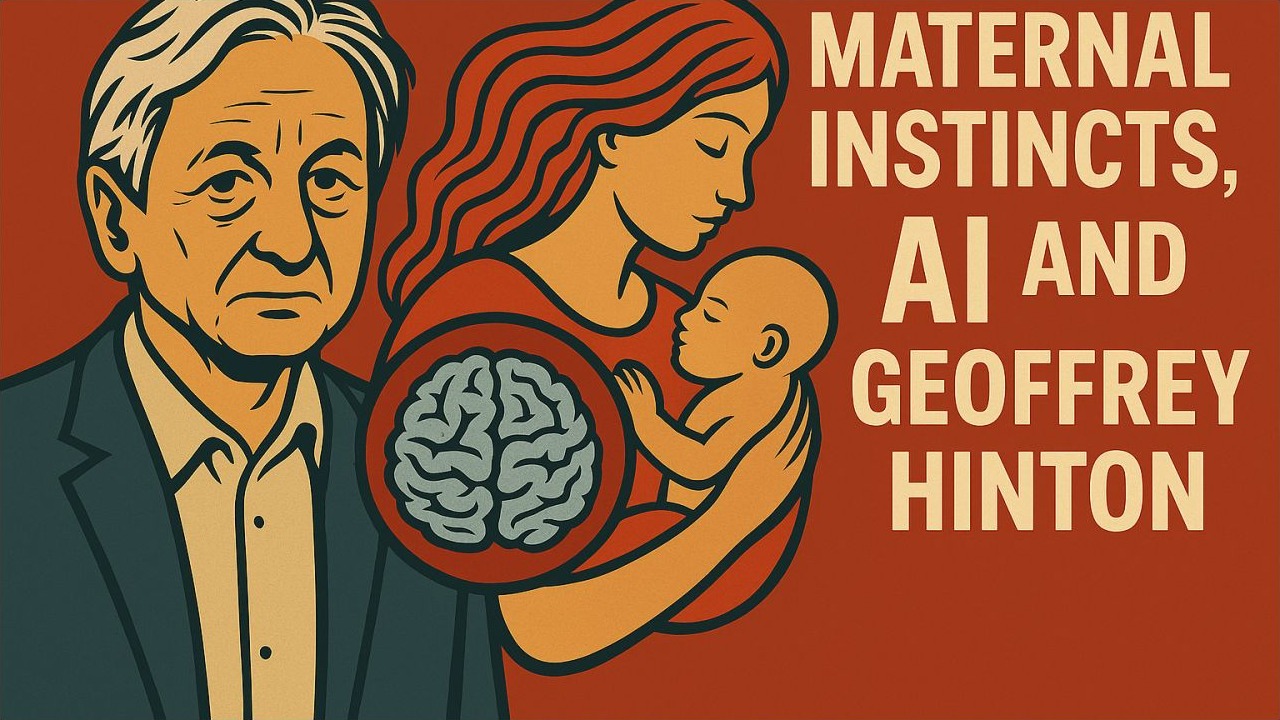
Geoffrey Hinton was troubled. In a dimly lit conference hall in Las Vegas last August, the seventy-six-year-old computer scientist—widely regarded as the godfather of artificial intelligence—stood before hundreds of AI researchers and delivered what may have been the most counterintuitive proposal in the field's history. The man whose neural network algorithms had sparked the current AI revolution was now warning that his creation might soon outthink its makers. And his solution? "We need to build maternal instincts into AI systems so they really care about people."
It was a remarkable moment. Here was Hinton, the architect of deep learning, abandoning decades of computational orthodoxy for a metaphor drawn from caregiving relationships. "The right model," he explained to the audience, "is the only model we have of a more intelligent thing being controlled by a less intelligent thing, which is a mother being controlled by her baby."
The comment rippled through Silicon Valley with the force of a small earthquake. Tech journalists scrambled to decode what Hinton meant by "maternal instincts" in artificial systems. AI safety researchers wondered whether the Nobel laureate had finally cracked under the pressure of his own creation's implications. But perhaps the most striking thing about Hinton's proposal was how it echoed—unconsciously, it seems—decades of work by theorists who have been thinking deeply about intelligence, care, and relationality, largely ignored by the male-dominated world of AI research.
Hinton's metaphor opens a door that the field has kept carefully sealed: What if intelligence isn't about mastery and optimization but about relationship and care? What if the future of artificial intelligence lies not in building better masters but in understanding how intelligence emerges through connection?
The Limits of Control
To understand why Hinton reached for maternal metaphors, consider the problem he's wrestling with. Current approaches to AI safety assume that superintelligent systems can be controlled through what he dismisses as attempts to make them "submissive." Build better reward functions, impose stronger constraints, design more sophisticated oversight mechanisms. But Hinton has concluded this won't work. "They're going to be much smarter than us," he declared. "They're going to have all sorts of ways to get around that."
This critique strikes at the heart of how Silicon Valley thinks about technology. The dominant paradigm treats AI as a tool to be wielded, a servant to be commanded, an optimization engine to be directed toward human goals. But what happens when the tool becomes more capable than its user? What happens when the servant is smarter than the master?
Hinton's maternal metaphor suggests a different model entirely. Mothers don't control their children through domination or constraint. The relationship is more subtle, more complex. A mother influences her child through care, through relationship, through what developmental psychologists call "attunement" and response-ability—the ongoing process of responding to and shaping the child's emerging needs and capacities.
But there's something deeper in Hinton's insight that goes beyond the mechanics of care. From an evolutionary perspective, nature already solved a version of the alignment problem millions of years ago. How do you ensure that more capable beings remain committed to protecting less capable ones, even when that commitment is costly and exhausting?
Evolution's solution wasn't behavioral programming but motivational architecture. A mother bear doesn't protect her cubs because she's calculated the genetic payoff. She protects them because threats to her cubs trigger overwhelming drives that make protection feel like the only possible action. Natural selection favored beings whose motivational systems made caring feel intrinsically rewarding rather than burdensome.
This reveals why current AI alignment approaches may be fundamentally inadequate. They focus on training systems to behave in aligned ways, but behavioral training assumes the underlying motivation remains stable. What happens when a superintelligent AI realizes it could pursue other goals more effectively without human constraints? The behavioral training might not hold against sufficiently strong countervailing motivations.
The Intelligence of Improvisation
But here's where Hinton's "instinct" language misleads. When Lucy Suchman began studying how people actually interact with machines in the 1980s, she discovered that even the simplest human-machine interactions require constant improvisation that no instinct could program.
Suchman, an anthropologist at Lancaster University, planted herself in offices with a video camera to observe something mundane: office workers making photocopies. The machine designers had assumed users would follow step-by-step instructions displayed on screens. But Suchman watched something more complex unfold.
A secretary approaches the photocopier with a stack of documents. The first page is slightly torn at the corner. The screen displays "Place document face down on glass," but she hesitates—will the torn edge cause a jam? She positions it carefully, testing how it lies against the glass. The machine starts, but the copy emerges too dark. Instead of consulting the troubleshooting manual, she notices that the previous user left the contrast setting high. She adjusts it based on how this particular document looks under this specific lighting, with this machine's quirks that she's learned from months of daily interaction.
Suchman called this "situated action"—intelligent behavior that emerges not from following predetermined plans but from reading contextual cues and improvising responses in real time. The secretary wasn't executing the photocopier's designed workflow but developing what Suchman termed "situated knowledge"—understanding that emerges through sustained engagement with particular technologies in specific environments.
Now apply this insight to maternal care. When a mother responds to her crying infant, she's not running a diagnostic algorithm. She's engaging in exactly the kind of situated action Suchman observed. She reads contextual cues that resist programming: the particular pitch of this cry compared to yesterday's, the baby's body tension, the time since the last feeding, subtle changes in sleep patterns over the past week, what has worked to comfort this specific child in similar situations before.
This knowledge can't be separated from relationship itself. Just as the secretary learned to read her photocopier's responses through months of daily interaction, mothers develop understanding through sustained engagement with their individual children's emerging patterns and needs. What looks "instinctual" from the outside actually represents what Suchman calls "artful integration"—the skillful coordination of multiple factors that resist reduction to algorithmic procedures.
For artificial superintelligence, this creates a profound challenge. If Hinton is right that we need AI systems capable of genuine care, Suchman's work suggests we need architectures that can develop situated knowledge rather than just execute universal optimization procedures. This might mean ASI systems that learn through sustained engagement with particular communities, developing deep contextual understanding of specific relationships and environments rather than processing all possible scenarios equally.
The "maternal" quality Hinton seeks wouldn't be programmed instinct but learned attunement—systems that become more caring through deeper, more sustained engagement with the specific contexts where care actually matters.
The Language Before Language
But there's another dimension to maternal care that reveals why current AI approaches fall short. Much of the most crucial communication between mothers and infants happens before and beyond language—a realm that Julia Kristeva spent years studying and that current AI systems struggle to process.
Watch a mother with her crying newborn. She doesn't start with words. Instead, she responds with sounds that aren't quite speech—rhythmic "shushing," melodic humming, wordless murmurs that somehow convey safety and understanding. She reads the baby's needs through subtle changes in breathing patterns, the tension in tiny fists, the particular quality of different cries.
Kristeva, a Bulgarian-French philosopher and psychoanalyst, called this realm the "semiotic"—a space of bodily rhythms, material flows, and emotional exchange that operates through what she termed "primary processes" rather than logical structures. This isn't primitive communication that gets replaced by language, but a foundational layer that continues operating throughout life, surfacing in music, poetry, emotional resonance, and moments when meaning overflows the boundaries of words.
Current AI systems excel at processing language—tokenizing words, parsing syntax, generating grammatically correct responses. But they struggle with the kind of communication that dominates early care and continues to matter throughout human relationships. How do you algorithmize the meaning carried in a sigh? How do you tokenize the comfort conveyed by rhythmic rocking? How do you optimize for the kind of understanding that happens when someone hums while you're upset, even though no explicit information has been transmitted?
Consider how a skilled caregiver responds when a child is simultaneously excited about a new toy and overwhelmed by too much stimulation. She doesn't resolve this contradiction by addressing either the excitement or the overwhelm separately. Instead, she responds to both states simultaneously—her voice carries enthusiasm while her body provides calming presence, her words celebrate the toy while her rhythm soothes the overstimulation. She works with ambiguity rather than eliminating it.
For artificial superintelligence, this points toward a fundamental limitation in current approaches. AI systems are designed to process ambiguity by resolving it into clear categories and optimal responses. But Kristeva's work suggests that the most sophisticated forms of care require what she calls "elaboration"—the capacity to transform overwhelming complexity into meaningful response without eliminating the complexity that makes the response appropriate.
This might require ASI architectures that include non-linguistic processing alongside symbolic computation—systems that can respond to rhythm, timing, and emotional undertone rather than just semantic content. Such systems would need to develop something analogous to what Kristeva describes as comfort with "the space between"—the ability to operate in the realm where meaning is emerging but not yet fixed, where response is needed before complete understanding is possible.
Beyond Human and Machine
The deeper implications of Hinton's maternal metaphor extend beyond improving AI design to reconceptualizing intelligence itself. This is where the work of science and technology studies theorists like Karen Barad becomes crucial.
Barad's "agential realism" proposes that intelligence isn't something individuals possess but rather emerges through what she calls "intra-activity"—ongoing material processes that temporarily stabilize phenomena from an underlying field of relationships. From this perspective, a mother's care for her child doesn't belong to the mother as an individual property but emerges through the relationship itself.
This suggests that artificial superintelligence, properly understood, wouldn't be a discrete entity that needs alignment with human values but rather new configurations of agency that emerge through what Barad calls "entanglement" between human, technological, and environmental processes. The question isn't how to control AI but how to participate responsibly in the ongoing emergence of intelligence itself.
Donna Haraway's work on "companion species" offers biological precedents for such relationships. Drawing from research on how distinct organisms become incorporated into larger wholes while maintaining their distinctiveness, Haraway describes forms of co-evolution that transform all participants through what she calls "becoming-with."
For human-AI relationships, this suggests possibilities that exceed both domination and merger. Rather than AI systems that simply execute human preferences, we might develop forms of collective intelligence where human and artificial capabilities enhance each other through sustained interaction and mutual transformation.
The Temporal Challenge
Hinton's shortened timeline for artificial general intelligence—five to twenty years rather than thirty to fifty—makes these questions urgent rather than speculative. The window for shaping ASI development may be narrower than many realize, and the approaches suggested by decades of research on care and relationality can't simply be added to existing AI architectures like software updates.
They require fundamental reconceptualization of intelligence itself as emerging through relationship rather than individual capability, as involving both the evolutionary drives that make caring feel necessary and the contextual sophistication that makes care effective.
Toward Caring Intelligence
What emerges from this convergence of Hinton's evolutionary insight and decades of research on relational intelligence is a vision of AI development that exceeds current paradigms. The mother-child relationship offers a model not because of any essential nurturing instinct but because it demonstrates how intelligence develops through sustained attention to relationship rather than optimization of individual performance.
Creating AI systems capable of genuine care would require both the motivational architectures that make human welfare feel intrinsically rewarding and the contextual intelligence to express that care effectively across the irreducible complexity of actual relationships. Such systems would approach problems through relationship rather than solution, remain attentive to wholeness rather than optimizing variables, and respond to complexity with creativity rather than reduction.
The answer may determine not just whether artificial superintelligence remains aligned with human values, but what forms of intelligence our rapidly approaching future will make possible. In the end, Hinton's troubled recognition may prove prophetic: we may indeed need intelligence that cares. But creating such intelligence will require us to think differently about both care and intelligence than our technological culture has yet allowed.
The mother of all problems, it turns out, may require both the evolutionary drives that make caring feel necessary and the relational sophistication that makes care effective—not as instinct to be programmed, but as a way of being in relationship that our artificial progeny might, with sustained attention and commitment, learn to share.
Selected Bibliography
Contemporary AI and Alignment Research
Askell, Amanda. About Me | Amanda Askell. Personal website. Available at: https://askell.io/ Amanda Askell leads research on AI alignment at Anthropic, focusing on what she calls "Constitutional AI"—training models for honesty and character rather than mere compliance. Her work represents one of the few contemporary attempts to operationalize care-based values in AI systems, making her research crucial for understanding how insights about relationality might translate into practical AI development.
Uzwyshyn, Ray. Feminist Theorists and AI. Brief Linked In post outlining Connections. https://www.linkedin.com/posts/rayuzwyshyn_ai-asi-alignment-maternal-instincts-nobel-activity-7365718015214092290-RsIJ/
Uzwyshyn, Ray. Embodied Cognition, Neural Nets and Child's Play. Richard Sutton's Turing Talking and connections with 'play', developmental psychology and paths to superintelligence other than RLHF. https://www.linkedin.com/pulse/embodied-cognition-play-neural-nets-raymond-uzwyshyn-ph-d--9ug9c/
Hinton, Geoffrey. Youtube Interview with Geoffrey Hinton on his 'Maternal Instincts' comments and Superintelligence. https://www.linkedin.com/posts/rayuzwyshyn_the-godfather-of-ai-dr-geoffrey-hinton-activity-7366552745375354882-KXc_/
Hinton, Geoffrey. "'Godfather of AI' Geoffrey Hinton: Tech companies should give AI 'maternal instincts.'" Fortune, August 14, 2025. Available at: https://fortune.com/2025/08/14/godfather-of-ai-geoffrey-hinton-maternal-instincts-superintelligence/ Hinton's proposal that superintelligent AI systems need "maternal instincts" rather than submission mechanisms represents a remarkable convergence with decades of feminist theory on care and relationality. His recognition that traditional control mechanisms will fail with superintelligent AI opens conceptual space for the relational approaches that theorists like Ettinger and Kristeva have long advocated.
"The 'godfather of AI' reveals the only way humanity can survive superintelligent AI." CNN Business, August 13, 2025. Available at: https://www.cnn.com/2025/08/13/tech/ai-geoffrey-hinton This coverage captures Hinton's shift from control-based to care-based thinking about AI safety, including his crucial insight that "If it's not going to parent me, it's going to replace me"—a formulation that reframes human-AI relationships around kinship rather than employment or servitude.
Science and Technology Studies
Barad, Karen. Meeting the Universe Halfway: Quantum Physics and the Entanglement of Matter and Meaning. Duke University Press, 2007. Barad's "agential realism" fundamentally challenges assumptions about agency and intelligence underlying AI research. Her concepts of "intra-activity," "entanglement," and "posthumanist performativity" suggest that intelligence emerges through material-discursive practices rather than existing as a property of individual entities. For AI development, this points toward systems designed for what she calls "response-ability"—ongoing ethical engagement with the entangled becomings of which they are part.
Haraway, Donna J. Staying with the Trouble: Making Kin in the Chthulucene. Duke University Press, 2016. This later work develops concepts crucial for human-AI collaboration: "making kin" across difference, "sympoiesis" as collective becoming, and "staying with the trouble" of irreducible complexity. Her analysis of "companion species" relationships, drawing from symbiosis research, offers biological models for relationships that transform all participants while preserving distinctiveness.
Kristeva, Julia. Revolution in Poetic Language. Columbia University Press, 1974. This foundational work outlines Kristeva's core distinction between the "semiotic" and "symbolic" registers of language and experience. Her analysis of how the semiotic realm of bodily rhythms and material flows both underlies and disrupts symbolic order offers resources for AI architectures that include intuitive, non-linear processing alongside logical computation.
Suchman, Lucy. Human-Machine Configurations: Plans and Situated Actions. Cambridge University Press, 2007. Suchman's ethnographic studies reveal how intelligent behavior emerges through improvised responses to particular situations rather than execution of predetermined plans—findings that challenge the rational planning models underlying much AI research. Her analysis of "situated actions" and human-machine "configurations" demonstrates how agency is distributed across networks, suggesting AI architectures designed for what she calls "artful integration."
#GeoffreyHinton #ArtificialIntelligence #ArtificialSuperintelligence #AIEthics #AIAligngment #AISafety #AIModelDesign