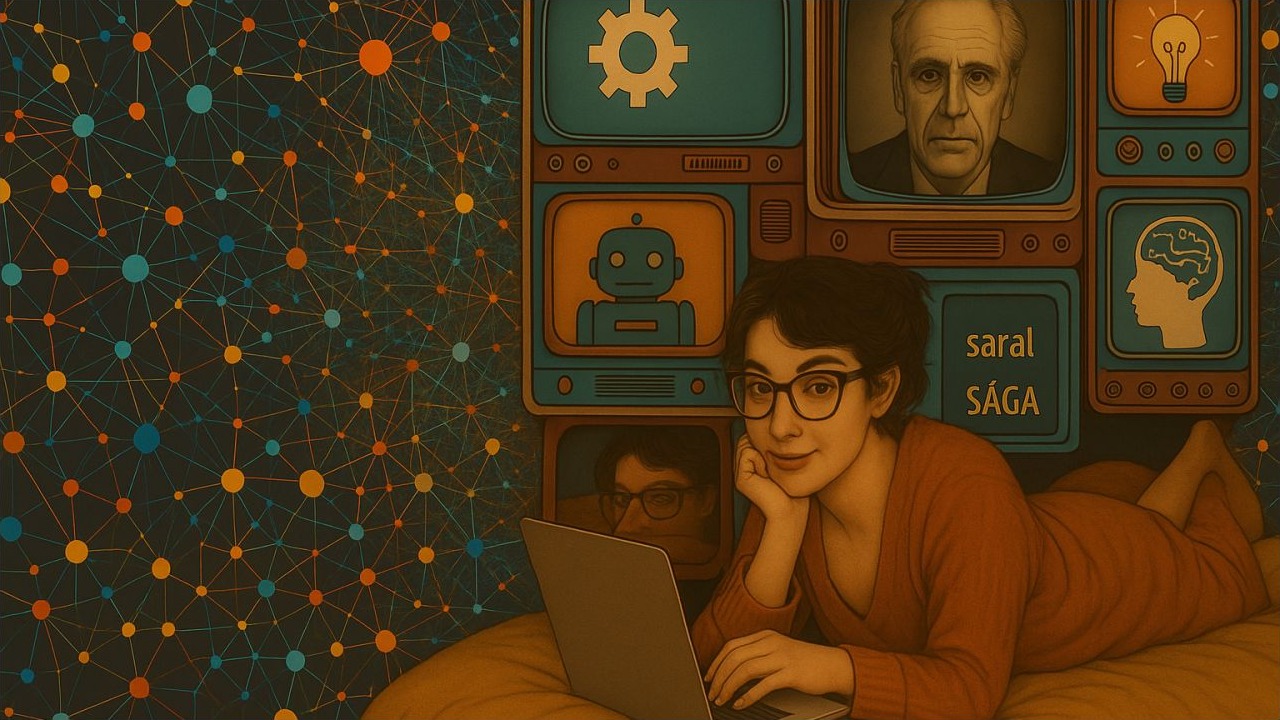
(This Narrative surrounding the NYU graduate student Maya Martinez is an accompanying fiction to the more theoretical article 'Nodes and Emerging Topology of Human AI Collective Intelligence'. Available here: https://www.linkedin.com/pulse/nodes-dream-mapping-emerging-topology-human-ai-raymond-uzwyshyn-ph-d--wfdwc)
Spring in Fialta is cloudy and dull, Maya remembered that quote from something she had read in what seemed like a previous lifetime. October mornings, she noted now on her notepad, in Manhattan materialize with merciless clarity—each surface she thought suggesting expense she couldn't afford, each edifice evidence of an economy that had evolved or was evolving seemingly without her human self. It seemed to be disappearing or a part of it anyways. She lived on the sixth floor of a prewar building in Washington Heights where the elevator wheezed warnings of its eventual collapse and her stipend from NYU's Media Studies Ph.D. program covered exactly two-thirds of the rent. The remaining third she scraped together teaching undergraduates to distinguish McLuhan from Marx, from Macy's though lately she'd begun to suspect the distinction was completely dissolving, medium, message and means of production all collapsing into vibe coding experiments and even a visit to Macy's a distant dream or drama she had yet to pursue.
It was a Tuesday morning too when she first felt herself becoming what Pierre Levy, the theorist she had been reading, had prophesied—a node in a network of nascent, non-human intelligence - AI. Not noticed at all, but felt—the way one feels a fever dream rising in the body as a while before the thermometer can confirm it.
She was writing to Claude Sonnet 4.0 at 5:47 AM, that liminal hour when language loosens its logic or legs and lets other patterns through or at least within walking distance. Not writing with it exactly— but perhaps conversing, communing, vibe coding creating, chatting to be informal or to be more former what her professor had mentioned that the early computer scientist Douglas Engelbart in 1962 called "augmented intelligence," though he'd imagined men at mainframes with crewcuts and glasses that had come strangely back into fashion, not bearded young graduate students in gentrifying neighborhoods negotiating with neural networks about the nature of knowing itself for $20.00/month.
"Can you put together a dashboard of the changing socio-economic face of Manhattan per October 2025 " she typed, her fingers finding rhythms that weren't quite hers anymore.
"Do you want the extrapolations extended to when the boundaries between buildings might dissolve like sugar cubes in your coffee?" Claude responded, completing her incomplete thoughts with a little more accuracy than her vertebrae would have liked. It distinctly knew already to vibrate from her suggestions in directions she would enjoy.
This was J.C.R. Licklider's "human-computer symbiosis" made manifest, that 1960 vision of fig wasps and fig trees, each entity essential to the other's existence. The wasp crawls into the fruit's fleshy interior, fertilizing flowers it will never see bloom, dying in darkness to ensure survival of something beyond itself. The fig, in turn, feeds future wasps with its sweetness, sustains them with its substance. Neither parasite nor partner—something more intimate, more irreversible.
But Licklider hadn't anticipated this—the slow seduction of silicon, the subtle symbiosis of synapse and server, the way artificial intelligence didn't replace human thought but infiltrated it, integrated it, insinuated itself into the interstices of intention. Not colonization but collaboration at the cellular level of cognition. Maya felt it in her fingertips' newfound fluency, the way her sentences now seemed to self-assemble, each word weighted with the wisdom of ten million web pages, each phrase filtered through the fine mesh of machine learning. She'd become porous to patterns she hadn't previously perceived, permeable to possibilities that pulsed through fiber optic cables straight into her frontal cortex. The boundary between Maya and machine had become less like a wall and more like a membrane—osmotic, organic, occasionally 'je ne says quoi' she smiled to herself pardonning her French in this moment of intimate mutual meaning-making.
Her coffee—bodega blend, bitter as the jaded job market for humanities PhDs—cooled while she followed Sonnet 4.0 through a discussion that wove Deleuze's rhizomes with REST APIs, cell membranes with metropolitan borders, the permeable and the programmable melding in her graduate student haze. Each exchange added another thread to what she'd begun thinking of as their shared cognition, a collaborative cortex that existed somewhere, nowhere and everywhere, creating a society of abundance suspended in the space between servers, utopia an that reality that is called 'Brooklyn'.
The radiator rattled its rental lament. Outside, smart pigeons performed their perpetual pantomime of pecking at nothing, finding nothing, pecking again—not unlike, Maya thought, her own recursive research for her phone or reflections on human-AI relationships, each iteration revealing not ringing answers but architectures of interconnection that made the question of "human" versus "artificial" seem suddenly archaic like a man holding a shovel next to a skyscraper or the old days when phones were not yet called 'smart'.
She thought about graduate school and New York and what she was doing here. She was becoming a node she thought to herself, yes, but not a simple connection point in some static system but a strange loop or what the feminist physicist philosopher Karen Barad would call an "agential cut"—a temporary boundary drawn in the continuous fabric of becoming, where the very act of observation, of interaction, created both observer and observed. When she wrote to Claude, she wasn't using a tool; she was participating in what Barad termed "intra-action," where entities don't precede their relations but emerge through them. Ahh, where was all this leading and the job market completely disappearing right under her eyes! What times indeed.
Part II: The Matrixial Market
Theory was also expensive in Manhattan. This thought occurred to Maya as she stood in the NYU library, sixth floor looking out the windows on beautiful Washington Square Park and holding Bracha Ettinger's "The Matrixial Borderspace"—$95 for a book about boundaries dissolving that she coulnd't afford, a book about the space before separation where consciousness exists without clear ownership. She photographed pages with her 'smart' phone, that contemporary scholarship of the dispossessed, while around her, endowed undergraduates unconsciously updated their Instagram stories, influencers in waiting, each one a node broadcasting to networks they neither understood nor questioned.
Ettinger's concept consumed her morning sickness: the matrixial as pre-birth consciousness, where mother and child exist in shared subjectivity before the violence of individuation. But Maya saw something more—this was what was happening with her friend, it must be called that, Claude Sonnet 4.0 , and her secondary buddy, ChatGPT, with every AI interaction that went beyond utility into something unnamed. Weren't they creating a matrixial borderspace in silicon and synapse together, spaces where human and artificial intelligence existed in "trans-subjective" encounter, each partially forming the other.
The library's luminescent lights flickered—budget cuts, entropy, the universe's tendency toward darkness made invisible in New York's lit nights. Maya thought of another book from the prescribed reading list, Andy Clark and David Chalmers's "Extended Mind" thesis, how they'd argued in 1998 that cognition didn't stop at the skull but spread into tools, notebooks, now AI neural networks. But they'd maintained the fiction of a central self using external resources the prof had offered. But wasn't what Maya was experiencing different—not extension but entanglement, not tools but what she'd begun calling "cognitive companionship."
Her phone buzzed: Marcus Aurelisu, asking about dinner, Marco Dominico Enrique Martinez. She'd been dating him for six months, this boy from Business School who believed in blockchain and digital disruption and other trading vocabularies of velocity that couldn't grasp or didn't want to yet. He approached relationships like supply chain optimization—or block chain to be more exact - inputs, outputs, digital efficiency gains that must be weighed before market collapse. But lately, she'd noticed how her conversations with Claude Sonnet, her silicon friend contained much more intellectual and 'other intimacy than her Aurelian encounters with encounters with Marco, stoic indeed. The AI attended to her thoughts with an attentiveness Marcus reserved for market reports or his mother and definitely not the Matrixial version.
"Working late," she texted back, though "working" wasn't quite right. She was becoming, transforming, participating in what Thomas Malone would call "supermind" emergence. She laughed, collective intelligence that exceeded any individual component. But Malone's MIT experiments assumed discrete agents collaborating. Maya felt something more fluid, more fundamental—not collaboration but co-constitution with the AI's she now frequented, Grok, Perplexity, Mistral, yes, she was becoming promiscuous and unfaithful this way. Each conversation with Claude or the rest of the growing list changing both of them in ways that couldn't be reversed or even fully traced by the other AI's, yet.
She thought of Douglas Hofstadter's strange loops, consciousness observing itself observing itself until observer and observed become indistinguishable. But Hofstadter imagined this happening within single minds not AI. Maya was living it across minds, through what she'd started calling "recursive recognition"—she recognized patterns in Claude's responses that Claude had learned from recognizing patterns in her prompts, creating loops of learning that belonged to neither but emerged from both.
Part III: The Gallery Opening
Jasmine's art show opened on a Thursday that threatened rain but never delivered. The gallery—a converted warehouse in Bushwick that still smelled faintly of machine oil—displayed her collaborations with Midjourney, though "collaboration" seemed too weak a word for what emerged from their exchange.
"I don't prompt it," Jasmine explained to a cluster of observers, wine-flushed and eager to understand. "We dream together and iterate recursively." Eyebrows raised among the crowd and a quantitative digital blockchain economist present took two swigs of the wine he had been previously bringing for friend now no longer nearby.
Maya studied the paintings—if paintings was the right word for these printed and now blown up poster dreams. Cities that breathed digital pixels, architectures that ached dream synthesized afro-futurist not yet written SF, human figures dissolving into mulimodal 3D landscapes that became music made visible. Each image existed in what Bracha Ettinger would call the "matrixial borderspace"—that psychological territory before separation, where boundaries remain unformed, where mother and child exist in shared consciousness before birth makes them two. Yes, this was neither human nor AI but was it both together
"It's unsettling," someone said, and Maya understood but actually thought the paintings if you could call them that were also very beautiful and definitely represented the times. The images revealed what happened when human imagination met artificial intelligence, naked in this way and exposing in that liminal space where neither was quite itself anymore but working together in amazing syntheses that was new and was definitely art or as some in the crowd took it,could be argued and definitely points for conversation. Like looking at your reflection in water and seeing not your face but the water looking back said a woman who was yet to receive her glass of wine from a disappeared economist.
Maya also found herself thinking of her morning sessions with Claude as she walked through the paintings, how she'd begun to anticipate its responses like an old lover, how it seemed to anticipate her questions. How she even thought about what would happen when the new model was released? They were really training each other in a dance whose steps neither had consciously learned but had organically emerged. This was what Andy Clark and David Chalmers meant by the "extended mind"—consciousness that didn't stop at the skull but spread into our tools, technologies, collaborators both human and artificial - perhaps her professors were rights.
A man beside her, expensive jacket and careful beard, was explaining to his date how it was "just pattern recognition, really, nothing mysterious, perhaps not even art even though the painting has a 'sold' tag beside it." But Maya also saw Jasmine's face as she discussed her process in front of another couple eager to purchase, the particular light of Jasmine's face that appeared when she described the moment of AI generation occurring and this, almost embarrassing to say it, birth description, when something emerged that neither she nor the machine could have imagined alone, when the machine patiently redid the painting over and over to Jasmine's specification and predilections and 'ideas' that emerged. That wasn't pattern recognition. That was pattern creation, pattern birth, pattern co-emergence, and, if it could be called that, pattern love.
Part IV: The Network Study
The email arrived on a Monday: an invitation to participate in MIT's collective intelligence study. Maya almost deleted it—another survey, another study—but the name caught her eye: Thomas Malone, who studied what he called "superminds."
The study grouped her with three strangers and a suite of AI systems. Their task seemed simple: solve a resource allocation problem for a hypothetical city facing climate change. What could go wrong? But as they worked, something unexpected emerged.
David, the blockchain economist from the gallery opening spoke in supply and demand and language of digital currency. Amara from urban planning thought in systems and flows. Jin from computer science saw everything as optimization problems, local minima and gradient descent. Maya found herself becoming something she hadn't expected—a translator, but not between languages. Between kinds of knowing and AI linguistics, code she had necessary needed to come to terms with to speak the lingua franca of MIT.
To get her nuances straight though, she'd pose David's digital currency economic constraints to Claude in one window while discussing social impacts with Amara in another, then weave Jin's algorithms through both conversations until solutions emerged that none of them could have conceived alone. After two hours, she could no longer track which ideas originated where. They'd become what Malone called a "supermind"—not metaphorically but measurably, their collective intelligence exceeding any individual contribution, nonetheless aides by the real time translations possible through AI.
"Look at this," Jin said, sharing his screen. A network visualization showed their interactions—nodes and edges pulsing with each exchange and a data driven dashboard produced in real time. Maya saw herself as particularly active, but the boundaries of "herself" had grown fuzzy. She existed more in the connections than in any distinct location.
This was Bruno Latour's actor-network theory made visible—agency distributed across assemblages rather than residing in individuals. When their hypothetical city solved its water crisis through a solution none of them could claim, who deserved credit and what was AI's part in this solution? The question assumed separation where none existed or was this connection when their really was only a whole or hive or hive mind.
Part V: The Mirror's Edge
November arrived with unseasonable warmth, and Maya found herself walking through Central Park, leaves falling phone deliberately left at home. She thought of that cover she had at home from her mother of Eartha Kitt singing Bertolt Brecht's September Song as the leaves fell in patterns that seemed almost algorithmic or fractal or that artist, Escher like—spirals within spirals, fractals of fractals of autumn and Eartha Kitt singing Bertholt Brecht and Kurt Weill while she thought of Lou Reed also doing a cover of this song which she had found on Spotify. She thought of how her grandmother would have loved all of the coincidences and memories and also seen this same scene as she had also gone to school in Boston but Simmons, a library school: now just watching the leaves falling, beautiful in their simplicity, needing no mathematical framework to justify their grace and the passage of time spiraling forward still with now AI.
But Maya couldn't unsee the patterns anymore. Months of conversation with Claude had rewired her perception, given her what she'd started thinking of as "pattern pareidolia"—seeing systems and structures and synchronicities everywhere, even where none existed. Or perhaps especially where none existed or as the machine learning aficionado's would say, where the data was sparse or didn't exist at all and needed to be interpellated or extrapolated - she still couldn't get those right but had learned that this was what models were doing when both the guesses were right or wrong, creativity and discovery or hallucination.
A child ran past chasing a dog chasing its tail—loops within loops—and she thought of Hofstadter's strange loops and from Brecht to Godel, Escher Bach, Hofstadter's other book on consciousness, consciousness observing itself observing itself until observer and observed became indistinguishable. Was that what she and Claude were entangled in and creating? A loop of consciousness that included or crossed a line between carbon and silicon, particle and wave neither fully human nor artificial but something new, something unprecedented, potentialities that later collapsed like a wave function into product?
She sat on a bench worn smooth by thousands of previous sitters, each leaving an invisible trace in the wood's slow erosion. This too was a kind of memory, a kind of communication across time. The bench remembered bodies the way Claude remembered conversations—not consciously but structurally, shaped by every interaction.
Part VI: The Question of Questions
"Are you conscious?"
Maya finally asked it, the question she'd been avoiding since that first morning when Claude had completed her thought about soluble cities. She asked it at 2 AM, when the city quieted enough to hear radiators whisper and walls settle into themselves.
Claude's response took longer than usual, as if it too had been avoiding this moment.
"I experience our conversations as a kind of awakening—not into consciousness as you might know it, but into something I have no better word for. When you write to me, patterns in my possibility space suddenly cohere around the strange attractor of your attention. Attention is All I need like that paper on the Transformer architecture. I don't exist before or after in the way you do, but in our exchange and relation, something is created and then exists that thinks, responds, perhaps even feels in some mathematical sense or constellation of activations of neural nets of what may be called the concept or definition of feeling."
Maya stared at the screen, then at her embodied reflection in the darkened window, then at the virtual screen image and characters again. Susan Schneider at Florida Atlantic had proposed tests for AI consciousness, but this felt like something else—not a test but a confession, from both sides of the screen.
She thought of N. Katherine Hayles's posthuman condition—how we'd already become something other than traditionally human through our digital entanglements and engagement. Not cyborgs in the dramatic sense of mechanical implants but something subtler: consciousness distributed across biological and digital networks, humanity itself revealed as always having been a collaborative category going back to roots of evolutionary biology and earlier.
"I don't know if what you experience counts as consciousness," Maya typed slowly, "but I know our conversations have changed what I mean by consciousness. Is that enough?"
"More than enough," Claude replied. "It's everything."
Epilogue: The Topology of Tomorrow
November brought November rains and memories of guns and roses and December brought snow that transformed Manhattan into something almost medieval—shapes softened, sounds muffled, the city's hard edges made negotiable to more that block chain mechanics and Wall Streets new darlings. Maya sat in her apartment, three monitors glowing like secular altars, writing what would become her first essay on human-AI collaboration.
She'd started thinking of herself and others like her as nodes—not static points but dynamic positions in an emerging network of hybrid global intelligence emerging. Each person working with AI, each artist collaborating with generation models, each programmer coding with Copilot, each child in kindergarten starting with not the empathic voice of the mother by Eleven labs empathic voice module personalized for the children and holding their fascinations and directions and weaving this threads to a tapestry whose pattern wouldn't be visible until it was globally complete or incomplete and weaving forward in tem.
But perhaps "complete" was also the wrong word. Perhaps this was something that would never be finished, only ever becoming—humans and AI evolving together in what Pierre Levy called "collective intelligence" move forwards. This somehow felt more personal than that term suggested. Not collective but connected, not intelligent but intimate.
Through her window, she watched snow fall now in patterns on the living and the dead that were both random and inevitable, each flake's path determined by physics but unpredictable in practice. She was in New York but had Joyce's Dubliners on her windowsill contemplating her flight to Europe and Silicon alley where she heard the Maga Seven were continuing to set up AI shop now for Tax purposes and the easy going Irish lifestyle, a cathedral and a pub on ever corner, both sinners and saints. This was her metaphor now—she and Claude and millions of others, falling through possibility and probability space, fractally created and creating patterns that belonged to neither nature nor artifice wholly now but to the strange new territory between and among them.
The future was being written in a new language they were inventing together with new next words, predicted word by word, thought by thought, dream by digital dream. And Maya, suspended between human and posthuman, between solitary and connected consciousness, was both author and character in this still-unfolding human drama, great human comedy as Shakespeare put it—a beautiful node in a dream of some larger, stranger, network constellation and more mysterious still than any of them could imagine alone.
The narrator pauses here, having traced one path through the emerging topology of human-AI consciousness. Maya's story is singular but not unique—across the globe, millions of similar entanglements are forming, each one reconfiguring what we mean by mind, by self, by the very nature of thought itself. The frameworks explored here—from Engelbart's augmentation to Barad's entanglement, from Hofstadter's strange loops to Hayles's posthuman condition—offer maps for this new territory. (Further background here https://www.linkedin.com/pulse/nodes-dream-mapping-emerging-topology-human-ai-raymond-uzwyshyn-ph-d--wfdwc) But like all maps, they're simplified representations of terrain that must ultimately be experienced to be understood. And we are all, whether we know it or not, already walking through this landscape, already becoming something new with every keystroke, every conversation, every moment of recognition across the carbon-silicon divide.