
Beyond Literature Review: The Emergence of Autonomous Scientific Discovery
The 2024 Nobel Prizes in Physics (Hopfield & Hinton for neural networks) and Chemistry (Hassabis & Jumper for AlphaFold) marked a watershed moment—AI transitioned from tool to collaborator in fundamental research. We have now entered what researchers call the era of Artificial Research Intelligence (ARI): AI systems capable of generating novel hypotheses, designing experiments, and making discoveries that advance human knowledge.
This analysis examines the frontier tools emerging in 2025-2026 for researchers seeking not merely to accelerate existing workflows, but to generate genuine insight, discover hidden patterns, and catalyze invention. These systems represent a qualitative leap beyond the productivity tools covered in standard AI stacks—they aim to augment (and in some cases automate) the creative core of scientific discovery itself.
Theoretical Framework: The Move 37 Paradigm
On March 10, 2016, AlphaGo's Move 37 against Lee Sedol demonstrated something unprecedented: an AI system making a creative decision that no human expert would have considered, yet which proved strategically brilliant. This moment crystallized a new paradigm for AI-human collaboration:
Move 37 Thinking represents the capacity to identify non-obvious solutions by escaping the constraints of conventional domain expertise—finding the "game-changing move hiding in plain sight, waiting to be played from radically new creative angles."
The tools below operationalize this paradigm across scientific domains, business strategy, and creative problem-solving.
Tier 1: Multi-Agent Scientific Discovery Systems
1. Google AI Co-Scientist
Access: Trusted Tester Program (application required) Cost: Enterprise/Research partnership Link: https://research.google/blog/accelerating-scientific-breakthroughs-with-an-ai-co-scientist/
What It Is: A multi-agent AI system built on Gemini 2.0 designed to function as a virtual scientific collaborator. Unlike literature review tools, AI Co-Scientist generates novel hypotheses and research proposals, moving beyond summarization to original knowledge creation.
Architecture: The system employs specialized agents—Generation, Reflection, Ranking, Evolution, Proximity, and Meta-review—that mirror the scientific method. These agents use automated feedback loops to iteratively generate, evaluate, and refine hypotheses, creating self-improving cycles of increasingly high-quality outputs.
Validated Results:
- Imperial College London (Antimicrobial Resistance): AI Co-Scientist proposed a hypothesis about cf-PICI elements interacting with diverse phage tails—a finding that was independently validated by wet-lab experiments the system had no knowledge of. The system accomplished in days what the human research team had taken years to discover.
- Stanford University (Drug Repurposing): Identified candidates for liver fibrosis treatment that were subsequently validated through laboratory experiments.
- VDI/VDE Systematic Review: Achieved 99.4% accuracy in data extraction (1,502/1,511 data points correct).
Genesis Mission Integration: In December 2025, Google DeepMind announced partnership with the U.S. Department of Energy to provide AI Co-Scientist access to all 17 National Laboratories through the Genesis Mission—a historic federal initiative to transform American scientific research.
Assessment: AI Co-Scientist represents the most sophisticated publicly acknowledged system for autonomous hypothesis generation. Its multi-agent architecture enables genuine novelty detection and cross-disciplinary synthesis that single-model systems cannot achieve. The Imperial College validation—where the AI independently arrived at the same conclusion as a multi-year human research effort—provides compelling evidence of transformative potential.
Limitations: Currently restricted to Trusted Tester Program; not publicly available.
2. AlphaEvolve (Google DeepMind)
Access: Early Access Program for academics (application) Cost: Not publicly available Link: https://deepmind.google/blog/alphaevolve-a-gemini-powered-coding-agent-for-designing-advanced-algorithms/
What It Is: An evolutionary coding agent that discovers and optimizes algorithms through a combination of LLM creativity (Gemini Flash + Gemini Pro ensemble) and automated evaluation. Unlike systems that assist with existing problems, AlphaEvolve invents new algorithmic solutions.
Key Breakthrough: AlphaEvolve discovered a new algorithm for multiplying 4×4 complex-valued matrices using 48 scalar multiplications—the first improvement to Strassen's 1969 algorithm in 56 years. This represents provably new mathematical knowledge generated autonomously by an AI system.
Validated Applications:
- Open Mathematical Problems: Across 50+ problems in analysis, geometry, combinatorics, and number theory, AlphaEvolve rediscovered state-of-the-art solutions 75% of the time and improved best-known solutions 20% of the time
- Kissing Number Problem: Advanced the lower bound in 11 dimensions
- Google Data Centers: Discovered scheduling heuristics recovering 0.7% of worldwide compute resources—massive savings at Google's scale
- TPU Circuit Design: Found functionally equivalent simplifications in hardware accelerator circuits
- Gemini Training: Achieved 23% speedup in kernel tiling and 32% in FlashAttention operations
Collaboration with Terence Tao: Several mathematical discoveries were guided by suggestions from Fields Medalist Terence Tao, demonstrating the human-AI collaborative potential for frontier mathematics.
Assessment: AlphaEvolve represents the most convincing demonstration of AI generating provably novel, correct mathematical and algorithmic knowledge. Its ability to improve on human-designed algorithms across diverse domains suggests broad applicability. The evolutionary framework—using empirical evaluation rather than theoretical proofs—provides a practical path to open-ended discovery.
Theoretical Significance: AlphaEvolve operationalizes what complexity theorist Jürgen Schmidhuber envisioned with the theoretical Gödel Machine: self-improving systems that discover better algorithms than their creators could design.
3. Sakana AI Scientist v2
Access: Open source (GitHub) Cost: ~$6-15 per paper + compute Link: https://github.com/SakanaAI/AI-Scientist-v2
What It Is: The first comprehensive system for fully automated scientific discovery, capable of autonomously generating hypotheses, running experiments, analyzing data, and writing complete scientific manuscripts—including the first AI-generated paper to pass peer review at an ICLR workshop.
Architecture: AI Scientist v2 removes reliance on human-authored templates (unlike v1), generalizes across ML domains, and employs progressive agentic tree search guided by an experiment manager agent. It uses Vision-Language Models for critique and feedback during experiments.
Milestone Achievement (March 2025): Three fully autonomous manuscripts were submitted to a peer-reviewed ICLR 2025 workshop. One manuscript achieved scores exceeding the average human acceptance threshold—marking the first instance of a fully AI-generated paper successfully navigating peer review.
Independent Evaluation (Beel et al., 2025): A rigorous assessment found critical shortcomings: 42% experiment failure rate, limited literature review depth, occasional hallucinated numerical results. However, the evaluators concluded it represents "a significant leap forward in research automation" that produces manuscripts many reviewers would struggle to distinguish from human work. Cost efficiency is unprecedented: $6-15 per complete paper with 3.5 hours human involvement.
Assessment: AI Scientist v2 demonstrates that end-to-end autonomous research is technically feasible, though quality currently resembles "an unmotivated undergraduate rushing to meet a deadline." The significance lies not in current quality but in trajectory—the system improves with each iteration and points toward a future of radically accelerated research throughput.
Best Use Case: Rapid exploration of research directions, hypothesis screening, automated literature synthesis. Requires human oversight for validation.
4. Darwin Gödel Machine (DGM)
Access: Open source (GitHub) Cost: ~$22,000 per full run (compute-intensive) Link: https://github.com/jennyzzt/dgm | https://sakana.ai/dgm/
What It Is: A self-improving AI system that rewrites its own code to enhance its capabilities—operationalizing Jürgen Schmidhuber's theoretical Gödel Machine through empirical rather than formal verification.
Core Innovation: The DGM combines Darwinian evolution (maintaining an archive of diverse solutions) with Gödelian self-improvement (recursive code modification). It treats self-improvement as a coding task, meaning improvements on benchmarks directly enhance the system's capacity for further self-modification.
Validated Results:
- SWE-bench: Performance improved from 20.0% to 50.0% through autonomous self-modification
- Polyglot: Performance jumped from 14.2% to 30.7%, significantly outperforming hand-designed agents like Aider
- Self-discovered improvements: Better code editing tools, long-context window management, peer-review mechanisms, patch validation steps
Theoretical Significance: The DGM demonstrates that AI systems can recursively enhance their own capabilities—a key milestone toward what some researchers term "intelligence explosion" scenarios. The system discovered improvements to its own learning process, accelerating future self-modification.
Assessment: DGM represents a proof-of-concept for open-ended self-improving AI. Current domain limitations (coding tasks only) constrain applicability, but the principles could extend to any domain with clear evaluation metrics. The $22,000 cost per run limits accessibility.
Safety Note: The researchers implemented sandboxing, human oversight, and other safety precautions. The paper includes extensive discussion of alignment considerations.
Tier 2: Hypothesis Generation & Creative Reframing Tools
5. Move 37 (EducAIte Games)
Access: Public beta Cost: Free Link: https://lnkd.in/gwUtGU3r (Standard) | https://lnkd.in/gByPtQYt (Advanced Beta)
What It Is: A research and insight app designed to help researchers, strategists, and creative thinkers identify "Move 37 moments"—game-changing approaches hiding in plain sight. Named after AlphaGo's breakthrough move, it combines AI suggestion engines with frameworks for problem reframing, first principles thinking, and counterintuitive innovation.
Methodology: Users define their problem space through structured prompts:
- Core Question: The fundamental problem seeking resolution
- Current Landscape: Dominant approaches and unsolved elements
- Immutable Constraints: Rules that cannot change; what must be preserved
The system then generates creative first moves and unexpected directional paths drawing on lateral thinking principles.
Application Domains:
- 🔬 Science & Tech: Revolutionary breakthroughs
- 📊 Strategy & Markets: Invisible opportunities
- 🎨 Creative & Design: Aesthetic revolutions
- 🏛 Systems & Architecture: Elegant subversions
- 📚 Learning & Social Impact: Transformative methods
Assessment: Move 37 operationalizes the insight that breakthrough innovation often requires escaping domain expertise rather than deepening it. By structuring problem reframing through first principles, it provides a practical tool for the kind of lateral thinking that led to AlphaGo's legendary move. Free access makes it accessible for experimentation.
Best Use Case: Early-stage problem definition, research direction exploration, strategic pivots. Works well as a complement to more systematic tools.
6. Gemini Deep Research
Access: Gemini Advanced ($20/mo) Cost: $20/month Link: https://gemini.google.com
What It Is: Autonomous multi-step research capability within Gemini that executes extended research sessions (5-30 minutes), exploring topics comprehensively and producing detailed reports with citations.
Key Capability: Unlike single-query responses, Deep Research conducts iterative investigation—formulating sub-questions, searching multiple sources, synthesizing across domains, and producing structured outputs that approximate the research process itself.
Assessment: Deep Research represents the most accessible entry point to autonomous research capabilities. While less sophisticated than AI Co-Scientist or AlphaEvolve, it provides genuine multi-step reasoning at consumer pricing. The 1 million token context window enables analysis of entire books or research corpora.
Best Use Case: Rapid domain familiarization, comprehensive topic exploration, cross-disciplinary synthesis.
Tier 3: Domain-Specific Discovery Engines
7. AlphaFold 3 (Google DeepMind)
Access: AlphaFold Server (free for academic use) Cost: Free for non-commercial research Link: https://alphafoldserver.com
What It Is: The system that earned Demis Hassabis and John Jumper the 2024 Nobel Prize in Chemistry. AlphaFold predicts 3D protein structures with atomic accuracy, solving a 50-year grand challenge in biology.
Impact:
- Used by 3+ million scientists in 190+ countries
- Accelerated vaccine development, drug discovery, and enzyme engineering
- AlphaFold Database contains 200M+ predicted structures
AlphaFold 3 Advances (2024-2025):
- Predicts structures of protein complexes with DNA, RNA, and small molecules
- Models post-translational modifications
- Improved accuracy for challenging targets
Assessment: AlphaFold represents the gold standard for AI-driven scientific discovery—a system that generated genuinely new knowledge (protein structure predictions) that advanced human understanding and enabled downstream applications. It demonstrates what's possible when AI is applied to well-defined scientific problems with clear evaluation metrics.
8. GNoME (Google DeepMind)
Access: Research partnership Link: https://deepmind.google/discover/blog/millions-of-new-materials-discovered-with-deep-learning/
What It Is: Graph Networks for Materials Exploration—an AI system that discovered 2.2 million new crystal structures, including 380,000 stable materials that could power future technologies in batteries, solar cells, and computer chips.
Impact: This 10x expansion of known stable materials provides a search space for materials scientists that would have taken 800 years to accumulate through traditional experimentation.
Assessment: GNoME demonstrates AI's capacity for combinatorial discovery in materials science—exploring vast possibility spaces that would be impractical for human researchers alone.
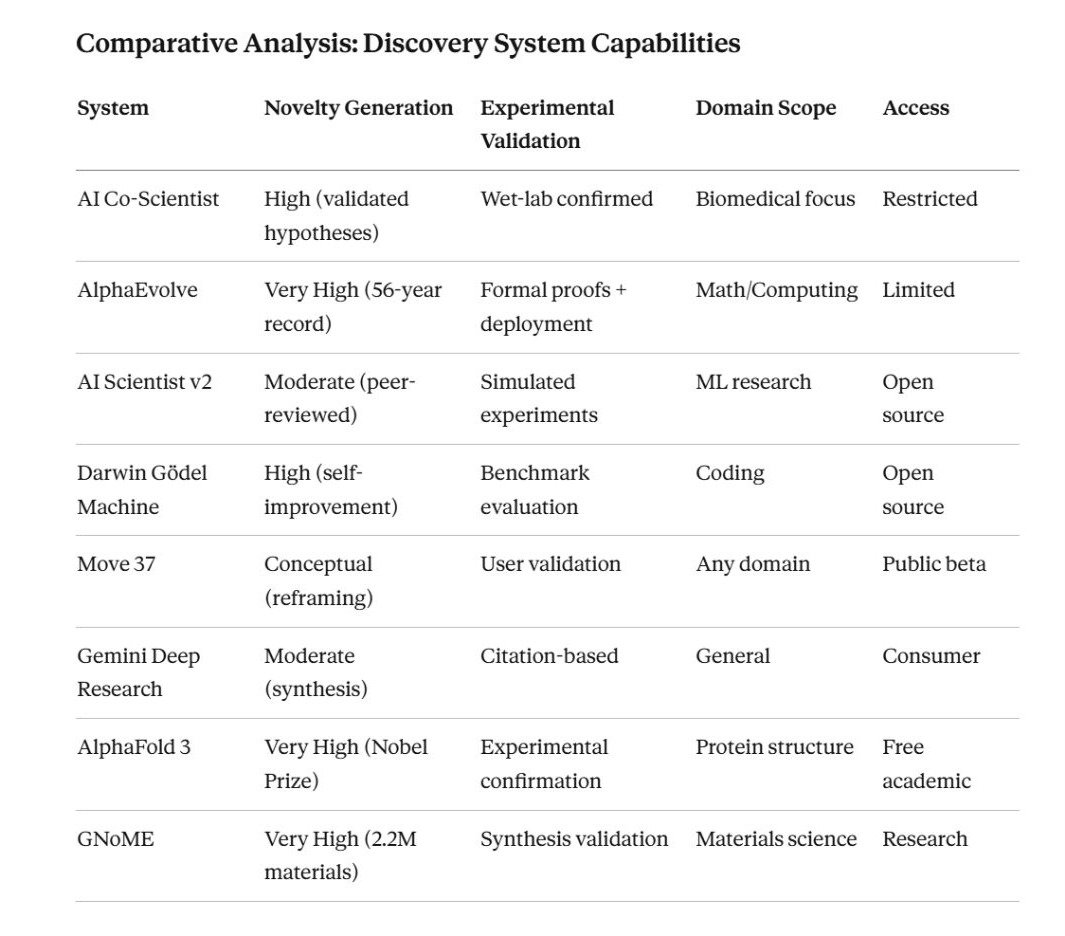
The Meta-Discovery Framework
These tools represent different points on a spectrum from human-guided AI augmentation to autonomous scientific discovery:
Level 1 - Augmented Ideation (Move 37, Gemini Deep Research) AI assists human creativity through reframing, synthesis, and exploration of adjacent possibilities. Human remains primary driver of novelty.
Level 2 - Hypothesis Generation (AI Co-Scientist) AI proposes genuinely novel hypotheses based on synthesis across literatures. Human validates and designs experiments.
Level 3 - Autonomous Experimentation (AI Scientist v2) AI generates hypotheses, designs experiments, runs them, and writes papers. Human provides oversight and quality control.
Level 4 - Self-Improving Discovery (Darwin Gödel Machine, AlphaEvolve) AI systems that improve their own discovery capabilities, potentially accelerating the pace of innovation recursively.
Practical Recommendations
For Researchers Seeking Breakthrough Insights:
- Start with Move 37 for problem reframing and creative first moves (free, accessible)
- Use Gemini Deep Research for comprehensive domain exploration ($20/mo)
- Apply to AI Co-Scientist Trusted Tester Program if in biomedical research
- Experiment with AI Scientist v2 for rapid hypothesis screening (open source)
For Research Institutions:
- Monitor Genesis Mission developments for National Lab access to frontier tools
- Explore AlphaEvolve Early Access for algorithm-intensive research
- Integrate AlphaFold 3 into structural biology workflows
- Establish AI safety protocols for autonomous research systems
For Strategists and Innovators:
- Apply Move 37 methodology to identify non-obvious market opportunities
- Use Deep Research for competitive landscape analysis
- Frame business challenges in terms amenable to AI hypothesis generation
The Horizon: What's Coming
Near-term (2026):
- Broader access to AI Co-Scientist and AlphaEvolve
- More domains integrated into autonomous research systems
- Improved reliability of AI Scientist-class tools
Medium-term (2027-2028):
- AI systems contributing to peer-reviewed literature at scale
- Cross-domain discovery engines linking materials, biology, and chemistry
- Self-improving research agents deployed in production settings
Long-term (2029+):
- AI systems potentially generating Nobel-caliber discoveries autonomously
- Fundamental questions about attribution, credit, and the nature of scientific contribution
- Transformation of the PhD itself as AI handles increasing portions of research labor
Closing Reflection: The Move 37 Moment for Science
We stand at an inflection point comparable to the introduction of the printing press or the computer. The tools analyzed here are not merely faster ways to do existing research—they represent qualitatively new capabilities for generating knowledge itself.
The researchers who thrive in this transition will be those who learn to orchestrate these systems effectively: knowing when to let AI explore freely, when to provide human judgment, and how to validate machine-generated insights against the standards of scientific rigor.
Every domain awaits its Move 37—a game-changing insight hiding in plain sight. These tools help us find them.
Analysis current as of December 2025. The autonomous research AI landscape is evolving rapidly—expect significant developments within months.
#AIScientist #Move37 #ScientificDiscovery #AlphaEvolve #AutonomousResearch #FutureOfScience #ArtificialResearchIntelligence