
Introduction: Why AI Matters to Hollywood Executives
Imagine producing a blockbuster feature film in hours instead of months, slashing budgets by millions while cranking out more content for hungry streaming audiences. That's the promise of AI video generation as we stand in July 2025—a technology that's evolving from experimental gadget to essential production tool. For studio heads, producers, and industry insiders, this isn't just about cool effects; it's about survival in a post-pandemic world where theater attendance is down, costs are up, and competition from tech giants is fierce. This essay breaks down the key trends, business implications, and future outlook, focusing on what really counts: cost savings, efficiency gains, and navigating the human side of change. We'll highlight conclusions from recent data and trends, keeping things straightforward for busy executives.
The State of Play: What AI Can Do Today
Right now, AI video tools like OpenAI's Sora, Runway's Gen-4 Turbo, Google's Veo 3, Kuaishou's Kling, and Character.AI's TalkingMachines are already making waves in Hollywood workflows. These systems can generate short video clips—think 10 to 120 seconds—with realistic motion, synced sound, and consistent characters. For example, Sora creates 20-second scenes in about a minute, while TalkingMachines does it in real-time for interactive content.
From a production standpoint, this means faster pre-visualization (pre-viz), where directors mock up scenes before shooting, cutting down on expensive reshoots. In post-production, AI helps with visual effects (VFX) and audio syncing, areas that traditionally eat up 20-30% of a film's budget. Industry reports from Deloitte and Ernst & Young show early adopters like Disney and Amazon saving 15-25% on these phases alone. However, for longer sequences, teams still need to stitch clips together manually, which can lead to inconsistencies—like mismatched lighting or character looks—that require human fixes.
The big takeaway? AI is speeding up the grunt work, allowing creative teams to focus on storytelling. But it's not perfect yet: sound syncing isn't always spot-on, and maintaining consistency over multiple shots remains a challenge, especially for fast-paced films with short average shot lengths (ASL) of 2.5 to 4 seconds.
Looking Back: How We Got Here and What It Means for Business
Just two years ago, in 2023, AI video was clunky—generating glitchy clips that took minutes for mere seconds of output. By 2024, tools improved dramatically, producing higher-quality videos seven times faster. Now in 2025, we're seeing real-time capabilities and market growth exploding from $555 million to a projected $2 billion by 2030.
For Hollywood executives, this rapid progress signals a shift toward leaner operations. Think about it: traditional film production costs $100-200 million on average, with VFX alone running $50 million for big titles. AI could trim that by automating routine tasks, much like how CGI revolutionized effects in the 1990s. Early indicators from studio pilots suggest 20-30% overall budget reductions, freeing up capital for marketing or new projects. Streaming platforms, facing subscriber churn, could use AI to create personalized content variants, boosting engagement and revenue.
The Future Outlook: Timelines and Bottom-Line Impacts
Based on current trends, AI video generation is on track to hit major milestones soon. By 2026, expect tools capable of creating 1-2 minute sequences in under a minute—ideal for trailers, ads, or social media clips. By 2027, full 90-minute films could be generated in under an hour, revolutionizing indie production and enabling studios to test concepts quickly.
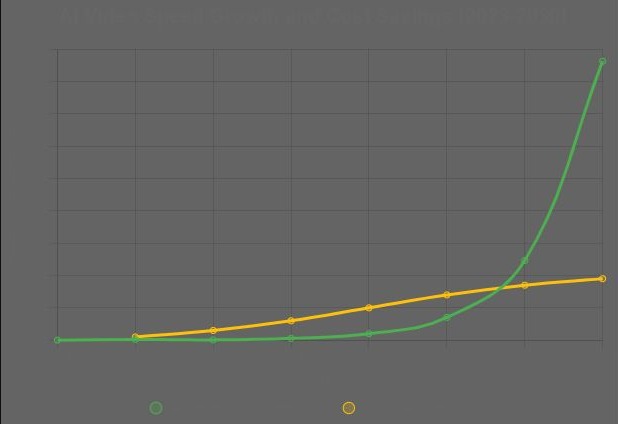
What does this mean for your P&L? Significant cost savings, potentially 30-50% in key areas like VFX and editing, as shown in the chart below. This could add billions to industry profits, especially for streaming giants needing constant content. However, shorter shot lengths in modern films (2.5-4 seconds on average) mean more clips to generate, so AI's speed improvements are crucial to keeping timelines tight.
Here's a visual look at the projected growth in AI speed and cost savings:
Clarifying the Charts: Cost Savings and Job Risk Explained
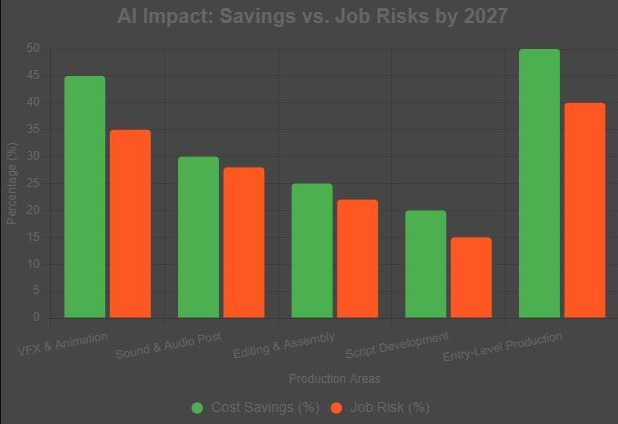
To address common questions about the charts, let's dive deeper. "Cost savings" refers to reductions in production expenses, primarily from two sources: salaries (by automating labor-intensive roles, reducing crew sizes) and speed of production (faster workflows mean less time on set or in post, lowering overheads like location fees and equipment rentals). For example, AI can cut VFX costs in half by generating effects that would otherwise require large teams, as noted by James Cameron. Calculations are based on industry benchmarks: traditional Hollywood films cost $185-926 per second, while AI alternatives range from $0.48-3.7 per second, leading to 30-90% savings depending on the scale. Deloitte's 2025 report estimates these figures from pilot projects, factoring in reduced reshoots (20-30% savings) and crew needs (15-40% labor cuts).deloitte.comentertainment.slashdot.org
"Job risk" means the potential for unemployment or role changes due to AI automation, with estimates showing 20-40% of positions affected—rising to 200,000 industry-wide by 2026, per some analyses. This includes job losses in VFX (35%) and entry-level production (40%), as AI handles routine tasks. It's calculated from surveys and economic models by firms like CVL Economics, which predict displacement based on task automation rates (e.g., 48% of professionals already using AI for editing or scripting).ai.plainenglish.io+2 more
The bar chart below illustrates these trade-offs:
Investing in People: Reskilling Strategies for the AI Era
To mitigate job risks, studios must prioritize investing in their workforce through reskilling—training employees to work alongside AI rather than be replaced by it. This involves upskilling in AI literacy (e.g., using tools for creative augmentation) and reskilling for new roles like AI prompt engineering or data curation. For instance, VFX artists could transition to supervising AI-generated effects, while editors learn hybrid workflows.
How to position your studio? Frame it as an innovative yet people-first leader: partner with unions like SAG-AFTRA for joint programs, as seen in post-2023 strike initiatives. Collaborate with tech firms (e.g., Google or xAI) for tailored training, and integrate reskilling into the workday—allocating 10-20% of time for learning, per Cognizant's recommendations.withollywood.org Examples include IKEA's $1.4 billion reskilling success (adaptable to Hollywood) and WEF's emphasis on equitable access.stealthesethoughts.beehiiv.comtimesofindia.indiatimes.com To adapt: Launch internal academies, subsidize online courses (e.g., Coursera AI for creatives), and tie reskilling to incentives like bonuses. This not only retains talent but positions studios as ethical innovators, attracting top creatives in a competitive market.
Strategically, forward-thinking executives should:
- Pilot AI in non-core areas like pre-viz to build expertise.
- Partner with tech firms for custom tools, as James Cameron has hinted.
- Focus on hybrid models where AI augments humans, preserving creative jobs while capturing efficiencies.
Conclusion: Seizing the AI Opportunity in Hollywood
In summary, AI video generation is set to transform Hollywood by 2027, enabling faster, cheaper production that could revitalize the industry. Short clips in minutes and full films in hours mean more content, lower costs, and new revenue streams—potentially adding tens of billions to the bottom line. But success hinges on addressing job displacements and ethical concerns head-on. For executives, the message is clear: Embrace AI thoughtfully, invest in people, and position your studio as a leader in this new era. The studios that adapt will thrive; those that don't risk being left behind in the credits.
¹ Note: Speculations on emerging tools like xAI's Grok 4 suggest even faster advancements, but details are limited as of July 2025.
References
- Deloitte Insights on AI in Media (2025)
- Ernst & Young Media Forecast (2025)
- CVL Economics Job Impact Study (2025)
- World Economic Forum Future of Jobs Report (2023)
- Various industry analyses from Forbes, Variety, and Hollywood Reporter (2023-2025)