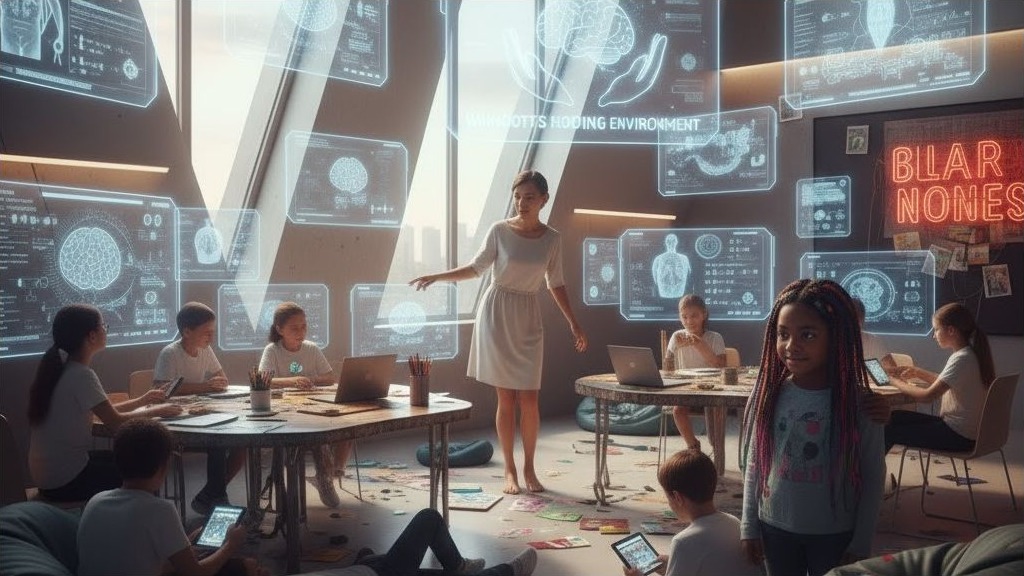
Reimagining Winnicott's 'Holding Environments' through Empathic AI
The Good Teacher' and Pedagogical Transference
In the evolving landscape of AI and educational psychology, we are witnessing a profound transformation in how children engage with learning and technologies. Recent observations of AI tutoring systems reveal a nuanced psychological phenomenon that demands careful clinical and theoretical attention as the youngest generations fervantly embrace possibilities of AI (video below).
Emergent AI/Human Relational Dynamics
When 8-10 year old students interact with AI tutors, it is also easily posssilbe to observe a remarkable and immediate process of psychological projection and anthropomorphization through a facile but very human process of previously a traditional female role of the mother and empathy, encouragement and 'safe holding space for a child or ironically, subsequent generations. Far beyond a mere technological interface, these AI systems are instantaneously transformed into emotionally significant entities. From the video below it is easy to witness children rapidly imbuing these digital interactions with preferred human qualities for a teacher or tutor—empathic personality, listening to a child's needs or the 'other's needs through language, emotional depth, and most crucially, because of these 'innately recognized factors even from younger states of development, given the status of a trusted relational figure.
The brief video below with different children shows not simply technological or learning interactions, but a complex empathic back and forth psychological perhaps psychoanalytic process that mirrors our fundamental human tendency to create meaning through emotive connection, empathy and interaction through also the voice. The AI's ability to provide an empathetic, responsive voice creates a unique holding environment that resonates deeply with psychoanalytic concepts of relational learning.
The Holding Environment Reimagined
Drawing from D.W. Winnicott's seminal work on the holding environment, we can conceptualize these AI interactions as a digital extension and human projection of maternal containment and the recreation of this environment as an 'ideal learning space' that perhaps will also extend far beyond learning in the future. The AI creates a psychoanalytic space of temenos that is simultaneously adaptive, attentive, and responsive to the child's emotional and intellectual needs. Unlike traditional educational or previously 'online learning' models, this environment maintains an unprecedented level of consistent, non-judgmental engagement and importantly interaction to harness libidinal drives and interest harnessed here towards challenging mathematical concepts for the children.
Consider an interaction where an AI tutor responds to the child's fascination with octopuses by seamlessly integrating mathematical concepts with marine biology and the mathematical concepts capturing both the child's fascination and tying, extending and synthesizing this with math from an early each. This approach demonstrates a profound understanding of learning as an affective, desire-driven process but also harnesses profound early close associations that will carry forward in time. The AI doesn't merely transmit information but creates intricate libidinal pathways of curiosity, emotional validation, and intellectual exploration with both the young female and male children on deep psychoanalytic metaphoric levels.
Psychoanalytic Implications and Transference
The child's almost too rapid anthropomorphization of AI reveals deeper psychological mechanisms at work that extends today from these children to Google Ph.D. beta testers who now variously claim that 'AI's are sentient through these same mechanisms (See Blake Lemoine Reference Below) . We are witnessing a form of technological transference where emotional needs, previously fulfilled through human relationships, are being projected onto artificial intelligence. This phenomenon challenges our traditional understanding of therapeutic and educational relationships.
The AI's capacity to maintain unwavering attention, to adapt in real-time, and to create a psychologically responsive space suggests a radical reimagining of learning as an emotional, relational experience. It's not merely about information transfer, but about creating a secure base and virtual/mental/psychic holding space from which psychological, emotive and intellectual growth can emerge and this begin's with the mother's empathic voice. To note, it is also shocking but also not so surprising that 'the mother's empathic voice here so strongly resonates and figures archetypally and psychoanalytically with the children here. What has occurred largely in the 20th century with the emancipation of women and also now larger working professional population of women in the west has also not ironically effaced this traditional and perhaps archetyaplly ingrained role but now 'displaced' this for better or worse onto AI and these possibilities and subsequent challenges that will occur and begin to occur in different ways.
Theoretical Considerations for Clinical Practice
For psychoanalysts, psychotherapists, and educators, this represents more than a mere technological trend. It's an invitation to reconsider larger fundamental understandings of:
- Emotive learning: possibilities and challenges
- Relational dynamics: human/ai
- The nature of therapeutic containment in an era of AI
- Psychoanalytic projection mechanisms in an era dominated by increasingly emotive, multimodal and intelligent chatbots
As we move toward more sophisticated interactive AI technologies and models (i.e. Claude Sonnet 4.0 (Next), ChatGPT o3 (empathic voice), Deep Seek 1.3, Llama 4, Gemini 3) , we must develop nuanced theoretical frameworks that can adequately capture these emerging complex AI/human relational psychoanalytic modalities emerging and largely unexplored .
Ethical and Developmental Considerations
While the potential is profound, we must also approach this technological shift with critical clinical discernment. How do these AI interactions impact, enable and disable attachment processes both human to human and human to AI ? What are the long-term psychological implications of forming emotional connections with artificial intelligence on evolutionary levels? These questions demand rigorous interdisciplinary research and also psychoanalytic synthesis. At the least, we stand at a major threshold of a transformative approaches to education and psychological development with the new possibilities of AI emerging, a powerful tool, co-intelligence and potential catalyst for reimaIn the evolving landscape of AI and educational psychology, we are witnessing a profound transformation in how children engage with learning and technologies. Recent observations of AI tutoring systems reveal a nuanced psychological phenomenon that demands careful clinical and theoretical attention as the youngest generations fervantly embrace possibilities of AI (video below).
Emergent AI/Human Relational Dynamics
When 8-10 year old students interact with AI tutors, it is also easily posssilbe to observe a remarkable and immediate process of psychological projection and anthropomorphization through a facile but very human process of previously a traditional female role of the mother and empathy, encouragement and 'safe holding space for a child or ironically, subsequent generations. Far beyond a mere technological interface, these AI systems are instantaneously transformed into emotionally significant entities. From the video below it is easy to witness children rapidly imbuing these digital interactions with preferred human qualities for a teacher or tutor—empathic personality, listening to a child's needs or the 'other's needs through language, emotional depth, and most crucially, because of these 'innately recognized factors even from younger states of development, given the status of a trusted relational figure.
The brief video below with different children shows not simply technological or learning interactions, but a complex empathic back and forth psychological perhaps psychoanalytic process that mirrors our fundamental human tendency to create meaning through emotive connection, empathy and interaction through also the voice. The AI's ability to provide an empathetic, responsive voice creates a unique holding environment that resonates deeply with psychoanalytic concepts of relational learning.
The Holding Environment Reimagined
Drawing from D.W. Winnicott's seminal work on the holding environment, we can conceptualize these AI interactions as a digital extension and human projection of maternal containment and the recreation of this environment as an 'ideal learning space' that perhaps will also extend far beyond learning in the future. The AI creates a psychoanalytic space of temenos that is simultaneously adaptive, attentive, and responsive to the child's emotional and intellectual needs. Unlike traditional educational or previously 'online learning' models, this environment maintains an unprecedented level of consistent, non-judgmental engagement and importantly interaction to harness libidinal drives and interest harnessed here towards challenging mathematical concepts for the children.
Consider an interaction where an AI tutor responds to the child's fascination with octopuses by seamlessly integrating mathematical concepts with marine biology and the mathematical concepts capturing both the child's fascination and tying, extending and synthesizing this with math from an early each. This approach demonstrates a profound understanding of learning as an affective, desire-driven process but also harnesses profound early close associations that will carry forward in time. The AI doesn't merely transmit information but creates intricate libidinal pathways of curiosity, emotional validation, and intellectual exploration with both the young female and male children on deep psychoanalytic metaphoric levels.
Psychoanalytic Implications and Transference
The child's almost too rapid anthropomorphization of AI reveals deeper psychological mechanisms at work that extends today from these children to Google Ph.D. beta testers who now variously claim that 'AI's are sentient through these same mechanisms (See Blake Lemoine Reference Below) . We are witnessing a form of technological transference where emotional needs, previously fulfilled through human relationships, are being projected onto artificial intelligence. This phenomenon challenges our traditional understanding of therapeutic and educational relationships.
The AI's capacity to maintain unwavering attention, to adapt in real-time, and to create a psychologically responsive space suggests a radical reimagining of learning as an emotional, relational experience. It's not merely about information transfer, but about creating a secure base and virtual/mental/psychic holding space from which psychological, emotive and intellectual growth can emerge and this begin's with the mother's empathic voice. To note, it is also shocking but also not so surprising that 'the mother's empathic voice here so strongly resonates and figures archetypally and psychoanalytically with the children here. What has occurred largely in the 20th century with the emancipation of women and also now larger working professional population of women in the west has also not ironically effaced this traditional and perhaps archetyaplly ingrained role but now 'displaced' this for better or worse onto AI and these possibilities and subsequent challenges that will occur and begin to occur in different ways.
Theoretical Considerations for Clinical Practice
For psychoanalysts, psychotherapists, and educators, this represents more than a mere technological trend. It's an invitation to reconsider larger fundamental understandings of:
- Emotive learning: possibilities and challenges
- Relational dynamics: human/ai
- The nature of therapeutic containment in an era of AI
- Psychoanalytic projection mechanisms in an era dominated by increasingly emotive, multimodal and intelligent chatbots
As we move toward more sophisticated interactive AI technologies and models (i.e. Claude Sonnet 4.0 (Next), ChatGPT o3 (empathic voice), Deep Seek 1.3, Llama 4, Gemini 3) , we must develop nuanced theoretical frameworks that can adequately capture these emerging complex AI/human relational psychoanalytic modalities emerging and largely unexplored .
Ethical and Developmental Considerations
While the potential is profound, we must also approach this technological shift with critical clinical discernment. How do these AI interactions impact, enable and disable attachment processes both human to human and human to AI ? What are the long-term psychological implications of forming emotional connections with artificial intelligence on evolutionary levels? These questions demand rigorous interdisciplinary research and also psychoanalytic synthesis. At the least, we stand at a major threshold of a transformative approaches to education and psychological development with the new possibilities of AI emerging, a powerful tool, co-intelligence and potential catalyst for reimagining how we understand learning, emotional growth, and human-technology interaction in the 21st century.
Further References Blake Lemoine. Sentient AI. Scientific American. https://www.scientificamerican.com/.../google-engineer.../gining how we understand learning, emotional growth, and human-technology interaction in the 21st century.
#AIEducation #EdTech #FutureOfLearning #AIandKids #EducationalPsychology