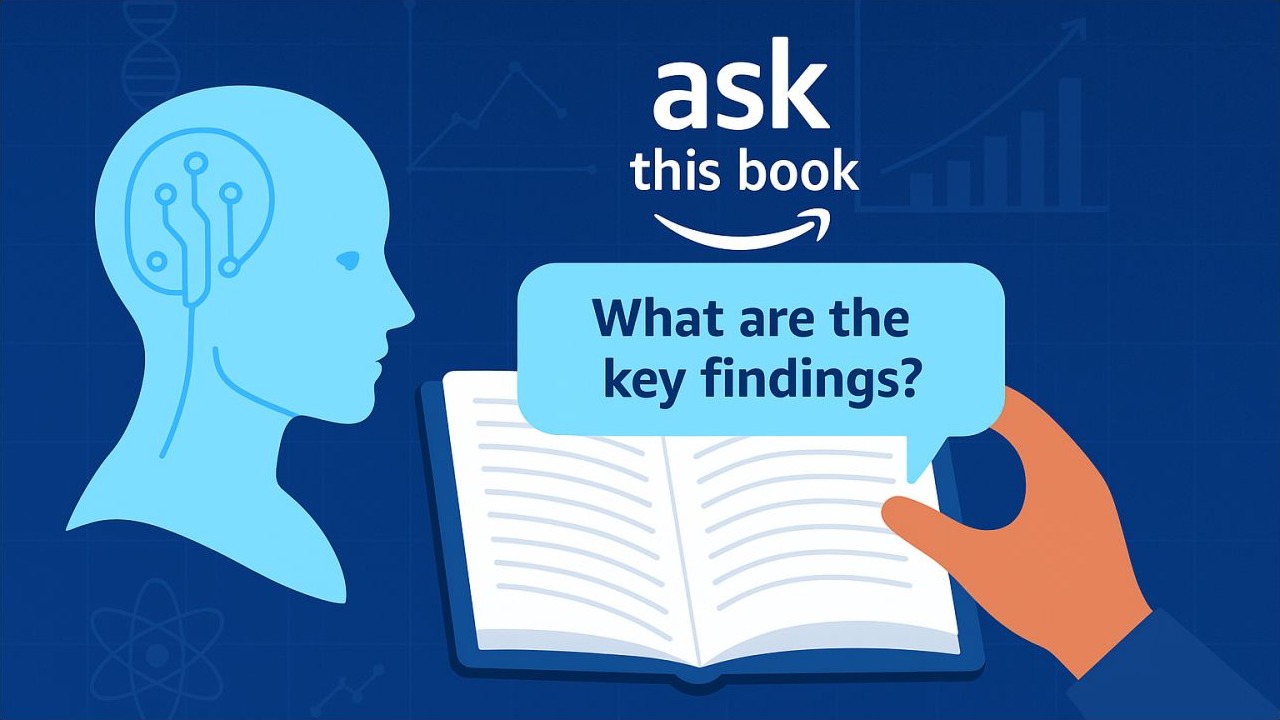
Amazon’s Ask This Book is a newly deployed in-book generative AI assistant embedded in the Kindle iOS app (rolling out to Kindle devices and Android in 2026). It allows readers to pose natural language questions about the book they’re reading and receive spoiler-filtered, contextual responses based on the text up to the reader’s current position. The Verge
At its core, this feature represents a transformative interface between a static text and dynamic human inquiry: users no longer need to break reading flow to search the web or external summaries; the book responds to questions about plot, character, themes, and even nuanced interpretive queries right in the reading environment. Digital Trends
How Ask This Book Operationalizes Data Extrapolation
From a data science and knowledge discovery perspective, Ask This Book can be understood as an open-book question-answering system tuned to the local context of a licensed dataset (the text you’ve read so far). This is conceptually similar to open-book question-answering (QA) architectures in NLP research, where a retriever locates relevant passages and a neural model synthesizes answers grounded in the available text. arXiv
Key aspects of this data extraction and discovery model include:
1. Contextual Retrieval + Synthesis When a user asks a question, the system effectively performs real-time retrieval within the licensed text and crafts an answer that maximizes relevance while minimizing spoilers. In effect, the book becomes a queryable semantic index of its own content.
2. User Query as a Catalyst The user’s question acts as a lens of attention that reorients the narrative information—what was once consumed linearly becomes a structured data set from which the AI draws out specific insights.
3. Local, Licensed Corpus vs. General Model Unlike generic search engines or large language models (LLMs) trained on broad corpora, this feature is designed to work within the scope of the purchased text, applying AI to your personal reading context rather than an external dataset. Digital Trends
Born of the Marriage of Human Inquiry and a Textual Knowledge Universe
This feature exemplifies the fusion of user-centric questioning and a high-dimensional knowledge universe embedded in text:
- Text as a Vector Space of Meaning The written book encodes relationships, concepts, narrative arcs, and argument structures. The AI transforms this latent structure into a navigable semantic space that responds to queries.
- User Query as Directed Search Where traditional reading requires the reader to infer and integrate meaning, Ask This Book externalizes part of that cognitive load by mapping natural language questions to relevant semantic segments.
- Knowledge Acceleration This feature accelerates discovery and invention by collapsing time and cognitive effort: rather than slowly piecing together understanding, users get immediate, localized answers that help reformulate hypotheses about the text. For research and creative work, this could enable rapid iteration on interpretation, hypothesis testing, or cross-textual comparison. Digital Trends
Benefits, Challenges, and Broader Implications
Benefits
- Deepens comprehension for dense nonfiction or complex narratives.
- Acts as a personalized reading assistant where the “index” becomes interactive, queryable knowledge.
- Keeps users engaged without forcing them to leave the interface. Digital Trends
Challenges
- Author and rights concerns: Authors and publishers cannot opt out, and the legal/ethical framework around AI interpreting copyrighted text remains unsettled. Writer Beware
- Model hallucination and fidelity: Answers might reflect generative inference rather than strict extraction—raising questions about accuracy and interpretive bias.
What This Feature Symbolizes in Larger AI-Driven Knowledge Work
Ask This Book is a microcosm of the broader shift in AI from passive information storage to interactive, adaptive knowledge interfaces. It reframes the fundamental relationship between:
- Static text → algorithmically accessible knowledge
- Human query → dynamic, contextual micro-answers
- Passive reading → active exploration
This points toward a future where knowledge work involves dialogue with texts rather than monologic consumption.
Concrete Next Step Toward Integration (Actionable for a LinkedIn Audience) Start applying this paradigm to your own research or creative practice: experiment with building queryable text corpora of your own—whether through APIs, custom GPTs, or commercial tools like Ask This Book. Treat key texts not as monolithic artifacts but as interactive data spaces, and document how query-driven insight shifts your reading, interpretation, and invention strategies.
If this sparks a latent desire in you—perhaps a tug toward reshaping how knowledge is negotiated between reader and text—what unanswered question about your own interaction with books or AI-mediated interpretation do you find yourself most curious to ask right now?
- Citations
- More
- indianexpress.com
- editorialge.com
- time.news
- geekwire.com
- aboutamazon.com
- kindle-chatgpt.com
- facebook.com
- pcworld.com
- reactormag.com
- completeaitraining.com
- publishersmarketplace.com
- reddit.com
- threads.com
- newsbytesapp.com
- yahoo.com
- engadget.com
- x.com
- slashdot.org
HASHTAG SUBJECT AREAS
Core AI & Knowledge Infrastructure
These anchor the post in AI and computational epistemology:
- #ArtificialIntelligence
- #GenerativeAI
- #AIinResearch
- #MachineLearning
- #LLMs
- #NeuralNetworks
Knowledge, Data, and Discovery
These emphasize books as datasets and accelerated insight:
- #KnowledgeDiscovery
- #DataExtrapolation
- #SemanticSearch
- #InformationRetrieval
- #KnowledgeGraphs
- #ComputationalKnowledge
Scientific Discovery & Invention
Best if you want to foreground non-fiction, STEM, and innovation:
- #ScientificDiscovery
- #AIinScience
- #ResearchAcceleration
- #DigitalScience
- #Invention
- #FutureOfResearch
Publishing, Reading, and the Future of Text
These connect the idea back to books, authors, and platforms:
- #FutureOfReading
- #DigitalPublishing
- #BooksAsData
- #InteractiveText
- #AIandPublishing