An exploration of a few of the papers and people reshaping artificial intelligence
In 2020, a team of researchers at OpenAI published a paper titled "Language Models are Few-Shot Learners." In it, the lead author, Tom Brown, along with thirty coauthors including Ilya Sutskever and Dario Amodei, introduced GPT-3, a language model with 175 billion parameters. The paper demonstrated that scaling up neural networks could lead to qualitatively different capabilities, including the ability to perform tasks without specific training.
No one could have predicted that this work would help ignite what some have called the third wave of artificial intelligence—a renaissance that would reshape industries, spark ethical debates in government chambers, and force a reevaluation of creativity itself. The paper stands as one of the most cited AI research works of the last five years, a touchstone for an industry and now era in perpetual and accelerating motion. This work seeks to take a little closer look at
I. The Foundation Model Revolution
Brown and his collaborators at OpenAI weren't the only researchers pursuing an ambitious vision of AI. Across the Atlantic, at DeepMind's London headquarters, another team led by John Jumper was tackling a problem that had bedeviled biologists for decades: protein folding.
The challenge—predicting the three-dimensional structure of proteins from their amino acid sequences—had been considered one of the grand challenges in computational biology. In 2021, Jumper and his colleagues published "Highly accurate protein structure prediction with AlphaFold," introducing a system that achieved unprecedented accuracy in the Critical Assessment of protein Structure Prediction (CASP) competition.
Demis Hassabis, co-founder and CEO of DeepMind, recognized the significance of this achievement early on. The work was so groundbreaking that in 2023, Hassabis and Jumper were awarded the prestigious Lasker Award, often considered a precursor to the Nobel Prize. Their approach fundamentally changed structural biology, with AlphaFold predicting the structures of nearly every known protein.
These two papers, seemingly unrelated in their domains, signaled a fundamental paradigm shift. Until this moment, artificial intelligence had largely followed a specialist model—systems designed for specific tasks like playing chess or filtering spam. But Brown and Jumper were among the vanguard architects of what Stanford researchers would later term "foundation models"—general-purpose systems trained on broad data that could be adapted to countless downstream tasks.
II. The Technical Convergence, US, International and Chinese Researchers
While GPT-3 was transforming language understanding, another team was reimagining computer vision. Alexey Dosovitskiy and colleagues at Google published "An Image is Worth 16x16 Words: Transformers for Image Recognition at Scale" in 2020, introducing the Vision Transformer (ViT).
The approach was deceptively simple: treat images not as continuous fields of pixels but as sequences of patches, analogous to words in a sentence. These could then be processed by the same transformer architecture that had powered language models like GPT-3. This paper brought transformers, which had revolutionized natural language processing, to the domain of computer vision.
Ze Liu and colleagues at Microsoft Research Asia extended this work with their "Swin Transformer" paper in 2021, which refined the approach to better capture the hierarchical structure of images. The Swin Transformer achieved state-of-the-art results across multiple vision tasks, demonstrating the adaptability of transformer architectures. The groundbreaking Swin Transformer paper emerged from a remarkable collaboration between Chinese academic talent and Microsoft's research powerhouse. Ze Liu, who began as a student at the University of Science and Technology of China before joining Microsoft Research Asia (MSRA) as an intern, led this effort alongside colleagues from Chinese universities and Microsoft researchers.
Liu's journey exemplifies the vibrant exchange between China's educational institutions and global tech research centers that has accelerated AI development worldwide in this period. His paper, which won the prestigious Marr Prize at ICCV 2021, marked a turning point in how computers process visual information. Before Swin Transformer, computer vision relied primarily on convolutional neural networks (CNNs), an approach that dominated for nearly a decade. Liu and his team successfully adapted transformer architecture—which had revolutionized language processing—to visual tasks, ultimately outperforming traditional methods across multiple benchmarks and applications.
By 2025, this work has proven transformative in ways that extend far beyond its technical achievements. The Swin Transformer architecture has become a fundamental building block in multimodal AI systems that seamlessly integrate vision, language, and other sensory inputs. Its influence extends to medical imaging, autonomous vehicles, augmented reality, and countless other applications where computers need to understand visual information. The paper also represents a broader shift in AI research dynamics. The collaboration between Chinese researchers at top universities and Microsoft Research Asia highlights how global talent flows have reshaped innovation networks from silicon valley to mainland China. This pattern of cross-pollination between academic institutions across Asia and major tech labs has accelerated, with researchers frequently moving between institutions and countries, creating a more globally distributed innovation ecosystem in AI.
What began as a technical contribution addressing specific challenges in computer vision has, by 2025, become part of the foundation for increasingly general-purpose AI systems that can perceive, understand, and generate across multiple domains simultaneously. The Swin Transformer's approach to efficiently processing visual information at different scales proved to be a crucial step toward the more unified, general AI architectures that now characterize the field.
At Google Brain, Jonathan Ho and his colleagues published "Denoising Diffusion Probabilistic Models" in 2020, adapting ideas from non-equilibrium thermodynamics to generate images of startling quality. This work laid the groundwork for the diffusion models that would later power text-to-image systems like DALL-E and Stable Diffusion and many other diffusion models whose effects are yet to be seen and potential as yet still fully unrealized.
For researchers who had been in the field long enough to remember its fragmented past—when computer vision, natural language processing, and speech recognition were entirely separate communities with their own methodologies and cranky back and forth movement—this convergence felt almost like unification in physics, different forces revealed as manifestations of the same underlying phenomenon.
III. The Research Ecosystem
When Demis Hassabis founded DeepMind in in Britain in 2010, he established its headquarters in London rather than Silicon Valley, a decision that reflected his belief in the importance of diverse perspectives in AI research and a trajectory which continues today in 2025 with many US AI companies expanding currently to the UK. Yet as our analysis of the most-cited papers reveals, geographic and institutional diversity remains elusive at the cutting edge of AI research until the later and more recent major intervention of DeepSeek.
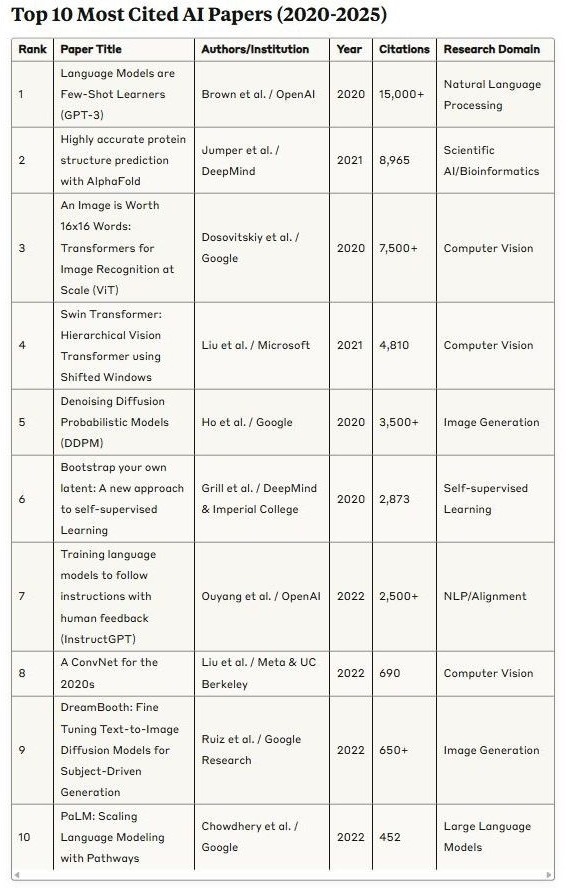
Nine of the ten most-cited papers emerged from corporate research labs, with Google and its subsidiaries claiming five, OpenAI two, Microsoft one, and Meta one. Only "Bootstrap Your Own Latent," a self-supervised learning approach, included an academic co-author from Imperial College London, and even that was in collaboration with DeepMind.
This concentration has complex implications. Corporate labs provide resources that academia often cannot—GPT-3's training alone cost millions in compute—but their dominance raises questions about who shapes AI's future. The universities are perhaps now more widely still recognized as behind or at least playing catch and this has had effects both good and ill both for industry and academia.
The field's increasing commercialization was exemplified by the 2022 paper "Training Language Models to Follow Instructions with Human Feedback" by Long Ouyang and colleagues at OpenAI. This research detailed how reinforcement learning from human feedback could align language models more closely with human intent, forming the basis for ChatGPT, which precipitated OpenAI's rapid commercial ascent.
Geoffrey Hinton, often called the "godfather of deep learning" and winner of the 2018 Turing Award (often considered the Nobel Prize of computing), worked at Google until 2023, when he left to speak more freely about AI risks. His departure highlighted the growing tensions between commercial interests and broader societal concerns about AI development.
IV. Cyclical Innovation
A curious phenomenon visible in our analysis of top papers in the last five yearss is the cyclical nature of innovation in AI. Just as ConvNets replaced fully-connected networks before themselves being displaced by transformers and a famous earlier paper called 'Attention is All You Need', Meta AI and UC Berkeley researchers reclaimed the ConvNet's relevance back with their 2022 paper "A ConvNet for the 2020s," modernizing the architecture for contemporary challenges.
This cyclicality extends beyond architecture choices. The diffusion models described in Ho's paper displaced GANs (Generative Adversarial Networks) as the dominant image generation approach, despite both being introduced years apart by Ian Goodfellow, now at DeepMind after stints at Google, Apple, and OpenAI. Goodfellow's career itself traces the winding path of AI innovation—and the increasingly revolving door between a handful of top institutions.
V. The Alignment Turn
At OpenAI, CEO Sam Altman has increasingly focused on what's termed "the alignment problem"—ensuring AI systems do what humans intend without unintended consequences. This focus is embodied in the paper "Training Language Models to Follow Instructions with Human Feedback" by Ouyang and colleagues, which has become foundational to the development of assistive AI systems like ChatGPT in the period 2021-2024.
The paper describes how reinforcement learning from human feedback can tune language models to better align with human preferences, addressing a core challenge: models trained only to predict text often generate harmful, misleading, or simply unhelpful content.
This pivot toward alignment—making AI systems that follow human intent and embody human values—represents perhaps the most significant meta-trend across these papers. Even techniques not explicitly developed for alignment purposes, like the personalization approach in "DreamBooth: Fine Tuning Text-to-Image Diffusion Models for Subject-Driven Generation" by Ruiz and colleagues at Google Research, can be understood as efforts to make AI systems more responsive to specific human contexts and needs.
The field's increasing focus on alignment coincides with growing public and regulatory attention. As these systems have emerged from research labs into products used by millions, questions of bias, safety, and control have moved from theoretical concerns to practical challenges requiring immediate solutions.
VI. AI's Scientific Frontier
In Cambridge, England, at the Laboratory of Molecular Biology, biologists now regularly use AlphaFold to visualize protein structures that had previously resisted analysis. This represents a profound shift: AI moving beyond optimizing digital experiences to addressing fundamental scientific questions. New systems in 2025 with names 'like Deep Mind's 'Co-Scientist' continue this trend generalizing the domain speciality and AI'ifying and enhancing the scientific method for the entire scientific research process
AlphaFold's earlier breakthrough—producing protein structure predictions accurate enough for experimental biologists to use in their work—signals AI's expansion into scientific discovery itself. The system has already helped researchers understand proteins involved in neurodegenerative diseases and antibiotic resistance and the methodologies continue and expand into other domains.
Pushmeet Kohli, who leads DeepMind's science team, has emphasized how AI doesn't just automate what humans can already do—it extends the boundaries of human knowledge. This scientific turn is evident in other highly-cited work including papers on AI for climate modeling, drug discovery, and materials science.
As we reflect on these six trends across the most influential AI papers of recent years, a complex portrait emerges—of a field simultaneously more unified in its methods and more concentrated in its power centers, more capable in its applications and more concerned with their implications.
The papers themselves, with their dense equations and technical language, might seem abstract, but they represent profoundly human endeavors: to understand, to create, to solve problems that have long resisted solution. Beyond their citations and technical innovations, they mark moments when artificial intelligence began to matter in new ways—not just as a subject of research, but as a force reshaping our understanding of language, biology, creativity, and perhaps eventually, ourselves.
Full Citations
Brown, T.B., Mann, B., Ryder, N., Subbiah, M., Kaplan, J.D., Dhariwal, P., Neelakantan, A., Shyam, P., Sastry, G., Askell, A., Agarwal, S., Herbert-Voss, A., Krueger, G., Henighan, T., Child, R., Ramesh, A., Ziegler, D.M., Wu, J., Winter, C., Hesse, C., Chen, M., Sigler, E., Litwin, M., Gray, S., Chess, B., Clark, J., Berner, C., McCandlish, S., Radford, A., Sutskever, I., & Amodei, D. (2020). Language Models are Few-Shot Learners. Advances in Neural Information Processing Systems, 33, 1877-1901.
Jumper, J., Evans, R., Pritzel, A., Green, T., Figurnov, M., Ronneberger, O., Tunyasuvunakool, K., Bates, R., Žídek, A., Potapenko, A., Bridgland, A., Meyer, C., Kohl, S.A.A., Ballard, A.J., Cowie, A., Romera-Paredes, B., Nikolov, S., Jain, R., Adler, J., Back, T., Petersen, S., Reiman, D., Clancy, E., Zielinski, M., Steinegger, M., Pacholska, M., Berghammer, T., Silver, D., Vinyals, O., Senior, A.W., Kavukcuoglu, K., Kohli, P., & Hassabis, D. (2021). Highly accurate protein structure prediction with AlphaFold. Nature, 596(7873), 583-589.
Dosovitskiy, A., Beyer, L., Kolesnikov, A., Weissenborn, D., Zhai, X., Unterthiner, T., Dehghani, M., Minderer, M., Heigold, G., Gelly, S., Uszkoreit, J., & Houlsby, N. (2021). An Image is Worth 16x16 Words: Transformers for Image Recognition at Scale. International Conference on Learning Representations (ICLR).
Liu, Z., Lin, Y., Cao, Y., Hu, H., Wei, Y., Zhang, Z., Lin, S., & Guo, B. (2021). Swin Transformer: Hierarchical Vision Transformer using Shifted Windows. Proceedings of the IEEE/CVF International Conference on Computer Vision (ICCV), 10012-10022.
Ho, J., Jain, A., & Abbeel, P. (2020). Denoising Diffusion Probabilistic Models. Advances in Neural Information Processing Systems, 33, 6840-6851.
Grill, J.-B., Strub, F., Altché, F., Tallec, C., Richemond, P.H., Buchatskaya, E., Doersch, C., Pires, B.A., Guo, Z.D., Azar, M.G., Piot, B., Kavukcuoglu, K., Munos, R., & Valko, M. (2020). Bootstrap Your Own Latent: A New Approach to Self-Supervised Learning. Advances in Neural Information Processing Systems, 33, 21271-21284.
Ouyang, L., Wu, J., Jiang, X., Almeida, D., Wainwright, C.L., Mishkin, P., Zhang, C., Agarwal, S., Slama, K., Ray, A., Schulman, J., Hilton, J., Kelton, F., Miller, L., Simens, M., Askell, A., Welinder, P., Christiano, P., Leike, J., & Lowe, R. (2022). Training Language Models to Follow Instructions with Human Feedback. Advances in Neural Information Processing Systems, 35, 27730-27744.
Liu, Z., Mao, H., Wu, C., Feichtenhofer, C., Darrell, T., & Xie, S. (2022). A ConvNet for the 2020s. Proceedings of the IEEE/CVF Conference on Computer Vision and Pattern Recognition (CVPR), 11976-11986.
Ruiz, N., Li, Y., Jampani, V., Pritch, Y., Rubinstein, M., & Aberman, K. (2022). DreamBooth: Fine Tuning Text-to-Image Diffusion Models for Subject-Driven Generation. Proceedings of the IEEE/CVF Conference on Computer Vision and Pattern Recognition (CVPR), 24208-24218.
Chowdhery, A., Narang, S., Devlin, J., Bosma, M., Mishra, G., Roberts, A., Barham, P., Chung, H.W., Sutton, C., Gehrmann, S., et al. (2022). PaLM: Scaling Language Modeling with Pathways. arXiv preprint arXiv:2204.02311.