What the Most-Cited Papers Really Tell Us About 21st-Century Scientific Research
In which the most consequential scientific breakthroughs of our time turn out not to be breakthroughs at all
I. THE CURIOUS CASE OF THE MISSING DISCOVERIES
On a crisp April morning in 2025, Nature magazine published an analysis that might have rattled the scientific establishment, had anyone been paying attention. The journal's news team had compiled the twenty-five most-cited papers of the 21st century—those research articles that scholars reference most frequently in their own work, the intellectual landmarks of our time. The list contained not a single one of the century's celebrated scientific breakthroughs.
The first mRNA vaccines? Absent. CRISPR gene-editing techniques? Nowhere to be found. The Higgs boson and gravitational waves—those cosmic confirmations that shook physics to its foundations? They didn't make the cut.
Instead, commanding the heights of our citation economy is a 2016 paper from Microsoft Research describing "deep residual learning networks," a technique that enabled artificial neural networks to contain many more layers than previously possible. With citations ranging from 103,756 to 254,074 (depending on which database one consults), this practical advancement in machine learning towers over what many would consider more fundamental discoveries.
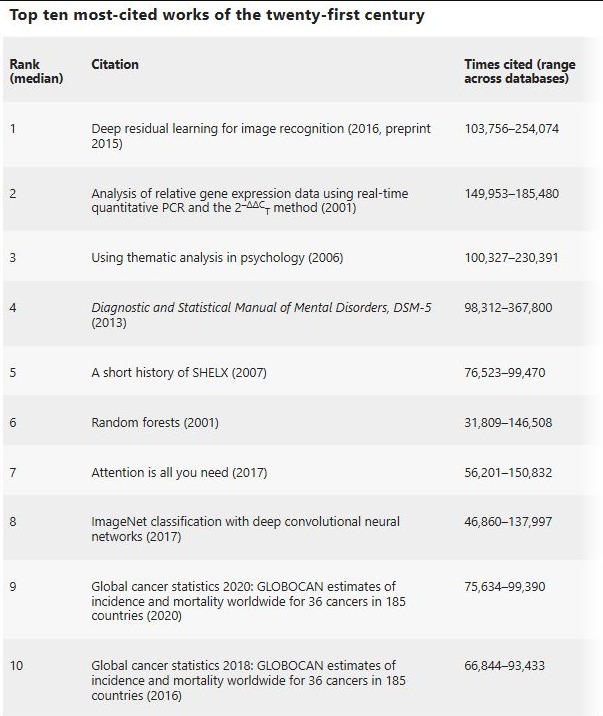
Most scientists will say they value methods, theory and empirical discoveries but in practice as the top ten list above shows, the methods get cited more. This peculiar reality—that the scientific community's collective footnoting habits favor useful techniques over groundbreaking insights—reveals something profound about how modern knowledge actually functions. The citation patterns map not what we nominally value, but what we genuinely depend upon.
II. TOOLS OVER BREAKTHROUGHS: THE PRACTICAL TURN
The resident intellectual celebrities of our century aren't the isolated geniuses making singular discoveries in hidden laboratories. They're the creators of workhorses—those papers that describe methods, software, protocols, and standards used by thousands of other researchers every day.
Consider the second-most-cited paper of the century: a 2001 article introducing the catchily named "2-ΔΔCT method" for quantifying gene expression in PCR experiments. Its origin story illuminates the curiously mundane nature of scientific fame. When pharmaceutical scientist Thomas Schmittgen submitted a paper using equations from a technical manual, a reviewer objected to citing a mere user guide. So Schmittgen contacted the manual's author, and together they published a paper that other scientists could reference—which they've done over 185,000 times.
"It wasn't written to be famous," Schmittgen told Nature. "It was written to be cited."
This pattern recurs throughout the list. At number five sits "A Short History of SHELX," a paper by British chemist George Sheldrick describing software he developed for analyzing crystal structures. Sheldrick started writing these programs "as a hobby" in the 1970s, yet by suggesting researchers cite his 2008 review when using any of his software, he accumulated 70,000-90,000 citations.
Even in psychology, traditionally resistant to quantification, the third-most-cited paper is Virginia Braun and Victoria Clarke's guide to "thematic analysis"—a qualitative research method they formalized in 2006 after noticing students lacked clear guidelines for the methodology. When the paper began accumulating citations far beyond their usual work on gender and sexuality, they were astonished. "It has a life of its own," Clarke noted. "It was entirely accidental."
What unites these citation behemoths is that they enable other researchers to work—they are the scientific equivalent of core foundational infrastructure. In an era drowning in data, papers that help organize, analyze, and standardize information become the most valuable currency.
III. THE DATABASE DIVERGENCE: HOW WE COUNT MATTERS
A curious fact also emerges when examining citation counts across databases: the distinctly low brow Google Scholar consistently shows 40-60% more citations than curated academic indices like the highly reputable and 'expensive' proprietary databases, Web of Science or Scopus. For ResNet, the differential is stark: approximately 367,000 citations in Google Scholar versus 162,000 in Web of Science.
This isn't merely a technical discrepancy. It reveals what we might call the "applied shadow" of science—the vast ecosystem of implementation that exists on the web and physically in labs around the glob and beyond the purviews of traditional (this paper journals) academic publishing. Google Scholar captures citations in preprints, technical reports, patents, and various gray literature that traditional indices perhaps even purposefully miss. The empire has its ways of striking back.
The implications extend beyond mere scorekeeping. Tenure committees, grant reviewers, and prize panels that rely on one or two qualified citation indexes risk systematically undervaluing work with broad practical impact. A database choice becomes, inadvertently, a value judgment about what kinds of influence matter.
IV. THE RISE OF THE HIVE MIND
The lone genius yielding to team science isn't a novel observation. Yet the citation giants provide quantitative evidence of this shift: the average author count across these papers ranges from five to ten people, spanning multiple institutions and often countries (See bibliography).
The DSM-5 psychiatric manual (number four on the list) represents perhaps the extreme of this collaborative trend—developed by numerous committees integrating perspectives from multiple countries. Even AI papers, often associated with tech giants like Microsoft and Google, typically have four or more authors.
This collaborative global turn makes intuitive sense in an era of increasing specialization and lighting speed globalization enabled by print print archives and the good 'old' world wide web. No single researcher possesses the statistical expertise, domain knowledge, programming skills, and theoretical background necessary to produce cutting-edge work across disciplines. Science has become, like much else in our networked age, a team sport and in some areas highlighted by the list (think DSM-5) a global medical bureaucracy.
V. THE CONVERGENCE ZONES
Where disciplinary boundaries blur, citation counts soar. The most dramatic example is the AI-biology interface, where computational techniques developed for one domain find unexpected application in another.
The same Transformer architecture that powers ChatGPT ("Attention Is All You Need," number seven on the list) now enables protein structure prediction. ResNet models underpin medical imaging analysis. The Random Forests algorithm (number six) finds applications in ecology, finance, and bioinformatics.
These cross-pollinations reveal that traditional academic departments still lost in 19th century compartmentalized models (think your high school trifecta: Chemistry, Biology, Physics)may be poorly structured for generating tomorrow's most influential work. The most fertile intellectual terrain appears to lie at the boundaries—where tools from one field solve longstanding problems in another.
As if to underscore this point, the GLOBOCAN cancer statistics reports (numbers nine and ten)—which track cancer incidence and mortality across 185 countries—represent a convergence of epidemiology, public health policy, massive data gathering and computational modeling.
VI. THE DATA-THEORY INVERSION
A philosophical shift underlies these citation patterns: the ascendance of data over theory, methods over paradigms. Modern science increasingly values:
- Concrete tools over abstract frameworks
- Standardized protocols over conceptual breakthroughs
- Open resources over proprietary systems
This pragmatic turn makes sense in an era of unprecedented data volume. When faced with terabytes of information, researchers need reliable ways to process it more than they need new ontological categories.
Even in psychology, Braun and Clarke's thematic analysis paper provided practical guidelines for analyzing qualitative data when such methods struggled for legitimacy. Its massive citation count reflects not just methodological utility but also a disciplinary identity crisis resolved through standardized approaches.
VII. THE PLATFORM PERSPECTIVE
Perhaps the most illuminating way to understand these citation patterns is to view modern science as a platform economy. The most-cited papers aren't final products of knowledge but enabling technologies—the infrastructure upon which other knowledge is built.
ResNet and Transformer models provide algorithmic foundations for countless AI applications. Nobel Prize winner for Physics nonetheless, Geoffrey Hinton is well-represented here. The 2-ΔΔCT method and SHELX software enable experimental results across biology and chemistry. The DSM-5 creates a common language for mental health research and treatment.
In this view, citations measure not just intellectual influence but functional dependency. They map how knowledge actually works—not as a collection of isolated discoveries but as an interdependent ecosystem where certain nodes provide essential services to many others.
VIII. THE HISTORICAL CONTRAST
If the 19th century was about mapping, compartmentalizing and boxing up the physical world for classification schemas and the 20th about splitting the atom and the gene, the 21st is about orchestrating information flows and interdisciplinary synthesis at planetary scale. This means workhorse methodologies and tool sets. The citation giants in the 21st century so far aren't revolutionary paradigm shifts but evolutionary adaptations to an environment of abundant but still quite disorganized, unaggregated and unsysthesized data.
This shift aligns with broader cultural trends: the valorization of platforms over products, networks over nodes, infrastructure over individual achievement. The scientific enterprise, despite its distinctive norms and practices, reflects the same structural forces reshaping other domains of modern life.
Yet something profound may be lost in this transition. The papers that transformed how we understand reality—Einstein's relativity, Watson and Crick's DNA structure, the recent detection of gravitational waves—often fade from citation counts precisely because they become so fundamental that they no longer require explicit acknowledgment. They graduate from citations to textbooks, becoming part of what philosophers call the "background knowledge" that scientists take for granted and frankly are much lower on the citation totem pole for work being done and methods being utilized on a daily basis.
As Oliver Lowry, author of the most-cited paper of all time (a 1951 protein measurement technique), once wrote: "Although I really know it is not a great paper... I secretly get a kick out of the response." The greatest scientific achievements of our time may share a similar fate—too important to be continuously cited, too fundamental to require regular acknowledgment.
IX. CONCLUSION: THE CHANGING ARCHITECTURE OF KNOWLEDGE
What these citation patterns ultimately reveal is not a failure of values but a change in how knowledge functions and flows. The most-cited papers create architecture and scaffolding and methodology rather than contents—they build the platforms, methods, and standards that others can follow and structure how we know and get answers rather than what we know.
This shift toward infrastructure over insight, collaboration over individual genius, and cross-disciplinary tools over domain-specific discoveries reflects a response to the particular challenges of 21st-century science: overwhelming data volume, increasing specialization, and problems too complex for any single discipline to solve alone but patiently awaiting interdisciplinary and multidisciplinary not to mention the staid ivy league institutions that have been talking the talk of interdisciplinarity for the past 30 years but like their boxes, compartments and departments and divisions thank you.
Understanding these structural changes matters not just for scientists but for anyone trying to grasp how knowledge works in the modern world. The citation giants are less intellectual revolutions than they are the scaffolding of our collective intelligence—less visible than breakthrough discoveries but arguably more consequential for how science actually progresses day by day.
In a century defined by information abundance, organizing knowledge has become as important as discovering it. The methods, standards, and tools that help thousands of researchers navigate this complexity may not make headlines, but they create the conditions under which future breakthroughs become possible.
Bibliography
American Psychiatric Association. (2013). Diagnostic and statistical manual of mental disorders (5th ed.). American Psychiatric Publishing.
Braun, V., & Clarke, V. (2006). Using thematic analysis in psychology. Qualitative Research in Psychology, 3(2), 77-101.
Breiman, L. (2001). Random forests. Machine Learning, 45(1), 5-32.
Bray, F., Ferlay, J., Soerjomataram, I., Siegel, R. L., Torre, L. A., & Jemal, A. (2018). Global cancer statistics 2018: GLOBOCAN estimates of incidence and mortality worldwide for 36 cancers in 185 countries. CA: A Cancer Journal for Clinicians, 68(6), 394-424.
He, K., Zhang, X., Ren, S., & Sun, J. (2016). Deep residual learning for image recognition. Proceedings of the IEEE Conference on Computer Vision and Pattern Recognition, 770-778.
Hutson, M. (2025). Exclusive: The most-cited papers of the twenty-first century. Nature, 610, 414-418. https://www.nature.com/articles/d41586-025-01125-9
Krizhevsky, A., Sutskever, I., & Hinton, G. E. (2012). ImageNet classification with deep convolutional neural networks. Advances in Neural Information Processing Systems, 25, 1097-1105.
Livak, K. J., & Schmittgen, T. D. (2001). Analysis of relative gene expression data using real-time quantitative PCR and the 2(-Delta Delta C(T)) Method. Methods, 25(4), 402-408.
Sheldrick, G. M. (2008). A short history of SHELX. Acta Crystallographica Section A: Foundations of Crystallography, 64(1), 112-122.
Sung, H., Ferlay, J., Siegel, R. L., Laversanne, M., Soerjomataram, I., Jemal, A., & Bray, F. (2021). Global cancer statistics 2020: GLOBOCAN estimates of incidence and mortality worldwide for 36 cancers in 185 countries. CA: A Cancer Journal for Clinicians, 71(3), 209-249.
Vaswani, A., Shazeer, N., Parmar, N., Uszkoreit, J., Jones, L., Gomez, A. N., Kaiser, Ł., & Polosukhin, I. (2017). Attention is all you need. Advances in Neural Information Processing Systems, 30, 5998-6008.