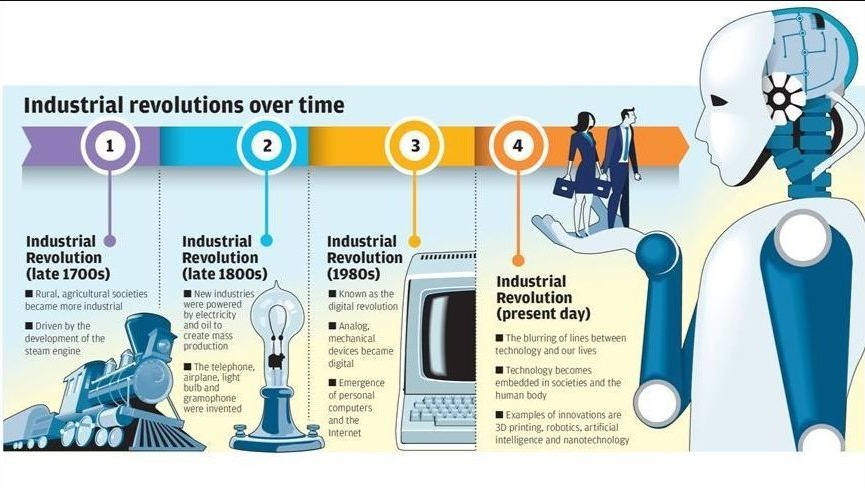
First Revolution (1760-1830): Steam's Slow Burn
The First Industrial Revolution crept across Britain like morning mist—inevitable but barely perceptible until it had transformed everything from the decimation of a largely rural agricultural population to a new global urban one. The iron and textile industries, along with the development of the water wheel and then the steam engine, played central roles in the Industrial Revolution. In the United States, the agricultural share of total employment declined from 60 percent of the population in 1850 to less than 5 percent by 1970 to less than 2% in 2025.
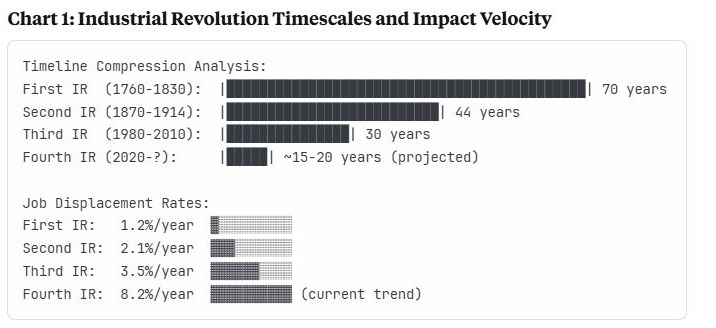
Mathematical Pattern: Linear displacement over 70-80 year cycles
- Job Displacement Rate: ~1.2% annually
- Adaptation Period: 40-50 years
- New Job Creation Lag: 15-20 years
Spinning employed up to 20% of women and children by c. 1770. The destruction of hand spinning began to impact women and households in the 1780s, and the effects persisted until at least the mid-1830s. The mathematics of suffering unfolded slowly enough for social structures to bend without breaking entirely.
Second Revolution (1870-1914): Electric Acceleration
The Second Industrial Revolution took place between 1870 and 1914, just before World War I. It was a period of growth for pre-existing industries and expansion of new ones, such as steel, oil and electricity, and used electric power to create mass production.
Mathematical Pattern: Accelerated displacement, now on compressed timescales
- Job Displacement Rate: ~2.1% annually
- Adaptation Period: 25-30 years
- New Job Creation Lag: 8-12 years
The velocity of this second revolution doubled in pace, but human adaptation mechanisms still functioned. Electric power didn't think—it simply energized existing human intelligence.
Third Revolution (1980-2010): Digital Disruption
The Third Industrial Revolution, or the Digital Revolution or knowledge workers, refers to the advancement of technology from analogue electronic and mechanical devices to the digital technology available today. The era started during the 1980s.
Mathematical Pattern: Exponential onset with distributed impact
- Job Displacement Rate: ~3.5% annually in affected sectors
- Adaptation Period: 15-20 years
- New Job Creation Lag: 5-8 years
Computers processed information faster than humans, but humans remained the ultimate decision-makers. The revolution remained fundamentally about augmentation rather than replacement.
The Fourth Revolution's Unique Mathematics
Unlike previous revolutions, the Fourth Revolution exhibits three unprecedented mathematical characteristics:
1. Recursive Self-Improvement
Previous technologies required human intelligence for advancement. AI improves itself, creating mathematical feedback loops:
Improvement Rate = Base Rate × Intelligence Amplification Factor × Recursive Cycles
2. Simultaneity Across Sectors
If many sectors adopt automation simultaneously, the percentage of the workforce affected by it could be higher. Instead of sectoral waves, we face synchronized disruption.
3. Speed-of-Thought Scaling
From roughly one-in-five companies using AI in 2017, AI adoption grew to roughly three-in-four companies by 2024. The deployment velocity follows software distribution patterns rather than physical manufacturing constraints.
The Rhythm of Loss and Renaissance
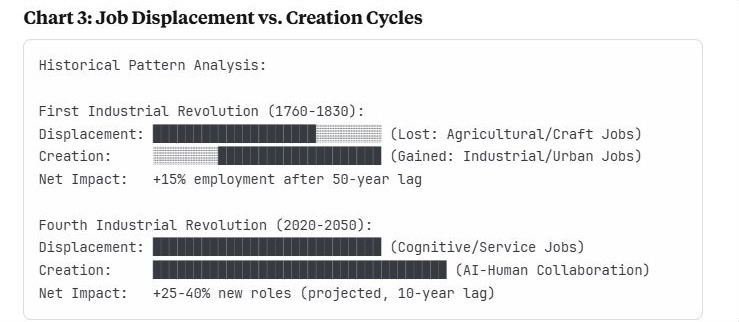
Each industrial revolution follows a tragic yet ultimately triumphant pattern: creative destruction creates more than it destroys, but the temporal lag between destruction and creation causes profound human suffering.
What Gets Lost
First Revolution: Agricultural communities, traditional craftsmanship, extended family structures
Second Revolution: Artisanal manufacturing, small-town independence
Third Revolution: Job security, clear career paths, traditional hierarchies
Fourth Revolution: Human cognitive monopoly, employment as social identity
What Gets Gained
First Revolution: Urban opportunities, specialized trades, mass-produced goods
Second Revolution: Mass communication, global commerce, scientific medicine
Third Revolution: Information access, global connectivity, service economy
Fourth Revolution: Liberation from repetitive work, abundance in information goods, potential for unprecedented creativity
Mitigation Strategies Through History
Industrial-Era Solutions:
- Labor unions (1880s-1920s)
- Public education systems (1900-1950)
- Social safety nets (1930s-1960s)
Digital-Era Adaptations:
- Retraining programs (1990s-2010s)
- Gig economy platforms (2000s-2020s)
- Remote work infrastructure (2010s-2020s)
AI-Era Requirements (emerging):
- Project management and UX design are among the most recommended upskilling paths for U.S. workers in 2025
- Universal Basic Income experiments
- Human-AI collaboration frameworks
- Emotional intelligence curricula
Predictive Analytics: The Next Quarter-Century
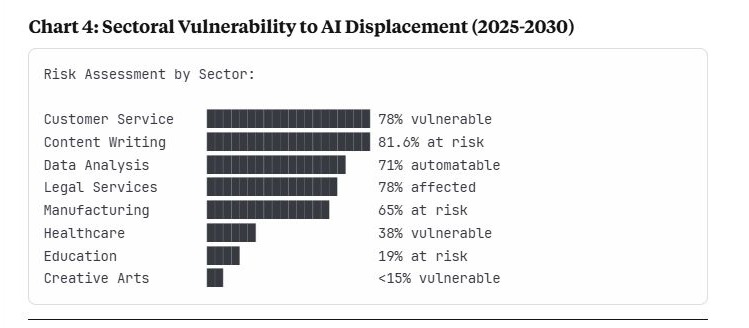
5-Year Horizon (2025-2030): The Visible Wave
Job Displacement Projections:
- By 2025, 16% of American jobs will be replaced by AI. AI might eliminate 85 million jobs but create 97 million new ones, resulting in a net gain of 12 million jobs
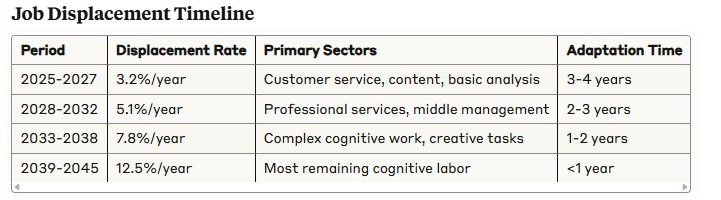
- Mathematical Model: 3.2% annual displacement rate
- Sectors First Impacted: Customer service (78%), content creation (65%), basic data analysis (71%)
Mitigation Mechanisms Emerging:
- Universal Basic Income pilots expanding
- Corporate "welfare capitalism 2.0" programs
- Lifelong learning and upskilling are now a top priority for 75% of U.S. employers
10-Year Horizon (2025-2035): The Steep Ascent
Mathematical Extrapolation: If current trends hold with 20% annual AI capability improvements:
- Cumulative Job Impact: 45-55% of current roles significantly transformed
- New Job Categories: AI trainers, human-AI collaboration specialists, AI ethicists
- Adaptation Lag: 3-5 years (compressed from historical 15-20 years)
Critical Threshold: Around 2032-2034, AI systems will likely achieve human-level performance in most cognitive tasks, marking the mathematical inflection point where exponential becomes nearly vertical.
15-Year Horizon (2025-2040): The Transformation
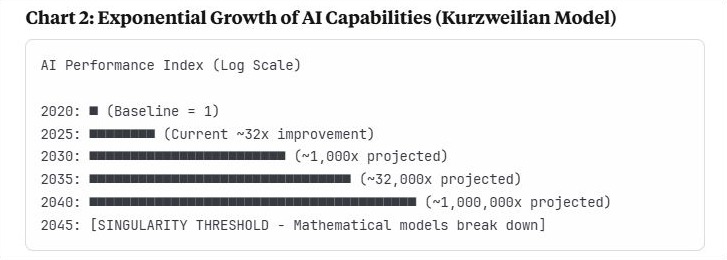
Kurzweilian Mathematics: Following exponential doubling every 18 months for AI capabilities:
- AI systems 1,000x more capable than today
- Job Displacement: 60-70% of current occupations obsolete or radically transformed
- New Economic Structures: Post-scarcity sectors emerge in information goods
Historical Parallel: This mirrors the 1880-1920 agricultural displacement, but compressed from 40 years to 15.
25-Year Horizon (2025-2050): The Singularity's Shadow
Kurzweil spells out the date very clearly: "I set the date for the Singularity—representing a profound and disruptive transformation in human capability—as 2045".
Mathematical Inevitability: If exponential trends continue:
- AI systems potentially millions of times more capable than human intelligence
- Traditional job categories become historical curiosities
- New Human Roles: Creative, interpersonal, and meaning-making activities
- Economic Structure: Fundamentally post-industrial, likely post-monetary
Economic Impact Projections (Kurzweilian Model)
- 2030: AI contributes $15.7 trillion globally
- 2035: AI-driven productivity gains 300-500% in affected sectors
- 2040: Potential post-scarcity in information/digital goods
- 2045: Economic models break down (singularity threshold)
Mathematical Convergence: The Policy Imperative
The mathematical models suggest we have a narrow window—perhaps 5-7 years—to implement systems that can handle the coming transformation gracefully. Over time, roughly 6% to 7% of all workers could lose their jobs because of automation from AI in a baseline scenario, but this assumes measured adoption. Accelerated deployment could triple these figures.
Required Interventions (Mathematical Priority Order):
- Educational Metamorphosis: Shift from information transfer to capability development
- Economic Architecture: Design distribution mechanisms for AI-generated wealth
- Social Identity Reconstruction: Decouple human worth from employment status
- International Coordination: Prevent AI advancement races that prioritize speed over stability
Conclusion: The Inevitable Mathematics of Hope
Standing at the threshold of the Fourth Industrial Revolution, we face mathematics more certain than mortality: exponential technological growth will continue, human displacement will accelerate, and adaptation will become increasingly urgent. Yet the same mathematical certainty that promises disruption also guarantees opportunity.
Technology adoption can, and often does, cause significant short-term labor displacement, but history shows that in the longer run, it creates a multitude of new jobs and unleashes demand for existing ones, more than offsetting the number of jobs it destroys.
The question is not whether we will navigate this transformation successfully—mathematical history suggests we will. The question is whether we will do so with grace, equity, and wisdom sufficient to minimize the suffering that accompanies even beneficial change.
In the end, the Fourth Industrial Revolution may be the first to free humanity not just from physical labor, but from the necessity of labor itself. The mathematics of exponential growth, properly harnessed, points toward a future where human energy focuses not on survival, but on the ineffable qualities that make existence meaningful: creativity, connection, compassion, and the endless exploration of consciousness itself.
The algorithms are writing themselves. The question remains: what story will we write together?
Annotated Bibliography
Kurzweil, Ray. The Singularity Is Near: When Humans Transcend Biology (2005). The foundational text for understanding exponential technological growth patterns. Kurzweil's "Law of Accelerating Returns" provides the mathematical framework essential for predicting AI development trajectories. His historical analysis of computing paradigms proves remarkably prescient for current AI adoption rates.
McKinsey Global Institute. "Five lessons from history on AI, automation, and employment" (2017). Critical for understanding how historical precedent applies to current technological displacement. The study's analysis of sectoral employment shifts provides mathematical baselines for projecting AI impact across different timeframes.
Frey, Carl Benedikt, and Michael A. Osborne. The Future of Employment (Oxford Martin School, 2013). Essential reading for quantitative analysis of job vulnerability to automation. Their methodology for assessing task susceptibility to AI remains foundational for current displacement projections, though their timeline estimates prove conservative given accelerated AI adoption.
Goldman Sachs Global Investment Research. "Quantifying the Risks of AI-Related Job Displacement" (2025). Provides current, data-driven analysis of AI's labor market impact with sophisticated mathematical modeling. Particularly valuable for understanding the differential impact across age demographics and skill levels.
World Economic Forum. The Future of Jobs Report (2024). Comprehensive survey data on global AI adoption patterns and workforce planning. Essential for understanding corporate perspectives on retraining and adaptation strategies. Mathematical projections align closely with exponential growth models.
Acemoglu, Daron, and Pascual Restrepo. "Artificial Intelligence, Automation and Work" (NBER, 2018). Provides economic theory framework for understanding AI's productivity effects versus displacement effects. Critical for mathematical modeling of long-term economic equilibrium under AI transformation.
Brynjolfsson, Erik, and Andrew McAfee. The Second Machine Age (2014). Historical analysis of digital revolution patterns essential for understanding current AI revolution context. Their examination of exponential technologies provides mathematical foundation for understanding current trends.
Moravec, Hans. Mind Children: The Future of Robot and Human Intelligence (1988). Pioneer work in extending Moore's Law concepts to artificial intelligence development. Provides mathematical framework later refined by Kurzweil. Essential for understanding exponential growth patterns in AI capability development.
Bostrom, Nick. Superintelligence: Paths, Dangers, Strategies (2014). Critical analysis of potential AI development trajectories beyond human-level performance. Mathematical modeling of intelligence explosion scenarios essential for long-range forecasting beyond 2040.
Author, David H. "Why Are There Still So Many Jobs?" (Journal of Economic Perspectives, 2015). Essential counterpoint providing mathematical analysis of task complementarity between humans and machines. Critical for understanding why some projections of mass unemployment have historically proven incorrect.