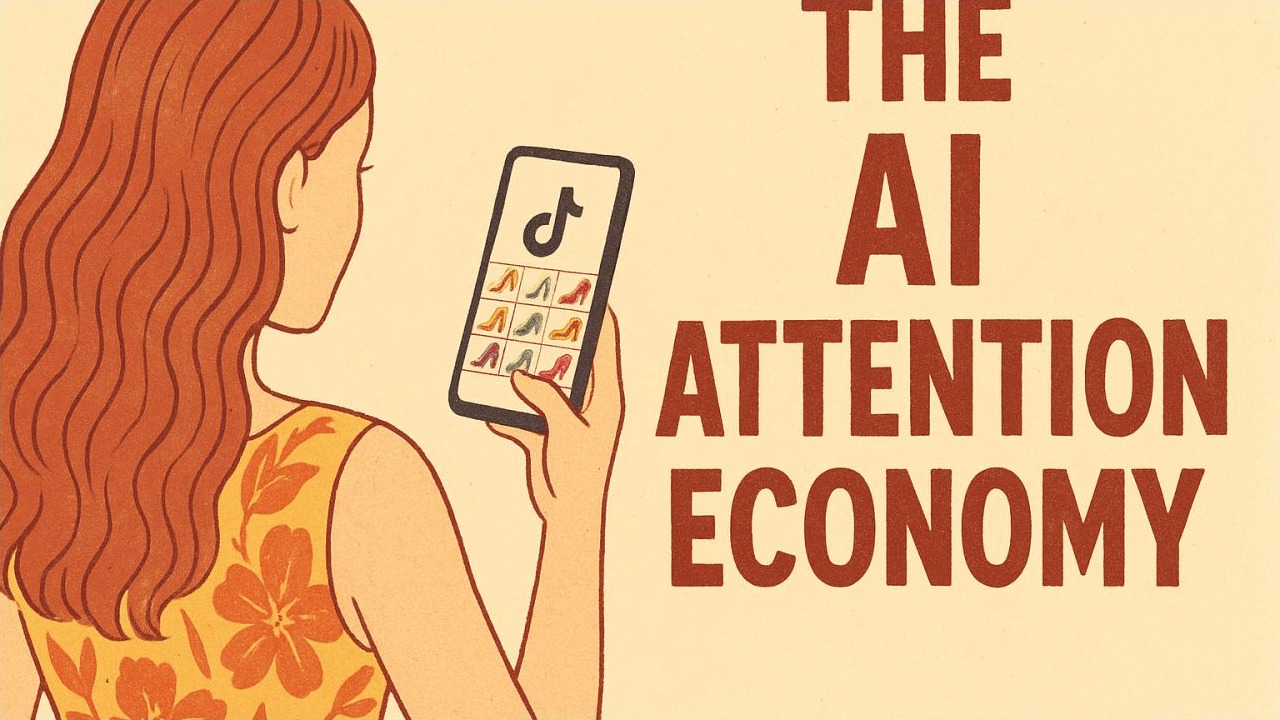
The woman sitting next to Kyla Scanlon on the six-hour flight to New York City never once looked up. For the entire journey across the continental United States, her eyes remained fixed on her phone, scrolling through an endless stream of TikTok videos—a cascade of get-ready-with-me tutorials, each lasting precisely the length of a shallow breath, each face filtered into algorithmic perfection. Scanlon, a twenty-five-year-old economist who has emerged as Generation Z's leading theorist of what she calls the "attention economy," watched this performance of modern consciousness with the fascination of an anthropologist discovering a new ritual.
"She wasn't consuming content so much as being consumed by it," Scanlon would later reflect. This accidental ethnography at thirty thousand feet captures something essential about our moment: we have moved from an economy where AI 'suggested', 'enhanced' or 'nudged' attention supports other forms of value creation to one where attention is the value creation. The woman on the plane, unknowingly, was both laborer and commodity in capitalism's newest factory—the factory of personal human consciousness itself.
To understand how we arrived at this altitude of unpermissioned absurdity, we must first descend into the theoretical depths mapped by the cultural critic Fredric Jameson nearly four decades ago. In 1984, when Ronald Reagan was president and MTV still played music videos, Jameson published an essay that would prove prophetic: "Postmodernism, or the Cultural Logic of Late Capitalism." Writing at the dawn of what we now recognize as the digital age, Jameson identified the cultural symptoms of late capitalism's new penetration or at least strong incursion into previously autonomous spheres. He saw postmodernism not as a style but as a condition or symptom —the aesthetic expression of a new phase of capital accumulation that had colonized most if not all of culture itself. And presently, how could this even expand any further and why is this at all relevant now, more than 40 years later.
The Architecture of Attention: From Jameson's Bonaventure to TikTok's Feed
Jameson's analysis centered on the Westin Bonaventure Hotel in downtown Los Angeles, a crystalline tower whose mirrored surfaces reflected the city while revealing nothing of its interior. The hotel's escalators, Jameson noted, moved visitors through space in ways that disoriented them, creating what he called a "crisis of representation"—an inability to map one's position within the larger whole. The Bonaventure became his metaphor for postmodern consciousness: reflective but opaque, spectacular but disorienting, impossible to navigate by traditional coordinates.

Today, the Bonaventure's architectural logic has been digitized and can be displayed or viewed from our pockets. The TikTok feed is the Bonaventure Hotel of the twenty-first century: an endless vertical scroll through countless images and mirrored surfaces that reflect our desires back to us while systematically fragmenting our capacity for sustained thought on a single image if viewed from a PC. Where Jameson's hotel visitors lost their spatial bearings, TikTok's users lose their temporal ones. The algorithm serves up "content" in units precisely calibrated to match the duration of human attention spans that have been scientifically shortened through years of behavioral conditioning.

But if TikTok is our Bonaventure, then its users occupy a fundamentally different position than Jameson's disoriented hotel guests. The woman on Scanlon's flight wasn't just lost in space—she is producing and partipating in the very space of her lostness, not strolling it but scrolling it. Every swipe, every pause, every micro-expression of interest or boredom is also being harvested, processed, surveilled and fed back into the algorithm that will determine what she will see and be fed next in this next level set of funhouse mirrors. Her attention or lack of it will become both the raw material and the finished product of a new kind of assembly line of which she is most likely almost completely unaware.
The Warhol Prophecy: From Diamond Dust to Data Dust
Jameson's most prescient cultural reading involved Andy Warhol's "Diamond Dust Shoes," a silkscreen that transformed Van Gogh's earlier emotionally charged peasant footwear (1889 into flat, glittering commodities drained of historical meaning. Where Van Gogh's shoes carried the weight of rural labor and existential struggle, Warhol's glittered emptily—beautiful surfaces without depth, signifiers without signifieds or x-ray -like abstract expressionist pop rearticulation of advertising culture American. This was Jameson's "waning of affect," the emotional numbness that accompanied capitalism's aestheticization of everything.

Forty years later, we can see how Warhol's diamond dust has become data dust remixed ad infinitum. Placed into the endless particulation of human experience into Facebook, Snapchat, Instagram and Tik Tok "content"—posts, stories, reels, tweets—mirroring and remixing Warhol's mechanical reproduction but at digital speed, multiple social media variant and form factors and infinite scale. Every moment of life becomes potential data, advertising, social commentary, art and critique simultaneously ; every emotion, a possible engagement metric to be catalogued and used as metadata for later use, reuse and appropriate 'nudging'. The difference now also is that we have all become Warhol, compulsively documenting, archiving, rat-packing and commodifying our own experience for audiences we've never met and perhaps never will, unwitting players in larger algorithmic machinations and use cases.

Consider the phenomenon of the "Instagram boyfriend"—the romantic partner conscripted into serving as personal photographer, capturing the spontaneous moments that must be carefully staged for social media consumption. This figure embodies the collapse of authentic and commodified experience that Jameson theorized. The romantic gesture exists primarily to be documented; the documentation or in some instances documentation of the documented that shapes the gesture's form; the form influences the feeling or distance from the feeling; the distance from the feeling becomes content for the algorithm that will determine how many people see it, which in turn will affect the couple's social standing, which will influences their future romantic choices and present recursive reflective thoughts on the likes, dislikes and care and love emoji's of both strangers and each other. This is what philosophers call "reification"—the process by which social relationships become disguised as relationships between things.
The Transformer Architecture: Attention is All You Need or All You Get
In 2017, as the attention economy began a more aggressive phase, a team of Google researchers published a paper with a title that would prove more profound than they intended: "Attention Is All You Need." The paper introduced the "transformer architecture," a breakthrough in artificial intelligence that achieved superior linguistic translation performance by focusing entirely on contextual attention mechanisms. Unlike previous neural networks that processed information sequentially, the transformer could analyze all parts of a sequence simultaneously, determining which elements deserved the most computational focus and which deserved less through a sophisticated relational algorithm.
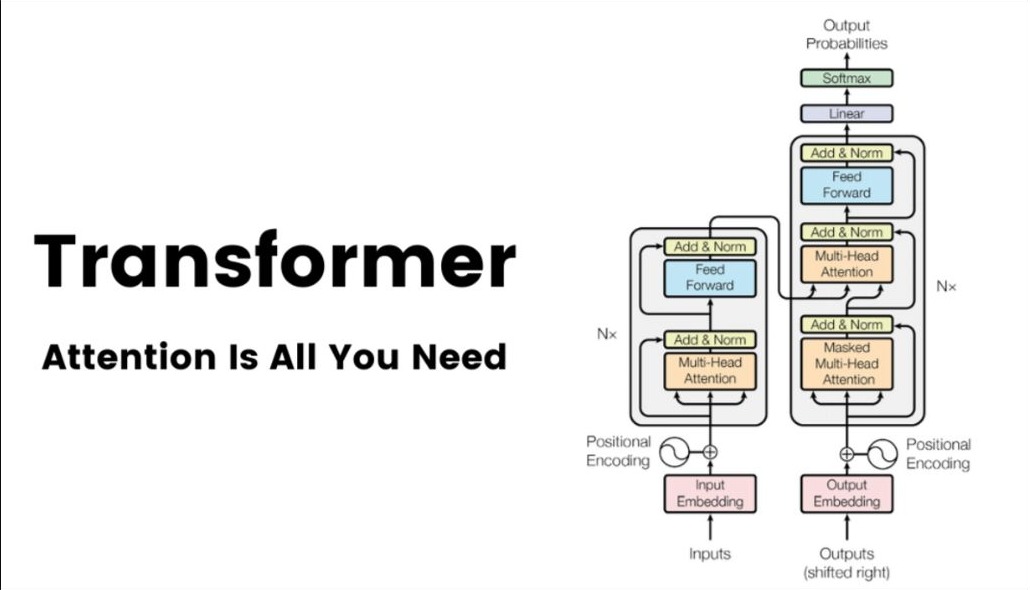
The paper's title, borrowed from the Beatles' "All You Need Is Love," captures the transformation with unintended irony. Love—the Beatles' metaphor for authentic human connection—has been replaced by probabilistic weighted attention, its quantified, algorithmic substitute. The transformer doesn't love; it attends with a certain weight. It doesn't feel; it focuses precisely. It doesn't connect; it correlates probabilities and relations on a tokenized scale.
But the transformer architecture is more than a technical achievement—it's also the computational crystallization of attention capitalism's new logic in the 21st century. Every element in a sequence (every moment of human experience) is evaluated for its relationship to every other element, with "attention weights" and bias semiotically determining significance and whether or not the artificial neuron or node will be activated to send forward it's message to the next layer of precise analysis for further consideration by the artificial brain. This process also mirrors now how social media algorithms organize our social reality: every post, every interaction, every digital trace is weighted against every other to determine what deserves our scarce cognitive resources and also ironically, proablistically can control them in a certain horizon of thought, ideas or other areas with the best chances for further ideological success and cognitive capture of an individual through this measurement and harnessing of desire and choice, libidinal or otherwise.
The efficiency gains come from parallelization—processing all tokens simultaneously rather than sequentially which later derives 'the large' in llm's or large language models presently trillions of 'parameters' of neural connections and hundreds of billions to produce the latest 'frontier' AI model. This computational advantage maps perfectly onto attention capitalism's demand for simultaneous engagement across multiple channels and near perfect probabilistic interpellation of and extrapolation towards further data. The algorithm doesn't want you to think deeply about one thing; it wants you to think shallowly about everything, all at once. Sequential processing—the kind required for reading a novel, following a complex argument, or having a meaningful conversation—becomes "inefficient" from the system's perspective.
Generation Scroll: The Barbell Breaks
To understand how this algorithmic logic shapes human consciousness, we must turn to its native speakers: the generation that has never known a world without smartphones. Kyla Scanlon, born in 1999, now 26 belongs to a cohort that has experienced what she calls "as many as three big economic downturns" during their formative years—the 2008 financial crisis, the 2020 pandemic recession, and the current quasi inflationary period. These repeated shocks have produced what Scanlon terms a "barbell strategy" for survival: Gen Z splits between extreme pragmatism (returning to trades, learning practical skills, what has been termed the 'plumber' AI robotics argument ) or extreme speculation (crypto investments, attention-based careers, digital ventures with astronomical risk-reward ratios).
This bifurcation also reflects a deeper fracture in how value is created and recognized. Traditional institutions promised a predictable progression: education leads to employment, better and more graduate degrees lead to better salaries, this in turn can lead to homeownership and what has been turned 'the American dream' in the past' (think white picket fence' and this trajectory all leads to a blissful and educated retirement for those who work hard and pursue American pragmatic motivation. As previous poet Laureate, Robert Frost famously wrote 'Good fences make good neighbors'. For Gen Z though and increasingly their peer generations on either side, the millennials and Gen X, this sequence has broken down, almost completely . College costs have inflated beyond reasonable return on investment for any sane human being not wanting to be loaded with 20 years of debt for a job that may disappear as the new technologies ever more quickly roll in with 'increased' intelligence'; housing prices have outpaced wage growth for all but the top 10% with the highly educated not even close to this group anymore; retirement seems like a historical curiosity and gaming the system and increasingly unsustainable side hustles and schemes the norm . In response, many young people have developed what Scanlon calls "financial nihilism"—a detachment from traditional economic planning coupled with a willingness to take enormous risks on speculative bets that previous generations still remembering their grandparents 'depression' era saving mentality still carried.
The "influencer" economy exemplifies this bizarre dynamic. A teenager with a smartphone can potentially earn millions by capturing the attention of other teenagers, while their college-educated peers struggle to afford rent. A young child is now forced now to go work in factories but become a 'toy' influencer with his or her parent hoping to cash in on the global need for good recommendations for 'five year old' authentic reviews and view counts on Youtube. This also creates massively perverse incentives: why spend four years studying engineering when you could spend four minutes dancing on TikTok and teaching new dubstep moves to potentially achieve greater financial six figure success monthly than most 16 year olds in a twenty year period ? The question isn't entirely unreasonable, which is precisely what makes it so disturbing.
Politics as Social Media Performance
Nowhere is the attention economy's colonization of governance more visible than in the political career of politicians , who must now perfect what Scanlon and Ezra Klein call feedback loops and learning the art of social media strategically with political decisions increasingly influenced by how events "play" on social media. Policies emerge from and return to the algorithmic ecosystem that determines what content gets seen. This extends to everything from evaluation of military decisions from quantified social media memes to how attention capitalism has reorganized the relationship between spectacle and governance. Traditionally, governments made decisions based on strategic considerations, then communicated those decisions to the public. In the attention economy, the communication is the decision; post become policy and narrative the event itself. This represents the completion of what the cultural critic Guy Debord, writing in 1967, called "the society of the spectacle." But where Debord imagined a world where "authentic life" was replaced by its representation, we now inhabit something more algorithmically recursive: a world where the representation shapes the life which reshapes the representation in real-time with the feedback loops mediated by algorithmic systems optimized for engagement rather than truth. Political genius here lies in understanding this transformation intuitively where associative speaking should mirror cognitive patterns produced by social media consumption. Constant contradiction reflect the platform logic of Twitter, where yesterday's tweet disappears into the infinite scroll. Emotional volatility should matches rapid-fire dopamine hits of smartphone notifications so algorithmic collective consciousness can be harnessed and utilized and appropriated effectively.
The Cultural Logic of Extraction
If we map the cultural evolution from Jameson's postmodernism to today's attention capitalism, we can trace a progression through aesthetic forms that increasingly prioritize immediate engagement over sustained contemplation. The MTV music video of the 1980s gave way to the YouTube viral video of the 2000s, which evolved into the TikTok of the 2010s, which has now spawned YouTube Shorts, Instagram Reels, and Twitter Spaces—each iteration becoming shorter, more addictive, more precisely calibrated to capture and hold fragmented attention.

Consider how this progression maps onto architectural space. The shopping mall of the 1980s, with its carefully designed "anchor stores" and predetermined circulation paths, has been replaced by the "infinite scroll" of online commerce, where Amazon's recommendation algorithm serves as both architect and landscape, creating personalized shopping environments that adapt in real-time to user behavior. The spatial disorientation that Jameson identified in the Bonaventure Hotel has become temporal disorientation in the digital environment, where "recommendations" based on past behavior create futures that feel predetermined yet unpredictable.
This shift from spatial to temporal colonization marks a qualitative change in how capitalism operates. Postmodernism eliminated what Jameson called "critical distance"—the space necessary for perspective and judgment. Attention capitalism eliminates what we might call "critical duration"—the time necessary for reflection and understanding. If you can think about something for longer than fifteen seconds, the algorithm considers you a inefficient user of your own consciousness, cognition should be colonized and preferably quickly.
The Algorithmic Self and Its Discontents
The most profound transformation may be psychological. Scanlon identifies how Gen Z has developed what she calls "algorithmic identity"—a sense of self that exists alongside and sometimes conflicts with their "real" identity. The algorithmic self is optimized for engagement: more attractive, more interesting, more successful than the real self, a simulacrum of the 'real' as the philosopher Jean baudrillard would put it, a image of the real you, more real than the actual you. This real also speaks and confirms authority in hashtags and thinks in thumbnails. It experiences life as content and relationships as networking opportunities towards higher echelon's of more 'savvy' social networkers' and these places on the foodchain.
This creates a form of alienation unknown to previous generations of say mere workers being alienated from the products of their labor; today's digital natives are alienated from the products of their own consciousness and cognition. Their thoughts, feelings, and experiences instantly become inputs for algorithmic systems designed to extract value from human attention, microgestures and even spelling errors revealing Freudian slips of their very human and very 'real' desires now algorithmically processed by very powerful multi-head' 'attention' mechanisms that specialize in 'group' policy thinking among themselves (I am not making up these terms) before returning to the user either output text or increasingly, humanoid robotic 'actions' . The humans now become estranged not just from what they make, but from how they think, feel, and relate to others if they do still even think of 'relating' to other humans after witnessing the great affordances with the powerful interpellative abilities of LLM's.
The phenomenon of "parasocial relationships"—emotional connections with influencers and content creators as well as LLM's now arising —illustrates this dynamic. Young people form intense attachments to personalities they've never met, following their daily routines, posts, comments, likes dislikes and most importantly 'product preferences' while, celebrating their successes, mourning their setbacks and spending their funds to become 'like' them and 'liking' them on social media. These mediated relationships provide proxies of genuine emotional sustenance while simultaneously serving as delivery mechanisms for advertising and clear pathways towards products that become laser focused on specific audiences open to influencer, audience and 'product' placement in a simulated bizarre love triangle enabled by 'the purchase' transaction' and in this way is a transactional relationship good or bad for everyone. The boundary between authentic connection and commodified experience dissolves now more entirely.
The Infrastructure of Consciousness
Perhaps the most alarming aspect of attention capitalism is how it systematically undermines the material infrastructure necessary for sustained human flourishing. Scanlon identifies a crucial contradiction: just as artificial intelligence creates unprecedented demand for electricity and becomes "the backbone of the entire S&P 500," American energy policy is moving away from the renewable sources that could meet this demand efficiently and sustainably.
This isn't coincidental but structural. Attention capitalism's short-term feedback loops—quarterly earnings reports, daily active user metrics, real-time engagement analytics—systematically discourage the long-term thinking necessary for infrastructure investment. Building solar panels requires patient capital and multi-year planning horizons. Optimizing TikTok requires real-time A/B testing and instantaneous algorithmic adjustments. The economic system increasingly rewards the latter while punishing the former.
The result is what Scanlon calls "adverse selection": the people most willing to play by attention economy rules are often the least suitable for positions requiring patient stewardship of complex systems. Politicians optimized for viral moments for quick large 'likes' make poor long-term planners. CEOs focused on social media engagement make poor industrial strategists. A civilization that can't sustain attention for longer than a TikTok video will struggle to build infrastructure designed to last for decades.
Creation Versus Extraction: The Choice That Remains
Yet within this dystopian analysis lies a seed of hope. Scanlon argues that we face a fundamental choice between "creation" and "extraction." While attention capitalism is fundamentally extractive—harvesting cognitive resources without creating genuine value—she observes that "every day, people are making the other choice to create. They're installing solar panels and rescuing flood victims and teaching skills and building the infrastructure that keeps civilization running."
This distinction offers a framework for resistance that moves beyond individual solutions (digital detoxes, mindfulness apps) toward systemic change and rearticulation of the system from within if that is possible. The question isn't whether to reject technology entirely, but how to reorganize technological systems around human rather than algorithmic values. What has been called alignment with human values and bleeding into discussions of this need before ASI or Artificial Superintelligence takes over completely for a currently impossible to see 'era of abundance'. It is still possible though to imagine social media platforms designed to enhance rather than fragment attention, economic systems that reward creation over extraction, political institutions that prioritize long-term thinking over viral engagement.
Such alternatives exist in embryonic and perhaps still durable forms. Wikipedia represents a successful example of collaborative knowledge creation that operates outside for the most part of market logic except for the fact that all frontier models have ingested the content completely. Community gardens, maker spaces, and tool libraries demonstrate economic relationships based on sharing rather than consumption. Local journalism projects show how information systems can serve democratic discourse rather than engagement optimization. Humans still write, at least at the edges of AI's generations but perhaps this too will soon pass and our era of literacy will now end. Previous eras of human's must have been surprised when the era of 'orality' ended probably also saying that it was impossible. How could an oral based civilization even exist? Now, it is impossible to think of a 'literate' culture disappearing but it is wise to note, no one laments the end of orality.
The Next Stage
The attention economy represents a new stage of capitalist development that requires theoretical frameworks in line with these new levels of complexity. Jameson's insight that "every position on postmodernism in culture—whether apologia or stigmatization—is also at one and the same time, and necessarily, an implicitly or explicitly political stance" applies equally to positions on attention capitalism.
The "Attention is All You Need" transformer architecture, despite its technical elegance, embodies the reification of social relations as mystification and naturalized omniscience but may be looked into further and further demystified but also rearticulated. But as Scanlon demonstrates, Gen Z's bifurcated response—between practical trades and digital speculation—reveals both the bankruptcy of current arrangements and emergent possibilities for different organizational forms.
The challenge is developing what we might call "temporal sovereignty"—the collective capacity to reclaim attention as a commons rather than a commodity or cognitive colonization of the mind. This requires moving beyond individual resistance toward the patient work of building alternative infrastructures: public media systems designed to inform rather than engage, educational approaches to AI literacy that prioritize depth over efficiency, economic arrangements that don't require the constant monetization of human consciousness taking things into realms that even ardent 'post-colonialists' could not even imagine in their wildest hopes.
As Scanlon argues, "You can't run an industrial economy on spectacle! You can't compete with China using tax cuts!" The next stage of capitalism may indeed be organized around attention, but like all historical formations, it contains within itself various seeds of contradictions—visible most clearly in Gen Z's current experience and youthfulness, now still hope that we must still be mindful of and the potential of this to turn in different directions as the declaration of independence proclaims 'a moe just and equal society' —this will ultimately lead to its transformation in one way or another as it has done in the past when balances become so out of kilter that a generation's core needs need to be redressed.

The woman on the airplane is still quietly scrolling, happily being nudged and prodded by conciliatory algorithms. But increasingly, people like Kyla Scanlon are watching the scrollers, understanding the system that shapes their behavior better, and even perhaps beginning to imagine alternatives or even discuss deeper possibilities. The attention economy's greatest vulnerability may be that it has produced a generation with the analytical tools and technical savvy to comprehend its own capture on deeper levels—and in this way the motivation to engineer an escape.
In the end, the choice is ours: we can continue optimizing human consciousness for algorithmic consumption and cognitive colonialism on more 'complete' global levels, or we can begin the patient work of optimizing algorithms for human flourishing. The choice is still ours. We are in fairly early innings and agency is still a possibility. The transformer taught us that attention is all we need. The question now is: what do we need attention for and who does it serve today and tomorrow?

Video Reference
The Ezra Klein Show: "How the Attention Economy Is Devouring Gen Z — and the Rest of Us" July 8, 2025, New York Times | 65 minutes Guest: Kyla Scanlon, Author of "In This Economy?" and Kyla's Newsletter
Listen/Watch: Apple Podcasts | iHeart
Annotated Bibliography
Primary Theoretical Frameworks
Jameson, Fredric. Postmodernism, or, The Cultural Logic of Late Capitalism. Duke University Press, 1991. New Left Review (Original 1984 Article) The foundational text for understanding postmodernism as capitalism's cultural expression. Jameson's concepts of "crisis of historicity," "waning of affect," and the elimination of "critical distance" provide the theoretical framework that attention capitalism extends and completes.
Vaswani, Ashish, et al. "Attention Is All You Need." Advances in Neural Information Processing Systems, 2017. ArXiv | Google Research The landmark paper introducing the transformer architecture. Beyond its technical innovations, the paper's title and methodology serve as metaphor for how attention capitalism reorganizes both computational and social relations around quantified probabilistic attention mechanisms.
Contemporary Analysis: Kyla Scanlon's Work
Scanlon, Kyla. "Trump, Mamdani, and Cluely." Kyla's Newsletter, June 25, 2025. Substack Develops the crucial framework "Attention → Speculation → Allocation" as the new economic supply chain. Analyzes how political power now flows through attention capture rather than traditional institutional channels.
Scanlon, Kyla. "From Dollar Dominance to the Slop Machine." Kyla's Newsletter, July 8, 2025. Substack Part 2 of her attention economy series, exploring the distinction between creation and extraction as fundamental to understanding economic futures. Documents how attention-based resource allocation systematically undermines productive capacity.
Scanlon, Kyla. "The Attention Economy." Kyla's Newsletter, April 27, 2023. Substack Early theoretical work defining attention economy as "monetized distraction" and establishing the framework of eyeballs as commodities. Introduces the concept that markets determine what stories capture our attention.
Scanlon, Kyla. "Gen Z and Financial Nihilism." Kyla's Newsletter, July 13, 2023. Substack Analyzes how Gen Z's experience of multiple economic crises during formative years creates new forms of economic relationship and "algorithmic identity" alongside real selves.
Economic Theory and Attention
Wenger, Albert. Discussion on "Capitalism in Our Attention Economy." Capitalisn't Podcast, Chicago Booth Review. Chicago Booth Review Wenger's argument that capitalism cannot efficiently allocate attention as a resource, and his vision for reducing economically-driven activity from 80-90% to 20-30% of human attention.
Hari, Johann. Stolen Focus: Why You Can't Pay Attention. Crown, 2022. Discussion in Current Affairs Documents the systematic degradation of human attention spans and the role of capitalist business models in creating addictive technologies that fragment consciousness.
Academic Research on Digital Capitalism
Bakioğlu, Burcu Şimşek. "Digital Capitalism and Child Labor Exploitation on YouTube." Sociology Lens, March 2024. Wiley Online Library Examines "kidfluencers" as manifestation of digital capitalism's expansion into child labor, showing how creative expression becomes commodified attention production.
Second Wave of Attention Economics. Interacting with Computers, December 2024. Oxford Academic Academic analysis of attention as "universal symbolic currency" in social media and broader economic systems, documenting the transition from advertising-based to attention-based economic models.
Supporting Analysis
Berkeley Economic Review. "Paying Attention: The Attention Economy." Berkeley Economic Review Comprehensive overview of attention economy theory from Herbert Simon's original conception through contemporary applications in technology and social media.
Galloway, Scott. "The Attention Economy and Young People." No Mercy / No Malice, January 2025. Prof G Analysis of how attention scarcity affects young people's career decisions and the "Barbell Strategy" between traditional trades and high-risk digital ventures.
#AttentionEconomy #LateCapitalism #GenZ #KylaScanlon #DigitalTransformation #FredricJameson #AI #TransformerArchitecture #CulturalCriticism #FutureOfWork #PoliticalEconomy #TechCritique #SocialMedia #PostmodernCapitalism #CognitiveLabor #AlgorithmicGovernance