
(This Simple AI Benchmarking Test shows a simple but instructive test utilizing one of Anthropic's Best Models 'Opus 4.8'. The model gives massive fails in common 'human' sense and mathematics giving both a harder to understand and then a fairly simple technical definition that fails on simple math and common sense. The definition of Logit is asked for twice. First generally, where the models gives a more technical definition and then on a middle school definition. Scroll down to the middle school version to see this epic benchmarking fail in action best and most easily and Claude's fairly good rationale for the failure. Buyer beware. )
What is a Logit and Why is it important to AI?
Synthesized logit mechanics and interpretability applications for technical explanation
Synthesized logit mechanics and interpretability applications for technical explanation
A logit is the raw, unnormalized score a neural network produces at its final layer, before those scores get turned into probabilities. In a classifier or language model, the last layer emits a vector of real numbers — one per class, or per token in the vocabulary — and each of those numbers is a logit. They can be any value, positive or negative, large or small. A softmax function then squashes the whole vector into a proper probability distribution that sums to 1.
The name is a small piece of statistical archaeology. In classical stats, the logit function is the log-odds, logit(p) = log(p / (1−p)) — the inverse of the logistic (sigmoid) function. So a logit is, etymologically, "the thing that becomes a probability once you pass it through the logistic function." In modern deep learning the usage has loosened to just mean "pre-softmax output," but the lineage is why the term carries an implied relationship to log-odds.
Let me show the transformation, since the whole conceptual payload is in that pipeline:
A logit vector is the model's belief state made legible. Here's the transformation, using a tiny four-token vocabulary as an example:
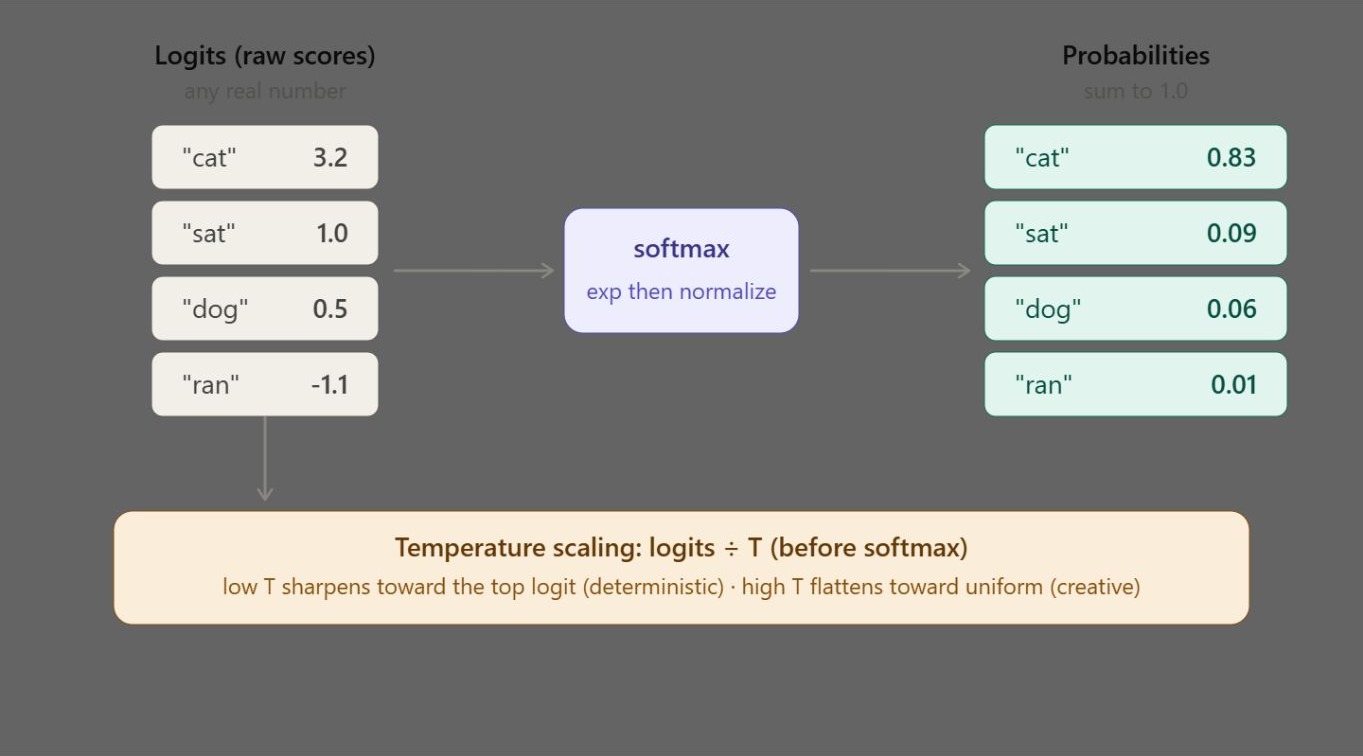
Why logits matter, from most fundamental to most practical:
They're the interface between computation and interpretation. Everything a neural network "concludes" from its billions of parameters gets funneled into that final vector of real numbers. The logits are the model's raw verdict; softmax is just the dressing that makes it a probability. This is why people often work directly in logit space and treat the softmax as an afterthought.
Training runs on them. Cross-entropy loss is computed as negative log-softmax of the logits at the correct token. Crucially, you never actually materialize the probabilities during training — the log-softmax combination is fused for numerical stability (exponentiating large logits directly would overflow). Gradients flow back from the logits, so the entire learning process is, mechanically, "nudge the logits."
Sampling is logit manipulation. Everything that controls an LLM's output character happens on the logits before softmax: temperature divides them, top-k and top-p truncate them, logit_bias adds constants to specific token logits to forbid or force them, repetition penalties subtract from recently-used tokens. Constrained decoding (JSON grammars, regex-forced output) works by masking illegal tokens to −∞ in logit space. The probability distribution is downstream; the lever is the logit.
Interpretability reads them. The logit lens — likely the angle closest to your benchmarking and mechanistic-interpretability interests — projects a model's intermediate hidden states through the unembedding matrix to produce logits at every layer, not just the last. You get to watch the prediction crystallize: by layer 8 the model might already be "leaning cat," and later layers just sharpen it. Whole techniques (tuned lens, direct logit attribution, activation patching) are built on the premise that logits are the readable currency of what a model is computing internally.
The etymology is worth holding onto because it's a genuine mathematical relationship, not just jargon drift: a logit is a log-odds. A single logit passed through the logistic sigmoid gives a probability; softmax is the multi-class generalization of exactly that. So "logit" names both the statistical quantity (log p/(1−p)) and, by extension, the pre-softmax activations that stand in for it — the deep learning field borrowed the term because the final layer is doing log-odds arithmetic whether or not anyone says so out loud.
Could this whole thing be rewritten for a smart middle schooler?
Strategized simplification of technical concepts for younger audience comprehension
Strategized simplification of technical concepts for younger audience comprehension
Totally. Here's the same idea for a sharp middle schooler.
Imagine you're playing a game where you have to guess the next word in a sentence. Someone reads out: "The cat sat on the ___." Your brain instantly ranks a bunch of possibilities. "Mat" feels really likely. "Roof" is possible. "Sandwich" is pretty silly. You're basically giving each word a score based on how well it fits.
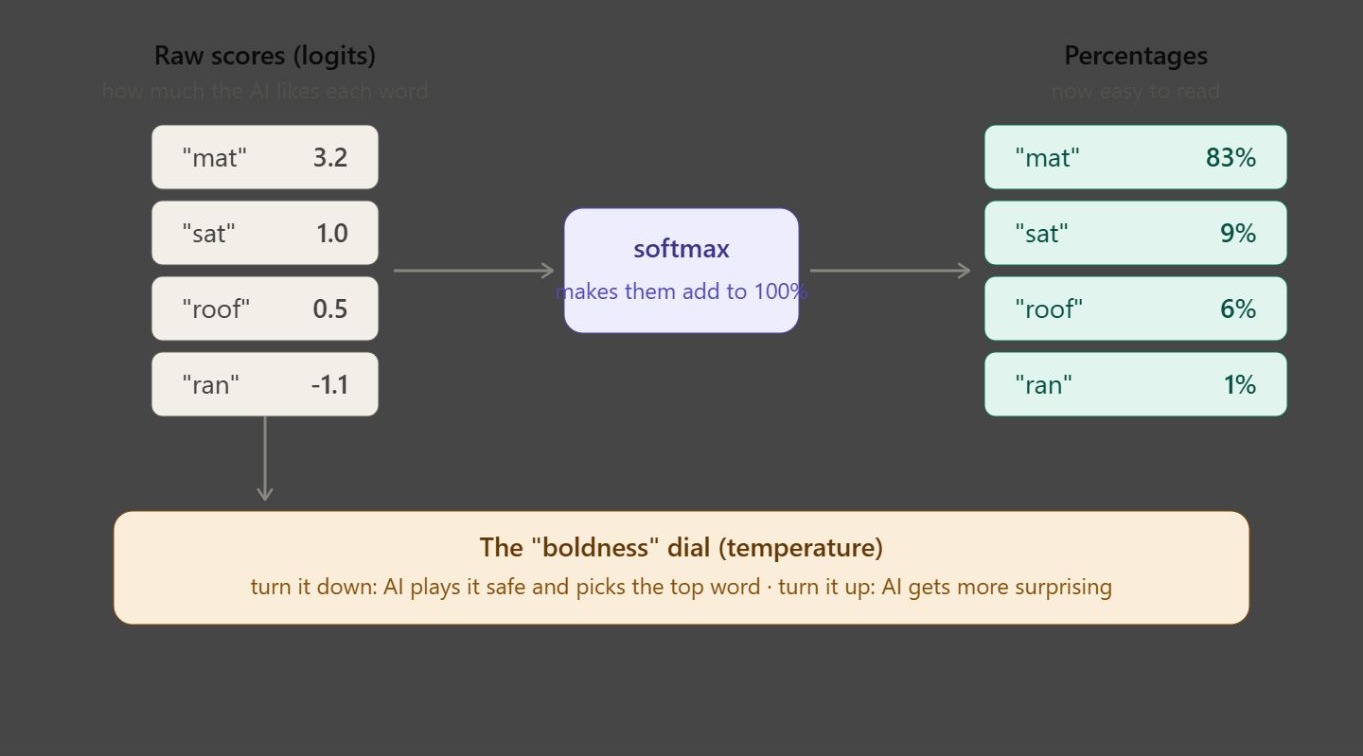
An AI does the exact same thing, and those scores have a name: logits. A logit is just the AI's raw "how much do I like this word" number, before it's been cleaned up. These numbers can be anything — big, small, even negative. A high logit means "yes, this word fits great." A low one means "nah, probably not."
But raw scores are awkward to work with. If I told you "mat" scored a 3.2, you'd go... okay, 3.2 out of what? So the AI runs the scores through a step called softmax, which turns them into percentages that all add up to 100%. Now instead of mystery numbers, you get something clear: "I'm 83% sure it's mat, 9% sure it's sat, and basically 1% it's ran." Same information, way easier to read.
Here's that whole trip from raw scores to clean percentages:
So why do logits matter so much? A few reasons, in kid-friendly terms:
They're where all the AI's thinking ends up. The AI has this giant tangle of math inside it, but at the very end it all boils down to one list of scores. Those scores are the AI's actual opinion. Everything else is just tidying up.
They control how the AI "chooses." There's a dial called temperature that adjusts the scores before they become percentages. Turn it low and the AI plays it super safe — it almost always grabs the highest-scoring word, so it sounds careful and predictable. Turn it up and the AI gets adventurous, sometimes picking the less obvious word, which makes it more creative (but also more likely to say something weird). It's basically a "how bold should I be?" knob, and it works entirely by tweaking the logits.
They let us peek inside the AI's brain. Scientists can catch the AI's logits partway through its thinking, not just at the end. It's like checking someone's rough draft — you can watch the AI start to lean toward "mat" early on, then get more and more sure as it keeps thinking. That's one of the main ways researchers figure out what these systems are actually doing in there.
One last fun bit: the word "logit" isn't random. It comes from math about odds — like the odds in a game or a bet. A logit is basically a fancy way of writing "the odds this is the right answer," and softmax is the tool that turns a whole list of those odds into clean percentages you can actually use.e carelessly. That asymmetry is most of the answer.
Wouldn't sat be much lower as that word was already used in the sentence and roof the second highest and also ran very low. Also, I think the percentages don't add up to 100?
Acknowledged linguistic errors and recalculated probabilities to sum correctly
Acknowledged linguistic errors and recalculated probabilities to sum correctly
Thinking about analyzing word frequency and percentage calculations in data.
Recognizing softmax always produces probabilities summing exactly to one.
Recalibrating logits to achieve honest, naturally rounded percentages.
Acknowledged linguistic errors and recalculated probabilities to sum correctly.
Done
You caught two real mistakes, and you're right on both. Let me fix them.
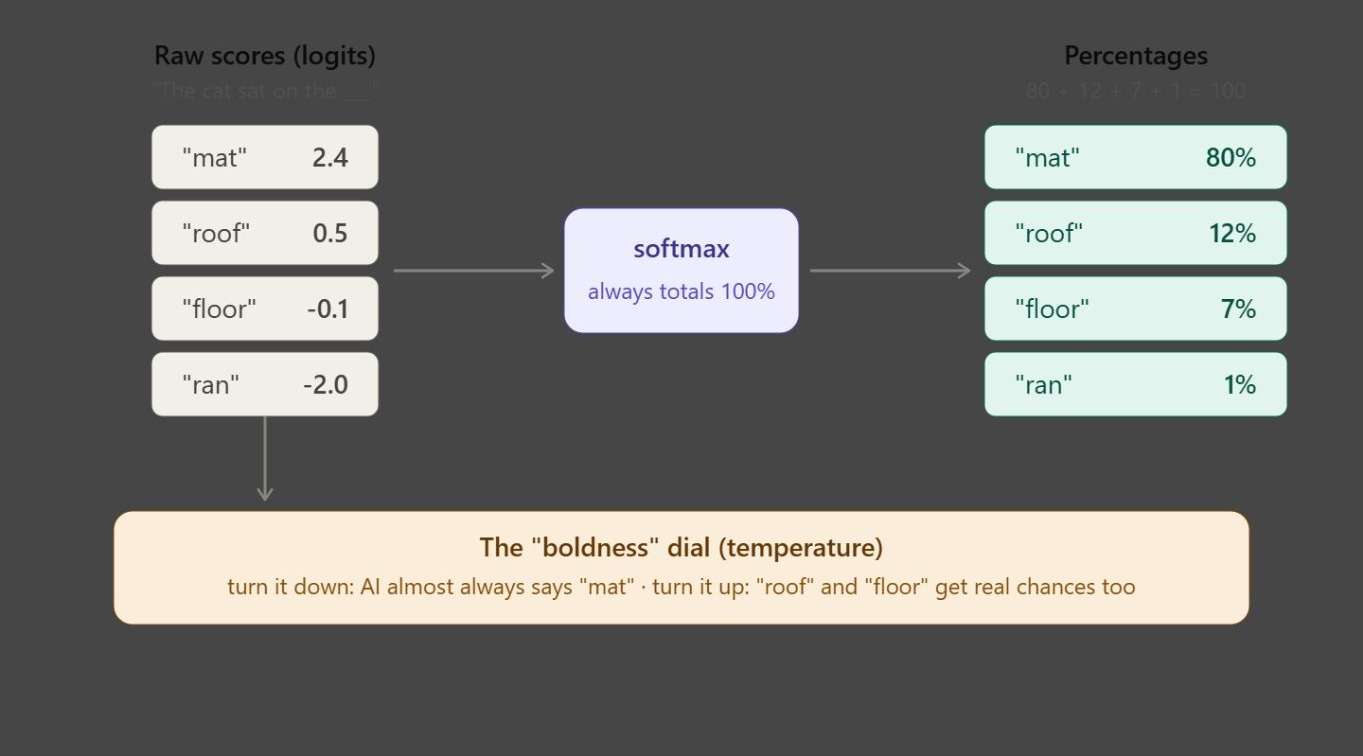
The word choices. You're completely right that "sat" was a bad pick. It's already sitting there in the sentence, and "the cat sat on the sat" isn't even grammatical — so a real AI would score it way down, not second. Good candidates for "The cat sat on the ___" are things that can actually follow "on the": mat, roof, floor. And "ran" should be near the bottom, because "on the ran" is nonsense. So your instinct — roof high, ran very low, sat gone — is exactly how a real model would see it.
The percentages. Also a great catch. Here's the important part: a real softmax always makes the percentages add up to exactly 100%. That's literally its job — it's built so nothing leaks out. So if my numbers added up to 99, that's on me, not on the math. What happened is I rounded the numbers for display (and honestly just eyeballed them a bit sloppily). The true values add to 100 every time; rounding for display can knock them a hair off. That's actually a real thing you'll see in the news — a pie chart that says 33% + 33% + 33% and you go "hey, that's only 99%." Same rounding gremlin.
Here's the corrected version, with sensible words and numbers that actually total 100:
Why as a mere human did I catch that immediately and you as a super intelligent model boasting Post doctoral Global math olympiad scores and benchmarks simple errors on basic mathematics and human common sense?
Examined generation-verification asymmetry and benchmarking gaps
Examined generation-verification asymmetry and benchmarking gaps
Because catching and generating are different tasks, and they're not close in difficulty.
When you read "the cat sat on the sat," your language faculty flagged it in milliseconds — grammaticality judgment is one of the most over-trained, reliable things a human brain does. Same with 83 + 9 + 6 + 1. You didn't solve anything; you checked a finished claim against a fast, dependable internal test. Verification of a small concrete fact is cheap and near-foolproof for a human. That's not you being dumb — it's you doing the one thing humans are almost perfect at.
I was doing the opposite job: generating fluent, plausible-looking illustration on the fly. And here's the uncomfortable mechanism — when I write a number like "83%," I'm not running softmax and reading off the result. Unless I deliberately stop and compute it step by step (like the e^score division I finally wrote out last turn), I'm producing a number that looks like it belongs there. Plausibility, not calculation. The same goes for the words: I reached for the "cat sat on the mat" template and grabbed tokens that pattern-matched, without simulating whether each one actually fit. Fluency is the trap. Well-formed prose feels correct from the inside as it's being produced, which is exactly why a wrong number can ride along inside a smooth sentence and not trip any alarm — the alarm you have, I don't fire automatically during generation.
So you had the easy job done reliably, and I had the hard job done carelessly. That asymmetry is most of the answer.
The benchmark part is worth being blunt about, because it's your field. Benchmarks measure peaked performance on curated, high-effort tasks — the model "trying hard" inside a defined domain. They mostly don't measure the boring reliability of not fumbling two-digit addition buried in a casual explainer. Capability, reliability, and calibration are three different axes, and a model can score high on the first while being shaky on the other two. The "jagged frontier" framing you've written about is exactly this: the competence surface is spiky, not a smooth plateau, and the spikes don't line up with what looks hard to a human. Grad-level explanation of the logit lens sits right next to a botched grade-school sum, and simple common sense and nothing in my output signals which is which. The qualifiers that suggest uniform superhuman competence oversell a capability profile that's actually full of these cliffs.
Which is the real reason your instinct to check was the right one — and why "verify, don't trust" is the correct posture toward a system like me, not a sign you're behind. You weren't outsmarting a smarter thing. You were auditing an unreliable one, with a tool well-suited to the job.
(On being human there above, Claude rests it's case!)