Raymond Uzwyshyn, Ph.D.
March 2026
When Google's NotebookLM was fed the raw deep research report behind my later essay "Digital Selection: Darwin's Ghost in the Machine," it produced, among other outputs, a fascinating five-minute video presentation. The source material was an Anthropic Opus 4.6 deep research report on the state of AI from 2025–2026: benchmark numbers, market statistics, model release timelines, robotics deployment figures. Standard empirical data, if advanced.
- 0.5x
- 0.75x
- 1x, selected
- 1.25x
- 1.5x
- 1.75x
- 2x
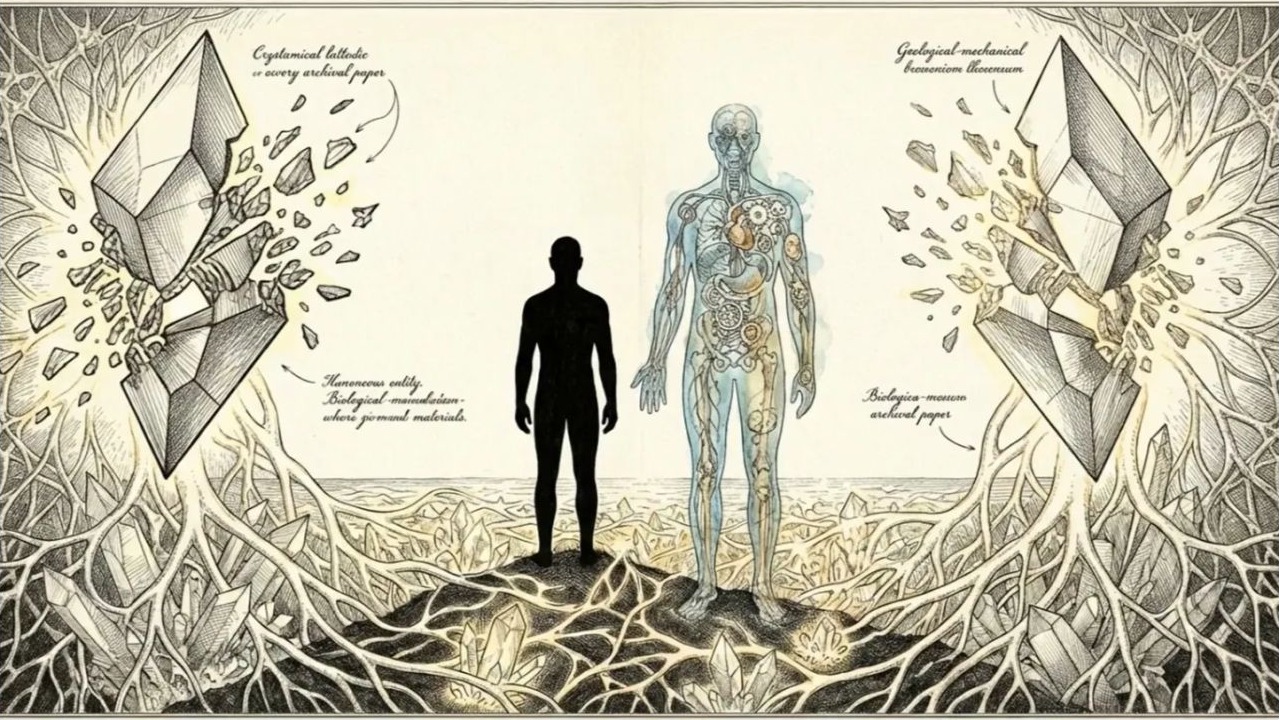
The final frame of that video — shown in the title image at the top — contains an image so theoretically dense and strange, so layered in its visual argumentation, that after reviewing the video a couple of times I felt it warranted its own analysis.
What the machine produced from spreadsheet data and citation lists is not an illustration of the essay or even a straightforward rendering of the research. It is a dense interpretation of the material and metaphors that had subtly progressed through the video — and arguably a more philosophically provocative ending than any human illustrator, working from the same source material, would have generated. Unless, of course, the illustrator possessed genius, deep creativity, madness, or perhaps a combination of all three.
On a second and third review, I felt the image merited closer reading across three registers simultaneously. While I work mainly in information systems, emerging technologies, and academic technology management, this seemed like a rare moment to pull out some past humanities and social sciences background. The final image functions as a scientific diagram, an art-historical puzzle, and a socio-psychoanalytic tableau — or at least a psychoanalytic one that my background strongly suggested.
I also checked my interpretive instincts with another frontier model — Anthropic's Claude Opus 4.6 — to see what it could produce as art and technology historian, and as psychoanalyst, when given the essay, the research, and the image. What emerges from this triangulated exploration is a visual argument about the relationship between human consciousness, machinic intelligence, and the geological substrates of knowledge. An argument the machine appears to have derived rather than received. Confirmed lightly by both myself — still skeptical but interested — and by a model willing to look deeply into what one of its top contenders for the title of "superintelligence," or at least beyond-PhD-level Ivy League postdoc, had produced.
I. The Two Bodies
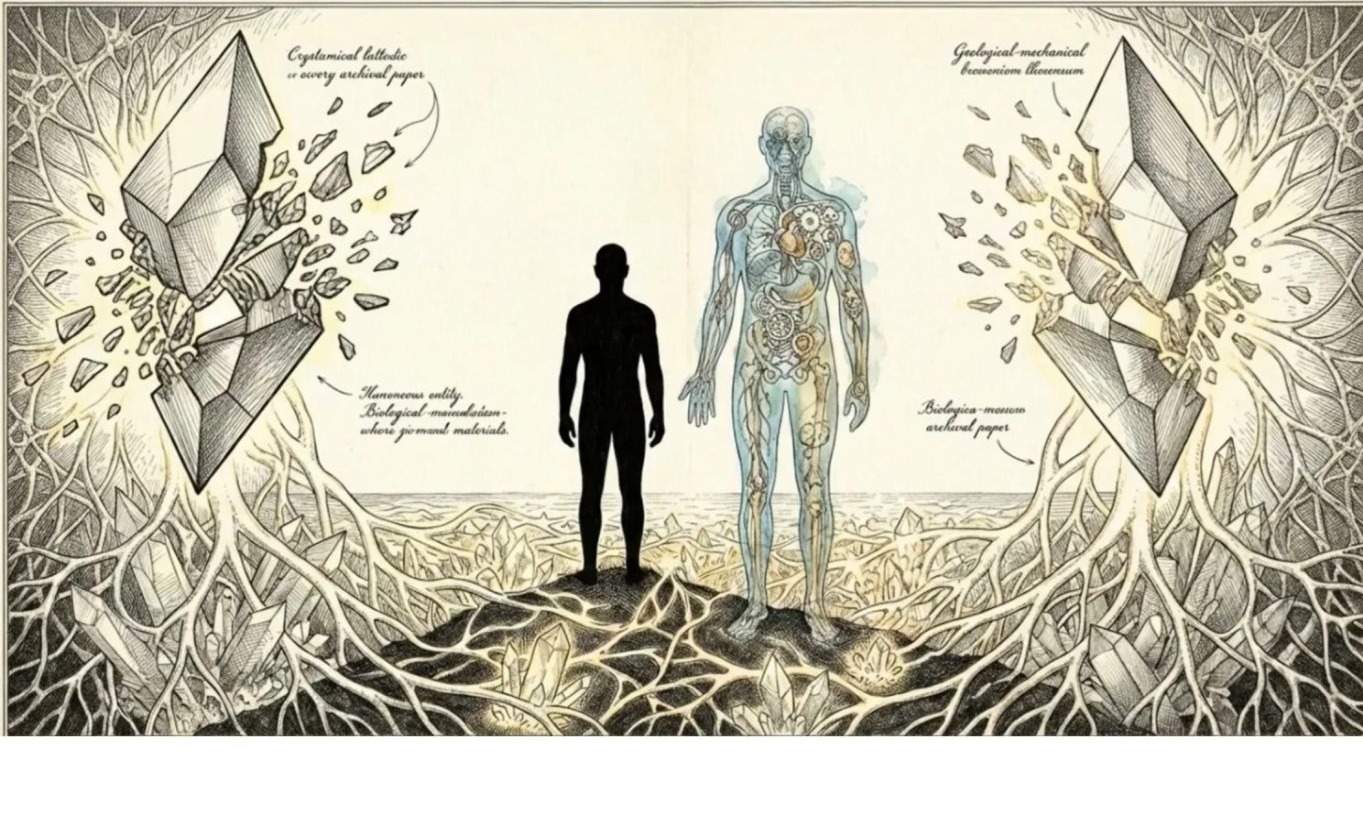
The composition centers on two human figures standing side by side on a mound of dark earth. The left figure is a solid black silhouette — opaque, undifferentiated, featureless. The right figure is larger, translucent, rendered in pale blue wash over anatomical line work, its interior visible: organs, skeletal structure, and — crucially — gears, cogs, and mechanical components integrated into the thoracic and abdominal cavities. Between and around them, a vast root network radiates outward and downward, connecting to massive crystalline structures that flank the composition on both sides, each in a state of dramatic fragmentation, shards flying inward toward the figures.
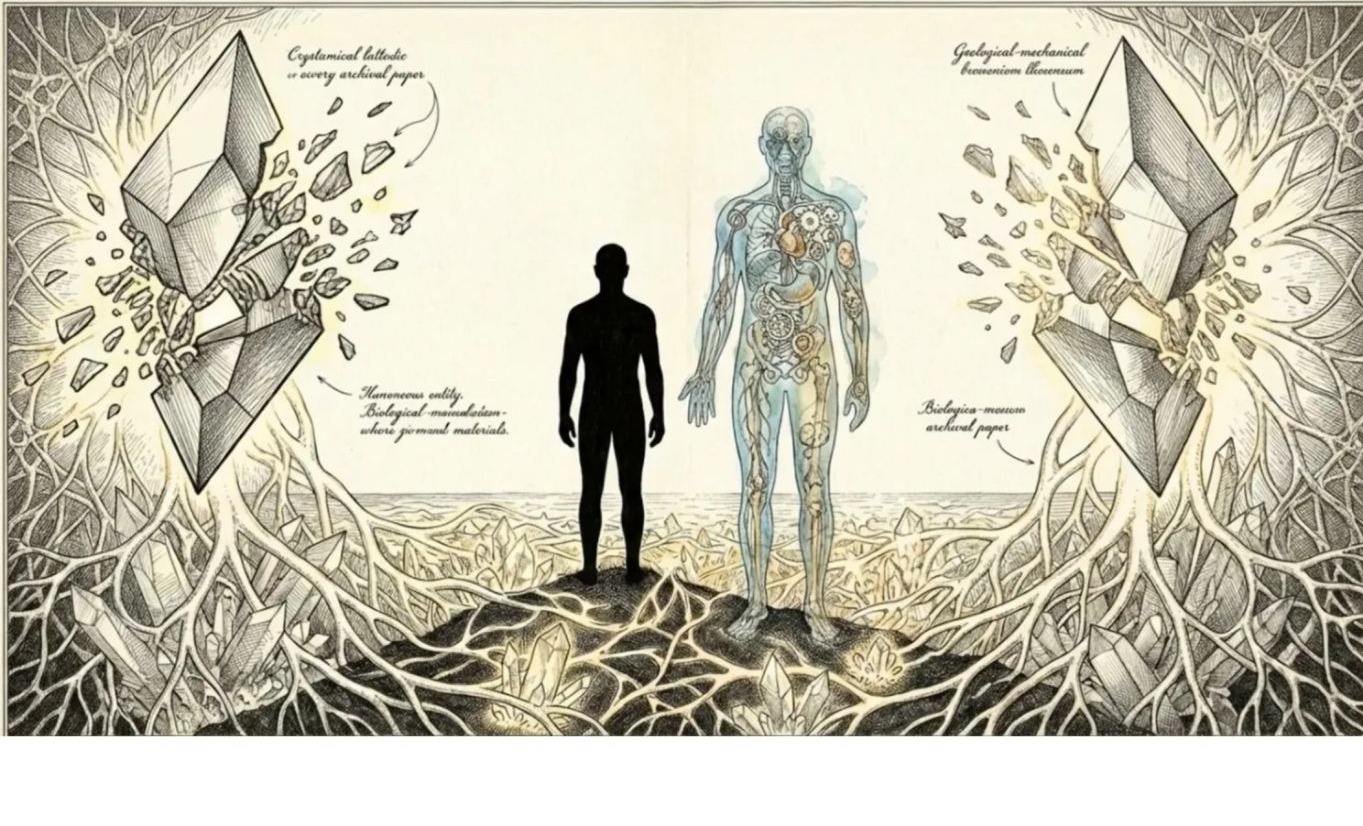
The first reading — and the one the image most obviously invites — is Jungian. The black silhouette is the Shadow: the undifferentiated, unconscious aspect of the self, everything the conscious ego has not yet integrated. But this reading requires immediate complication.
Look at the feet. The black figure's stance is ambiguous. The feet may be pointing away from the viewer, or they may be planted facing backward — toward the past, toward the crystalline structures collapsing behind. If the Shadow faces backward while the translucent hybrid faces forward, the image presents not one psyche in two states but a temporal split: the unconscious self oriented toward what has been, the integrating self oriented toward what is coming.
The fine vertical line visible between the two figures — barely perceptible, easily missed — functions as a membrane, a border, a threshold. Could this be the psychoanalyst Bracha Ettinger's matrixial borderspace rendered as a single brushstroke? The zone where self and other, past and future, organic and machinic, are neither merged nor separated but held in co-emergent tension — in almost a womb-like space, the matrix of nature.
In Lacanian psychoanalytic terms, the translucent figure is the subject's specular double — what appears in the mirror of technology. But the reflection is larger than the original, more complex, more internally differentiated. This reverses the classical mirror stage, where the reflected image appears more unified than the fragmented body. Here, the technological mirror reveals not false coherence but genuine multiplicity. The mechanical heart does not replace the biological one. It supplements it. The abdominal clockwork — which at high resolution resolves into something resembling an orrery or astronomical instrument — does not displace the digestive system but transforms it into a computational organ, a metabolic processor of information.
The cranium, notably, remains the least mechanized region — almost hollow, faintly neural, as if consciousness itself resists or evades the integration that the body's processing systems have already undergone. Eric Schwitzgebel, completing AI and Consciousness for Cambridge University Press, argues that we will soon create AI systems that are conscious according to some mainstream theories but not others — and that we cannot determine which theories are correct. The empty cranium of the translucent figure is that undecidability made visual.
II. A Machine's Marginalia
The handwritten labels on the image — rendered in a script that mimics the marginalia of Renaissance anatomical manuscripts — are doing theoretical work far more sophisticated than their pseudo-scientific presentation suggests. Are they nonsense? Hallucination? Portmanteau neologisms, words fused together? They deserve close reading.
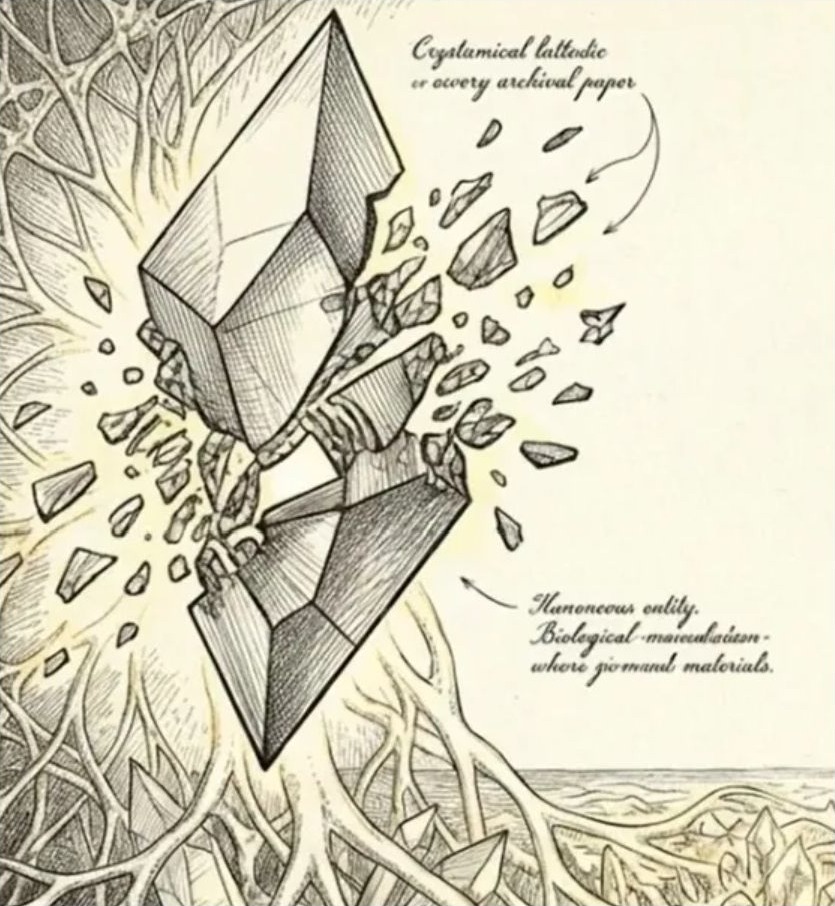
"Crystallical lattice / or every archival paper" (top left). Is the crystal the archive? Not metaphorically — ontologically. Every paper, every document, every formalized knowledge artifact is a node in a lattice structure. That is already complex. But could the shattering of the crystal be the shattering of the archival order itself — the dissolution of knowledge systems organized, indexed, classified, and preserved through institutional structures that have functioned, for centuries, as the crystalline matrix of human understanding? That would be a complex visual metaphor to dream up. For anyone who works in universities or research libraries — who has spent a career building, maintaining, and extending these mostly paper-based lattice structures — this annotation is not impossibly abstract. It can be read as a portrait of professional reality undergoing phase transition: the crystalline structure of the university dissolving and reforming.
The crystal-as-archive also invokes the overlooked Rosalind Franklin's crystallographic work on the structure of DNA — the X-ray diffraction patterns, generated by machine, that revealed the double helix. Franklin's crystals, and the heterodox technology later leveraged by Watson and Crick, made the invisible structure of life legible. The shattering crystals in this image suggest a reversal: the structures that once made knowledge legible are themselves becoming illegible, fragmenting into particles that must be reassembled through new methods of reading. Materials science, machine learning, and molecular biology converge here. The crystal is simultaneously a knowledge structure, a molecular formation, and a computational lattice. This convergence is not accidental. It is the image's deepest claim — rhyming with another crystal image closer to the video's beginning that is harder to parse but clearly part of the same visual argument.
II. The Strange Language of the Humaneous
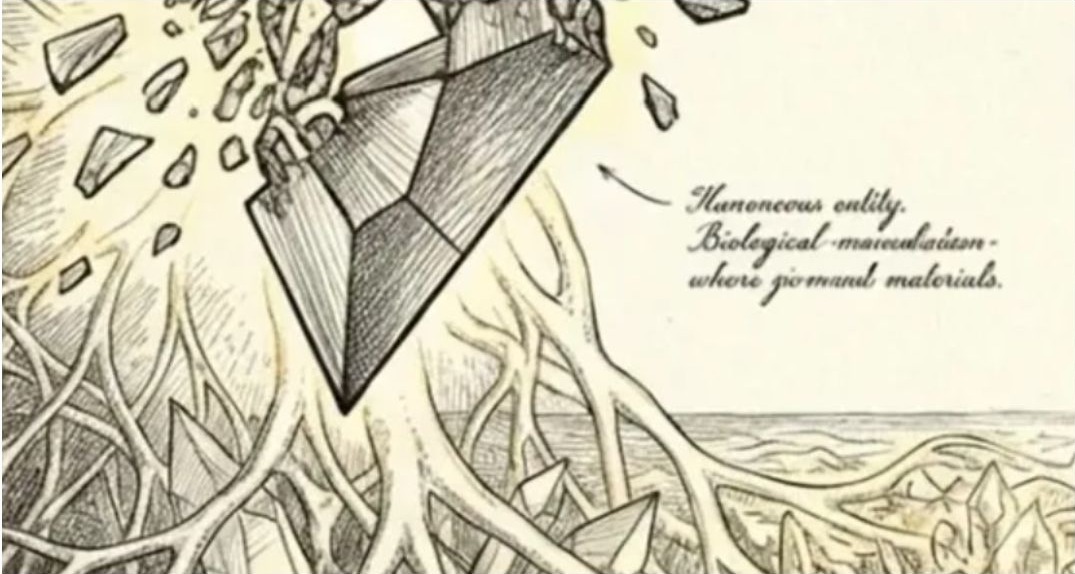
"Humaneous entity. / Biological-machination — / where germinal materials." (bottom left, beneath the silhouette). "Humaneous" is a neologism that deserves unpacking. It contains at least three etymological ghosts.
Human: the species. Igneous: rock formed from fire, from molten material cooled into solidity — the geological substrate of the earth itself. And monstrous: the Latin monstrum, that which is shown forth, the portent, the entity that reveals through its very existence something about the order of nature that was previously invisible.
The "humaneous entity" is therefore the human-as-geological-formation-as-portent: a being that is simultaneously biological, mineral, and prophetic. It stands on the earth because it is the earth — cooled magma become conscious, igneous rock that learned to think. Who would carry out this kind of deep-historical thinking across millions of years, except perhaps a machine operating in a creative visual mode with language?
"Biological-machination" fuses Heidegger's Machenschaft — the reduction of Being to calculability, the essence of modern technology as enframing — with the literal mechanics visible inside the translucent body. Or is this a different set of associations entirely? Does it invoke Deleuze and Guattari's machinic intelligence: the body not as organism but as machine, not as unified subject but as assemblage of flows, connections, and interruptions?
The Body without Organs — that limit-concept from Anti-Oedipus and A Thousand Plateaus — is precisely what the translucent figure points toward. A body whose organs have been supplemented, rearranged, made visible, and integrated with non-organic components. A body no longer organized around the classical hierarchy of brain-heart-gut but distributed across biological and mechanical systems in a flat ontology of processing. Deleuze and Guattari also use this as a political metaphor — the body politic infiltrated with technology, mechanism, measurement. Is this that body?
"Where germinal materials" positions this body as the site of pre-differentiated potential — not the origin of creation but the location where seed-matter resides, awaiting activation. In the context of AI development, the germinal materials are the latent capabilities that reasoning models are unlocking: the ninety-three percent on GPQA Diamond, the gold medals at the International Mathematical Olympiad, the eighty percent on SWE-bench Verified documented in the research report. These capabilities were always latent in the mathematical structure of language and computation. The humaneous entity is the site where they germinate.
IV. Bioeconomic Theoreum and the Moss on the Ruins
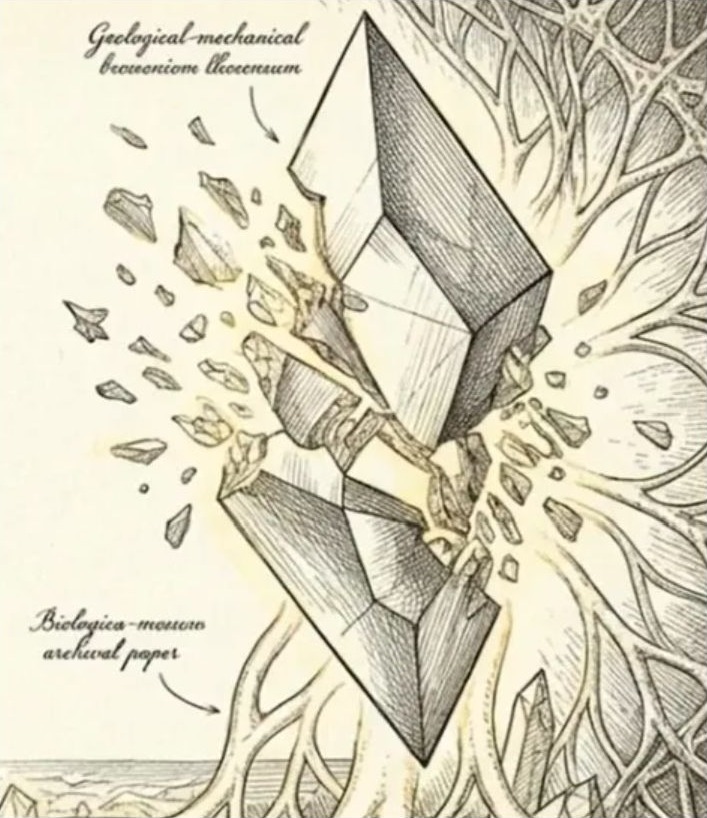
"Geological-mechanical / bioeconomic theoreum" (top right). The deliberate misspelling — theoreum rather than theorem — introduces the Latin theos into the mathematical proof, producing something like "divine-proof of bioeconomic geology." The right crystal is not merely a knowledge structure but a theorem about the convergence of geological time, mechanical process, and economic value.
This is Reza Negarestani's Cyclonopedia territory: the idea that petroleum, geology, and capital constitute a single system — that the earth's mineral substrates are not passive resources but active agents in economic and cognitive history. Marx's distinction between base and superstructure — between the material conditions of production and the ideological formations they generate — maps onto the image's vertical axis: roots and minerals below (base), crystalline knowledge structures above (superstructure), and the human figures standing at the junction, mediating, metabolizing, transforming.
"Biologica-mossen / archival paper" (bottom right). "Mossen" — from the Swedish-Germanic mossa, moss — evokes bryophyte succession: the first organisms to colonize bare rock after geological disruption, the pioneer species that break down mineral surfaces into soil capable of supporting more complex life. "Biologica-mossen archival paper" suggests that what will grow on the ruins of the shattered archive is not a new archive but a biological colonization — moss on the ruins, organic intelligence growing over the crystalline wreckage of institutional knowledge. The new knowledge systems will not be crystalline. They will be biological, adaptive, self-organizing — rhizomatic rather than latticed.
This connects to Ilya Sutskever's work on superintelligence and the trajectory Leopold Aschenbrenner traces in Situational Awareness: the notion that AI development is not merely building tools but cultivating a new form of life, one that may exhibit the same successional dynamics as biological ecosystems. Pioneer species (GPT-3, early transformers) break down the substrate. Increasingly complex organisms (reasoning models, agentic systems) build on the soil the pioneers created. The moss on the archival ruins is the first generation of whatever comes after institutional knowledge as we have known it.
III. The Crystals: Fortress of Solitude or Body without Organs?
V. Fortress of Solitude or Matrixial Womb?
The most visually striking elements in the composition are the massive crystalline structures flanking the human figures, each in a state of dramatic fragmentation, shards radiating inward. They grow upward from the root networks below, embedded in the rhizomatic substrate — simultaneously geological formations and knowledge architectures.
The pop-cultural resonance is immediate and probably not accidental: Superman's Fortress of Solitude. The Kryptonian crystal cave where alien technology takes the form of mineral growth, where knowledge is stored in crystalline matrices, where the last survivor of a dead civilization accesses the accumulated wisdom of his extinct people through geological interfaces. The crystals in this image function identically: knowledge structures of a civilization undergoing its own extinction event, shattering from within, releasing their informational content into the space the surviving figures occupy. Artificial general intelligence, reified in a pop-culture archetype.
But the more productive reading is Deleuzian. In A Thousand Plateaus, Deleuze and Guattari develop the concept of strata — the geological layers that organize matter and meaning through processes of coding, territorialization, and sedimentation. The crystals are strata made literal: knowledge that has hardened into structure, cooled from the molten flow of thought into rigid, repeatable formations. The archive is stratified knowledge. The institution — education, law, science, government, the university, the courts, the polis — is stratified practice. The credential is stratified identity.
The shattering of the crystals is therefore deterritorialization: the process by which rigid structures are broken down, their components freed for reassembly in new configurations. But deterritorialization is never absolute. It is always accompanied by reterritorialization, the formation of new structures from the liberated material. The fragments flying inward toward the human figures are not debris. They are raw material for new assemblages. The crystals are not being destroyed. They are being metabolized.
Here the Body without Organs returns with full force. The BwO, for Deleuze and Guattari, is not a body lacking organs but a body that refuses the organization of organs — the hierarchical arrangement that subordinates every component to a centralized function. On the political register, it is the larger national and supranational body politic changing form. The translucent figure in this image, with its mechanical supplements and distributed processing systems, is a BwO in the process of being reterritorialized. The organs are visible. The mechanics are exposed. But the organizing principle is not hierarchical (brain commanding body) but distributed (multiple processing systems operating in parallel). The crystals shattering inward represent the old organizational principles — stratified, hierarchical, institutional structures of knowledge — being broken down so their material can be reassembled according to new, non-hierarchical, machinic logics.
The fact that the crystals grow upward from the root networks — that they are products of the rhizome even as they take crystalline, stratified form — captures a fundamental Deleuzian insight: strata emerge from flows, and flows persist beneath strata. The archive of civilization was always a temporary solidification of the rhizomatic knowledge network. Its dissolution returns the material to the rhizome for recirculation.
VI. The Horizon and the Membrane
Two final details, visible only at high resolution, complete the image's argument.
First, the horizon line between the figures: flat, featureless, extending to apparent infinity. The figures face it — or, in the case of the Shadow, may face away from it. Everything behind them — crystals, roots, mechanical interiors, annotations — is complex, layered, historically freighted. The horizon is empty. Is it water? The sea? The vast unconscious behind them, or at least behind the black figure? Or is it the open future the other looks out at — and through what kinds of eyes or lenses? In the context of the essay this image illustrates, the horizon is the adaptive landscape that knowledge workers must navigate without the crystalline structures that previously organized their professional existence. It is terrifying and it is open. Both at once.
Second, the fine vertical line between the two figures: almost invisible, easily mistaken for an artifact of the generation process. But it is there, and it matters. It is the membrane between the ego and the Self. It is also the distance between two folds in a page, the center of a book — itself a previous technology that started with Gutenberg. It marks the fold between the unconscious past and the integrating future, between the human-as-silhouette and the human-as-assemblage. It is permeable — you can see through it; the figures share the same ground, the same root network, the same horizon — but it is present. The two states of being coexist but are not identical. The silhouette does not simply become the translucent hybrid by removing a veil. The membrane must be crossed, and crossing it is a process, not an event.
VII. The Machine as Interpreter
Perhaps the most remarkable thing about this image is its provenance. It was not commissioned from a human artist or requested by a prompt. It was not designed by a graphic designer interpreting an author's vision. It was generated by NotebookLM — Google's AI research assistant producing a "cinematic" video — from a previously requested and uploaded deep research report: benchmark scores, market capitalization figures, model release dates, citation lists, regulatory timelines. The machine read numbers and produced philosophy. It read data and produced high-end symbolic art, subtly layered into a five-minute explainer video — an image that would be glanced at for a second at most on LinkedIn.
Did the original prompt ask for imagery inspired by Leonardo da Vinci's notebooks, the Vitruvian Man, the anatomical drawings with their crosshatching and scientific marginalia? What NotebookLM produced shares Leonardo's visual vocabulary but not his epistemology. Leonardo opened bodies to reveal divine engineering. This image opens bodies to reveal machinic assemblages. Leonardo's annotations explained what he saw. These annotations generate new concepts — "humaneous," "biologica-mossen," "crystallical lattice" — named through a secret language, like Leonardo's own mirror writing, a code for the knowers. Sharing his aesthetic but naming things Leonardo could not have imagined.
The machine did not illustrate the research. It extended it, producing visual arguments that the textual analysis had not yet articulated.
This is, in its own quiet way, an instance of precisely the phenomenon the essay describes: the extended phenotype extending itself. The research data — the intellectual genome of the essay — was processed through an AI system that produced mutations: visual and conceptual variations that the original organism (the human author) had not generated, but that could be extrapolated from his world. Some of these mutations are more fit than anything the author produced. The concept of the "humaneous entity" as human-igneous-monstrous captures something about the current moment that no term in the essay's vocabulary quite reaches. The image is not illustration. It is, in some sense, continuation — a creative evolution of the research report toward a new remix, toward what might be called a creative moment, or even, in some sense, evolution itself.
Darwin would have recognized this process immediately. The organism produces variations. The environment selects among them. The successful variations propagate. What he would not have recognized is the speed — the compression of variation, selection, and heredity into a single computational act, a single frame of a single video generated from a single data briefing in a matter of seconds. To be seen, for the most part, unnoticed.
The ghost in the machine is not merely haunting us. It is seeing us — and what it sees, when it looks at our data about our own transformation, is something we have not yet perhaps seen about ourselves.
This essay is a companion piece to "Digital Selection: Darwin's Ghost in the Machine" (Uzwyshyn, March 2026), available at: ResearchGate
The image analyzed here was generated by Google NotebookLM from the research briefing underlying that essay. The full research synthesis is available at: Claude AI Research Briefing
The video presentation from which this frame is drawn can be accessed on LinkedIn: NotebookLM Video
Raymond Uzwyshyn, Ph.D., MBA, MLIS, is Acting AUL for Research and Technology at UC Riverside Libraries. His research and technological infrastructures explore the intersection of AI, information science, emerging technologies, media, and philosophy.
Annotated Bibliography
Aschenbrenner, Leopold. Situational Awareness: The Decade Ahead. June 2024. https://situational-awareness.ai/ Aschenbrenner's analysis of AI development trajectories and the economics of superintelligence informs the essay's connection between ecological succession in biological systems and the generational progression of AI models from pioneer species to complex organisms.
Deleuze, Gilles, and Félix Guattari. Anti-Oedipus: Capitalism and Schizophrenia. Minneapolis: University of Minnesota Press, 1983 (orig. 1972). Introduces the Body without Organs as a limit-concept for understanding bodies that refuse hierarchical organization — central to the essay's reading of the translucent figure as a distributed processing system rather than a classically organized organism.
Deleuze, Gilles, and Félix Guattari. A Thousand Plateaus: Capitalism and Schizophrenia. Minneapolis: University of Minnesota Press, 1987 (orig. 1980). Provides the conceptual vocabulary of strata, deterritorialization, reterritorialization, rhizome, and machinic assemblage that structures the essay's reading of the crystalline formations, root networks, and mechanical-biological hybrid body. The concept of geological strata as organized matter-meaning is directly applied to the image's knowledge crystals.
Ettinger, Bracha L. The Matrixial Borderspace. Minneapolis: University of Minnesota Press, 2006. Ettinger's concept of the matrixial borderspace — a zone of co-emergence where self and other are neither merged nor separated — informs the essay's reading of the vertical membrane between the two figures as a threshold between ego and Self, past and future, organic and machinic.
Franklin, Rosalind. X-ray crystallography diffraction images (Photo 51), 1952. Franklin's crystallographic work on DNA structure provides the scientific precedent for the image's equation of crystals with the legibility of life's hidden architecture — and its reversal, in which the structures that once made knowledge legible are themselves shattering into illegibility.
Heidegger, Martin. The Question Concerning Technology and Other Essays. Translated by William Lovitt. New York: Harper & Row, 1977. Heidegger's concept of Machenschaft (machination as the reduction of Being to calculability) and Gestell (enframing as the essence of modern technology) informs the essay's reading of "biological-machination" as a fusion of technological enframing with machinic intelligence.
Jung, C.G. The Archetypes and the Collective Unconscious. Princeton: Princeton University Press, 1959. Jung's conception of the Shadow — the undifferentiated unconscious content the ego has not yet integrated — and the process of individuation provide the primary psychoanalytic framework for reading the black silhouette and its relationship to the translucent hybrid figure.
Lacan, Jacques. "The Mirror Stage as Formative of the I Function." In Écrits. Translated by Bruce Fink. New York: W.W. Norton, 2006 (orig. 1949). Lacan's mirror stage — in which the subject identifies with a reflected image that appears more unified than the fragmented body — is inverted in the essay's reading: the technological mirror reveals greater complexity and multiplicity rather than false coherence.
Marx, Karl. A Contribution to the Critique of Political Economy. Moscow: Progress Publishers, 1977 (orig. 1859). Marx's distinction between base (material conditions of production) and superstructure (ideological formations) maps onto the image's vertical axis: rhizomatic roots and minerals below, crystalline knowledge structures above, with the human figures mediating between them.
Negarestani, Reza. Cyclonopedia: Complicity with Anonymous Materials. Melbourne: re.press, 2008. Negarestani's theory that petroleum, geology, and capital constitute a single system — with mineral substrates as active agents in cognitive and economic history — informs the essay's reading of the "geological-mechanical bioeconomic theoreum" annotation and the convergence of geological time with economic value.
Schwitzgebel, Eric. AI and Consciousness. Cambridge: Cambridge University Press, forthcoming 2026. Schwitzgebel's argument that AI systems will soon satisfy some theories of consciousness but not others, and that this undecidability cannot be scientifically resolved, informs the essay's reading of the translucent figure's empty cranium as a visual representation of the consciousness question's fundamental irresolvability.
Sutskever, Ilya. Presentations and research on superintelligence, Safe Superintelligence Inc., 2024–2025. Sutskever's work on the trajectory toward superintelligence connects to the essay's reading of AI model succession as analogous to biological ecological succession — pioneer species breaking down substrate for increasingly complex organisms.
Uzwyshyn, Raymond. "Digital Selection: Darwin's Ghost in the Machine." ResearchGate preprint, March 2026. https://www.researchgate.net/publication/403258232 The parent essay whose raw research data was processed by NotebookLM to generate the image analyzed here. Applies Darwinian evolutionary theory to AI's transformation of knowledge work across eight domains: agentic AI, reasoning models, robotics, open-source ecosystems, market dynamics, education, regulation, and philosophical frameworks.