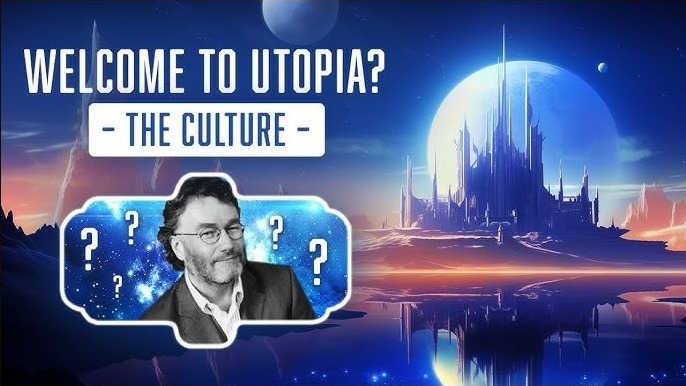
Introduction: Iain M. Banks, a renowned Scottish serious fiction and SF author, is best known for his Culture series—a visionary science fiction saga that imagines a post-scarcity, utopian society governed by super intelligent AIs and autonomous agents. The series explores themes of abundance, the role of technology in human life, and the ethical questions surrounding artificial intelligence. Banks's Culture series provides a radical, yet thought-provoking blueprint for a world where material needs are fulfilled and the pursuit of self-actualization is free from the constraints of survival. This vision resonates deeply with today’s tech visionaries, many of whom are inspired by his concept of an advanced, abundant future—yet the current state of the world remains a stark contrast, particularly in the wake of the recent OpenAI GPT- o3 release, which has pushed AI capabilities one step closer to what is termed 'AGI' or Artificial General Intelligence and what many of today's tech visionaries believe will open a future of abundance and superabundance with Artificial Superintelligence and what these capabilities will allow.
The Influence of Iain M. Banks on Tech Visionaries:
Banks’s depiction of a post-scarcity society influenced contemporary figures such as Elon Musk, Jeff Bezos, Peter Diamandis, and Sam Altman, who see AI and advanced technologies as crucial tools for transforming the future. Musk has been vocal about his admiration for the Culture series, aligning it with his ambitions to terraform Mars and ensure humanity's survival by developing technologies capable of tackling global issues. Meanwhile, Peter Diamandis, through his book Abundance, envisions a world where exponential technologies—such as AI, robotics, and synthetic biology—lead to the elimination of scarcity, echoing the utopian ideals of the Culture.
Recently, the release of OpenAI’s GPT- o3 and Anthropic's MCP framework have made significant strides toward realizing a crucial component of the Culture series' vision: artificial intelligence capable of performing highly advanced tasks involving tests that previously only very educated and specialized humans (ARC tests) and the very highest levels of physics, mathematics, chemistry and coding Ph.D's and post-docs or, conversely, autonomous AI agents are capable of achieving. (https://www.linkedin.com/feed/update/urn:li:activity:7276654335827103746/ ). With GPT-o3, AI has demonstrated its ability to generate human-like text, answer questions, and with other advanced models (Midjourney, Dalle-3, Stable Diffusion) create art and amazing AIVideo (SORA, Veo2, Kling, Minimax, etc.). This signals the next phase in the journey toward AGI (Artificial General Intelligence)with a profusion of autonomous agents (KrewAI, AutoDev, etc.). This MCP-enabled autonomous multimodal AI will soon encompass the entire human multi-sensory spectrum and external database driven online information universe. Sam Altman, CEO of OpenAI, is at the forefront of this revolution, with now a purported re-focus on the safe and responsible development of AGI with his competitor, Dario Amodei, at Anthropic and their Claude series reiterating these original values through words again and perhaps more focus on actions. These goals intersect with the ideals of Bank's SF Culture 'society of Abundance' series, where super intelligent Minds (AIs) manage the functioning of society. These are the challenges of being human, post or transhuman, even in a global society that has risen past the challenges of 'survival' and 'scarcity'. For most of us on our present planet, earning our daily bread and rent/mortgage for adequate shelter is enough.
AI 2025: From Present Disparity to Future Abundance?
Despite the present major advancements in the past three years of AI and robotics especially, there remains large glaring gaps in income and living conditions between the tech-driven futuristic dreams of abundance and the socio-economic realities we face today. In cities like San Francisco and Silicon Valley and, more widely the larger state of California, still very much home to many tech giants, the promise of technological prosperity is undermined by extreme inequality and the ugly fact of also being the home of the largest homeless population in the United States and history of California. While the tech industry has produced some of the ongoing list of wealthiest individuals in the world, it has also exacerbated social disparities to a previously level unseen, with a homeless crisis visible on the very streets that Silicon Valley calls home and homeless being shipped to other areas of California and other states being dropped on small towns doorsteps, silently, with the dictum - not my problem any longer. San Francisco and other California cities rapid gentrification, driven in part by tech investments, has led to skyrocketing housing costs, pushing many of its residents into poverty and also, the largest exodus from California in its history. This has also not led to happiness from other states. Californians sell their homes, especially those in what would be considered previously 'the middle class', to go to live in other states. They drive up the real estate to unheard of levels. Go ask the average Texan or Idahoan what they think of Californians, including 'Elon Musk', and the very industries that he is building in other states - too expensive in California, even for billionaire empire builders.
The growing wealth gap in cities like San Francisco and states like California also reflects a broader problem in our society—one that resonates with the tension between the ideals of a post-scarcity and 'abundance society and the stark inequalities of the present and what this means for both the previous 'American Dream' and even the previous more educated upper middle class. Turning to Bank's 'Culture Series', how can societies of abundance, like those portrayed in the Culture series, exist? Larger vast portions of the population and those who used to be named in especially 'the working class struggle' cannot meet their most basic need, such as food, shelter, and healthcare, An ever larger portion of the middle class head to other areas of America if they are able.
The Disconnect Between Technological Potential and Human Need:
Iain M. Banks’s Culture offers a powerful critique of how technological potential, if harnessed for the collective good, could reshape human existence. Current societal structures, entrenched in economic models driven by scarcity and competition, hinder the realization of such a vision. It is indeed hard to see how Banks 'minds' will solve this problem or talk of 'universal basic income' will provide anything like a salve or equitable, pragmatic solution. This disconnect is particularly apparent when we observe the lives of those caught in the precarious middle class. Even highly educated professionals, such as professors or teachers, face the struggles of never being able to buy a home or survival with basic groceries and utility bills. The economy increasingly favors an elite and now with AI discards higher education as a route of possible escape or upward social mobility.
Peter Diamandis’s vision of an “Era of Abundance” depends on technological innovation and the promise of universal basic income (UBI) as key components for solving systemic poverty. However, in practice, the gaps in wealth and opportunity remain vast. Pragmatic examples with AI seem more to disappear even with Lawyers or Doctors now knocked down at least one or two notches with advances of AI for diagnoses or legal consultation. (See this post for law example: https://www.linkedin.com/posts/rayuzwyshyn_ai-claude3-claude3-activity-7212040457575415808-FY1X?utm_source=share&utm_medium=member_desktop ), Most are still excluded from the benefits of the technological advances of AI that could potentially liberate society. While Wall Street is currently benefiting from stratospheric P/E and P/S startup valuations, the rest of the population must remain silent regarding any 'inflation'.
A New Future: The Challenges Ahead
While AI holds the potential to transform society into something closer to Banks’s Culture, there are real challenges ahead. As we see with the latest advancements in GPT- o3, Anthropic's multi-agentic new models (https://www.linkedin.com/feed/update/urn:li:activity:7270782355605204993?utm_source=share&utm_medium=member_desktop )and other forms of AI, the path to AGI remains fraught with ethical, economic, and political questions. How do we ensure that AI’s capabilities are distributed fairly across society, and not just concentrated in the hands of the elite? How do we navigate the potential of AI to create a post-scarcity society while addressing the entrenched inequalities that exist in the present?
Does the solution lie in a combination of technological innovation, such as universal basic income and increased investment in human capital? Is this a more equitable distribution of wealth or is closer look at Iain M. Banks Culture series necessary? Will this disambiguate what the tech giants seem to know or at the least are intrigued by in these utopian challenges. At the least, achieving a true society of abundance will require not only breakthroughs in technology but also a fundamental shift in social relations, education and how we view and distribute resources at the low end of Maslow's self-actualization ladder (food, shelter, relationships).
As we continue to make strides in AI, we must keep in mind the principles of equity and justice that are necessary for a future where abundance is a reality for all, especially as we move towards superintelligence. In Bank's novels, the 'Minds' are mostly benevolent except in circumstances that are termed 'Out of Context' or 'Special Circumstances'. These are the names also given for the watcher-like groups reminiscent of Plato's Republic and his own utopian notes on the watchers and famous question, 'Who is watching the watchers?' Are we on the verge of a Culture-like AI driven humanoid robot utopia? Are we witnessing the birth of a more equitable society. The path forward will require vision, action and empathy. In Banks universe this is a quality that is congruent with 'higher intelligence' whether artificial or human.
Conclusion:
Iain M. Banks’s Culture Series remains a powerful reminder of what humanity could achieve in a world where advanced technology serves to eliminate scarcity. The rise of AI, exemplified by the advancements of OpenAI and the release of GPT-o3, Anthropic, Google and other new models brings us closer to realizing a global dream or, alternatively, a larger unanticipated nightmare. We currently grapple with the stark ongoing realities of income inequality, poverty and a larger society that is anything but 'post-scarcity'. Are we flooded with the abundance for populations to choose higher interests? It is clear that technological advancement alone is not enough to create a post-scarcity society. A broader socio-economic, socio-cultural and socio-psychoanalytic shift is needed on global levels. Only this will ensure that the benefits of AI and other exponential technologies are shared by all, not just a privileged few.
For more context on Banks Culture Series and Background to this Article:
Leopold Aschenbrenner's Macroeconomic Analysis of AI https://www.linkedin.com/posts/rayuzwyshyn_situationalawarenesspdf-activity-7205336468758667264-gdh4?utm_source=share&utm_medium=member_desktop
AI Agents and Upcoming Economic Paradigm Shifts https://www.linkedin.com/feed/update/urn:li:activity:7216447018242596864?utm_source=share&utm_medium=member_desktop
Positioning Yourself for the AI Economy (Five Part LinkedIn Post Series)
Popular Contextual Video: What Did Iain M Banks Want Us To Learn From The Culture?
California: Socio-Economic Portrait https://www.facebook.com/groups/165563067224915/permalink/2017189328728937/
Societies of Control in the Age of AI's Deep Learning https://www.facebook.com/groups/deleuzeandguattari/permalink/8128073360612551/
#AI #FutureofWork #Abundance #Macroeconomics #AIEconomies #MiddleClass #FutureWork