Interactive Data Visualization: https://claude.ai/public/artifacts/d0cfd3e7-4d45-49a8-9262-ddef892bd0a5
Across conference rooms and consulting suites, hospital corridors and university halls, a fundamental shift is quietly reordering how we value the intellectual work of knowledge work across the spectrum of work areas and global geographies. The change is arriving also without fanfare or loud clamor—no factory whistles, worker revolutions or pink slips—just software that can draft better briefs, analyze data quicker and with better accuracy, and generate more robust reports with startling competence and vanishing cost to institutions or employers.
The Architecture of Professional Work in the 21st century
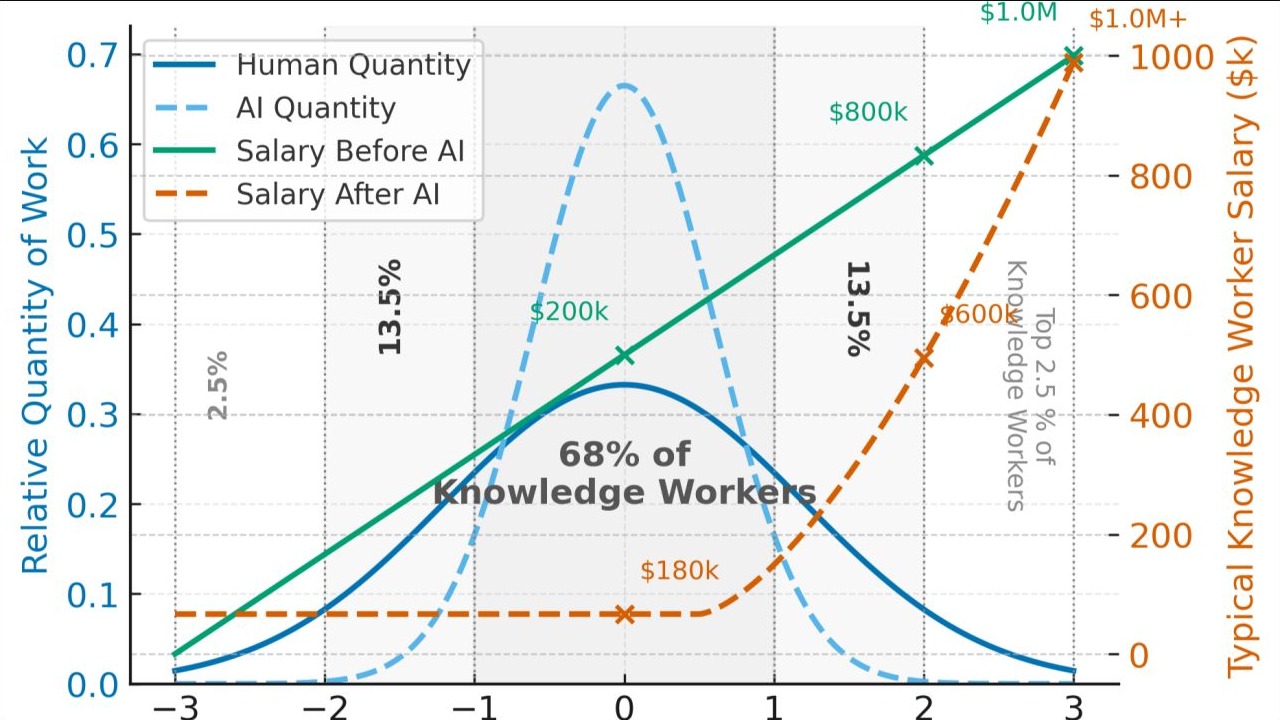
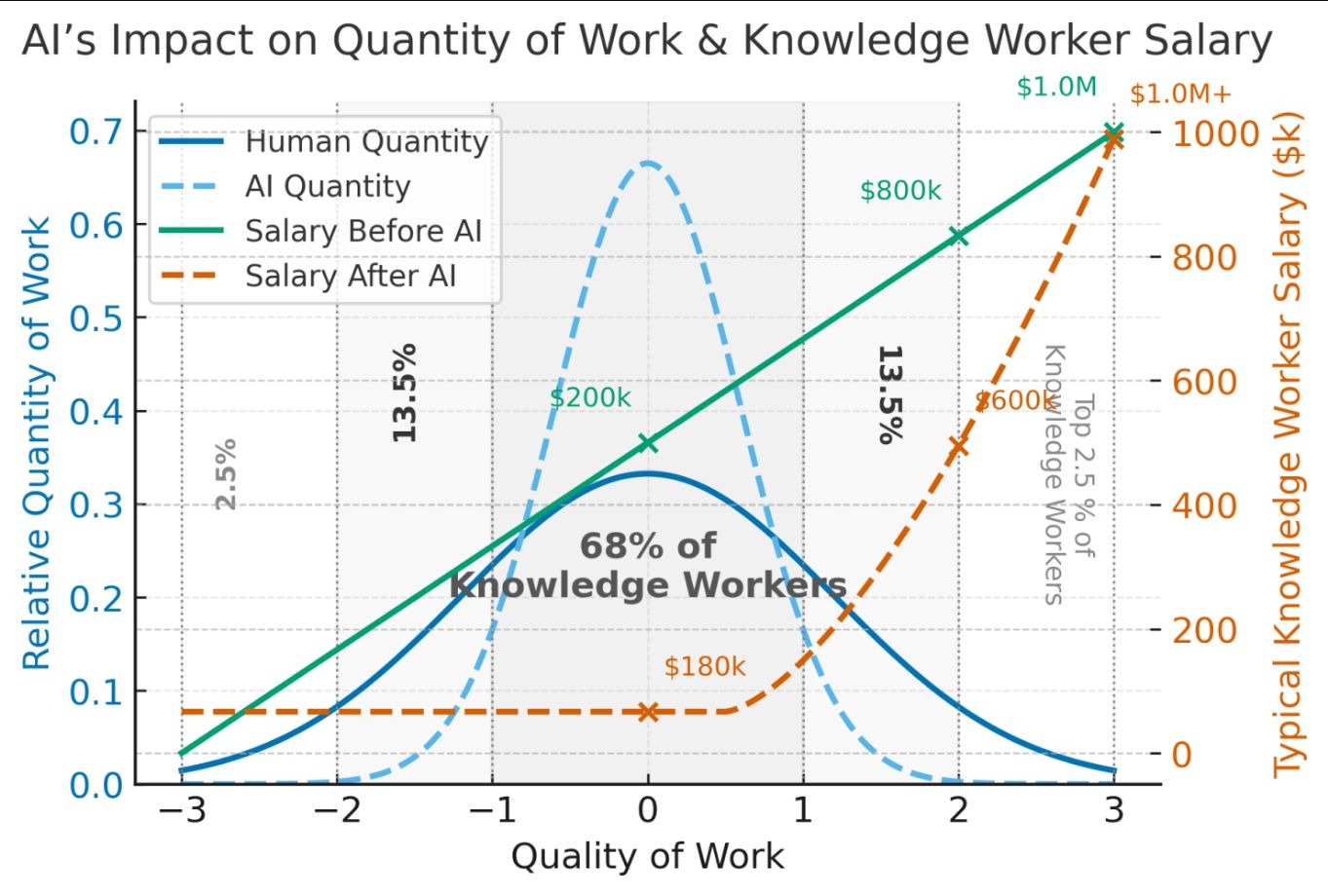
To understand what's happening, consider how professional output has always distributed itself along a predictable curve. In any field—medicine, law, academia, business management—about 68 percent of professional work clusters around solid but unremarkable quality. Another 14 percent reaches the skilled tier above that average and also below it. And roughly 2-3 percent achieves the kind of excellence that commands premium compensation and the other downside half, quick firings for gross incompetence.
Knowledge workers—those whose primary currency is judgment across the spectrum rather than muscle—now constitute roughly 38-42 percent of the U.S. workforce, encompassing some 71.5 million Americans QuoraUpwork Inc. These livelihoods depend on transforming information into knowledge, insight and action driven decisions. This includes primary care physicians earning an average of $281,000 How Much Do Doctors Make? [Salary by Specialty 2025] | White Coat Investor, first-year associates at major law firms strategizing cases and starting at $215,000-$225,000 BrightflagAbove the Law, university professors averaging $101,955 for full-time faculty National Education AssociationMission Graduate NM, and middle managers earning around $75,000-$83,000 PayScaleSalary.com.
The middle band tells the story of professional America's broad prosperity in the 20th century. A family physician handling routine lab results and chart notes for a majority of visits and cases. A second-year associate drafting standard employment contracts or pro forma legal matters . A marketing, Sociology or Chemistry professor preparing introductory lectures. An business operations manager assembling tedious but necessary quarterly reports. These roles, requiring college education, at least a masters degree or further professional training and have sustained the upper-middle class. Roughly 45 percent of US workers now hold bachelor's degrees, up from 31 percent in 2000 Key US workforce trends | Pew Research Center—creating the economic foundation for suburban prosperity.
At the skilled tier, specialists command premiums: radiologists averaging $529,000 How Much Do Doctors Make? [Salary by Specialty 2025] | White Coat Investor, experienced attorneys billing $341 per hour on average Attorney at WorkThomson Reuters, tenured professors at research universities, and senior managers overseeing complex operations. The top echelon represents genuine scarcity: neurosurgeons earning $764,000 How Much Do Doctors Make? [Salary by Specialty 2025] | White Coat Investor, elite law firm partners billing $1,680-$2,600 per hour Above the LawLaw.com, Harvard professors l earning $1.5 million How Much Do College Professors Make In 2025 (Average Salary), and C-suite executives directing organizational strategy.
Enter Large Language Models 2025: The Economics of Artificial Competence
Enter the new new incumbents - Large language models. These predictive analytics deep learning artificial machines have fundamentally and successfully begun to altered the supply equation. Current AI systems process a million tokens for roughly ten cents Lawyer Statistics Every Law Firm Should Know in 2025, making a standard report or memo cost less than a subway ride in New York to generate. More critically, these systems consistently produce work that lands square in that broad previously unassailable middle band of professional quality that was the bordered territory of professional universities and long and hard training for most in this category.
The scale also becomes clear when quantified. More than 20 million Americans now freelance in knowledge work Upwork Study Finds 1 in 4 U.S. Skilled Knowledge Workers Now Work Independently, Generating $1.5 Trillion in Earnings | Upwork Inc., while traditional employment holds steady. All the while Scale AI, Alexander Wang's silicon valley RLHF Metadata labelling firm prides itself on employing Ph.D.'s from the US big twenty moonlighting for 45.00/hour or less to make up the now not rising salaries of the previous endowed US professoriate to quietly train the next level of IQ benchmarking beating AI models. If roughly 50 million Americans currently perform work that falls within one standard deviation of average professional output, and AI can replicate much of that work at near-zero marginal cost, we're witnessing what economists might call a significant supply shock—substantial enough to affect wage dynamics, though not necessarily the dramatic displacement some predict.
The evidence appears subtly but persistently in compensation data. Primary care physician wages have grown at barely 1.4-3 percent annually White Coat InvestorWeatherby Healthcare despite persistent shortages. Law firm starting salaries have remained essentially flat in real terms since 2023, even as billing rates increase 10 percent annually BrightflagThomson Reuters. Academic compensation has grown just 4.2 percent nominally, barely exceeding inflation National Education AssociationInside Higher Ed. The broad middle of professional work—once the foundation of middle-class prosperity and bedrock of the american dream with home and white picket fence—is experiencing its first sustained period of wage stagnation relative to productivity in generations with mostly hedge funds still purchasing homes for rental properties, mortgages at sky high rates and the birth rate for Western countries at historical lows.
The Premium for Irreplaceable Excellence
Yet the story's other half reveals something more complex than simple displacement. As AI saturates the market for routine professional work, value concentrates dramatically at the extremes of the tail, the right tale. The professionals thriving in this new landscape aren't those who resist automation or AI—they're those who have learned to orchestrate it and combine their pedigrees with AI potential.
Consider the radiologist now earning over $500,000 annually. AI handles routine scans, flagging obvious pathologies and normal results. This frees her to focus on ambiguous cases requiring synthesis of imaging data with patient history, human evaluation unusual presentations, and complex diagnostic reasoning involving cross referencing of systems previously unconnected and now being validated by groups of specialist human professionals working together with AI. The radiologist processes fewer routine reports as AI can take care of most with quick glances from the radiologist for the checkmark but higher salaries produces for more specialized and tricky human/ai high-value clinical insights that were never before possible.
Or examine the corporate litigator billing $1,000 or higher per hour—rates surprisingly increasingly common among senior partners at AmLaw 25 firms Above the LawLaw.com. AI systems handle legal research and draft preliminary documents in minutes. The lawyers apparently ow concentrate on crafting novel arguments, reading juries, and developing emotive evoking strategies that reshape legal precedent. Clients pay not for document production but for the kind of human drama and judgment that can sway case outcomes a percentage towards not guilty no matter what the AI's on both sides argue with the details.
This pattern emerges across professions: venture capitalists who use AI for due diligence while focusing on founder psychology and market timing and human network connections, professors who automate grading over to AI to pursue more lucrative interdisciplinary research that results in the commercialization of generates patents with AI's new interdisciplinary pattern recognition, middle managers who delegate report creation to concentrate on strategic leadership and complex problem-solving.
These new millennia 'early adopter' AI enhanced professionals—perhaps 3 million Americans, the top 2.5% at the far right of the distribution at most for now—have discovered that AI collaboration doesn't diminish their value but can amplifies it exponentially. They operate in what economists call the "augmentation or enhancement zone," where human judgment and evaluation guides machine capability toward outcomes neither could achieve independently and the synthesis is good for all parties involved.
Global Realignments
This transformation creates ripple effects across international markets. The Philippines' BPO industry employs 1.14 million people and contributes 7.4 percent of GDP CIPDOutsourceaccelerator, with 89 percent of BPO workers facing high risk of automation according to the International Labor Organization OutsourceacceleratorBusinessWorld. India's IT and outsourcing sector employs over 5.4 million people and contributes 8 percent to GDP Impact of AI and Automation on India’s Employment Landscape +2, with AI adoption reducing demand for non-AI workers by approximately 1 percent three years after implementation AI is transforming Indian call centers. What does it mean for workers? - The Washington Post.
These economies, built on providing skilled but standardized services, suddenly find their competitive advantage evaporating. When AI can perform financial analysis, legal research, and customer service at superhuman speed for subhuman costs, geographic arbitrage loses its economic logic. Recent reports from the Philippines show BPO workers facing increased quotas and monitoring as companies integrate AI tools to satisfy clients demanding greater automation Rest of WorldUnity Connect.
Conversely, regions that cultivate expertise in complex judgment, creative synthesis, and strategic decision-making may see their human capital appreciate rapidly. The venture partners of Silicon Valley, the financial strategists of London, the pharmaceutical innovators of Basel occupy increasingly valuable economic territory—not because they avoid automation but because they direct it toward ends that only human imagination and human/ai collaboration can conceive.
The Mathematics of Disruption
The scale demands careful analysis rather than hyperbole. Thirty-eight to forty-two percent of the American workforce could be classified as knowledge workers Key US workforce trends | Pew Research Center, representing roughly 60-75 million people. Within this group, the distribution follows predictable patterns: most work clusters around professional competence, a smaller segment achieves specialized expertise, and a tiny fraction reaches genuine excellence.
If current AI capabilities primarily affect the middle 68 percent of this bell curve knowledge worker distribution, we're looking at potential impacts on 40-50 million jobs—not immediate displacement, but gradual compression of wages and consolidation of roles. This represents a substantial labor market shift, though historically comparable to other technological transitions like computerization or the earlier electrication of the globe or first industrial revolutions, which unfolded over decades rather than years.
The international dimension adds complexity. India produces over 4 million IT and business process workers AI is transforming Indian call centers. What does it mean for workers? - The Washington Post, while the Philippines hosts nearly 1.2 million BPO employees AI threatens Philippine BPO workers, IMF report warns - Outsource Accelerator. These workers, performing tasks at the global mean for a fraction of Western wages, face particular pressure as AI eliminates the arbitrage opportunity that justified offshoring. On the other hand, this can also be thought of in terms of earlier periods of colonialism, here the techno-colonialism retracting in one way and perhaps expanding in another globally.
Unlike previous technological disruptions and third wave industrial revolutions that primarily affected manual labor, this transformation targets the professional and knowledge working class whose consumption has anchored suburban prosperity for decades and the latter half and first quarter of the 20th and 21st centuries respectively. The doctors, lawyers, professors, and managers who form the backbone of specialized knowledge work find their economic assumptions suddenly not a monopoly anymore for human cognitive work and like previous revolutions of the physical laboring class, now unreliable as a hegemony.
Alternative and Complex Scenarios: Where the Chart Might Be Wrong
The bell curve analysis assumes several conditions that may not hold or may be more complex than discussed. Recent modeling by economic research institutes suggests three other plausible scenarios Generative AI, the American worker, and the future of work | Brookings: a "tailwind" scenario where AI raises GDP by 11 percent by 2050 with moderate labor disruption; a "jet-stream" scenario where rapid AI adoption creates new jobs within three years; and a "headwind" scenario where a ten-year lag between job displacement and creation leads to more severe unemployment.
The optimistic case suggests the chart underestimates job creation. Historical evidence shows that technological revolutions often generate entirely new categories of work Center for American ProgressScienceDirect—web developers, social media managers, cybersecurity analysts—roles that didn't exist before enabling technologies emerged. If AI follows this pattern, the economic benefits could concentrate less dramatically, with new middle-skill roles emerging to replace displaced ones.
The pessimistic scenario imagines broader displacement. Some analyses suggest nearly 40 percent of global employment faces AI exposure IMFMcKinsey & Company, including physical tasks as AI-enabled robots become more capable. Models considering rapid implementation estimate AI could eliminate 20-50 percent of current knowledge worker jobs Incorporating AI impacts in BLS employment projections: occupational case studies : Monthly Labor Review : U.S. Bureau of Labor Statistics if adoption accelerates and complementary job creation lags.
Most likely, the reality combines elements of both: significant displacement in routine cognitive work, gradual wage compression in the professional middle class, dramatic value concentration at the extremes, and emergence of new roles requiring human-AI collaboration.
Adaptation in the New Landscape
The path forward requires recognizing that professional value now derives not from the ability to perform tasks competently, but from the capacity to perform them in ways that no algorithm can replicate—or to direct algorithms in pursuit of uniquely human goals.
The physician who delegates documentation to AI while developing personalized treatment protocols that integrate multiple data sources from a multimodal spectrum of databases and technologies (i.e. XRay, MRI, Sonography etc) to synthesize new insights towards treatment with the human in the loop serving an evaluative function. The lawyer who automates research to focus on courtroom persuasion and client relationship management and more psychoanalytic thought to case management. The professor who uses AI for curriculum design to concentrate more on individualized mentoring and alternatively breakthrough interdisciplinary research stretching the boundaries of his discipline and leveraging his or her domain knowledge towards intersectional other domains and the insights and possibilities here that have not yet been mined or developed. These professionals position themselves not as competitors to machines but as their conductors, collaborators and entangled partners in more complex relationships that emerge through the intra-action between human and AI.
The economic logic reveals the stakes clearly. Current estimates suggest 74 percent of billable work could be automated by generative AI Lawyer Statistics Every Law Firm Should Know in 2025, yet 51-61 percent of physicians surveyed report dissatisfaction with their compensation Weatherby HealthcareCompHealth despite being among the highest-paid professionals. This suggests that even highly compensated knowledge workers sense the shifting foundation of their economic value.
For the millions whose work currently clusters around professional averages, the choice becomes stark: evolve toward irreplaceable expertise or accept commodity pricing as this bottoms with the continued exponential improvements and affordances of AI. For knowledge workers globally, particularly in developing economies built on labor arbitrage, the reckoning may come swifter still.
The Commodification of Human Capabilities
What we're witnessing is the systematic conversion of human intellectual labor from a scarce resource commanding premium prices to an abundant commodity competing with machine output similar to previous industrial revolutions and for example shift from agriculture based economics to urban centers and associated challenges and opportunities. Commoditization occurs when products or services become interchangeable, forcing prices toward marginal cost. In knowledge work, this means any cognitive task that AI can perform "well enough" loses its pricing power and previous monopoly or at least hegemony that 'human workers' possessed.
A legal brief that would have taken an mediocre but degreed law associate 20 hours and cost $4,000-$5,000 can now be drafted by AI in minutes for pennies, then refined by human oversight for a fraction of the time, a couple hours, 10%, rather than the 20. A doctor's diagnostic report requiring decades of specialized training becomes a template-driven task supported by AI analysis that now a doctor or qualified nurse simply needs to verify or double or triple check with a competing AI model. A financial model that once demonstrated analytical expertise transforms into a prompt-engineering exercise.
This commoditization creates what economists call a "barbell effect"—value concentrates at the extremes while the middle empties out. Tasks requiring minimal skill migrate to AI, while work demanding exceptional judgment, creativity, or human connection commands unprecedented premiums - the large middle is vacuumed out.
Synthesis and Extrapolation
The quiet revolution reshaping professional work represents more than a technological upgrade—it's a fundamental restructuring of how human intelligence creates economic value. The bell curve hasn't disappeared; it has simply revealed which human capabilities remain irreplaceable and which have become commodities through a different optic.
For the 70+ million Americans whose livelihoods depend on cognitive labor and have spent a good part of their lives training for and working in knowledge based professions, the implications demand immediate attention. The broad upper middle that has sustained professional prosperity for generations faces compression toward commodity pricing. The extremes—both the irreplaceably excellent and the uniquely rare human—command growing premiums. And entirely new categories of human-AI collaborative work are emerging at the intersection.
The international dimension suggests this transformation extends far beyond American shores. Countries like India and the Philippines, whose economic development depended on providing skilled cognitive services at lower costs, must reimagine their competitive advantages in a world where machines can perform those services at near-zero cost. Simultaneously, regions that cultivate expertise in the thin air of genuine excellence may see their human capital for the very high end appreciate dramatically.
The speed of this transformation, while not apocalyptic, exceeds most higher educational institutions' adaptive capacity and bureaucratic bloat that was a mainstay of previous large knowledge infrastructures. Educational systems designed to produce competent enough generalists, compensation structures anchored in routine professional expertise, and social safety nets calibrated for industrial displacement now all require fundamental recalibration.
Most fundamentally, we're witnessing the emergence of a new form of human-machine collaboration that transcends simple automation. The professionals thriving in this landscape aren't those who perform tasks better than machines, but those who can envision and direct outcomes that only human imagination can conceive, then orchestrate both human and artificial intelligence to achieve them.
The question facing every knowledge worker is no longer whether they can do their job well, but whether they can do it in a way that justifies human-level compensation in an age of artificial competence. For those who can answer yes—who can push their contribution toward the thin, valuable edge of the curve—the rewards are climbing toward historical peaks. For those who cannot, the future belongs to whatever costs less than electricity.
The revolution is still largely quiet, but its consequences will reshape the geography of human prosperity and civilization as we know it today for decades and the centuries to come.
Sources:
- Pew Research Center. "Key US workforce trends" (2024) Key US workforce trends | Pew Research Center
- Upwork. "1 in 4 U.S. Skilled Knowledge Workers Now Work Independently" (2024) Upwork Study Finds 1 in 4 U.S. Skilled Knowledge Workers Now Work Independently, Generating $1.5 Trillion in Earnings | Upwork Inc.
- Clio Legal Trends Report (2024); BrightFlag Law Firm Billing Rates (2025) Attorney at WorkBrightflag
- White Coat Investor, Medscape Physician Compensation Report (2024-2025) White Coat InvestorWeatherby Healthcare
- National Education Association Higher Education Faculty Salary Analysis (2025) National Education AssociationInside Higher Ed
- CIPD, IMF working papers on Philippine BPO industry (2023-2025) CIPD | AI 'is threat to low-skilled BPO roles in Philippines +2
- IMF Research on AI and India's Services Sector (2024) The Washington PostIndiaAI
- Institute for Government, "The Impact of AI on the Labour Market" (2024) Generative AI, the American worker, and the future of work | Brookings