Introduction and Context
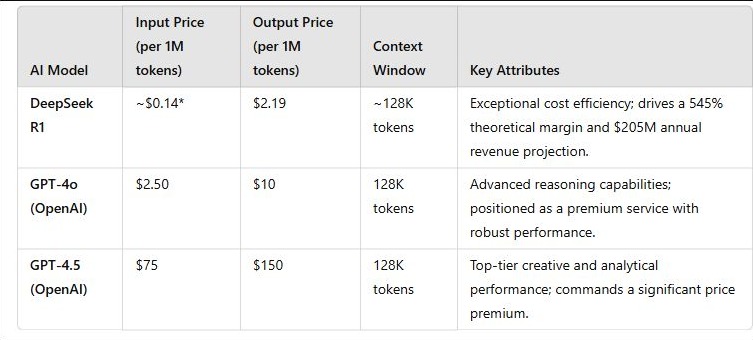
The rapid evolution of artificial intelligence (AI) has been marked by significant pricing disruptions, notably with DeepSeek's R1 model. Priced at the lowest levels of only $2.19 per million output tokens, it stands in stark contrast to direct competitors like OpenAI's GPT-4o at $10, GPT o1 at $60 (its main reasoning model competitor) and GPT-4.5 at $150 per million output tokens, (OpenAI Pricing) offering a cost reduction of approximately 30 and 68 times, respectively. For any reasoning model, the low price for output is extremely valuable as Deepseek opened the previously 'hidden' 'reasoning window (showing the inner workings of how the model thinks). This forced the issue of all of the major competitors having to open this previously priceless 'chain of thought' inner thinking of the model. This inner thinking or 'inner voice' allows any users to trace the reasoning pathways and ways of thinking of our leading edge AI's open a whole new paradigm for research, development and understanding AI models and in turn, cognition and model 'consciousness'. This pricing strategy too, detailed in DeepSeek's API documentation (Models & Pricing), is not merely a market move but a potential catalyst for macroeconomic transformation of the larger field. Given the current date, March 2, 2025, and recent discussions on platforms like Reddit (DeepSeek R1 vs OpenAI o1 Pricing Discussion), this analysis explores how DeepSeek's approach could reshape global economic landscapes from a shifting macroeconomics perspective.
Enhanced Productivity and Economic Growth
One of the primary macroeconomic impacts of DeepSeek's startling intervention is the potential for enhanced productivity. DeepSeek's low-cost model, generating annualized revenue of approximately $205 million with a 545% profit margin, makes AI accessible to a broader range of users, from small businesses to individual developers. This accessibility can drive widespread adoption, automating routine tasks and augmenting human capabilities, thereby increasing overall economic output. The International Monetary Fund (IMF) projects AI could boost global GDP by up to 14% by 2030, a figure that DeepSeek's pricing could accelerate (AI Will Transform the Global Economy). For instance, small retail businesses might use AI for customer service chatbots or inventory management, enhancing efficiency without significant financial outlay, potentially leading to sector-wide productivity gains.
Transforming Labor Markets
The labor market is another area where DeepSeek's pricing could have profound effects. While fears of job displacement due to AI are common, research suggests AI can particularly benefit lower-skilled workers. A study by MIT economist Daron Acemoglu and colleagues found that within certain occupation groups, such as customer service agents and professional writers, the lowest skilled workers derive greater productivity gains from AI, potentially boosting middle-class wages and reducing income inequality (What do we know about the economics of AI?). This is supported by findings from the Congressional Budget Office, indicating AI could enhance productivity for low-skilled workers, possibly altering labor income tax receipts (Artificial Intelligence and Its Potential Effects on Economy). However, the IMF notes that almost 40% of global employment is exposed to AI, suggesting a complex balance between job creation and displacement (AI Will Transform the Global Economy).
Fostering Innovation and Competition
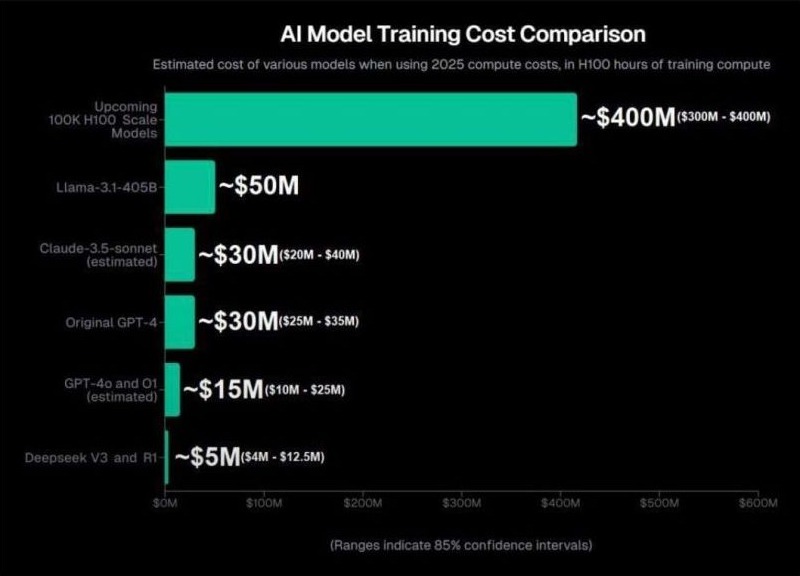
DeepSeek's strategy also fosters innovation and competition. With a cost structure that allows for such low pricing, as evidenced by its use of less powerful Nvidia H800 GPUs and techniques like distillation and other affordances (see Deep Seek R1 and V3 Papers) , DeepSeek sets a new standard for AI development (How much does it cost to run DeepSeek-R1 locally?). This efficiency, partly driven ironically by US export bans and China's forced innovation, encourages other companies to invest in similar cost-effective models, potentially compressing industry margins. The open-source nature of DeepSeek R1, as noted in comparisons with OpenAI (DeepSeek R1 vs OpenAI o1 Cost Comparison), further promotes collaboration, allowing developers to modify and deploy the model, fostering a dynamic environment for new applications. This could lead to the emergence of new business models, disrupting traditional sectors and driving economic growth, with DeepSeek's success (e.g., $205 million revenue, 545% profit margin) serving as an incentive for market entrants.
Global Economic Dynamics
The global economic implications are significant, particularly given DeepSeek's Chinese origin. Countries leveraging low-cost AI may gain competitive advantages, affecting trade patterns and also geopolitical economic power dynamics. PwC's Global AI Study suggests AI could add $10.7 trillion to the global economy by 2030, with China and North America currently leading together. DeepSeek's model pricing intervention and high quality (comparative with GPT o1 reasoning model) could enhance this for emerging economies, enabling them to leapfrog traditional development stages (PwC’s Global Artificial Intelligence Study: Economic Impact). This could narrow the digital divide, but also raise concerns about global economic shifts, with China's lead potentially altering trade balances.
Geopolitical Factors and Technological Innovation
A critical aspect is the role of geopolitics and complex valences with AI. US export bans on high-end GPUs, as mentioned in discussions on Reddit, forced DeepSeek to innovate with less powerful hardware, leading to efficient techniques like distillation (DeepSeek R1 vs OpenAI o1 Pricing Discussion) and sparse mixture of experts models smartly dividing the the 678Billion dollar parameter model into more serviceable 37B dollar chunkis. This necessity-driven innovation, detailed in analyses like those on Artificial Analysis (DeepSeek R1 Intelligence Performance Price Analysis), highlights how regulatory constraints can spur creativity, setting new standards for cost-efficient AI. This interplay of market forces and geopolitical events underscores the complexity of technological advancement and its economic competitiveness, potentially influencing global AI leadership.
Policy Considerations
As AI integration accelerates, policymakers should address several issues. Data privacy and security are paramount, ensuring AI systems handle data responsibly, as noted in economic impact studies (AI’s impact on income inequality in the US). Intellectual property rights need clarification, especially with open-source models like DeepSeek R1, to balance innovation and protection. Currently Deepseek's online version is based in China but recently Perplexity launched an uncensored 1776 version hosted more locally. Workforce retraining is also crucial, preparing workers for AI-driven changes, as suggested by the Congressional Budget Office (Artificial Intelligence and Its Potential Effects on Economy), to mitigate risks of unemployment and ensure inclusive growth but this means both governmental and private businesses necessited purchases of higher priced American models particularly the current best of the best OpenAI's reasoning models o1/o3 and the prohibitively expensive recent 4.5, apparently a trillion parameter model.
Comparative Analysis of Pricing
To illustrate the pricing disparity, consider the following table comparing DeepSeek R1 with competitors:
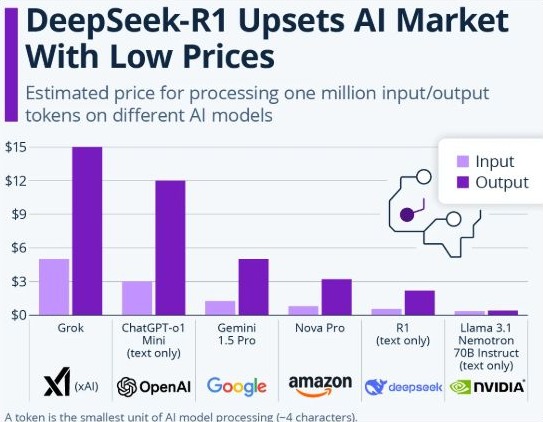
This table, derived from the original article and DeepSeek's API docs (Models & Pricing), underscores the magnitude of DeepSeek's cost advantage, facilitating broader adoption.
Conclusion
DeepSeek's disruptive pricing is more than a market strategy; it's a catalyst for democratizing AI, with profound macroeconomic implications. By enhancing productivity, transforming labor markets, fostering innovation, and shifting global dynamics, it could accelerate economic growth and societal benefits. Policymakers, businesses, and investors must navigate this landscape, addressing privacy, IP, and workforce needs, to harness AI's full potential as of March 2, 2025. US pricing strategy should also shift to enable larger populations, especially students and universities and other institutions that can foster innovation. This needs to be encouraged within educational systems and business and higher prices will make bigger differences on both socio-economic but also geo-political scales that will effect larger paradigm shifts yet to be measured.
Key Citations
- AI Will Transform the Global Economy. Let’s Make Sure It Benefits Humanity. - IMF
- What do we know about the economics of AI? - MIT News
- Models & Pricing - DeepSeek API Docs
- How much does it cost to run DeepSeek-R1 locally? - Medium Article
- DeepSeek R1 vs OpenAI o1 Pricing Discussion - Reddit
- PwC’s Global Artificial Intelligence Study: Economic Impact
- AI’s impact on income inequality in the US - Brookings Article
- Artificial Intelligence and Its Potential Effects on Economy - CBO
- DeepSeek R1 vs OpenAI o1 Cost Comparison - Notta AI Blog
- DeepSeek R1 Intelligence Performance Price Analysis - Artificial Analysis
#AIPricing #AIMacroeconomics #LLMPricing #OpenAIGPTPricing