Simplified Podcast Overview of Entire Series https://notebooklm.google.com/notebook/7ff5222c-441d-4397-8d43-54f510d1c0e5?_gl=1*ndqjdg*_ga*NzczNDc0MTc5LjE3NDc1MzE1NzI.*_ga_W0LDH41ZCB*czE3NDc1ODQzNTYkbzIkZzAkdDE3NDc1ODQzNTYkajYwJGwwJGgwJGRRUHJRc2s2U2E3ZmdxdjRXbGRpd1NxSzlTTW1sNGtRZUhR&pli=1&authuser=0
V. Knowledge Worker Adaptation Strategies: The Remix
In 1835, a group of skilled handloom weavers in Yorkshire, facing displacement by mechanical looms, formed a cooperative that pivoted from production to retail—creating one of the first consumer cooperatives as an adaptive response to technological disruption. Their pivot wasn't merely changing jobs but transforming their relationship to the value chain—moving from making cloth to curating and selling it. Nearly two centuries later, knowledge workers face similar displacement pressures but with fewer historical templates to follow. The adaptive strategies that emerged during industrialization—guild protection, collective bargaining, skill specialization—evolved across generations. Today's algorithmic displacement compresses adaptation timeframes from generations to months, requiring more immediate strategic responses.
Rather than presenting abstract biological concepts, let's examine three concrete strategies emerging among successful knowledge worker adaptations: skill remixing, centaur teaming, and environment crafting.
Skill Remixing: New Combinations from Existing Elements
Just as DJs create new music by combining existing tracks, forward-thinking knowledge workers create value by remixing their professional capabilities in response to algorithmic disruption. This isn't merely transferring skills but recombining them in ways that complement rather than compete with AI capabilities.
Consider legal professionals navigating the rise of contract analysis algorithms. Partners at firms like Latham & Watkins aren't merely surrendering document review to machines; they're remixing their analytical training toward higher-order case strategy. While algorithms identify contractual patterns, human attorneys focus on what Charles Dickens satirized in "Bleak House" as the true essence of legal practice: the human elements that algorithms cannot grasp. A senior partner at Gibson Dunn described this remix: "The AI handles the 'what' of contract terms, freeing us to focus on the 'why' and 'what if'—the negotiation leverage points, relationship dynamics, and strategic positioning."
This remixing manifests in specific daily practices. The lawyer who previously spent eight hours reviewing discovery documents now spends two hours evaluating algorithmic findings and six hours determining how those findings affect negotiation strategy. Instead of tracking contractual clauses, they track emotional responses in mediation. Rather than merely identifying precedents, they craft narrative frameworks that position those precedents within compelling human stories that resonate with judges and juries.
Similar remixes appear across professions. Radiologists at Massachusetts General Hospital now spend less time identifying anomalies in images (increasingly handled by algorithms) and more time integrating those findings with patient narratives and treatment planning. As one physician put it, "The algorithm detects the tumor; I determine what that tumor means for this specific patient's life." Financial analysts at BlackRock spend less time constructing spreadsheet models (increasingly automated) and more time determining which questions those models should address—what investment strategist Aswath Damodaran calls "moving from data processing to question formulation."
This skill remix isn't merely adapting to technology but transforming professional identity in response to changed possibilities. The journalist who previously identified as fact-gatherer now identifies as sense-maker. The professor who previously identified as content-deliverer now identifies as wisdom-cultivator. The programmer who previously identified as code-writer now identifies as system-architect.
The success of these remixes depends on what pop psychologist Malcolm Gladwell might call "pattern recognition 2.0"—the ability to see which aspects of professional training can be repurposed in algorithmic environments. Remember the Walkman? When streaming music arrived, Sony executives saw only competition for portable audio, while Apple recognized the opportunity to remix portable audio with digital libraries and touch interfaces, creating the iPod. Similarly, knowledge workers who see AI as merely replacing specific tasks miss opportunities to remix their capabilities into new professional identities.
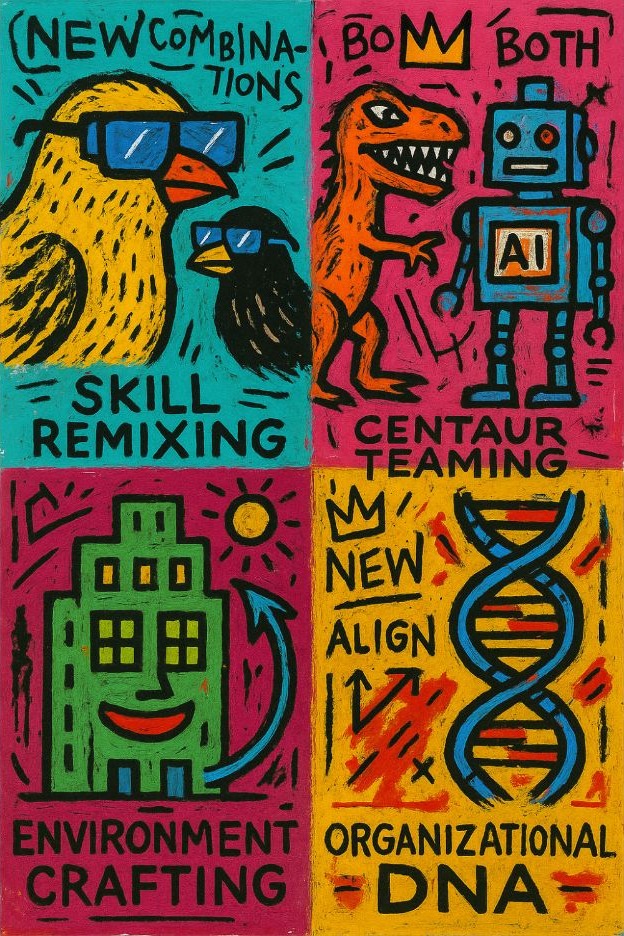
Hopeful examples of successful remixes abound across sectors. Journalists at ProPublica remixed traditional investigative skills with data science to create algorithm accountability reporting—investigating the social impacts of algorithmic systems. Teachers in Finland's phenomenon-based learning approach remixed subject expertise with facilitation skills to guide student-led, AI-augmented project work. Architects at Bjarke Ingels Group remixed design skills with environmental science to create "hedonistic sustainability"—buildings that improve environmental outcomes while enhancing human experience.
Centaur Teaming: Human-AI Partnerships That Amplify Both
In chess, "centaur" teams—humans and AI working in partnership—consistently outperform either humans or AI operating alone. This hybrid approach, which former world chess champion Garry Kasparov calls "advanced chess," offers a model for knowledge worker adaptation across domains. Rather than competing against AI (a losing proposition in many specialized tasks) or surrendering to it (abandoning distinctly human contributions), centaur teaming creates partnerships that amplify both human and algorithmic strengths.
Medical diagnosis offers a particularly clear example. A 2023 study published in Nature Medicine demonstrated that radiologists using AI assistance detected 90% of lung nodules, while AI systems alone detected 79% and radiologists alone detected 73%. Why does this partnership outperform either component? Because the intersection of human and algorithmic capabilities captures strengths while mitigating weaknesses of each:
- Humans excel at: contextual understanding, anomaly detection, patient rapport, treatment integration
- AI excels at: pattern recognition, consistency, recall of research literature, quantitative precision
- Together, they create capabilities neither possesses alone: contextualized pattern recognition, precision with exceptions, quantitative reasoning with qualitative understanding
This centaur approach appears in research teams at the Allen Institute for AI, where human scientists formulate research questions and theoretical frameworks (where humans excel) while algorithms identify relevant literature and pattern-map findings (where machines excel). The resulting publications show higher citation impact precisely because they combine human creativity in question formulation with algorithmic thoroughness in literature review—what computer scientist Ben Shneiderman calls "human-centered AI."
The partnership works because each component handles what cognitive scientists call its "home domain." The spreadsheet was never really about calculation (which computers always did better) but about human financial modeling—creating structured representations of complex systems. Similarly, AI's value isn't replicating human cognition but extending it in specific directions—handling tasks like large-scale pattern recognition that humans find difficult while leaving contextual judgment and purpose-setting to human partners.
Successful examples of centaur teaming include:
- Marketing teams at Ogilvy pairing copywriters with generative AI to produce variations on creative concepts, with humans setting strategic direction and evaluating outputs
- Urban planners in Barcelona combining algorithmic traffic simulations with human evaluations of street-level experience to create "superblocks" that optimize both traffic flow and community experience
- Musicians like Holly Herndon collaborating with voice-modeling AI to create compositions neither human nor machine could produce independently
This partnership approach requires what AI researcher Fei-Fei Li calls "human-in-the-loop" thinking—designing workflows where human judgment remains central while algorithmic capabilities extend specific cognitive functions. The resulting centaur teams don't merely survive in algorithmic environments but thrive precisely because they leverage complementary capabilities.
Environment Crafting: Building Cognitive Ecosystems That Favor Human Strengths
Just as beavers construct dams that create favorable ecosystems, knowledge workers can construct professional environments that leverage distinctly human capabilities while incorporating algorithmic strengths. This isn't merely adapting to technological change but actively shaping it to enhance rather than diminish human contribution.
The beaver's dam doesn't just provide shelter; it creates a pond ecosystem that benefits the entire watershed—regulating water flow, preventing erosion, creating habitats for diverse species, and even preventing forest fires by maintaining moisture in surrounding areas. Similarly, well-crafted professional environments don't just protect individual jobs but create ecosystems where human capabilities flourish alongside algorithmic ones.
Successful examples demonstrate this ecosystem-building approach:
In journalism, reporters at The Associated Press crafted a specific division of cognitive labor: algorithms generate routine financial reports (earnings announcements, sports scores, property transfers) while human journalists focus on investigative work, narrative crafting, and source relationship development. This isn't merely automating "routine" stories but deliberately creating a professional ecosystem where algorithmic capabilities handle information processing while human capabilities handle meaning-making. AP executive editor Sally Buzbee described this as "freeing journalism to be more human"—redirecting reporter attention from data compilation to contextual understanding and accountability reporting.
In education, teachers at Michigan's Lindsay Unified School District crafted a competency-based learning environment where algorithms deliver content and track progress while human teachers focus on motivation, conceptual scaffolding, and social development. This environment doesn't merely automate instruction but creates an educational ecosystem where technology handles information transmission while human teachers cultivate wisdom, purpose, and relationship—what educational philosopher Nel Noddings calls "care ethics" in teaching.
In healthcare, oncologists at Memorial Sloan Kettering constructed treatment protocols where algorithms analyze genomic data and research literature while physicians integrate this analysis with patient values, comorbidities, and life circumstances. Oncologist José Baselga described this as creating "data-rich, wisdom-guided treatment"—an ecosystem where algorithmic capabilities handle data processing while human physicians handle meaning integration. The protocols specify exactly when algorithmic recommendations should be followed (standardized cases) versus when human judgment should override them (complex comorbidities, quality-of-life tradeoffs, value conflicts).
These environment-crafting approaches succeed because they don't merely react to technological change but actively shape it toward human flourishing. The journalist who crafts a role focused on algorithmic accountability, the teacher who crafts learning experiences centered on wisdom cultivation, the physician who crafts treatment protocols integrating data with values—each creates professional ecosystems that enhance rather than diminish human contribution.
These three strategies—skill remixing, centaur teaming, and environment crafting—provide concrete frameworks for knowledge worker adaptation. Yet their success depends increasingly on organizational contexts that either facilitate or impede these approaches. The solitary knowledge worker, regardless of individual adaptive capacity, faces constraints when embedded in organizations designed for previous technological paradigms.
VI. The Path Forward: New Organizational DNA
The Galapagos finches that prompted Darwin's insights didn't evolve in isolation but within ecosystems that shaped their adaptive possibilities. Similarly, knowledge worker adaptation occurs within organizational ecosystems that either accelerate or impede evolutionary processes. Organizations designed for industrial-era productivity—with rigid hierarchies, specialized job functions, and standardized workflows—create selection pressures misaligned with algorithmic environments. By contrast, organizations deliberately designed for adaptation create contexts where individual knowledge workers can successfully navigate technological disruption.
Traditional organizational structures follow what media theorist Neil Postman called "technopoly" logic—subordinating human capabilities to technological imperatives. The factory subordinated human physicality to mechanical rhythms; the early office subordinated human cognition to information processing routines. Today's algorithmic workplace threatens similar subordination unless deliberately designed otherwise.
Forward-thinking organizations are developing new structures specifically designed to enhance human-AI complementarity rather than competition. These approaches fall into three categories: fluid teams, contribution metrics, and augmentation cultures.
Fluid Teams: Adaptive Structures for Changing Environments
Netflix's approach to team formation offers a particularly accessible model of adaptive organization. Rather than fixed departments with stable membership, Netflix uses what CEO Reed Hastings calls "high-alignment, loose coupling"—clear shared objectives with flexible team composition that adapts to changing circumstances. Teams form around specific challenges rather than fixed functions, with membership evolving as needs change. This organizational fluidity—resembling what biologists call "distributed resilience"—creates selection pressures favoring adaptability over specialization.
When front-line teams directly sense environmental changes (including technological disruption), they can rapidly reconfigure skills and processes without waiting for hierarchical approval. Netflix's "keeper test"—asking managers whether they would fight to keep each team member if they tried to leave—creates continuous selection pressure for evolving rather than static capabilities. This fluid approach selects for knowledge workers who combine domain expertise with adaptive versatility—precisely the combination gaining advantage in algorithmic environments.
Similar patterns emerge in organizations across sectors. Shopify's "pods" approach replaced traditional e-commerce functions with cross-disciplinary teams that combine technical and domain expertise. GitHub's open allocation system allows engineers to select which projects they work on rather than receiving assignments through hierarchical channels. What these organizations share isn't a specific structure but selection pressures favoring what biologist Stuart Kauffman calls "evolvability"—the capacity to adapt to unpredicted environmental changes.
Contribution Metrics: Measuring What Matters in Algorithmic Environments
Traditional performance metrics—inherited from industrial manufacturing—often measure knowledge worker value through productivity proxies like output volume, processing speed, and standardization. These metrics create selection pressures favoring precisely the skills most vulnerable to algorithmic displacement. By contrast, organizations developing what management theorist Peter Drucker presciently called "contribution metrics" select for distinctly human capabilities that complement rather than compete with algorithmic strengths.
Basecamp's "hill chart" approach to project management illustrates this shift. Rather than measuring progress through quantitative completion metrics, hill charts visualize progress through exploration and implementation phases—recognizing that determining what should be built often proves more valuable than execution itself. This approach selects for knowledge workers who excel at problem framing rather than merely task completion—skills increasingly complementary to algorithmic capabilities.
Similarly, Bridgewater Associates' "dot collector" system evaluates employees on criteria like independent thinking, intellectual curiosity, and creative disagreement rather than merely productivity or compliance. This creates selection pressures favoring distinctly human capabilities like conceptual innovation and critical evaluation rather than routine task execution. Pixar's "plussing" culture—where team members are evaluated on their ability to build on others' ideas rather than merely executing assigned tasks—similarly selects for collaborative enhancement rather than individual productivity.
When knowledge workers receive recognition for question formulation, contextual judgment, and collaborative enhancement rather than merely process execution, the selection landscape shifts toward sustainable human advantage. Organizations at the forefront of this shift—like Microsoft's research division, which explicitly evaluates researchers on question quality rather than merely publication quantity—create selection environments favoring sustainable human advantage.
Augmentation Cultures: Selecting for Human-AI Synergy
The most forward-thinking organizations are developing what computer scientist Douglas Engelbart called "augmentation cultures"—environments specifically designed to enhance human capabilities through appropriate technological integration. Unlike automation cultures (which prioritize human replacement) or resistance cultures (which reject technological assistance), augmentation cultures deliberately select for human-AI synergy.
Epic Games' creative workflow exemplifies this approach. Rather than replacing artists with AI generation tools, Epic integrates these tools into creative processes where human artists establish conceptual direction and aesthetic judgment while algorithms handle execution aspects like texture generation and background elements. This creates selection pressures favoring human capabilities in creative direction and aesthetic evaluation rather than merely technical execution.
Similarly, Lego's Future Lab combines human designers (who determine play value and conceptual frameworks) with algorithmic design tools (that optimize structural integrity and manufacturability). This integration creates selection pressures favoring human capabilities in play experience design and emotional engagement rather than merely technical design aspects.
The emerging divide between augmentation and replacement approaches resembles what evolutionary biologists call a "speciation event"—the divergence of populations into separate evolutionary trajectories. Organizations pursuing replacement—using algorithms to substitute for human judgment—create one trajectory; those pursuing augmentation—using algorithms to enhance human judgment—create another. These divergent approaches don't merely reflect different technological strategies but fundamentally different conceptions of value creation and human contribution.
This organizational bifurcation creates what pop culture has recognized in films like "Her" and "Ex Machina"—a profound question about whether technology serves human flourishing or human obsolescence. The path organizations choose shapes not just their own futures but the broader landscape for knowledge worker adaptation. Those creating augmentation cultures—where technology enhances rather than replaces human capabilities—establish evolutionary niches where knowledge workers can thrive rather than merely survive in algorithmic environments.
The choices facing organizations today echo what Stephen Jay Gould called "punctuated equilibrium"—periods of rapid change following relative stability. For decades, knowledge work organization relied on management principles derived from industrial manufacturing. Today's algorithmic capabilities disrupt that equilibrium, requiring new organizational approaches that measure, develop, and leverage distinctly human capabilities. The organizations pioneering these approaches—creating fluid teams, contribution metrics, and augmentation cultures—establish new selection environments that favor sustainable human advantage.
VII. Conclusion: A New Humanism
When Darwin published "The Origin of Species" in 1859, he concluded with a remarkably optimistic passage: "There is grandeur in this view of life... that, whilst this planet has gone cycling on according to the fixed law of gravity, from so simple a beginning endless forms most beautiful and most wonderful have been, and are being, evolved." This perspective—finding beauty in adaptation rather than fearing displacement—offers wisdom for our own evolutionary moment. Darwin wrote these words amid Victorian anxiety about humanity's place in nature; they remind us that evolutionary pressure often reveals unexpected possibilities rather than merely threats.
The Darwinian pressures reshaping knowledge work don't merely threaten displacement but catalyze redefinition of human value. Throughout technological history, automation has consistently eliminated certain human functions while simultaneously creating space for new expressions of human capability. When agricultural machinery reduced demand for manual harvesting, it created capacity for increased education. When calculators automated arithmetic, they enabled focus on higher mathematical reasoning. When word processors eliminated typing pools, they created space for more substantive editorial contribution.
Today's algorithmic systems similarly eliminate certain knowledge functions while potentially expanding others. As LLMs automate routine content generation, they simultaneously create capacity for more meaningful human contributions:
- Content evaluation - Determining which machine-generated outputs deserve attention and which mislead
- Contextual application - Understanding how generalized knowledge applies to specific circumstances
- Purpose alignment - Ensuring technological capabilities serve meaningful human objectives
These expanded functions transform what philosopher Hannah Arendt called the human condition. In the age of AI, Arendt's distinctions between "labor" (routine reproduction of existence), "work" (creation of durable goods), and "action" (participation in shared meaning-making) take new significance. Algorithmic automation increasingly handles labor functions, potentially freeing human capacity for work and action. Yet this liberation happens only if we deliberately design for it—creating organizational and social structures that value distinctly human contribution.
In networked, AI-enhanced environments, Arendt's concept of "action" transforms from public speech in physical agoras to collaborative meaning-making in digital and physical spaces. The financial analyst who previously constructed earnings models now focuses on determining which questions deserve modeling and how resulting insights serve strategic purpose—moving from labor to action. The content creator who previously optimized for algorithmic distribution now focuses on distinctive perspective and cultural contribution—moving from labor to work. The educator who previously transmitted standardized information now cultivates wisdom, purpose, and discernment—moving from labor to action.
This shift toward meaning doesn't reflect mere sentimentality but evolutionary pressure. In algorithmic environments, meaning-making provides distinctive fitness advantage because meaning itself transcends pattern-matching. The literature professor who helps students understand not just what texts say but why they matter; the therapist who helps clients construct meaningful narratives from experience; the organizational leader who articulates purpose beyond profit—these knowledge workers contribute what Bourdieu would recognize as "symbolic capital" rather than merely technical execution. They provide what philosopher Charles Taylor calls "strong evaluation"—not just determining what can be done but what should be done.
This meaning-oriented work requires what philosopher Martha Nussbaum explicitly defines as "central human capabilities"—not just skills but capacities for distinctive human flourishing:
- Practical reason: The ability to form a conception of the good and engage in critical reflection about the planning of one's life
- Affiliation: The ability to live with and toward others, to recognize and show concern for other human beings
- Control over one's environment: The ability to participate effectively in political choices that govern one's life
- Senses, imagination, and thought: The ability to use the senses, to imagine, think, and reason in a "truly human" way
These capabilities don't compete with algorithmic functions but complement them—creating distinctly human contribution that algorithmic systems cannot replicate. The path toward developing these capabilities doesn't require rejection of technological assistance but rather its appropriate integration into expanded human agency.
This integration resembles what biologist Lynn Margulis demonstrated through endosymbiotic theory—that major evolutionary advances often come not through competition but through symbiotic combination. Margulis showed how eukaryotic cells (the foundation of all complex life) emerged when formerly independent organisms combined into more capable assemblages. The mitochondria powering our cells were once independent bacteria that joined with other cells to create entirely new capabilities. Similarly, human-AI integration may create capabilities neither possesses independently—not through competition but through appropriate combination.
This evolutionary lens offers knowledge workers—or what we might now call "meaning professionals"—a pathway not merely to survival but flourishing in algorithmic environments. The professional who remixes their skills toward distinctly human capabilities, builds centaur partnerships with algorithmic systems, and crafts environments that enhance human contribution doesn't merely adapt to technological change but participates in the evolution of human possibility. They find in technological disruption not just challenge but invitation to deeper expression of distinctly human capacity for meaning, purpose, and flourishing.
Darwin's optimistic conclusion reminds us that evolution contains beauty as well as struggle—the emergence of "endless forms most beautiful and most wonderful" through the very pressures that challenge existing adaptations. Our own evolutionary moment contains similar potential—not merely adaptation to technological disruption but expansion of distinctly human capabilities. The meaning professional who navigates this moment successfully finds in algorithmic environments not the end of human contribution but its transformation—the beginning of new expressions of human capacity that we have only begun to imagine.
Annotated Bibliography
Arendt, Hannah. The Human Condition. University of Chicago Press, 1958.
- Arendt's distinction between labor, work, and action provides a framework for understanding how algorithmic automation might shift human activity toward meaning-making rather than mere reproduction of existence.
Author, David H. "Why Are There Still So Many Jobs? The History and Future of Workplace Automation." Journal of Economic Perspectives 29.3 (2015): 3-30.
- Economist Author examines automation's complex effects on labor markets, providing key insights into which job categories face displacement versus enhancement from technological change.
Bourdieu, Pierre. Distinction: A Social Critique of the Judgement of Taste. Harvard University Press, 1984.
- Bourdieu's analysis of how aesthetic discrimination functions as cultural capital provides a framework for understanding how information discrimination similarly functions in algorithmic environments.
Darwin, Charles. On the Origin of Species. John Murray, 1859.
- The foundational text establishing natural selection as the mechanism of evolution. Darwin's careful observations of adaptation pressures and population dynamics create the conceptual framework applied throughout this essay.
Damodaran, Aswath. "Narrative and Numbers: The Value of Stories in Business." Columbia University Press, 2017.
- Finance professor Damodaran examines how valuation requires both quantitative analysis and narrative understanding, offering a framework for human-AI complementarity in financial work.
Dawkins, Richard. The Extended Phenotype: The Long Reach of the Gene. Oxford University Press, 1982.
- Dawkins expands evolutionary thinking beyond the organism itself to include all effects genes have on their environment. His concept helps us understand technologies like AI as extensions of human cognition that create feedback loops with our development.
Dickens, Charles. Bleak House. Bradbury & Evans, 1853.
- Dickens' satirical portrayal of the legal system offers insights into the human elements of law that resist algorithmic simulation, providing perspective on how legal professionals might adapt to technological change.
Engelbart, Douglas C. "Augmenting Human Intellect: A Conceptual Framework." SRI Summary Report, October 1962.
- Engelbart's pioneering work on human-computer symbiosis provides a vision for how technological capabilities might enhance rather than replace human intelligence.
Gladwell, Malcolm. Blink: The Power of Thinking Without Thinking. Little, Brown and Company, 2005.
- Gladwell's exploration of intuitive judgment and pattern recognition offers insights into distinctly human cognitive capabilities that might complement algorithmic analysis.
Gould, Stephen Jay. Punctuated Equilibrium. Harvard University Press, 2007.
- Gould's theory of punctuated equilibrium explains how periods of relative stability are interrupted by rapid evolutionary change, providing a framework for understanding accelerated adaptation in algorithmic environments.
Hastings, Reed, and Erin Meyer. No Rules Rules: Netflix and the Culture of Reinvention. Penguin Press, 2020.
- Hastings describes Netflix's adaptive organizational structure, offering insights into how organizations might design for continuous evolution rather than static optimization.
Herndon, Holly. PROTO. 4AD Records, 2019.
- Musician Herndon's collaboration with voice-modeling AI demonstrates how human-AI creative partnerships can produce work neither could generate independently.
Kasparov, Garry. Deep Thinking: Where Machine Intelligence Ends and Human Creativity Begins. PublicAffairs, 2017.
- Former world chess champion Kasparov examines how human-AI partnerships in chess outperform either component alone, offering a model for knowledge worker adaptation.
Li, Fei-Fei. "How to Make A.I. That's Good for People." New York Times, March 7, 2018.
- AI researcher Li argues for human-centered design approaches that leverage algorithmic capabilities while maintaining human agency and judgment.
Margulis, Lynn. Symbiotic Planet: A New Look at Evolution. Basic Books, 1998.
- Margulis's work on endosymbiotic theory demonstrates how major evolutionary advances often occur through symbiotic combination rather than competition, offering a model for human-AI collaboration.
McLuhan, Marshall. Understanding Media: The Extensions of Man. McGraw-Hill, 1964.
- McLuhan's analysis of how media environments shape human cognition and social organization provides a framework for understanding how algorithmic environments similarly shape adaptive pressures.
Noddings, Nel. Caring: A Feminine Approach to Ethics and Moral Education. University of California Press, 1984.
- Noddings' ethics of care provides a framework for understanding distinctly human contributions in educational contexts, offering insight into teacher adaptation to algorithmic environments.
Nussbaum, Martha C. Creating Capabilities: The Human Development Approach. Harvard University Press, 2011.
- Nussbaum's capabilities approach provides a framework for understanding human flourishing beyond mere functioning, offering insight into how knowledge workers might cultivate distinctly human capacities.
Postman, Neil. Technopoly: The Surrender of Culture to Technology. Knopf, 1992.
- Postman's critique of technological imperialism provides a framework for understanding how algorithmic capabilities might subordinate human values unless deliberately designed otherwise.
Shneiderman, Ben. Human-Centered AI. Oxford University Press, 2022.
- Computer scientist Shneiderman argues for AI design approaches that enhance rather than replace human capabilities, offering a framework for sustainable knowledge worker adaptation.
Taylor, Charles. Sources of the Self: The Making of the Modern Identity. Harvard University Press, 1989.
- Taylor's concept of strong evaluation provides a philosophical framework for understanding how meaning-making constitutes a distinctly human capability that transcends algorithmic pattern-matching.
Wang et al. "A Combined Human-AI Approach to Lung Nodule Detection Provides Superior Performance to Either Method Alone." Nature Medicine 29.4 (2023): 845-852.
- This research demonstrates how hybrid human-AI diagnostic approaches outperform either component alone, offering evidence for the effectiveness of centaur teaming in healthcare
Part I and Part II (Introduction): https://www.linkedin.com/pulse/digital-selection-darwins-ghost-machine-raymond-uzwyshyn-ph-d--pg54c