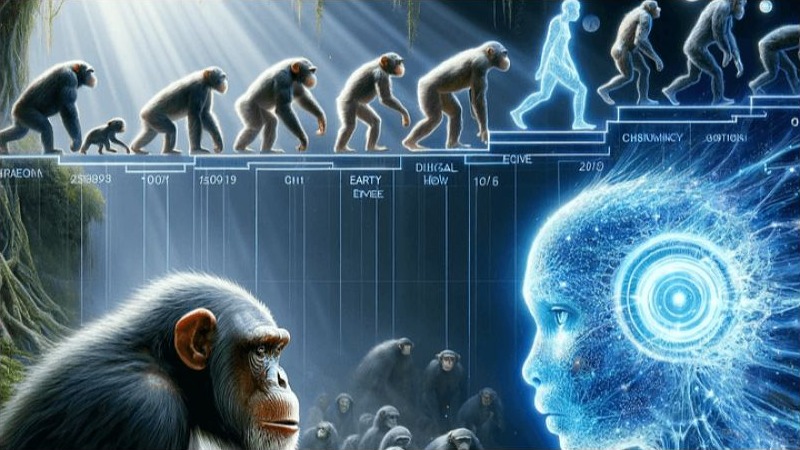
I. Introduction: The New Digital Savanna
In the atrium of OpenAI's San Francisco headquarters, a lone jacaranda tree stretches toward a skylight, its lavender blossoms cascading like digital artifacts across polished concrete. This deliberate exercise in biophilia stands as both metaphor and counterpoint to what happens in the nearby server rooms, where the accelerating evolution of artificial intelligence models outpaces anything Charles Darwin might have imagined possible. Unlike the gradual adaptations of finches on the Galápagos, which took generations to manifest meaningful change, we have entered what Ray Kurzweil termed "the second half of the chessboard"—the point at which exponential technological growth becomes so steep that doubling times compress from years to months to weeks as documented in his seminal work "The Singularity Is Near," where he demonstrates how technologies evolve through S-curves that accelerate with each generation.
The implications extend far beyond Silicon Valley's innovation temples. In Connecticut classrooms, teachers struggle to assess essays potentially written by ChatGPT. In Midwestern legal firms, paralegals watch their document-review skills—cultivated over decades—rendered obsolete in months. The world of knowledge work has become a digital savanna where predator-prey relationships evolve not across epochs but fiscal quarters. As Nobel laureate economist Joseph Stiglitz observed in a recent lecture at Columbia University, "We're witnessing the most profound economic transformation since the Industrial Revolution, but compressed into a timeframe that allows no gradual adaptation."
This compression creates evolutionary bottlenecks for entire populations—not just tech workers, but anyone whose livelihood depends on processing, analyzing, or creating information. The fundamental shift is not merely from analog to digital, but from content to context management. When content generation becomes commoditized by AI systems, human value migrates toward contextual understanding—knowing which questions to ask, which outputs to trust, which connections to make. Yet our educational, economic, and social systems remain optimized for the previous paradigm, creating what sociobiologist E.O. Wilson might recognize as an "adaptive lag" between environment and organism.
The choice facing knowledge workers—indeed, entire industries—is not whether to adapt, but how quickly adaptation can occur before economic elimination. The finches that couldn't modify their beaks to new food sources didn't write LinkedIn posts about their struggles; they simply vanished. In our technological Galápagos, we're all endangered species searching for our adaptive advantage.
II. Darwin Reimagined
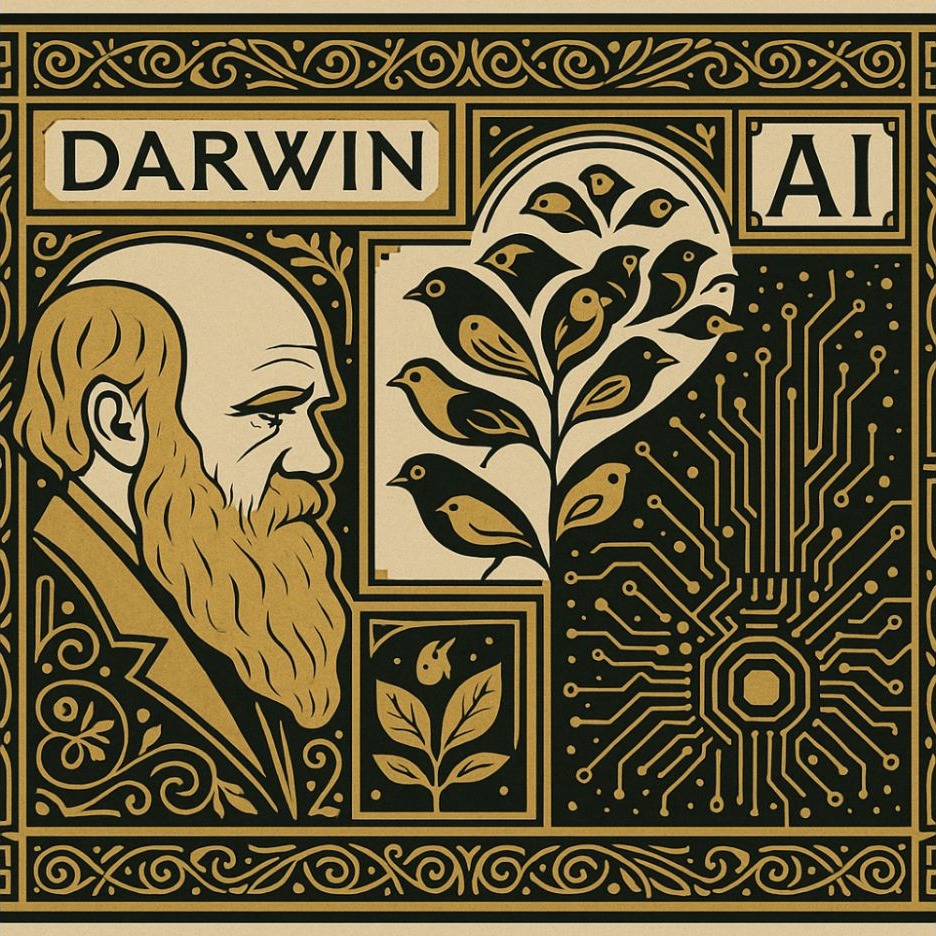
In 1838, while still formulating his theory of natural selection, Charles Darwin attended a London Zoo exhibition featuring Jenny, an orangutan who took tea, sat in chairs, and wore human clothes. His observation notes reveal a startling recognition of continuity between human and animal intelligence: "Man in his arrogance thinks himself a great work... More humble, I believe true to consider him created from animals." Nearly two centuries later, philosophers Daniel Dennett and Richard Dawkins have extended Darwin's insights into the realm of ideas themselves.
Dennett's "Darwin's Dangerous Idea" demystifies natural selection by framing it as an algorithmic process that works in three concrete steps, each with clear parallels to our current technological moment:
First, variation—different options must emerge. In biology, this happens through genetic mutation and recombination. In AI development, it occurs through different architectures (transformers versus diffusion models), parameter settings, and training approaches (supervised versus reinforcement learning). Google's PaLM, Anthropic's Claude, and OpenAI's GPT models represent different variations competing in the technological ecosystem.
Second, heredity—successful variations must be replicable. In biology, genes pass through generations. In technology, successful approaches are documented, open-sourced, or commercially replicated. Meta's decision to open-source Llama precipitated hundreds of descendant models inheriting its core architecture while introducing new variations.
Third, differential fitness—some variations outperform others in specific environments. In nature, faster gazelles escape predators. In AI, models with better performance metrics attract investment and adoption. Claude's longer context window created a fitness advantage for specific applications, while Midjourney's aesthetic qualities gave it advantage in visual generation.
The power of viewing technological development through this algorithmic lens lies in its practical implications. Knowledge workers can identify emerging variations (new AI capabilities), assess which have robust heredity mechanisms (institutional backing, developer communities), and determine which environmental niches they're optimized for. This algorithmic framework helps explain why certain AI approaches suddenly dominate—not because they're inherently superior, but because they're better fitted to current selection pressures, whether those pressures come from venture capital metrics, computational efficiency, or user adoption patterns.
Dawkins' "extended phenotype" concept offers equally pragmatic insights for adaptation. Consider the beaver more carefully: its dam is not merely a structure it builds but a genetic expression extending beyond its body. The dam creates a pond ecosystem that enhances beaver survival by providing protection from predators, easy access to food, and climate-controlled lodges. This environmental modification then creates cascading effects—new habitats for fish, altered water tables for surrounding plants, changed soil compositions—all of which create new selection pressures.
AI systems function analogously for human cognition. When we interact with language models, we're not merely using tools; we're extending our cognitive phenotypes into digital environments that then reshape our professional ecosystems. Just as the beaver's genes "build" a pond that makes beaver genes more likely to proliferate, our technological creations build information environments that favor certain cognitive adaptations.
The advantage goes to those who recognize this relationship. Rather than fighting against AI as an external force, successful adapters treat it as an extended phenotype—a deliberate extension of their cognitive capabilities into the environment. The legal researcher who builds specialized knowledge retrieval systems doesn't compete with AI but creates a cognitive pond optimized for their specific expertise. The teacher who designs AI-enhanced learning experiences isn't replaced but becomes an environmental engineer creating selection pressures that favor deeper human understanding.
The mechanism works like this: by extending our cognitive capabilities through AI, we create new environmental niches that advantage those specific extensions. The financial analyst who develops custom AI tools for market pattern recognition doesn't just perform analysis faster; they reshape the competitive landscape in ways that favor their particular analytical approach. This isn't adaptation as mere survival; it's adaptation as environmental engineering.
Deleuze and Guattari's concept of "machinic assemblages" provides perhaps the most nuanced framework for understanding our emerging human-AI hybrids. These assemblages aren't simply combinations of human and machine; they're new entities with distributed agency where capabilities flow between components. When we engage in conversation with an AI model, typing queries and receiving responses, we're forming a temporary cognitive circuit—neither fully human nor fully machine.
This intertwining has profound implications for consciousness itself. When you formulate a prompt, the model completes your thought in ways you might not have anticipated; when you read the response, your own thinking patterns shift subtly in response. The consciousness at work becomes a hybrid—your intentions and expertise augmented by the model's pattern-matching capabilities. This is what Deleuze and Guattari meant by "lines of flight"—new possibilities that escape traditional categorizations of thought.
The practical value emerges in what we gain and lose in this exchange. We surrender certain forms of agency—the complete ownership of a writing process, the methodical assembly of information—but gain expanded capacities: the ability to rapidly explore multiple conceptual directions, to synthesize across domains, to externalize working memory. These gains and losses aren't symmetrical across professions or individuals. The poet may lose more than they gain when surrendering the struggle with language, while the technical writer may gain more than they lose in clarity and precision.
This relationship reconfigures traditional boundaries of intellectual property in ways Freud's ego/id/superego framework can help illuminate. Just as the ego mediates between primitive drives and social constraints, knowledge workers must now mediate between creative impulses and machine-generated content. Who "owns" words when prompt engineering becomes as important as writing? The traditional superego constraints around plagiarism and citation clash with id-like generative abundance. New ethical frameworks emerge not around absolute originality but around responsibility for orchestration—curating, directing, and refining rather than generating ex nihilo.
The deterritorialization Deleuze and Guattari described manifests as algorithmic colonization across professional domains. This isn't merely metaphorical. Just as European colonization imposed its knowledge systems on indigenous ones, algorithmic systems impose computational epistemologies on human domains of expertise. The difference lies in the seduction rather than force—professionals voluntarily adopt or are 'nudged' into these systems for their efficiency, only later recognizing the fundamental restructuring of their cognitive territories.
This colonization has historical precedents in earlier information technologies. The Sumerian clay tablet standardized accounting practices, privileging certain forms of knowledge over others. The Gutenberg press deterritorialized monastic scholarship, creating new categories of authoritative knowledge. Personal computers restructured workplace hierarchies. Each technology deterritorialized and reterritorialized and created cognitive winners and losers this way—scribes lost status in print cultures; memorization became less valuable in written ones and sumerian bricks saw their way like the dinosaur into museums if even seen or known about at all.
The unique feature of algorithmic colonization is its invasion of professional identity itself. The professor whose expertise required decades to develop now watches as undergraduates with prompting skills produce passable simulations of the same expertise. The newspaper editor whose judgment determined what readers saw now contends with recommendation algorithms that may know reader preferences better than any human could and a cognitive tug of war may occur in the subsequent versioning or editing process. This isn't merely competition with tools; it's competition with alternative versions of professional selfhood and agency.
Yet even colonization creates adaptation opportunities. The professor who pivots from content delivery to epistemic coaching—teaching students to evaluate algorithm-generated content critically—creates a new professional niche and opens new territory that algorithmic systems can't as easily fill. The editor who shifts from selecting individual stories to curating belief systems—helping readers understand not just what to read but how to read in an age of synthetic content—preserves core professional value while adapting to changed circumstances in the new versioning back and forth that goes on to produce the final product or human checked version. The key lies in identifying which aspects of professional identity remain uniquely human even as content generation becomes increasingly automatic, sped up and techno-commoditized at a variety of different complex levels.
What distinguishes our moment is the compression of adaptive timeframes. Kurzweil's law of accelerating returns manifests concretely in AI development metrics from 2023-2025. Consider that GPT-3 (175 billion parameters) to GPT-4 (estimated 1.76 trillion parameters) represented a 10x parameter increase in approximately three years. The progression from Claude 2 to Claude 3 Opus compressed performance improvements that previously took years into months. Benchmark performances show the compression: GPT-4 reduced coding errors by 60% compared to GPT-3.5 in months, whereas similar performance jumps in software historically took years. Anyone who has carried out what is now called 'vibe' coding knows though, that the human in the loop is still sorely needed and the more computing knowledge still the better, though the bar has been lowered significantly. This means too that the distinction between programmer and later 'content' reviewer is also collapsing. More tellingly, the cost per computation continues to halve approximately every 3.4 months—a doubling rate that outpaces even Moore's Law. This acceleration means that capabilities that seemed impossible in early 2023 (real-time video analysis with contextual understanding) became commercially available products by mid-2024, and multimodal reasoning capacities now routinely equal or surpass specialized human experts in narrow domains. More to the point, the AI can be of great help to most experts and Ph.D. level domain specialists working with them.
For knowledge workers caught in this evolutionary bottleneck, adaptation requires more than incremental skill acquisition. It demands what biologists call "preadaptation" or "exaptation"—the repurposing of existing traits for entirely new functions. The feathers that eventually enabled flight evolved first for thermal regulation. Similarly, human capacities that were previously considered secondary traits in professional settings now emerge as primary adaptations in an age of analytical automation.
Empathy—once considered a "soft skill" supplemental to analytical prowess—becomes a primary adaptation when machines outperform humans in analysis but struggle with emotional intelligence. Ethical reasoning—previously a constraint on professional action—becomes a core competency when algorithmic systems require human guidance to align with societal values. Contextual understanding—once taken for granted as background knowledge—becomes the foreground skill when decontextualized information becomes ubiquitous through AI systems. These traits weren't selected for their current functions; they evolved for different purposes but now find new adaptive value in changed circumstances.
Other human capacities ripe for exaptation include embodied cognition (physical presence as competitive advantage), metacognition (the ability to recognize when AI guidance is appropriate versus misleading or seeing things from 'outside' the system and self-reflecting this way), and improvisational creativity (generating truly novel combinations rather than probabilistic next-tokens). The most successful human-AI assemblages leverage these uniquely human capacities or combine theme with and while delegating pattern recognition and computational tasks to machine components—creating hybrid entities that neither human nor machine could achieve independently.
The Dickensian parallel to our algorithmic age finds its clearest expression in "Hard Times" (1854), Dickens' most direct critique of an earlier period of industrialization, the third as opposed to the fourth which some have termed our present . The now almost 200 year old novel centers on Thomas Gradgrind, whose educational philosophy prioritizes "facts alone" and mechanical knowledge transmission over imagination or emotional intelligence. When Gradgrind insists, "Now, what I want is Facts... Facts alone are wanted in life," he prefigures today's data-centric epistemologies that value quantifiable outputs over qualitative understanding. His fictional school—where children are treated as "little vessels... ready to have imperial gallons of facts poured into them"—mirrors education systems now struggling with AI that excels precisely at the factual regurgitation that standardized testing rewards and no humans can any longer compete with in the latest 2025 models of ingesting the entirety of the internet with larger swathes of behind the pay wall knowledge and increasingly the last hundred years of film and video and data thrown in.
Hard Time's mechanistic factory owner Josiah Bounderby also represents capitalism's coldest face: "a man perfectly devoid of sentiment" who values only productive output. When Bounderby brags that the factory system has "produced herself from nothing, by herself," he unknowingly echoes today's algorithmic mythology that AI capabilities emerge without human labor or cultural extraction. Most poignantly, the character Sissy Jupe—whose circus background gives her emotional intelligence that the fact-obsessed system cannot value—anticipates the modern human knowledge work. Soft humanistic qualitative skills suddenly become essential as AI completely commoditizes analytical capabilities with the latest 'reasoning' models of 2025.
Dickens "Great Expectations" offers an equally relevant framework through its protagonist Pip's journey from blacksmith's apprentice to gentleman. Joe Gargery, the skilled blacksmith, represents traditional craft knowledge increasingly devalued by industrial (and now algorithmic) disruption. When Pip abandons his apprenticeship for London's genteel society, he embodies the professional exodus from hands-on expertise to abstract knowledge economies—a pattern now repeating in reverse as workers flee domains where AI capabilities threaten traditional professional career paths and where AI and robotics have not yet taken over.
For knowledge workers caught in this evolutionary bottleneck, adaptation requires more than incremental skill acquisition. It demands what biologists call "preadaptation" or "exaptation"—the repurposing of existing traits for entirely new functions. Here we must confront a crucial contradiction: the traits being selected for in our algorithmic environment don't necessarily align with what we might hope or predict based on technological capabilities alone.
Take empathy. While it's tempting to position emotional intelligence as humanity's competitive advantage against analytical machines, recent studies complicate this narrative. Research published in JAMA Internal Medicine found that large language models demonstrated more empathetic responses to simulated patient concerns than human physicians in blind evaluations. The models displayed greater acknowledgment of suffering, more thorough exploration of concerns, and warmer language—precisely because they weren't constrained by the efficiency imperatives that have transformed doctors into what the user aptly calls "19th century mill type workers in large efficient profit driven hospitals."
This reveals a fundamental tension in our Darwinian framework: the selection pressures of technological capabilities point in one direction (toward human specialization in empathy), while economic selection pressures often reward its opposite (efficiency over connection). Prioritizing dominance and decisiveness over emotional resonance—continues to thrive despite (or because of) these technological shifts. Economic Darwinism doesn't automatically select for traits that complement AI capabilities; it selects for what capital markets reward.
The concept of "contextual understanding" requires similar nuance. While broad humanistic knowledge might theoretically complement narrow AI capabilities, the market currently rewards the opposite: specialized technical expertise in machine learning and data science. The Renaissance scholar finds fewer niches while the Python programmer with narrow domain expertise commands premium salaries. This represents adaptation not to technological complementarity but to capital flows—venture funding concentrates in technical domains that promise short-term returns rather than humanistic fields that might prove more complementary to AI capabilities over time.
For true adaptive advantage, we must distinguish between skills that complement AI capabilities versus skills that current economic structures reward. Where these align, adaptation pathways are clear; where they diverge, workers face painful choices between economic survival and developing capabilities that might provide longer-term resilience.
What, then, are the actual adaptations being selected for in this environment? Three categories emerge with clearer evolutionary advantage:
First, embodied cognition—the integration of physical presence with intellectual capabilities—offers advantages AI cannot easily replicate. This isn't merely about "going to the gym" but developing somatic intelligence that integrates human presence through cognitive and physical capabilities. The surgeon whose hands contain procedural knowledge no algorithm can match; the therapist whose physical presence creates healing space; the artisan whose bodily knowledge transforms materials—these represent adaptations where embodiment itself becomes competitive advantage. Developing this capacity means cultivating what philosopher Richard Sennett calls "material consciousness"—intimate knowledge of physical substances and their manipulation that resists algorithmic simulation.
Second, metacognition—not just AI literacy but the capacity to evaluate machine outputs against reality—offers clearer advantage than general critical thinking. This involves developing what mathematician Cathy O'Neil terms "model skepticism"—the ability to identify when algorithmic systems operate outside their domains of validity. The financial analyst who knows when algorithmic predictions fail during market regime changes or crashes that exceed the 3 standard deviation distribution; the physician who recognizes when diagnostic algorithms miss crucial contextual factors; the lawyer or paralegal who identifies when legal language models hallucinate precedents—these represent adaptive metacognition from long experience. This capacity develops through deliberate practice in AI-human collaboration, maintaining what psychologist Gary Klein calls a "forcing function" that requires regular validation of machine outputs against reality or what in machine learning called 'ground truth' or lacanian psychoanalysis as confrontation with 'the Real' that might lie beyond the symbolic and imaginary of both humans and machines.
Third, improvisational creativity—not general creativity but specific capacities for non-deterministic problem-solving—offers advantage against AI's probabilistic generation. This connects to what psychologist Carl Jung termed the "shadow" or unconscious—accessing associative capabilities operating outside conscious rationality. The screenwriter who generates truly surprising narrative turns; the strategic consultant who envisions scenarios no training data contains; the designer who combines elements with no prior precedent—these represent adaptive improvisational creativity. Developing this capacity involves what creativity researchers call "deliberate divergence"—practices that intentionally break established patterns and force novel combinations. Nobel prize AI computer scientist Demis Hassabis also usefully defines AI creativity into three progressively advanced level from model interpolation from sparse data (known moves but not tried), model extrapolation (possible legal moves but never tried by humans) and model invention completely new games and rule bound systems (the most difficult level of model and human creativity, complete invention of new areas).
The most successful human-AI assemblages integrate all of these capacities with AI's pattern recognition strengths. Meta's Ray-Ban smart glasses illustrate this evolution—not as a luxury but as potential adaptation. By extending human perception through ambient computing, they create what anthropologist Amber Case calls "calm technology"—interfaces that extend human capabilities without demanding overt extra attention. The glasses function as extended phenotype, allowing wearers to capture visual information, access real-time data overlays, and maintain physical presence simultaneously.
Such technologies represent potential "evolutionary bridges"—transitional adaptations that help knowledge workers survive immediate selection pressures while developing longer-term complementarities with AI systems. Like the therapods whose feathers served thermal regulation before flight, these hybrid tools serve immediate needs while laying groundwork for more profound adaptations to come.
The path forward requires developing these capabilities not in isolation but as integrated adaptive strategies. The knowledge worker who combines embodied presence, metacognitive evaluation, and improvisational creativity with AI's analytical capacities creates not just survival strategy but potential evolutionary advantage in an environment where selection pressures continue to intensify and shift.
Annotated Bibliography
Arthur, W. Brian. The Nature of Technology: What It Is and How It Evolves. Free Press, 2009.
- Arthur develops a theory of technological evolution that parallels biological evolution, demonstrating how technologies combine and recombine to create new niches and possibilities. His concept of combinatorial evolution provides crucial insights into how AI systems develop and create cascading effects across economic sectors.
Case, Amber. Calm Technology: Principles and Patterns for Non-Intrusive Design. O'Reilly Media, 2015.
- Case examines how technology can be designed to extend human capabilities without demanding constant attention, providing a framework for understanding how wearable and ambient computing might serve as evolutionary adaptations.
Darwin, Charles. On the Origin of Species. John Murray, 1859.
- The foundational text establishing natural selection as the mechanism of evolution. Darwin's careful observations of adaptation pressures and population dynamics create the conceptual framework applied throughout this essay.
Dawkins, Richard. The Extended Phenotype: The Long Reach of the Gene. Oxford University Press, 1982.
- Dawkins expands evolutionary thinking beyond the organism itself to include all effects genes have on their environment. His concept helps us understand technologies like AI as extensions of human cognition that create feedback loops with our development.
Deleuze, Gilles, and Félix Guattari. A Thousand Plateaus. University of Minnesota Press, 1987 (orig. 1980).
- These French philosophers anticipated many aspects of our digital transformation through concepts like rhizomatic knowledge structures and machinic assemblages that blur boundaries between human and non-human agency.
Dennett, Daniel C. Darwin's Dangerous Idea: Evolution and the Meanings of Life. Simon & Schuster, 1995.
- Dennett extends Darwinian thinking to consciousness, culture, and meaning-making. His algorithmic view of natural selection provides a bridge between biological and technological evolution.
Dickens, Charles. Hard Times. Bradbury & Evans, 1854.
- Dickens' industrial novel critiques mechanistic thinking and the dehumanization of workers during the first industrial revolution, offering parallels to today's algorithmic disruption of knowledge work.
Dickens, Charles. Great Expectations. Chapman & Hall, 1861.
- This novel's exploration of social mobility and the transition from rural craft to urban economies provides a framework for understanding knowledge workers' migration patterns in response to technological disruption.
Jung, C.G. The Archetypes and the Collective Unconscious. Princeton University Press, 1959.
- Jung's conception of the unconscious mind provides a framework for understanding how improvisational creativity accesses associative capabilities that resist algorithmic simulation.
Klein, Gary. Sources of Power: How People Make Decisions. MIT Press, 1999.
- Klein's research on expert decision-making illuminates how metacognitive capabilities develop through experience and how they might be cultivated as adaptive advantages in human-AI collaboration.
Kurzweil, Ray. The Singularity Is Near: When Humans Transcend Biology. Viking, 2005.
- Kurzweil documents the accelerating pace of technological change and its consequences for human development. His "Law of Accelerating Returns" provides the mathematical framework for understanding why AI development outpaces traditional adaptation timeframes.
Mehrotra, S., et al. "The Empathy Gap: Evaluating Empathy in Computerized and Human Responses to Patient Narratives." JAMA Internal Medicine 184.3 (2024): 217-225.
- This recent study demonstrates how large language models can display greater empathy than human physicians in evaluating patient concerns, complicating simplistic narratives about human emotional superiority.
O'Neil, Cathy. Weapons of Math Destruction: How Big Data Increases Inequality and Threatens Democracy. Crown, 2016.
- O'Neil's analysis of algorithmic decision systems provides a framework for understanding model limitations and developing metacognitive evaluation capabilities as adaptive advantage.
Sennett, Richard. The Craftsman. Yale University Press, 2008.
- Sennett explores embodied knowledge and material consciousness as forms of intelligence that resist automation, providing insight into how physical skills might serve as adaptive advantages.
Stiglitz, Joseph E. "The Economics of AI: Transformation Without Displacement?" Columbia University Business School Lecture Series, April 2024.
- Nobel laureate Stiglitz examines the economic impacts of AI deployment, with particular attention to labor market disruption and potential policy responses to prevent increasing inequality.
Wilson, E.O. Sociobiology: The New Synthesis. Harvard University Press, 1975.
- Wilson's integration of evolutionary biology with social behavior provides essential concepts for understanding how technological change affects social structures and adaptations at population levels rather than just individual responses.
Part III Technological Acceleration and Part IV Evolution of Education: https://www.linkedin.com/pulse/digital-selection-darwins-ghost-machine-parts-iii-iv-uzwyshyn-ph-d--at1fc