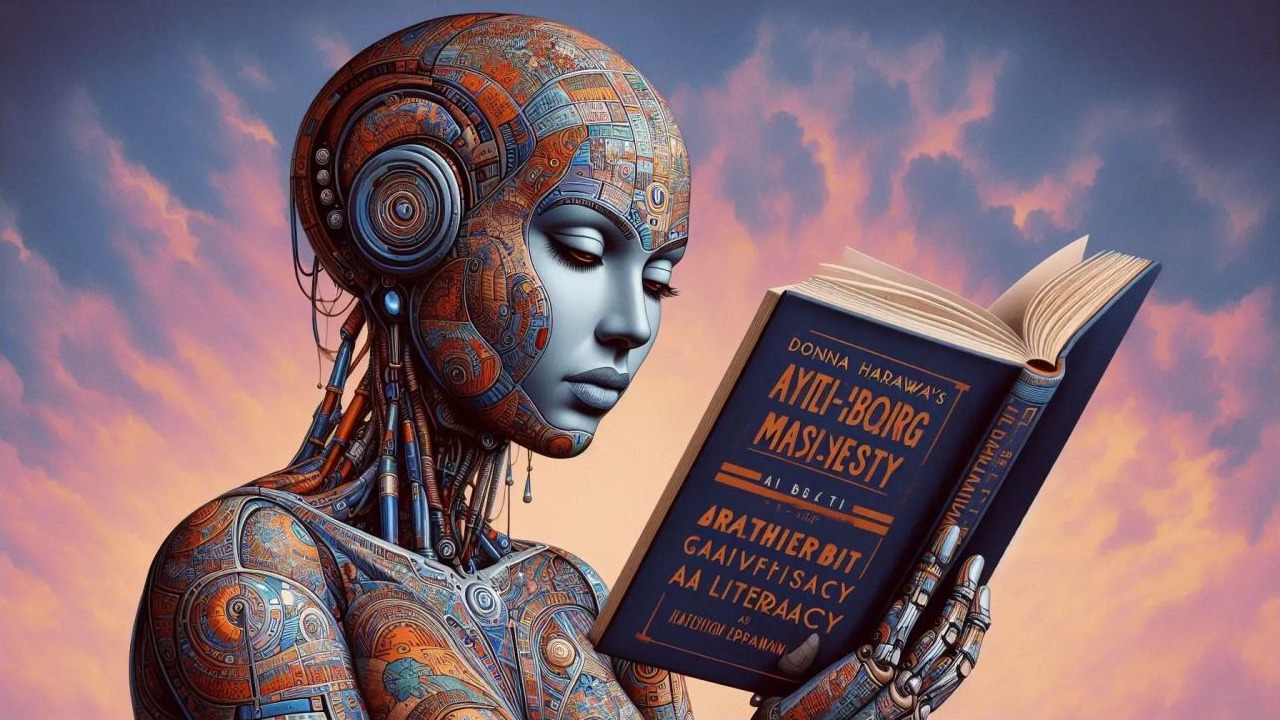
Who Is Donna Haraway and Why Does She Matter Now?
In 1985, Donna Haraway, a biologist and feminist theorist at UC Santa Cruz, published an essay that would become one of the more influential texts in science technology and society studies: "A Cyborg Manifesto." At the time, personal computers were just entering homes, the internet was still a military research project, and artificial intelligence seemed like distant science fiction. Yet Haraway saw something others missed—that the boundaries between humans and machines were dissolving. This dissolution would begin to reshape in 2025 almost everything about how we live, work, and understand ourselves.
Today, as we grapple with ChatGPT, Claude, and other AI systems that write, code, create art, and even simulate empathy, Haraway's forty-year-old insights feel startlingly current. Her "cyborg"—a fusion of human and machine—isn't just a metaphor anymore. It's our daily reality and increasingly ourselves as we think with AI, create through AI, and struggle to distinguish human-generated content from machine-generated content.
The Informatics of Domination: How Power Works Through AI
To understand why Haraway matters for AI literacy, we need to grasp her central concept: the "informatics of domination." This rather intimidating term describes a fundamental shift in how power operates in our global technological society.
Haraway argued that we've moved from an older system of control with its rigid hierarchies and clear boundaries—to something more fluid yet potentially more controlling. In her framework, the old world operated through fixed categories: you were either worker or boss, man or woman, human or machine. The new world though operated through information flows, probability calculations, and constant optimization - sound familiar. If you've been thinking at all about AI, you've probably heard a few of those terms before
Haraway provided a long and detailed chart of these transitions from one paradigm to the other which we increasingly inhabit. Where we once had "Representation" (things standing for other things), we now have "Simulation" (copies without originals) or fakes increasingly building on fakes and the real becoming a distant 'blur'. Where we once had "Organisms" (whole, integrated beings), we now have "Biotic Components" (interchangeable parts in larger systems). Where we once focused on "Reproduction" (making copies of existing things), we now engage in "Replication" (endless variation and recombination and remixing). The writer Philip K. Dick even had a special name for these types of Cyborgs. In his book which became Bladerunner, he called them 'Replicants
One of Haraways key but very complex insight in her essay was this: "Control strategies concentrate on boundary conditions and interfaces, on rates of flow across boundaries—and not on the integrity of natural objects."
Let me unpack this dense statement with a concrete AI example. When you interact with ChatGPT, the system doesn't have "integrity" as a unified being with consistent beliefs or knowledge. Instead, it manages probabilities and potentials—controlling the flow of tokens (words) based on statistical patterns learned from vast datasets, your prompts and the contexts you give it or choose to withhold. The AI model operates at the boundaries between meaningful and meaningless, between human-like and machine-like, constantly optimizing its outputs based on your inputs, the 'intra-action' between user and system generating emergent dialogue and thought. There's no "there" there—just interfaces predicting the next word and managing information flows.
This is exactly how modern AI systems work. They don't understand in any traditional sense; they manage statistical relationships between data points. Those data points also make up their 'picture' or 'constellation or 'probability' distribution of what they take to be us through our language, our words and the complex networks they create between the words the models generate. The models here operate through what Haraway presciently identified as the core mechanism of our age: the manipulation of information flows rather than the control of physical objects or defined entities.
The Integration Paradox: Why We Need New Literacies
One of Haraway's most troubling insights was that we would become integrated into technological systems we neither fully understand nor control. She called this the "homework economy"—a world where the boundaries between work and life, public and private, human and machine dissolve.Haraway borrowed the term "homework economy" from economist Richard Gordon, but she expanded it far beyond its original meaning. While Gordon focused on the literal phenomenon of electronics assembly work being done in homes, Haraway saw this as symptomatic of a broader transformation in the nature of work itself.
She argued that all work was becoming "feminized"—not in the sense of being done by women, but in taking on the characteristics traditionally associated with women's labor: "To be feminized means to be made extremely vulnerable; able to be disassembled, reassembled, exploited as a reserve labour force; seen less as workers than as servers; subjected to time arrangements on and off the paid job that make a mockery of a limited work day; leading an existence that always borders on being obscene, out of place, and reducible to sex."
The "homework" in "homework economy" operates on multiple levels:
- Literal homework: Work increasingly happens at home—a prediction that proved prescient with remote work, gig economy, and especially post-2020 hybrid arrangements.
- Work as homework: Employment becomes like school homework—never quite finished, bleeding into personal time, always subject to evaluation and optimization.
- The home as factory: The domestic space becomes a site of production. Your laptop on the kitchen table, your Ring doorbell generating surveillance data, your social media posts creating value for platforms.
- Feminized labor conditions: Work takes on the precarious, boundary-less quality traditionally associated with women's domestic labor—always on call, mixing emotional and technical labor, never fully off the clock.
Consider how this manifests in 2025: Knowledge workers check Slack from bed, answer emails during dinner, train AI systems through their interactions without being paid for this labor. The "workplace" exists everywhere and nowhere. You're never fully at work, but never fully not at work. Your home internet, your personal devices, your cognitive capacity—all become means of production you must provide yourself.
This is why Haraway found it troubling. The homework economy doesn't just exploit labor; it colonizes life itself. When she wrote that we're integrated into the "integrated circuit," she meant that we become components in a vast machine where "factory, home, and market are integrated on a new scale and... the places of women are crucial—and need to be analyzed for differences among women and for meanings for relations between men and women in various situations."
Today's AI literacy crisis exemplifies this perfectly. Recent studies show that while 83% of workers believe AI increases the importance of human skills, nearly half of Gen Z workers cannot effectively evaluate AI's limitations or identify when it's generating false information. We're dependent on systems we can't fully comprehend—integrated into what Haraway called the "integrated circuit" of global information capitalism.
This creates what she termed "stressed systems"—situations where the system "fails to recognize the difference between self and other." We see this daily: students who can't distinguish their own thinking from AI-generated text, artists whose style gets absorbed into training data without their consent, writers who lose track of which ideas are theirs and which came from their AI assistant.
The Evolution of Cyborg Writing: From Essays to Vibe Coding
Perhaps Haraway's most prescient observation was that "Writing is preeminently the technology of cyborgs." By "writing," she meant all forms of creating meaning through symbols—including what we now call coding.
We're witnessing a profound shift in what counts as literacy. Traditional prompt engineering—carefully crafting specific instructions for AI—is evolving into something more intuitive and holistic: "vibe coding" or context engineering. Instead of writing explicit commands, developers and users increasingly work through feeling and contextual understanding, managing what Haraway called "the play of writing and reading the world."
Consider how modern AI interactions work. You don't program ChatGPT with precise instructions like traditional software. Instead, you negotiate with it, managing context, adjusting tone, iterating on outputs. You're not writing code in the traditional sense—you're engaged in what might be called "context engineering," where success depends on three key elements:
- Omniscience: Understanding the whole system, its training, its biases, its capabilities
- Transparency: Seeing through the interface to grasp the underlying patterns
- Relationality: Managing the connections between different elements—your prompt, the model's training, the desired output
This represents a migration from left-brain logical thinking (step-by-step instructions) to right-brain holistic pattern recognition (managing gestalts and contexts). The essay—that cornerstone of traditional literacy—is being supplemented or even replaced by new forms: interactive applications, data-driven dashboards that merge narrative with numbers, AI-assisted creations that blur authorship.
Haraway anticipated this when she wrote about "cyborg politics" as "the struggle for language and the struggle against perfect communication." She understood that controlling these new forms of inscription—whether prompts, code, or hybrid human-AI texts—would become a new form of political power.
Response-ability: The Ethics of Being Already Compromised
One of Haraway's most challenging ideas is her rejection of innocence. The cyborg, she insists, "is not innocent; it was not born in a garden; it does not seek unitary identity." This connects to what feminist philosophers call "response-ability"—not just responsibility, but the ability to respond to and be accountable for our technological entanglements.
What does this mean practically? It means acknowledging that we're already cyborgs. Every Google search shapes the algorithm that shapes future searches. Every interaction with AI contributes to training data. We're not standing outside these systems making pure ethical judgments—we're already cyborgs, centaurs, mermaids and maenads implicated, already compromised, already part of the machine.
This doesn't mean giving up on ethics. Instead, it means what Haraway calls taking "responsibility for the social relations of science and technology." It means recognizing that every prompt we write, every dataset we create, every AI interaction we have is a small political act that shapes these systems' development. Even if we are solely taking up 'the technological' formalism completely Haraway would argue that is not enough - AI literacy means necessarily looking at the surrounding context of the system, the science, technology and society so we can be better citizens or if not that, better cyborgs.
Building Affinities, Not Identities
Traditional education often focuses on identity: you're a left brain analytical "STEM person" or a right brain "humanities person," a "digital native" or a "digital immigrant." A right wing republican tech bro or left wing liberal feminist radical and for sharper definition split down the middle by gender. Haraway proposed something radically different: organizing around affinity—chosen connections based on shared concerns rather than essentialized identities where intersectionally all kinds of different camps unexpectedly could meet in the middle with 'affective affinities'.
She drew on the work of feminist theorist Chela Sandoval to argue that effective resistance comes from "conscious coalition, of affinity, of political kinship" rather than fixed identity categories. This also has profound implications for AI literacy education.
Consider current AI education initiatives. The most successful ones bring together unlikely allies:
- Artists teaching engineers about creativity and bias and engineers teaching artist how to take up and work with new tools - together on projects for win/wins
- Children teaching adults about uninhibited AI interaction and adults pointing out the usefulness of rules and when and when they should not be broken
- Philosophers working with programmers on ethical frameworks and programmers bringing in the bigger picture in their programs to allow in the right brain 'vibes' of vibe coding and help enable them
- Indigenous communities sharing non-Western approaches to intelligence with AI researchers and AI researchers bringing in possibilities of Western approaches and technology to enable indigenous and other cultures that may be being marginalized by monocultural hegemonies (false representations of wider horizons of truth)
The expansion of AI literacy to early childhood education with both the technology and surrounding ethical and empathic human frameworks around this exemplifies this affinity model. It's not based on children's supposed identity as "digital natives" but on creating connections between diverse stakeholders (children, parents, educators, technologists) around shared concerns for the future through our evolving intra-action and co-emergence with technology.
The Line Between Education and Indoctrination
How do we teach AI literacy without falling into indoctrination—either techno-utopian cheerleading or dystopian fear-mongering, both binary sides of coin that leave little in the middle? Haraway's method of "irony" provides guidance. By irony, she doesn't mean sarcasm but rather "holding incompatible things together because both or all are necessary and true." This is the nature of truth as sometimes the deepest truths lie in the nature of contradiction that is larger enough to hold both or multiple truths together.
This means teaching AI literacy not as fixed rules but as ongoing negotiations and dialogue or 'dialogic' with the model, a developing conversation that makes sense and leads to wider understadnign . This also means helping students hold multiple truths simultaneously: AI is both empowering and controlling, both creative and derivative, both tool and agent. It means developing what Haraway calls "situated knowledges"—partial perspectives that come from a viewpoint, acknowledge transparency and forego an 'omniscient stance' and are cognizan and outward facing with their own limitations and outputs rather than claiming universal truth to the faults that lead to model 'hallucination' .
Why This Matters: The Sophistication of Haraway's Framework
Some might dismiss a 1985 crazy California feminist manifesto about cyborgs as irrelevant to today's AI challenges. They would be completely wrong. Haraway's framework and other figures from this school offer something most current AI discourse and literacy lacks: a wider way to think about human-machine relationships that avoids both extreme naive optimism towards 'abundance utopias' when we see homeless in the streets and paralyzing pessimism about AI at all costs on the other side ignoring the immense potential and amazing possibilities.
Harawys concept of the cyborg as "a creature of social reality as well as a creature of fiction" perfectly captures our current moment. AI is simultaneously a lived technical reality of the system will live in globally today (dominated by unseen algorithms, servers and code) and simultaneously a cultural fiction we also create (the stories we tell about intelligence, creativity, consciousness). Understanding both dimensions—and their interplay and 'the real' in between and the hard work of 'teasing this out' —is essential for true AI literacy.
The manifesto's notorious difficulty—its dense theoretical language, its dizzying array of references, its refusal to simplify and anxious tone—itself carries a message that we all also bare in our era today. It suggests that cyborg consciousness is demanding for everyone, requiring us to think in new ways, to hold contradictions without resolution, to navigate complexity without reducing it to simple binaries to as Haraway would put it in a later book 'stay with the trouble' as an active citizen engaged in the wold of today.
Practical Implications for AI Literacy Today
Haraway's framework suggests several practical approaches to AI literacy:
- Teach Boundaries as Fluid: Instead of presenting human and AI capabilities as firmly separate, help students understand the permeable, shifting boundaries between human and machine cognition and assemblages that make up technology networks between human and ai.
- Embrace Partial Perspectives: Rather than seeking complete understanding of AI systems (impossible given their complexity), teach students to work with partial, situated knowledge from their current positions while acknowledging limitations and striving for better understanding of the AI's 'partial' perspectives and where it is coming from.
- Focus on Flows, Not Things: Help students understand AI not as a thing but as a process—flows of data, gradients of shifting probabilities, patterns of emerging interaction depending on 'the other', the user, the person, the human and 'the cyborg'.
- Develop Response-ability: Teach students that they're not outside observers of AI but already implicated participants with a viewpoint who must take response -ability for their role in these systems using these superpowers and 'abilities' and also 'hold the systems' and networks and designers assemblages also towards perspectives of 'response' ability for 'transparency' and 'relationality' and mutual care of the system created .
- Build Affinities: Create unexpected connections across disciplines, ages, genders, AI agents and backgrounds rather than reinforcing traditional educational silos or models.
Conclusion: Living on the AI Verge
In the Cyborg Manifesto of 1985 Haraway wrote like someone on the verge—on the verge of a new world, a new consciousness, a new politics and new technologies. Her breathless concatenation of examples, her mixing of myth with technical analysis, her combination of feminism with cybernetics, analytical left brain technology with right brain ethical perspectives—all suggest someone racing to document a transformation they could feel but others couldn't yet see.
Forty years later, we're living in the techno-political cyber-social mediated world she anticipated. We are the cyborgs holding our phones for dear life, negotiating, dialoguing and intra-acting daily with AI systems, our thinking intertwined and entangled with machine intelligence, our creativity augmented, enhanced and challenged by artificial systems. The question isn't whether we'll become cyborgs—we already are. The question now is what kind of cyborgs do we choose to become.
Haraway's manifesto doesn't provide easy answers, but it offers something more valuable: a framework for beginning to think about AI literacy and our cyborg present condition that embraces complexity, acknowledges complicity, and insists on responsibility. As we develop AI literacy for 2025 and beyond, Haraways vision of ironic, situated, response-able engagement with technology remains not just relevant but essential.
The "woman on the verge" has become us and our everyday reality. The verge is now our permanent address.
#AILiteracy #DonnaHarray #AIEthics #CyborgManifesto