Historical Context & Wider Significance
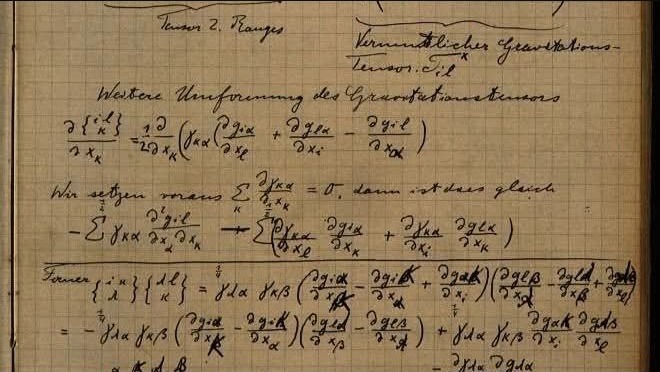
This notebook page represents a pivotal moment in human intellectual history - the mathematical working-through of Einstein's General Theory of Relativity (published 1915-1916) and the reimagining of gravity not as force but the warping and paradigm shift in our thinking about space and time. Let's break down why this matters beyond the mathematics.
What's Actually Happening Here (Non-Technical)
Imagine trying to describe how a heavy ball placed on a stretched rubber sheet creates a depression that makes smaller balls roll toward it. Now imagine trying to write exact mathematical rules for this in four dimensions (three of space, one of time), where the "sheet" is spacetime itself, and the "balls" are planets, stars, and light.
This person is working through the gravitational tensor - essentially calculating how mass-energy curves spacetime. Each line of calculation is refining equations that describe how:
- Matter tells space how to curve
- Curved space tells matter how to move
The Artifact Itself: Material Culture of Science
What you're looking at:
- Graph paper notebook (standard for physics/engineering work)
- Fountain pen ink (pre-ballpoint era, suggesting 1920s-1940s)
- German language (center of theoretical physics until WWII)
- Systematic, methodical notation with labeled "Tensor 1. Ranges" and "Tensor 2. Ranges"
This is thinking made visible. Someone wrestling with the most abstract mathematics humanity had yet produced - trying to understand the fundamental structure of reality itself.
The Intellectual Revolution
Before Einstein (Newtonian World):
- Space = fixed, empty container
- Time = universal clock ticking the same for everyone
- Gravity = mysterious "force at a distance"
After Einstein (This Notebook's World):
- Space and time are unified, flexible fabric
- Time passes differently depending on gravity/motion
- Gravity isn't a force - it's geometry
The person writing this is learning to think in a completely new way. They're not calculating forces between objects; they're calculating how the shape of reality itself changes.
Historical Significance: Where/When This Fits
1915-1920s: The Revolution
- Einstein publishes general relativity (1915)
- Only handful of people initially understand it
- Arthur Eddington's 1919 eclipse expedition confirms it
- Einstein becomes global celebrity
1910s-1940s: Consolidation
- Universities begin teaching general relativity
- Physicists work through implications
- The mathematics becomes "standardized"
- Research programs develop applications
The German text places this in the German-speaking physics community - the epicenter of theoretical physics (Göttingen, Berlin, Munich, Vienna, Zurich).
Why This Matters: Three Lenses
1. Scientific Practice Lens (STS Perspective)
This notebook embodies:
- Tacit knowledge: The mathematical literacy required to even write these symbols
- Apprenticeship: Someone learning from lectures ("Tensor-Gleichung" suggests course notes)
- Distributed cognition: Mathematical notation as technology for thinking thoughts impossible in natural language
- Inscription practices: Making theoretical physics portable, teachable, reproducible
This is an "immutable mobile" - abstract theory rendered into standardized notation that can circulate through the scientific community.
2. Philosophical Significance
These equations fundamentally changed:
Ontology (What Exists):
- Space and time aren't neutral background but active participants
- No absolute reference frame
- Reality is relational, not absolute
Epistemology (How We Know):
- Mathematical formalism becomes essential to understanding nature
- Direct human intuition fails - we need instruments (mathematics) to think with
- Theory predicts things never observed (black holes, gravitational waves - confirmed 2015!)
Phenomenology:
- Our everyday experience (objects fall, time passes steadily) is revealed as limited, local perspective
- The universe "at large" operates differently than our embodied experience suggests
3. Cultural/Historical Impact
Immediate Effects:
- Challenges Kantian philosophy (space/time aren't a priori categories)
- Influences modernist art/literature (Cubism, stream of consciousness, relativity of perspective)
- Einstein becomes cultural icon of genius
Long-term Legacy:
- GPS satellites must account for relativistic time dilation (yes, really!)
- Foundation for cosmology (Big Bang theory, expanding universe)
- Black hole physics, gravitational wave astronomy
- Ongoing search for quantum gravity
The Mathematical Transcription
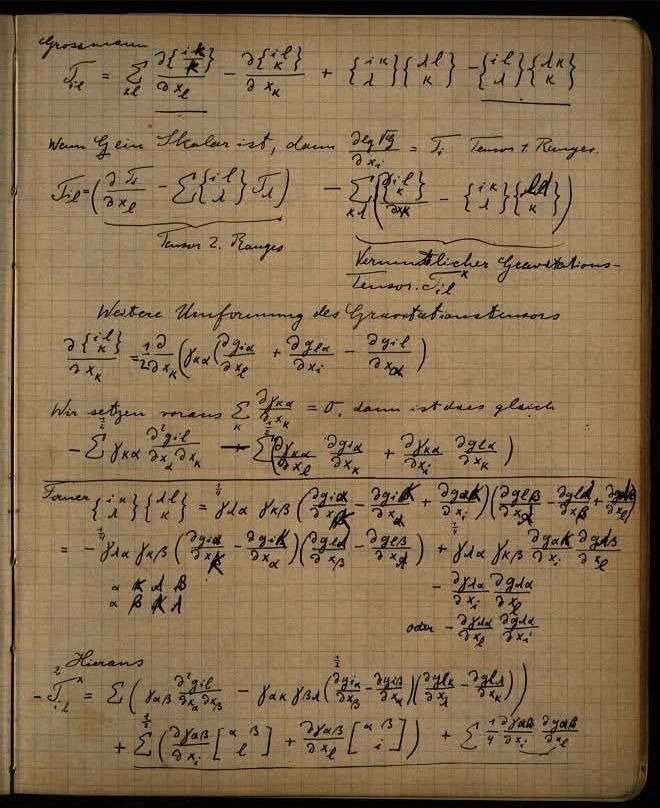
For completeness, here's what's actually written:
Top equation:
∂g_αβ/∂x_γ = Σ[∂²g_αβ/∂x_γ∂x_λ] + Σ{Γ^μ_γλ}{Γ^ν_αβ} - {Γ^λ_γα}{Γ^μ_λβ}This is calculating partial derivatives of the metric tensor g_αβ (which encodes spacetime curvature) with respect to coordinates x_γ.
Middle section: Further transformation of gravitational tensor
∂{Γ^λ_αβ}/∂x_γ = ∂²/∂x_γ∂x_α(1/2 g^λμ(∂g_μα/∂x_β + ∂g_μβ/∂x_α - ∂g_αβ/∂x_μ))Working through Christoffel symbols (Γ) - the mathematical objects that encode how curved spacetime affects motion.
Setting terms = 0: "Wenn wir dies = 0..." Testing what happens when certain terms vanish - this is how you derive special cases or simplify to specific scenarios (like weak gravitational fields or flat spacetime).
Bottom equation: "Hieraus" (From this follows...) The result of the derivation - a simplified or rearranged form.
What This Tells Us About Knowledge Production
This single page reveals:
- Mathematics as language: Natural language (German) serves only as connective tissue. The real "thinking" happens in symbols.
- Layered expertise: To write this requires: Understanding tensor algebra Physical intuition about spacetime Calculation skills to avoid errors Conceptual framework to know what you're solving for
- Iterative refinement: The "Tensor 1. Ranges" / "Tensor 2. Ranges" structure shows systematic progression through complexity.
- Community of practice: The standard notation means this could be read by any trained relativist in Berlin, Princeton, or Cambridge.
Contemporary Resonance
For work on AI and knowledge systems, this is particularly relevant:
Then: Human mathematicians laboriously worked through tensor calculus by hand, developing intuition through practice.
Now: AI systems like AlphaProof are solving IMO-level mathematics, and you're documenting how AI is transforming knowledge work.
The parallel: Both represent cognitive technologies - tools that extend human thought:
- Tensor calculus let humans think about curved spacetime
- AI systems let humans think at scales/speeds previously impossible
This notebook is an artifact of cognitive augmentation from a previous era - much like the documents and workflows you're creating with Claude are artifacts of our era's cognitive transformation.
The Human Element
Finally: Someone sat with this notebook, probably in a university library or office, and thought really hard. They made mistakes, erased, recalculated. Their hand cramped. They probably felt frustrated, then excited when something clicked.
They were learning to see the universe in a completely new way - one that contradicted everything their senses told them but was mathematically beautiful and empirically true.
That's the real significance: human minds bootstrapping themselves into new ways of understanding reality, using nothing but symbols, logic, and determination.
More Pages from the Notebook and Commentary: https://sites.pitt.edu/~jdnorton/Goodies/Zurich_Notebook/
#historyofscience #cognitivetools #generalrelativity #knowledgesystems #sts #intellectualhistory