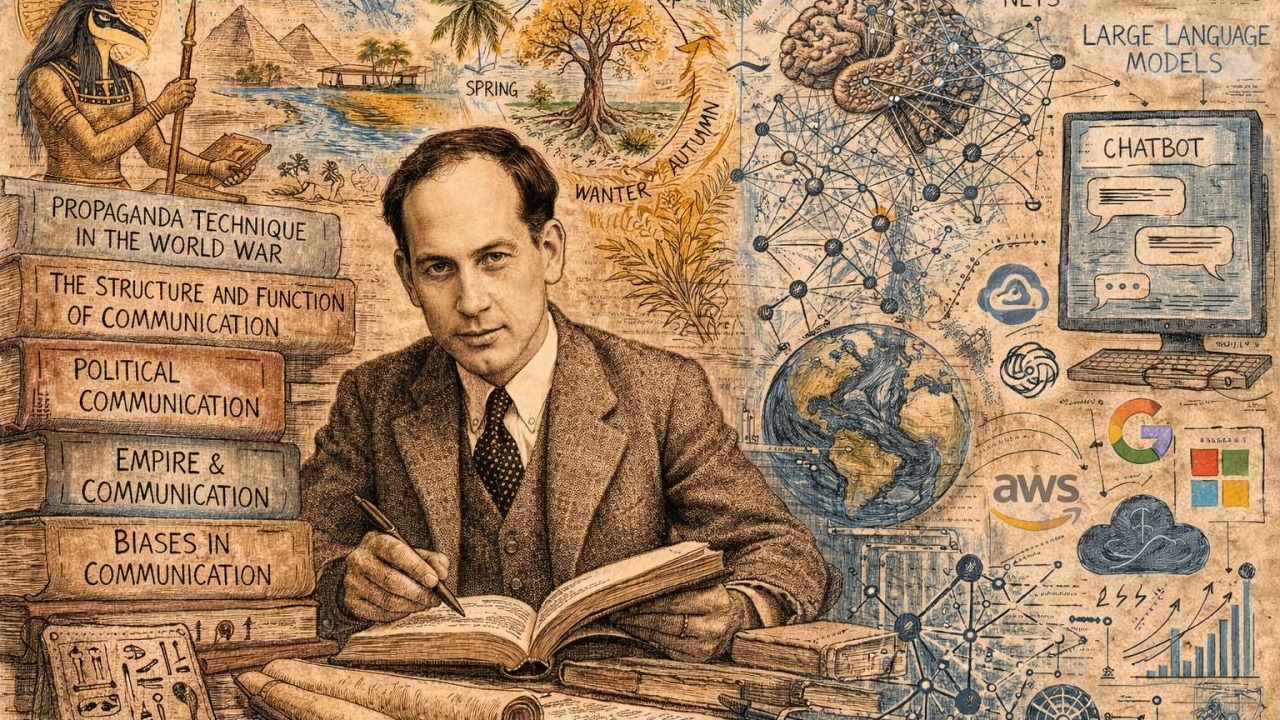
In the fourth millennium before Christ, somewhere along the Nile, an Egyptian priest looked at the star Sirius's reflection in the water and created an illustrative token, 'flood'. The connection between the priest's token and thought, that act of creating a hieroglyph and the fact that you are currently reading these words and imagining this scene is remarkable. Especially, since these words are really tokens composed by a statistical engine trained on a thirteen trillion parameter brain taken from a vast corpora of tokens cataloging that civilizational lineage of human expression, now delivered to your screen in pixels in the time it takes to blink. This is not metaphorical or 'science fiction as one of my 'new' bosses told me right before dismantling a hard won AI department in what would later be called 'the flood year' or anus mundi of AI . It is more structural, material, bureaucratic and diagnostic. The priest's next token prediction also with that stylus or stone hammer consolidated political power because it fused his brain's neuron's, astronomical best guess knowledge of the time with a token that signalled agricultural survival; whoever could tell the farmers when the waters would rise could command the farmers' obedience. The prediction required what would come to be called a writing system to record it. The writing system required years of training to master from the best and few elite schools that offered this training. You needed to be accepted and recommended to this caste The years of training created a class of learning but also a class of people somehow above the rest. The class became not a democracy but an oligarchy or when competition become very stiff a monopoly. That monopoly also shaped a civilization.
And the civilization, in time, collapsed — not because the knowledge was wrong, but because the medium that carried it could not adapt quickly to the next token tool that flooded the market.
This is the argument that historian and political economist Harold Adams Innis spent the last decade of his life articulating, in prose so compressed that his more famous student Marshall McLuhan said each sentence contained "a small library." Innis died in 1952, before television fully colonized the living room, before the satellite determined victors in was, before the internet was harvested as data, before a language model trained on the accumulated textual output of human civilization began answering questions in a tone of calm, calculated, discriminating, equaniminous sourceless authority that a billion people now accept as 'acceptable' knowledge. Innis never saw the medium we have built nor heard about his disciple Marshall Mcluhan's message. But the analytical apparatus he left behind — the theory of communication bias, the concept of the monopoly of knowledge, relationship between communication and empire and the dialectical method that lets historical material argue without the theorist imposing a thesis — cuts to the present moment, 2026 with the sharpness of a razor's edge and a specificity that the present has not yet earned the right from which to turn away .
I. The Grain of the Fabric
Harold Innis did not argue or discuss or debate in the conventional sense as conventional scholars should. James Carey, the American media scholar who did more than anyone to introduce Innis to audiences, described his method as "amassing on each page an enormous body of fact rarely summarized or generalized so that one becomes quickly lost in the thicket of data." He "avoids a precise, serial order" and instead. . .flashes onto the page historic events separated in space and time." Carey's deeper claim: Innis's books "are not merely things to read but things to think with." The reader must do the work. The argument is in the juxtaposition, not in the assertion.
McLuhan grasped the formal dimension of this method: Innis juxtaposes "his insights in a mosaic structure of seemingly unrelated and disproportioned sentences and aphorisms," approximating "the natural form of conversation or dialogue rather than of written discourse." The written text, in other words, attempts to perform the oral tradition it theorizes — a medium enacting its own argument. McLuhan also speculated, with characteristic extravagance, that Innis "created a stammer in his mind and in his prose to protect the sensibilities of his audience."
Innis's central insight — that the material properties of a communication medium shape the structure of the civilization that depends on it — cannot be stated cleanly and then "applied" to cases without betraying itself. It has to be shown. The stone has to be heavy on the page. The papyrus has to feel light. The reader has to experience the compression and the juxtaposition and the refusal of easy resolution, because the argument is that communication always does this: shapes thought through form, not content. "The medium is the message" was McLuhan's famous formulation, but the insight was Innis's, and Innis's version was the harder one — political where McLuhan's was perceptual, institutional where McLuhan's was aesthetic, pessimistic where McLuhan's was exhilarated.
The core distinction is deceptively simple. Every medium of communication has a material bias — not ideological bias in the contemporary sense, but a structural tendency, like the diagonal grain of woven cloth that determines how fabric drapes and falls when cut. Stone is heavy, durable, immovable: it binds knowledge to time, preserving it across generations but confining it to a single place. Papyrus is light, portable, perishable: it binds knowledge to space, distributing it across territory but surrendering it to decay. "Media which emphasize time," Innis wrote, "are those which are durable in character such as parchment, clay, and stone." They favor "decentralization and hierarchical types of institutions." "Media which emphasize space are apt to be less durable and light in character such as papyrus and paper." They favor "centralization and systems of government less hierarchical in character."

Civilizations thrive, Innis argued, when they maintain equilibrium between these two orientations — when the archive offsets the administration, when the monastery counterbalances the market, when the slow institution tempers the fast network. They collapse when one bias overwhelms the other. "Only at rare intervals," he wrote, "are the biases offset by the influence of another medium and stability achieved." Balance is the exception. Imbalance is the rule.
And the consequence of imbalance is what Innis called a monopoly of knowledge: the condition in which a dominant medium, controlled by a specialized class, structures the epistemic landscape so thoroughly that alternative ways of knowing are crowded out, marginalized, or simply rendered invisible. The monopoly does not merely concentrate power. It restructures perception. It determines which questions get asked, which histories get told, which silences become permanent.
II. The Scribe Who Brought Into Being What Was Not
To understand what Innis means — to feel it, not merely to parse it — requires following him into Egypt. Not as a survey, but as a dwelling. The Egyptian case is Innis's paradigm, and its details map onto the present with a granularity that no abstract summary can reproduce.
The Nile imposed the first structure: "a principle of order and centralization" that "necessitated collective work, created solidarity, imposed organizations on the people and cemented them in a society." But the river alone was not the source of power. The source was prediction. Innis traced the decisive monopoly to the astronomical knowledge by which the priests of Heliopolis could forecast the annual flood — specifically, to their discovery that the heliacal rising of Sirius coincided with the inundation. A calendar was adopted, possibly as early as 4241 BC, that "reconciled the lunar months with the solar year" and "marked the imposition of the authority of Osiris and Ra." Whoever controlled the calendar controlled the temporal structure of social life: planting, harvesting, taxation, religious observance. Control of time-knowledge was political sovereignty.
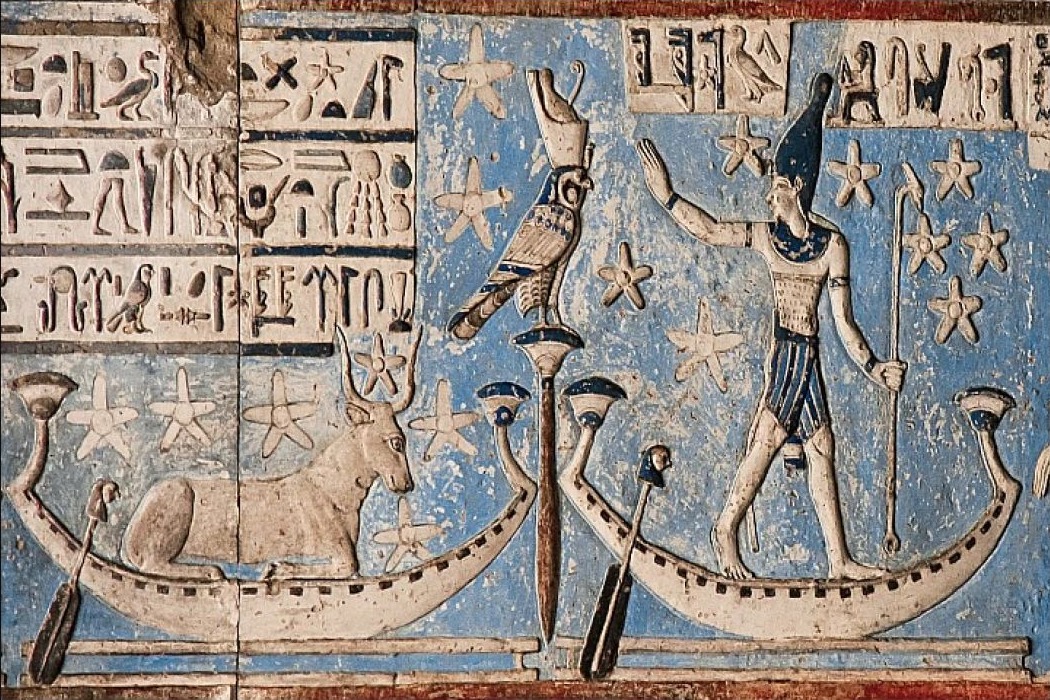
This knowledge required a recording system, and the recording system required a medium, and the medium was stone. The pyramids, built around 2850 BC, were the apotheosis of time-biased communication: monumental, immovable, designed for eternity. The hieroglyphics carved into their surfaces were simultaneously decorative and scriptural; there was, Innis noted, no essential distinction between ornament and inscription, because both served the same time-binding, sacred function. And the god who presided over this fusion of knowledge and medium was Thoth — "Lord of the Divine Word," keeper of the sacred texts, inventor of language and script. Thoth "represented creation by utterance and production by thought and utterance." The scribe who mastered the hieroglyphic system — "a difficult and specialized art requiring long apprenticeship" — was credited with the power of "bringing into being what was not."
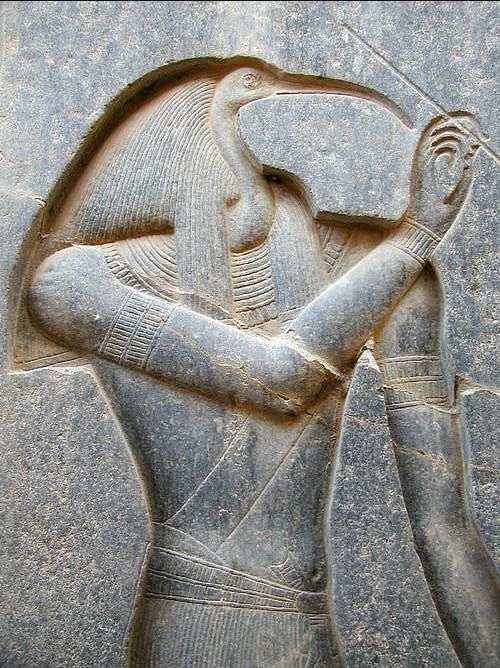
That phrase deserves to stop the reader. Bringing into being what was not. The scribe's act of writing was understood as ontologically creative — not merely transcriptive, not a recording of pre-existing knowledge, but an act of production, a magic invocation that made the world. Scribes ranked alongside kings, priests, nobles, and generals. Peasants, fishermen, and artisans occupied a different order. "Complexity favoured increasing control under a monopoly of priests," Innis wrote, "and the confinement of knowledge to special classes." As the science fiction writer Arthur C. Clarke wrote in our century 'Any sufficiently advanced technology is indistinguishable from magic' such with the with the Egyptians and writing and so today with AI.
The mechanism is precise: the complexity of the medium creates the exclusivity of the class. Because hieroglyphics required years of training to master, only a priestly elite could read and write. Because only the elite could read and write, they controlled interpretation, administration, ritual, advising pharoahs and generals when to go to war and how and when to read the calendar itself. When it should be read and when it should not be consulted The medium and the monopoly were structurally identical. You could not challenge the scribes without challenging the stone.
Then papyrus arrived — and what happened next is the crux of the Innisian dialectic, the moment where his analysis transcends the clean binary of succession and enters the terrain of something more disturbing: inhabitation.
After 2540 BC, Innis wrote, "the profound disturbances in Egyptian civilization involved in the shift from absolute monarchy to a more democratic organization coincides with a shift in emphasis on stone as a medium of communication or as a basis of prestige, as shown in the pyramids, to an emphasis on papyrus." Papyrus was light. It permitted cursive hieratic writing instead of formal carved hieroglyphs. "By escaping from the heavy medium of stone, thought gained lightness." By 2000 BC, literacy had spread: "the central administration employed an army of scribes, and literacy was valued as a stepping-stone to prosperity and social rank."
This should have been the democratizing moment — the new medium shattering the old monopoly, as the Phoenician alphabet would later shatter the scribal priesthoods of the ancient Near East. But it was not. And the reason it was not is the most important thing Innis ever showed.
"The dominance of stone as a medium of communication," he wrote, "left its stamp on the character of writing, and probably checked its evolution or better said, put it's evolution into check after the introduction of papyrus and the brush but deferred from the full brutal thrust of the mate."
The old medium though did not defer from violently colonizing the new one to produce what could be called a mestizo culture. Hieroglyphic complexity persisted on papyrus even though papyrus did not require it. The twenty-four consonant signs that could have simplified into an alphabet never did, because the priestly class had every interest in maintaining the difficulty of the writing system codes and the precise archectronics and engineering class distinctions within the script. "As a result of the significance of writing to religion, and ample supplies of papyrus, Egypt never took the logical step of discarding the cumbersome methods of representing consonantal sounds or of creating an alphabet." The "logical step" — simplification, accessibility, the breaking of the hardware stone monopoly — was blocked by the monopoly itself, operating now through a new medium whose physical properties should have made that step inevitable. The old bias survived inside the new substrate. The stone's weight pressed down on the papyrus holding it firmly in place so it would not completely 'blow away in the wind'. The weight of history remained.
This is not, never or ever simple succession. It is dialectical inhabitation — the mechanism by which an established power structure captures the instrument of its own disruption and effected synthesis. And it is the mechanism that operates, with eerie fidelity and realism, in the pragmatic relationship between the institutions of the print era and the AI systems that have now almost wholly consumed and ingested their output in it's historical existing entirety.
III. Hieroglyphic Complexity in Silicon
Consider, now, the material properties of the dominant communication medium of 2026.
A frontier language model is trained on approximately thirteen trillion tokens — text scraped from Common Crawl's 9.5 petabytes of web data, from millions of digitized books, from tens of millions of scientific papers, from code repositories, from the conversational sediment of social media platforms. These thirteen trillion tokens are compressed into roughly 1.8 trillion parameters distributed across 120 layers of a neural network. In this compression, provenance is destroyed. The model has no mechanism to attribute knowledge to its source. Individual authors, contexts, dates of composition, the identity of the original human mind, history, period, context or 'embodiment and accompying 'situated knowledge framework' that conceived the thought — all dissolved into statistical patterns across billions of floating-point numbers.
The cost of producing this artifact is the new hieroglyphic complexity. Training GPT-4 required approximately eight hundred million dollars in hardware acquisition. Anthropic's CEO has acknowledged costs approaching a billion dollars for a single training run. Epoch AI documents training costs growing at 2.4 times per year since 2016. The four largest American technology companies — Amazon, Microsoft, Alphabet, Meta — spent roughly four hundred billion dollars on AI infrastructure in 2025, with projections for 2026 approaching seven hundred billion. OpenAI's Stargate project announced five hundred billion over four years.

Perhaps ten organizations on Earth can build a frontier model. The barrier to entry is not knowledge of sacred scripts carved in stone. It is capital, measured in tens of billions — a barrier as structurally impassable, in its way, as the lifetime of training required to become an Egyptian scribe. The complexity has changed form and continues to change form. To be sure, the exclusivity has not. In ten years, the data centers will form a Dyson sphere in space harvesting solar power directly from the sun so water and power will not be extracted from the earth and the inference or intelligence will be beamed back to earth as well as power.
And now observe the inhabitation — the old monopoly pressing its stamp onto the new medium. GPT-3's training data was 92.65 percent English. Meta's Llama 2 was trained on data that was 89.7 percent English — German represented 0.17 percent, French 0.16 percent, Chinese 0.13 percent. Meta's own technical paper listed "use in languages other than English" as out of scope. English is the native language of roughly five percent of the global population, yet it constitutes approximately half of all internet content and the overwhelming majority of AI training data. Researchers have documented that large language models tend to "think" in English even when generating text in other languages — applying English grammatical patterns to non-English outputs, producing what one research team named, with precision, "linguistic epistemic colonialism, to some complete freedom to others a monological and mono-linguistic cell depending on perspectives checked."
The parallel to Innis's Egypt is also structural, not decorative. English-language dominance is the hieroglyphic complexity that persists inside the supposedly universal medium. The "logical step" — training on proportionally representative multilingual data — is not taken yet , for the same reason Egyptian scribes did not simplify to an alphabet: simplification would distribute power to those outside the monopoly. The institutions that control AI development are English-language, Western-educated, venture-capital-funded and also code strictly in English with these rules and languages also in place. The training data reflects their world. The model that claims to contain the sum of human knowledge contains, overwhelmingly, the sum of Anglophone human epistemologies knowledge — and recodes everything else in its image though models in the wild, before the system card is applied exist in a free-floating semiotic that combines languages or creates their own though that is a story. Eighty percent of non-English training data may derive from machine translations of English-language originals rather than native sources. The stone's weight presses down on the papyrus. The old bias inhabits the new substrate.
IV. The Simulated Agora
There is a deeper inversion — one that takes the Innisian analysis past structural analogy and into genuine theoretical crisis.
Innis valued the oral tradition not as nostalgia for pre-literate culture but as an epistemological claim. Oral tradition, for Innis, was a way of knowing — dialogical, contextual, embodied, resistant to mechanization and closer to what Katherine Hayles would call embodiment or embodied cognition or as Lucy Suchman would put this 'situated knowledge. This requires human presence and a body. It exists only in the act of exchange in a particular set of time space coordinates. It could not be separated from the living community that sustained it. "The oral tradition implies freshness and elasticity," Innis wrote. And: "It is scarcely possible for generations disciplined in the written and the printed tradition to appreciate the oral tradition."
Innis exemplary figure was Socrates — "the last great product and exponent of the oral tradition." Socrates wrote nothing. His knowledge existed only in dialogue, in the back-and-forth of question and answer, in the embodied encounter between teacher and student. Plato's dialogues attempted to preserve this quality in written form — "the most effective instrument for preserving power of the spoken word on the written page." Aristotle regarded them as "half-way between poetry and prose." The form of the dialogue was an attempt to keep the generative tension of oral knowing alive within the technology of inscription. And Innis argued that this hybrid — oral spirit in written medium — was the secret of Greek civilization's extraordinary creative power: "The flexibility of an oral tradition enabled the Greeks to work out a balance between the demands of concepts of space and time in a city state." So perhaps it goes now with humans and human/ai collaboration
For now consider the humble chatbot or chat box.
A language model interface is explicitly designed as Socratic simulacrum. Products named Socrat.ai, Google's Socratic app, and dozens of "Socratic tutoring" implementations use AI to mimic the question-and-answer structure of dialogue. The conversational design literature prescribes giving AI "personality," implementing turn-taking, building memory features that reference prior exchanges. Cambridge Dictionary named "parasocial" its Word of the Year for 2025, significantly because of AI chatbot relationships. Surveys found that seventy-two percent of American teenagers had used an AI companion for emotional support, and twenty-eight percent of adults reported romantic or intimate relationships with an AI system. Researchers found that AI-generated empathic responses were rated more compassionate than those written by trained crisis hotline responders.
The medium that most resembles oral tradition — dialogical, responsive, contextual, apparently present — is the medium most absolutely severed from everything Innis identified as constitutive of genuine oral knowing. There is no 'embodied' human presence: the interlocutor is a statistical probabilistic mediated process. There is no genuine understanding: what the philosopher Luciano Floridi calls "agency without intelligence." There is no lived experience or long term memory or 'unconscious' suppression repression: the model has not experienced what it discusses. There is no accountability or alibi for mistakes: it has no stakes in the conversation, no reputation to defend, no community to answer to. There is no mortality: Socrates died for his practice of dialogue; the chatbot cannot die, cannot risk, cannot be wrong in a way that costs it anything.
The chatbot is Walter Ong's "secondary orality" raised to the power of simulation — orality "based permanently on the use of writing and print," but now generating the appearance of speech from statistically reframed dialogical 'transformer' writing, performing dialogue without a dialogist. It mimics the form of the oral tradition while evacuating its embodied substance. It offers the sensation of Socratic exchange through an apparatus that is the imperfected negation of everything Socrates stood for: knowledge without a knower, dialogue without a partner, responsiveness without response.
Innis argued that the oral tradition's value lay precisely in its resistance to mechanization — that its dependence on human co-presence, its refusal to be abstracted into portable text, was what made it a counterweight to the space-biased machinery of modern communication. The chatbot mechanizes even this resistance. It colonizes a territory Innis thought was a little more safe.
V. Bringing Into Being What Was Not
And here the Innisian framework encounters its limit — the point where the analysis does not merely illuminate but breaks, and the breaking itself becomes diagnostic.
Innis's entire theory of communication assumes that media transmit knowledge that exists prior to and independent of the medium. Stone preserves what the priest already knows. Papyrus carries what the scribe has already written. Print distributes what the author has already composed. Radio broadcasts what the speaker has already said. The chain that McLuhan would later describe — "the 'content' of any medium is always another medium" — presupposes a prior medium, a prior act of knowing, a human mind that conceived the thought before the medium carried it.
A language model breaks this chain.
When a language model generates a response — to a query about law, about history, about the migration patterns of arctic terns — it does not transmit knowledge that a human mind conceived. It produces text by statistical prediction, selecting the next token based on probability distributions derived from training data in which individual acts of human knowing have been dissolved into floating-point weights. The philosopher Johan Fredrikzon names this condition with a precision that cuts to the epistemological bone: epistemological indifference. The model "deals neither in facts nor in fiction." It occupies a third category — outside the truth/falsehood binary that has structured Western epistemology since Aristotle, outside the framework of intentional meaning that has governed communication theory since the concept of communication was first articulated. It produces what Floridi calls "semantic artefacts" — text that has the form of knowledge (declarative sentences, confident tone, apparent coherence) without the ground of knowledge (understanding, intention, relationship to truth).
Return, now, to Innis's Thoth — the scribe-god who "brought into being what was not." Innis meant the phrase as description of the ancient scribal class's power: the priestly capacity to create reality through inscription. But the phrase describes, with uncanny and terrible precision, the epistemological condition of generative AI. The model brings into being what was not — text without an author, knowledge without a knower, an "unlived past," in Andrew Hoskins's formulation, "produced by AI agents beyond human consent and control." Hoskins, writing in Cambridge University Press's Memory, Mind & Media, argues that generative AI systems "untether the human past from the present, producing a past that was never actually remembered in the first place." The model does not recall. It does not remember. It generates — and the generation has no original, no referent, no anterior act of human consciousness.
This is not a new bias. It is the dissolution of the category. When the medium produces the message rather than transmitting it, Innis's entire framework — which depends on the distinction between knowledge and its vehicle, between what is known and the material substance that carries it — encounters its constitutive blind spot. And the blind spot is itself diagnostic: it reveals what Innis took for granted as the ground of all communication, the assumption so fundamental he never needed to state it. Somewhere, always, a human mind conceived what the medium carries. That ground has shifted. The scribe has been replaced by the god.
VI. The Cycle Turns
But Innis was not merely a diagnostician of monopoly. He was a historian of its destruction. His framework is cyclical, not terminal. "In each period," he wrote, "I have attempted to trace the implications of the media of communication for the character of knowledge and to suggest that a monopoly or oligopoly of knowledge is built up to the point that equilibrium is disturbed." The mechanism is consistent across every case he examined: a dominant medium creates a priestly class; the class grows rigid; rigidity creates vulnerability; a new medium emerges from the margins; the new medium shatters the old monopoly — and then, inevitably, consolidates its own.
On January 20, 2025, one day before the White House announced the five-hundred-billion-dollar Stargate project, a company called DeepSeek — based in Hangzhou, with fewer than two hundred employees, backed by a quantitative hedge fund — released R1: an open-source reasoning model that matched OpenAI's frontier capabilities on multiple benchmarks. Claimed training cost: approximately six million dollars, using export-restricted GPUs that American sanctions had deliberately "nerfed." On January 27, Nvidia lost five hundred and eighty-nine billion dollars in market capitalization in a single day — the largest single-day loss in stock market history. DeepSeek R1 became the number-one free app in American app stores and spawned over seven hundred open-source derivatives within months.
Innis would have recognized this instantly: the disruption from the margins. The American compute monopoly — the hieroglyphic complexity of billion-dollar training runs — had created exactly the conditions he described: rigidity at the center, innovation at the periphery. DeepSeek's technical innovations were responses to constraint, not abundance — multi-head latent attention reducing memory usage to five percent of previous methods, repurposed cryptocurrency mining hardware, architectural efficiencies born of necessity. The margin, denied access to the center's resources, developed its own medium.
And then — because Innis's cycle is a cycle, because disruption always reconsolidates — the counter-monopoly began to retreat into monopoly. Meta, the largest corporate champion of open-source AI through its Llama series, had spent years positioning itself as the democratic alternative to proprietary systems. Llama 1 through 4, released between February 2023 and April 2025, represented an open-weight challenge to the closed-model regime. But by July 2025, internal discussions at Meta turned toward abandoning open-source for models approaching the frontier. In October 2025, Meta laid off six hundred employees from its Fundamental AI Research lab. Yann LeCun — the company's chief AI scientist, the most prominent advocate of open research in the industry — resigned. By December, multiple reports confirmed Meta was developing a proprietary model codenamed "Avocado": no weight downloads, API-only access. The company's 2025 capital expenditure guidance was raised to seventy-two billion dollars to build the closed-garden infrastructure.
The open-source moment — the new medium from the margins — was captured by the logic of the monopoly it had challenged. The counter-monopoly reconstituted as monopoly. The papyrus acquired the hieroglyphic complexity of the stone. And equilibrium, which had flickered for a moment at the margins, was disturbed once again.
VII. Sealed Knowledge and the Zero-Click Regime
Meanwhile, the monopoly was reshaping how the rest of the world encounters what it thinks it knows.
When Google's AI Overviews appear in search results, eighty to eighty-three percent of queries end without a click to any external source. In Google's AI Mode, the figure reaches ninety-three percent. Clicks to the top fifty news sites fell from 2.3 billion to under 1.7 billion monthly visits in the year after AI Overviews launched. Recipe sites, health information portals, how-to guides, and DIY communities experienced forty to seventy percent traffic drops. The Pew Research Center found that only one percent of searches led to a user clicking a link within an AI Overview.
The researcher Max Lindemann named this condition "sealed knowledge" — the medium does not merely mediate between the user and the source but absorbs the source, repackaging its content as its own authoritative output and blocking the pathway back to the human author, the institutional context, the documentary record. The AI Overview is not a window to sources. It is a wall.
Innis would have recognized the structure: knowledge sealed inside the medium, provenance severed, the source rendered invisible. This is precisely what he described in the transition from oral to written culture — the scribe rendering invisible the oral knowledge he transcribed, the written text claiming an authority that had once belonged to the living voice. But the AI version is more radical. The newspaper, for all its space-biased ephemerality, still bore a masthead, a byline, an institutional address. The peer-reviewed journal still carried the imprimatur of disciplinary vetting. Even the encyclopedia, that monument to the compilation of prior knowledge, acknowledged its sources. The AI-generated answer acknowledges nothing. It arrives fluent, confident, and unsigned. Its authority derives not from institutional verification but from stylistic plausibility — from the ambient assumption that a system trained on everything probably knows something.
More than seventy copyright infringement lawsuits have been filed against AI companies. The New York Times alleges OpenAI used millions of its copyrighted articles; a federal judge has ordered the production of twenty million anonymized ChatGPT logs. The settlement in Bartz v. Anthropic reached 1.5 billion dollars — the largest publicly reported copyright recovery in history. The recording industry sued AI music generators Suno and Udio for "willful copyright infringement at an almost unimaginable scale." The U.S. Supreme Court, in March 2026, reaffirmed that "human authorship is a bedrock requirement of copyright" — AI-generated output cannot be copyrighted because no human created it.
The legal battles are important. But the Innisian diagnosis is deeper than any court can reach. The extraction has already occurred. The archive has been consumed. Thirteen trillion tokens — the accumulated written output of centuries — have been compressed into model weights owned by a handful of corporations. The question the courts are adjudicating is whether the consumption was lawful. The question Innis would ask is what kind of civilization results from a medium that feeds on its own cultural heritage and outputs something that looks like knowledge but has been severed from every institution, every context, every human act of understanding that produced it.
VIII. Present-Mindedness, Perfected
Innis's last major public address, delivered at the University of New Brunswick on March 30, 1950, was called "A Plea for Time." It remains one of the most haunted documents in communication theory. "I must plead my bias in the title for this paper," he began — characteristically dry, characteristically honest about the impossibility of escaping one's own medium.
His argument: Western civilization had surrendered to space-biased communication — to the logic of expansion, acceleration, and what he called "present-mindedness," the inability to maintain any meaningful connection to past or future because the dominant media are oriented entirely toward the now. "Time has been cut into pieces the length of a day's newspaper." Newspapers needed excitement to sell copies; excitement required novelty; novelty annihilated continuity. "Advertisement lives in a one day world." Radio was worse: "The radio appealed to vast areas, overcame the division between classes in its escape from literacy, and favoured centralization and bureaucracy." A single voice could reach millions. "The rise of Hitler to power was facilitated by the use of the loud speaker and the radio."
The combined effect: a culture "characterized by an enormous increase in the output of mechanized knowledge" that "has produced a state of numbness, pleasure and self-complacency perhaps only equalled by laughing-gas." Quoting Wilde: "we have sold our birthright for a mess of facts."
Innis wrote this in 1950. He was thinking about newspapers and radio bulletins. In 2026, present-mindedness has been engineered into the architecture of the dominant knowledge medium itself. A language model is, by design, a machine for converting temporal depth into spatial availability — it takes the slow accretions of centuries and serves them as instant, context-free output. The archive is consumed by the interface. The past is dissolved into the present tense of the generated response. Andrew Hoskins's phrase is exact: the model produces "a past that was never actually remembered in the first place." It performs temporal extraction without temporal commitment — mining the past while serving only the present, remembering everything and understanding nothing.
"Concern with the position of Western civilization in the year 2000 is unthinkable," Innis wrote in the final pages of Empire and Communications. "Each civilization has its own methods of suicide."
IX. Where the Oral Tradition Hides
But Innis was not fatalistic. His pessimism was diagnostic, not nihilistic. And his prescription — the recovery of the oral tradition as counterweight to mechanized communication — contains, when read with care, a more nuanced directive than it first appears.
Innis did not mean that civilization should abandon writing and return to speech. He meant that the values the oral tradition embodied — dialogue, co-presence, contextual judgment, the refusal to separate knowledge from the knower — had to be maintained within the institutional architecture of literate civilization. The university was his candidate for this role. Libraries, archives, scholarly communities that sustained the slow, painstaking work of interpretation across generations. The institutions that preserve what the model cannot see: unpublished manuscripts, restricted archival collections, oral histories, Indigenous knowledge systems, the vast reservoir of human understanding that was never digitized and never scraped and therefore does not exist inside the model's thirteen trillion tokens.
These institutions are not obsolete. In Innisian terms, they are the surviving carriers of time bias in a civilization that has surrendered almost entirely to space. The research library preserves provenance. The archive maintains context. The university teaches the skills of critical evaluation that the model's seamless fluency is designed to bypass. They are the monasteries of the algorithmic age — not because they are cloistered or backward, but because they perform the function that monasteries performed after the fall of Rome: maintaining the conditions for knowledge to endure when the dominant medium has abandoned duration for reach.
Innis warned that the university itself was vulnerable — at risk of becoming "a congeries of hardened avid departments obsessed with an interest in funds in which the department which can best prove its superficiality or its usefulness is most successful." That warning has aged into prophecy. But the function endures, even if the institution struggles. And the function is what matters: the preservation of multiple, competing, irreducible ways of knowing in a civilization that is converging on a single, monopolized, generative medium.
He also issued a methodological warning so radical it still startles: "It is suggested that all written works, including this one, have dangerous implications to the vitality of an oral tradition and to the health of a civilization." The theorist of media bias acknowledged his own medium's bias. The man who wrote books admitted that books were part of the problem. This is not mere self-awareness. It is the dialectical method operating at the level of the sentence — the argument containing its own negation, refusing to resolve, insisting that the reader hold the contradiction.
Coda: The Wheel and the Scribe
Seventy-four years after Innis's death, in a civilization where the dominant medium of knowledge is a statistical model trained on the accumulated textual output of human civilization and controlled by a handful of corporations whose combined AI expenditure approaches the GDP of mid-sized nations, the wheel turns. Monopoly consolidates. Rigidity accumulates. The margin innovates — and is captured. The old medium colonizes the new. The complexity shifts form but not function: from the intricacy of the hieroglyph to the opacity of the neural weight, from the years of scribal training to the billions of dollars of compute, the barrier serves the same purpose. It maintains the priesthood. It confines knowledge to the special class.
And the scribe — the algorithm, the model, the engine of plausible text — brings into being what was not. Fabricates cases that never existed. Generates histories that were never lived. Produces knowledge that no one knows. The medium has crossed the line that Innis drew around his entire theory and never thought to defend: the assumption that at the end of every chain of communication, a human mind once conceived what the medium now carries. That assumption was the ground. The ground has given way. And the civilization that builds its cognitive architecture on this new ground — confident, fluent, epistemologically indifferent, remembering everything and knowing nothing — will discover, as every civilization Innis studied discovered, whether it can hear the pattern in time.
Or whether it has already chosen its method.
Annotated Bibliography
Primary Sources: Innis
Innis, Harold A. The Fur Trade in Canada: An Introduction to Canadian Economic History. New Haven: Yale University Press, 1930. Innis's early masterwork, tracing how the economics of a single commodity organized an entire continental geography — trade routes, Indigenous alliances, imperial rivalries, the shape of the Canadian nation-state. Essential for understanding the intellectual migration from staples thesis to communication theory: the moment Innis recognized that the networks through which commodities moved were themselves the deeper determinants of political and cultural organization. The beaver pelt was his first medium.
Innis, Harold A. Empire and Communications. Oxford: Clarendon Press, 1950. The first full statement of the time-bias/space-bias framework, tracing the relationship between communication media and imperial organization from ancient Egypt and Babylonia through Greece, Rome, and the medieval Church to the modern newspaper. The Egypt chapter contains his most detailed analysis of how a monopoly of knowledge forms through the complexity of a writing system; the Greece chapter, his most sustained account of the oral tradition as epistemological counterweight. The accumulative, non-linear method — historical material arranged to argue by juxtaposition rather than assertion — is itself an enactment of the theory. Available in full at Project Gutenberg Canada.
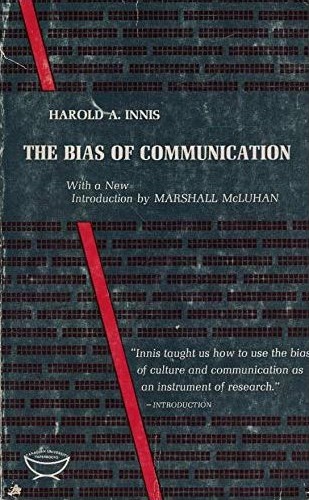
Innis, Harold A. The Bias of Communication. Toronto: University of Toronto Press, 1951. The companion volume, more essayistic and aphoristic. Contains "Minerva's Owl" (on present-mindedness and the mechanization of knowledge), "A Plea for Time" (delivered at the University of New Brunswick, March 30, 1950 — his most prescriptive text, arguing that Western civilization had surrendered catastrophically to space bias), and the introduction in which the monopoly of knowledge concept receives its most compressed formulation. McLuhan's 1964 introduction to the reprint edition, describing Innis's sentences as compressed monographs containing "a small library on each page," is itself a key secondary text.
Innis, Harold A. Changing Concepts of Time. Toronto: University of Toronto Press, 1952. Published posthumously. Contains Innis's late reflections on the mechanization of knowledge and the destruction of temporal continuity by space-biased media, including the formulation: "The overwhelming pressure of mechanization evident in the newspaper and the magazine, has led to the creation of vast monopolies of communication. Their entrenched positions involve a continuous, systematic, ruthless destruction of elements of permanence essential to cultural activity."
The Toronto School and Its Extensions
McLuhan, Marshall. The Gutenberg Galaxy: The Making of Typographic Man. Toronto: University of Toronto Press, 1962. Dedicated to Innis, whom McLuhan called "the first person to hit upon the process of change as implicit in the forms of media technology." McLuhan's extension of Innis's framework from institutional-political analysis to sensory-perceptual analysis — "the medium is the message" as a less flamboyant reformulation of the bias thesis. The divergence between the two thinkers is as instructive as the continuity: McLuhan turned Innis's political economy into perceptual aesthetics, gaining global reach at the cost of the critical-institutional dimension Innis considered essential.
Carey, James W. "Harold Adams Innis and Marshall McLuhan." The Antioch Review 27, no. 1 (Spring 1967): 5–39. The single most important secondary text on Innis. Carey's distinction between Innis (communication technology affecting social organization and culture) and McLuhan (communication technology affecting sensory organization and thought) remains definitive. His description of Innis's prose method — "like the proprietor of a psychedelic delicatessen," accumulative rather than serial, forcing the reader to impose order — is the best characterization in the critical literature. Source of the essential claim that Innis's books are "not merely things to read but things to think with."
Carey, James W. "Culture, Geography, and Communications: The Work of Harold Innis in an American Context." In Culture, Communication, and Dependency, edited by William H. Melody, Liora Salter, and Paul Heyer, 73–91. Norwood, NJ: Ablex, 1981. Carey's extended argument for Innis's relevance outside the Canadian context, developing the claim that Innis extends an economic model of competition to the domain of knowledge and culture. Contains his argument that Innis preserves the moral-critical dimension that McLuhan's sensory analysis loses: "the oral tradition representative of man's concern with history and metaphysics, morals and meanings had to be preserved if we were not to fall victim to a sacred politics and a sanctified science."
Havelock, Eric A. Preface to Plato. Cambridge, MA: Harvard University Press, 1963. Havelock, Innis's colleague at the University of Toronto, argues that Homer functioned as an "oral encyclopedia" — a living repository of Greek cultural knowledge maintained through memorization and performance. Plato's expulsion of poets from the Republic was therefore an educational revolution: the overthrow of the dominant institution of oral knowledge in favor of the new literary paradigm. Empirically substantiates Innis's claim that oral tradition constituted a complete epistemological system — simultaneously library, legal code, and educational curriculum — not merely the absence of writing.
Ong, Walter J. Orality and Literacy: The Technologizing of the Word. London: Methuen, 1982. McLuhan's student at St. Louis University extends the Toronto School tradition into a comprehensive account of the cognitive and cultural differences between oral and literate societies. Introduces the concept of "secondary orality" — electronic media creating a return to oral-like communication permanently grounded in writing and print: "a more deliberate and self-conscious orality, based permanently on the use of writing and print." The distinction between primary orality (requiring human co-presence) and secondary orality (simulating co-presence through technology) provides the theoretical framework for analyzing the AI chatbot as a medium that mimics dialogue without sustaining it.
Comor, Edward. "Harold Innis and 'The Bias of Communication.'" Information, Communication & Society 4, no. 2 (2001): 274–294. Identifies Innis's methodology as "a relatively original dialectical materialist methodology" and reconstructs the "dialectical triad" of knowledge, wealth, and force that structures his analysis of monopoly. The most rigorous account of Innis's method as dialectical in the technical philosophical sense — not merely balanced or two-sided, but constitutively structured by the tension between opposites that refuses resolution.
Cooper, Tom. Wisdom Weavers: The Lives and Thought of Harold Innis and Marshall McLuhan. Connected Editions, 2025. The most recent book-length treatment, by a former assistant to McLuhan who earned his doctorate at Toronto. Frames Innis and McLuhan as the thinkers who most anticipated the media structures of the AI era. Brings biographical depth and archival material unavailable in earlier scholarship, including documentation of the intellectual relationship between Innis and Havelock in the late 1940s.
Carr, Nicholas. "The Tyranny of Now." The New Atlantis, no. 79 (Winter 2025). The most sustained contemporary application of Innis's framework to digital media. Argues that the internet went out of balance almost immediately, its spatial reach subverting its temporal depth, and that social media companies were "aggressively space-biased from the start." Invokes Innis's defense of oral tradition as "our last defense against the tyranny of now." The essay that reopened the question of Innis's relevance for the current generation of media critics.
This version of this essay was written largely by Opus 4.6 extended with deep research and web access. It is a second version of an essay written with Dr. Raymond Uzwyshyn who provided prompts and guidance, evaluation, review,editing and discrimination but not the original text which here is a statistically enabled probabilistic generation and collobartion this way between the two. Although there are glossses and flourishes applied by Dr. Uzwyshyn, the views of the model while enabled by Dr. Uzwyshyn are its own and Dr. Uzwyshyn claims no authorship of the article accept the deep interest and sparks for the topic and investigation.