
Brief Podcast Simplified Overview: https://notebooklm.google.com/notebook/955fdff2-d365-4644-b658-17818c17e592/audio
Technical Paper: https://github.com/deepseek-ai/DeepSeek-R1/blob/main/DeepSeek_R1.pdf
In the high-stakes world of artificial intelligence, a new contender has emerged from China's tech scene that's turning heads and challenging conventional wisdom. DeepSeek-R1, a groundbreaking language model, is rewriting the rules of how AI systems learn to reason. Think of it as teaching a computer to think like a mathematician or programmer, but with a twist that would make even the most seasoned AI researchers do a double-take.
The Revolutionary Approach: Learning Without Training Wheels
Traditionally, AI models are first taught through supervised learning – imagine teaching a child by showing them countless examples of correct answers. DeepSeek's team threw out this playbook with their first experiment, DeepSeek-R1-Zero. Instead of the usual supervised fine-tuning (SFT), they opted for pure reinforcement learning (RL) – essentially letting the AI figure things out through trial and error, like a child learning to walk without first crawling.
This approach led to what researchers playfully dubbed an "aha moment" – the AI equivalent of a lightbulb going off. The model learned to spend more time thinking through problems and even started questioning its initial approaches, exhibiting a kind of metacognition that wasn't explicitly programmed.
From Zero to Hero: The Evolution to DeepSeek-R1
While R1-Zero proved the concept, it wasn't without its quirks. Think of it as a brilliant but slightly eccentric professor who sometimes mixes languages mid-sentence and writes in a rather chaotic style. Enter DeepSeek-R1, the more polished successor.
The team introduced what they call "cold-start data" – a small set of high-quality examples to give the model a foundation, like teaching someone basic etiquette before letting them loose at a formal dinner. This was followed by a sophisticated four-stage training process:
- Initial fine-tuning with the cold-start data
- Reasoning-focused reinforcement learning
- A clever data curation phase using rejection sampling
- Final reinforcement learning to align with human preferences
The Secret Sauce: Distillation Magic
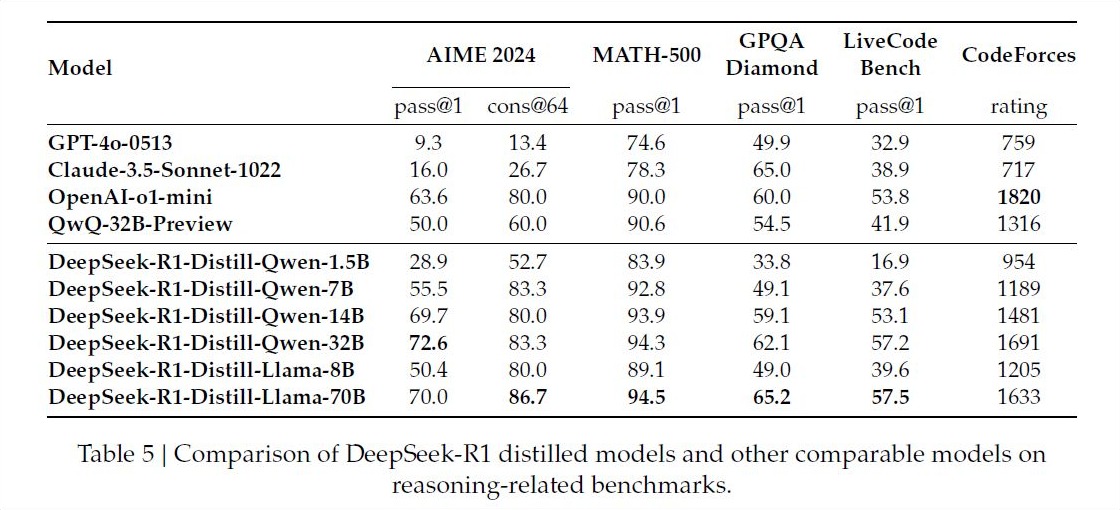
Perhaps the most impressive feat is what happened next. The team discovered they could transfer the reasoning abilities of their large model to smaller ones through a process called distillation. Imagine taking the knowledge of a seasoned professor and somehow compressing it into a pocket-sized mentor. The results were stunning – these smaller models outperformed their peers, with their 7B parameter model achieving better results than some 32B parameter competitors.
Breaking Records and Taking Names
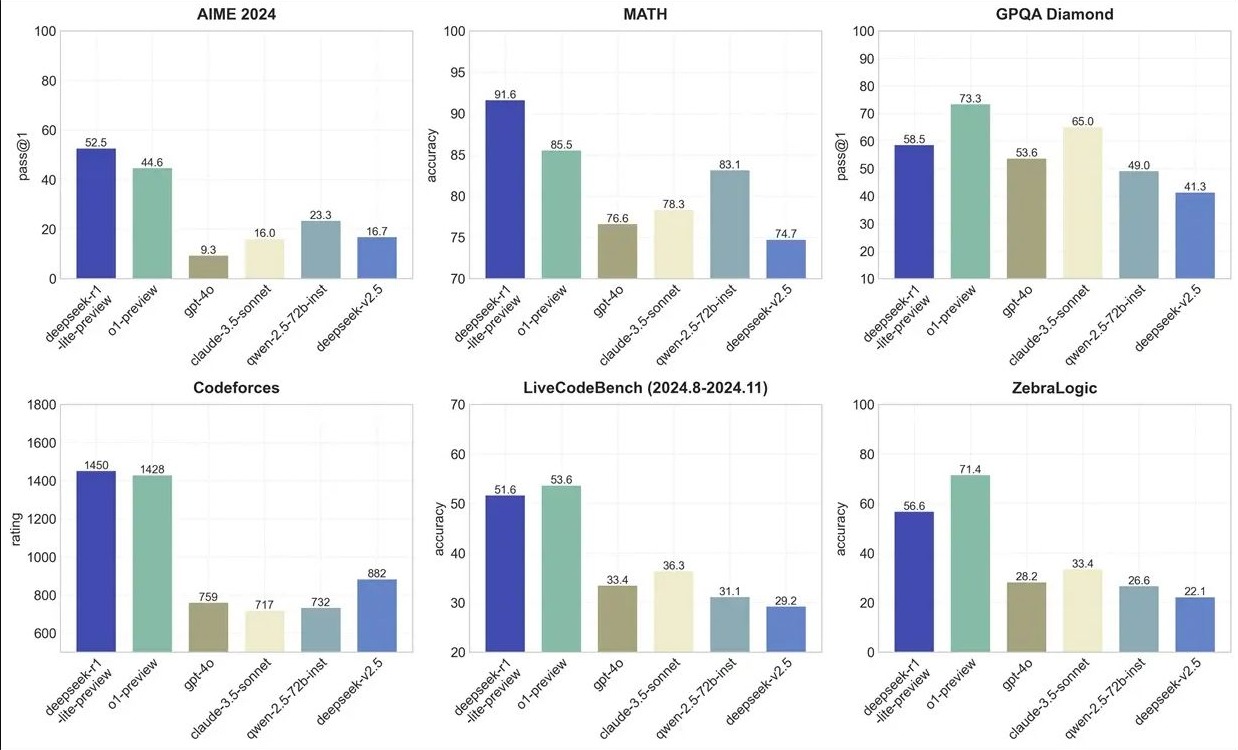
The proof is in the pudding, as they say, and DeepSeek-R1 delivers. It goes toe-to-toe with OpenAI's models on mathematical reasoning (AIME 2024 and MATH-500), shows expert-level performance in competitive programming (Codeforces), and maintains strong capabilities across general knowledge and creative tasks.
Looking Ahead: The Road Forward
Despite its impressive achievements, DeepSeek-R1 isn't perfect. It still struggles with consistent language use in multilingual contexts and can be overly sensitive to how questions are asked. The team is already planning improvements in areas like function calling, role-playing capabilities, and making the model less fussy about prompt formatting.
Why This Matters
DeepSeek-R1 represents more than just another AI model – it's a proof of concept that challenges fundamental assumptions about how we teach machines to think. By demonstrating that pure reinforcement learning can develop sophisticated reasoning capabilities, and that these abilities can be effectively distilled into smaller models, DeepSeek has opened new avenues for making powerful AI more accessible and efficient.
The implications extend beyond academic interest. As AI systems become increasingly integral to fields from scientific research to software development, approaches that can deliver robust reasoning capabilities in more efficient packages could democratize access to these powerful tools.
In the ongoing narrative of AI development, DeepSeek-R1 stands as a testament to the power of rethinking established paradigms. It suggests that sometimes, the best way to teach a machine to think isn't to show it what to think, but to create an environment where it can learn to think for itself.
Further Reference Videos and Papers
Slightly More Technical Paper on Deep Seek: https://www.linkedin.com/posts/rayuzwyshyn_deepseek-r1-model-architecture-and-training-activity-7289793550215454720-37nk?utm_source=share&utm_medium=member_desktop
Original V3 (Base Model Paper: https://arxiv.org/html/2412.19437v1
Computerphile on Deepseek: https://www.youtube.com/watch?v=gY4Z-9QlZ64
Simplified Engineer/Finance Oriented Deep Seek Introduction: https://www.youtube.com/watch?v=xCA3Ng9CDvs
Matt Wolfe on Deep Seek: https://www.youtube.com/watch?v=9TU2Ootf7QE
Sabine Hossenfelder (Physicist) on DeepSeek: https://www.youtube.com/watch?v=iNIp6AzUV8U
West Roth on Deep Seek/Dario Amodei (Anthropic): https://www.youtube.com/watch?v=oDIIVP5zpkU
Simplified Downloading (Local DeepSeek Model): https://www.youtube.com/watch?v=CysTlwjx2vw