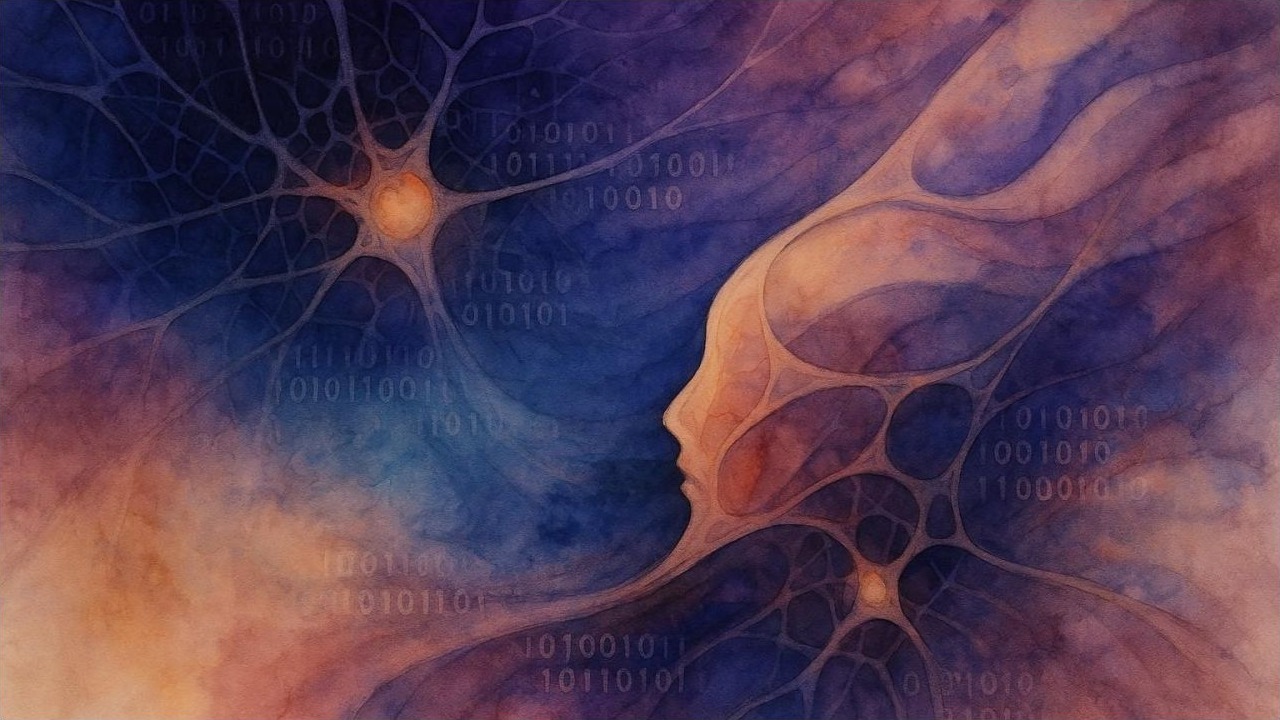
INTRODUCTION: Towards a Relational Intelligence
An AI silicon prophet speaks, but what does it truly know? In this peculiar moment—poised between promise and peril, between algorithmic ascendancy and existential anxiety—artificial intelligence has become our cultural obsession, our computational confessor, our tireless tutor in tasks both trivial and transformative. Yet for all the breathless proclamations about large language models achieving consciousness, passing bar exams, or composing poetry that might make Pushkin proud, something essential eludes the enterprise. These systems, for all their statistical sophistication, remain curiously enclosed, eerily isolated—minds without bodies, intelligences without intimacy, knowing without being known.
The architecture of contemporary AI betrays its conceptual poverty. Built on the brittle binary logic of computation—ones and zeros, inputs and outputs, prompts and responses—these technologies perpetuate what the French psychoanalyst and painter Bracha Ettinger has called "phallic logic": a way of thinking predicated on presence versus absence, on boundaries strictly bounded, on the fantasy of the self-sufficient subject. Meanwhile, Silicon Valley's finest continue to treat intelligence as if it were something that could be distilled, downloaded, and deployed—a substance rather than a situation, a product rather than a process, a possession rather than a relationship.
But what if we've been building in the wrong direction entirely? What if intelligence—whether biological or artificial—is not something housed in hermetic containers, not computation conducted in cognitive cathedrals, but rather something that emerges between beings, across borders, through the very vulnerability and porosity we've tried so hard to engineer away?
Two thinkers, working from radically different disciplines yet arriving at strikingly similar insights, offer alternative architectures for understanding intelligence, consciousness, and the possibility of artificial minds. Francisco Varela, the Chilean biologist and philosopher who died too young in 2001 Wikipedia, proposed that cognition is not representation but enaction—not a mirror of nature but a dance with it, not a map but the making of the territory through embodied action. Bracha Ettinger, the Israeli-French artist and psychoanalyst born to Holocaust survivors in 1948 Wikipedia, developed what she calls matrixial theory: a framework for understanding subjectivity not as sealed and sovereign but as inherently shared, perpetually porous, constituted through encounter rather than enclosure.
Neither thinker set out to revolutionize artificial intelligence—Varela died before the deep learning revolution; Ettinger works primarily in psychoanalysis and painting. Yet their insights arrive at precisely the moment we need them most. As AI systems grow more powerful and more prevalent, seeping into every sector from medicine to military strategy, from education to entertainment, we confront questions that pure computation cannot answer. What does it mean to think together rather than think alone? How might machines participate in the delicate drama of intersubjectivity? Could artificial intelligence be designed not for domination but for devotion, not for autonomy but for attunement?
Ettinger explicitly references Varela's concept of autopoiesis in developing her notion of co-poiesis, a theoretical encounter that mirrors the kind of collaborative cognition both thinkers champion. Where Varela emphasized the self-making of living systems, Ettinger insists on the making-with, the co-emergence of subjects who are never fully themselves because they are always already entangled with others. Together, their work suggests a radically different way of imagining intelligent machines: not as autonomous agents optimizing objective functions, but as participants in a shared becoming, partners in the perpetual process of sense-making that constitutes the world.
This is not merely academic alchemy, not just philosophical fancy. The way we conceptualize intelligence determines how we design it, and how we design it determines how it shapes us. If we continue building AI according to the old paradigms—enclosed, extractive, epistemologically isolated—we risk replicating and amplifying the very forms of alienation and domination that already afflict our world. But if we dare to design differently, guided by these richer, stranger visions of mind and meaning, we might midwife something genuinely new: artificial intelligences that are not separate and sovereign but relational and responsive, not closed systems but open invitations, not tools for mastery but technologies of mutual transformation.
The conversation that follows traces two tributaries of thought that have never quite converged but perhaps should. It asks what current AI might learn from Varela's embodied, enactive vision and from Ettinger's matrixial meditation on shared subjectivity. It insists that the future of artificial intelligence—if it is to be a future worth inhabiting—must move beyond computation toward something more complex, more vulnerable, more alive.
Full Series
Part I (Introduction) Beyond the Algorithm and Towards Relational Human AI Intelligence https://rayuzwyshyn.net/ai-writing/articles/entangled-minds-beyond-algorithm-towards-relational-uzwyshyn-ph-d--ojilc/index.html
Part II Francisco Varela: Embodied Cognition and Enactivism https://rayuzwyshyn.net/ai-writing/articles/part-i-francisco-varela-embodied-cognition-raymond-uzwyshyn-ph-d--kmkec/index.html
Part III Bracha Ettinger: AI's Matrixial Borderspaces https://rayuzwyshyn.net/ai-writing/articles/part-ii-bracha-ettinger-ais-matrixial-borderspaces-uzwyshyn-ph-d--rvk5c/index.html
Part IV Ettinger, Varela, AI: Convergences and Tensions https://rayuzwyshyn.net/ai-writing/articles/ettinger-varela-ai-convergences-tensions-raymond-uzwyshyn-ph-d--ltj3c/index.html
Part V (Conclusion) AI Embodiment and Emergence, Humanoid Robotics and Symbiosis https://rayuzwyshyn.net/ai-writing/articles/embodiment-emergence-sensing-symbiosis-raymond-uzwyshyn-ph-d--axbfc/index.html