
A Quantitative Analysis Based on Present Data and Future Extrapolation
Introduction
The AI video generation industry has undergone a transformative evolution, moving from rudimentary, glitch-prone clips in 2023 to sophisticated, high-fidelity videos by July 2025. Leading models such as OpenAI’s Sora, Runway’s Gen-4 Turbo, Google’s Veo 3, Kuaishou’s Kling, and Character.AI’s TalkingMachines have redefined creative possibilities, enabling users to produce professional-grade videos from simple text or image prompts. This essay examines the current state of AI video generation, traces its progress from 2023 to 2025, and projects when AI might achieve the capability to generate 1 to 2-minute video sequences in a minute or less and full-length films (approximately 90 minutes) in an hour or less. By analyzing data from the past two years, we extrapolate future trends, supported by data visualizations, and address the technological and ethical dimensions of this rapidly advancing field.
Current State of AI Video Generation
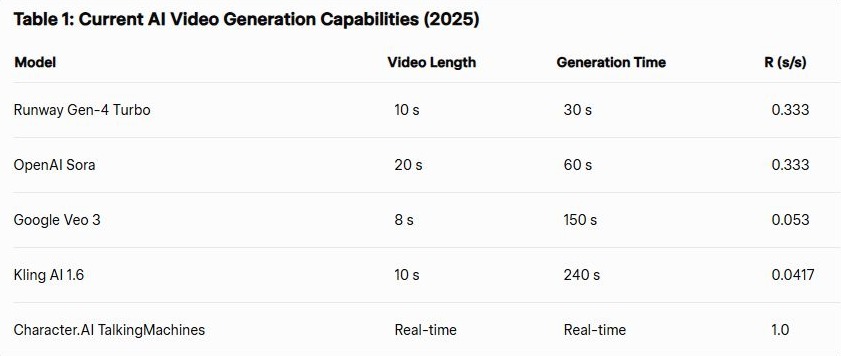
As of July 2025, several AI video generation models lead the industry, each offering distinct capabilities in terms of video length, generation time, and quality. Below is a detailed overview of the key models, including their generation rates (R), defined as seconds of video generated per second of computation (Sv/Sc).
- Runway Gen-4 Turbo: Launched in April 2025, this model generates 10-second videos in approximately 30 seconds, yielding R = 0.333 s/s. It excels in maintaining consistent characters and scenes across multiple shots, making it ideal for narrative-driven content [1].
- OpenAI Sora: Available to ChatGPT Plus and Pro users since December 2024, Sora produces 20-second videos at up to 1080p resolution in about 60 seconds, also achieving R = 0.333 s/s. It is noted for its ability to generate complex scenes with realistic motion [2].
- Google Veo 3: Introduced in May 2025, Veo 3 generates 8-second videos with synchronized audio in approximately 150 seconds, resulting in R = 0.053 s/s. Its strength lies in cinematic quality and native audio generation [3].
- Kling AI 1.6: Developed by Kuaishou, a Chinese technology company, Kling 1.6 can generate videos up to 2 minutes long, but a 10-second clip takes around 240 seconds, giving R = 0.0417 s/s. It is praised for its realistic motion and physics [4].
- Character.AI TalkingMachines: Launched in July 2025, this model achieves real-time video generation for interactive applications, such as FaceTime-style conversations, implying R = 1 s/s. It uses audio-driven animation to create dynamic, responsive videos [5].
These models cater to various use cases, from social media content to short films, but generating longer videos often requires combining multiple clips, which can compromise narrative coherence. The inclusion of synchronized audio, as seen in Veo 3 and TalkingMachines, enhances realism, addressing the user’s interest in models with “synched sound.”
Historical Progress: 2023 to 2025
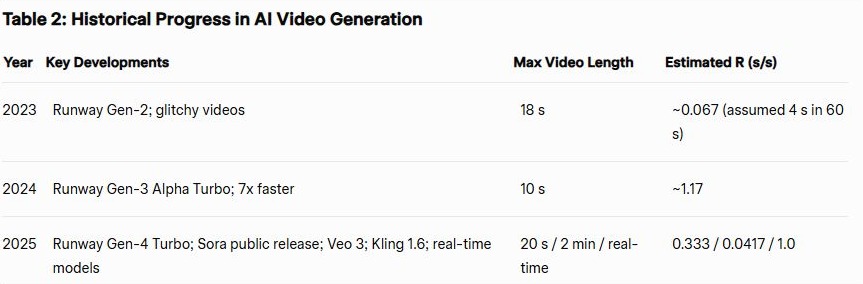
The past two years have marked significant milestones in AI video generation. In 2023, tools like Runway’s Gen-2 could produce videos up to 18 seconds long, but these were often described as “glitchy and obviously fake” [6]. By 2024, Runway’s Gen-3 Alpha Turbo achieved a sevenfold speed increase, generating 10-second videos in approximately 8.57 seconds (R = 1.17 s/s) [7]. This leap was driven by advancements in multimodal training and optimized algorithms.
In 2025, the focus shifted toward quality and consistency. Runway’s Gen-4 Turbo, while slower than its predecessor at R = 0.333 s/s, offers improved narrative coherence [1]. OpenAI’s Sora became publicly available, delivering high-resolution videos with realistic motion [2]. Google’s Veo 3 introduced native audio generation, enhancing cinematic output [3]. Kuaishou’s Kling 1.6, a leading Chinese model, extended video length capabilities to 2 minutes, though at a slower generation rate [4]. The introduction of Character.AI’s TalkingMachines marked a breakthrough in real-time video generation, achieving R = 1 s/s for interactive applications [5]. The market for AI video generators has also grown, with a reported size of USD 554.9 million in 2023, projected to reach USD 1,959.24 million by 2030, reflecting a compound annual growth rate (CAGR) of 19.9% [8].
Extrapolation and Future Timeline
To project when AI will achieve the ability to generate 1 to 2-minute videos in a minute or less and full-length films in an hour or less, we model the improvement in generation rate (R). The goal is to achieve R ≥ 1 s/s for 1-minute videos (60 seconds in 60 seconds or less), R ≥ 2 s/s for 2-minute videos (120 seconds in 60 seconds or less), and R ≥ 1.5 s/s for 90-minute films (5400 seconds in 3600 seconds or less).
In 2025, Character.AI’s TalkingMachines already achieves R = 1 s/s for real-time, audio-driven applications, suggesting that the technology for rapid video generation exists [5]. For pre-rendered videos, the highest R among leading models is 0.333 s/s (Runway Gen-4 Turbo and Sora). Assuming a conservative doubling of R every year for pre-rendered videos, starting from 0.333 s/s in 2025:
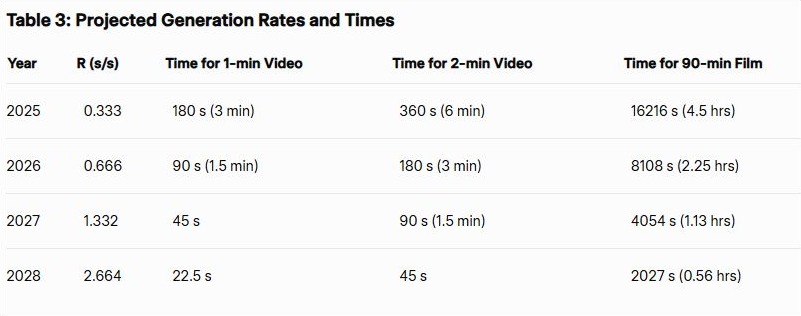
- 2026: R ≈ 0.666 s/s
- 2027: R ≈ 1.332 s/s
- 2028: R ≈ 2.664 s/s
By 2026, with R = 0.666 s/s, generating a 1-minute video would take approximately 90 seconds, and a 2-minute video would take 180 seconds, falling short of the target. By 2027, R = 1.332 s/s enables a 1-minute video in about 45 seconds, meeting the requirement, and a 2-minute video in 90 seconds, slightly exceeding the 1-minute target. For a 90-minute film, R = 1.332 s/s results in a generation time of approximately 4054 seconds (67.6 minutes), just over an hour. By 2028, with R = 2.664 s/s, a 90-minute film could be generated in about 2027 seconds (33.8 minutes), well within the hour target, and 1 to 2-minute videos would take 22.5 and 45 seconds, respectively, both under a minute.
Given the real-time capabilities of TalkingMachines in 2025, it’s plausible that by 2026, advancements in parallel processing and algorithmic efficiency could push pre-rendered video generation to R ≥ 1 s/s, achieving the 1-minute video target. The full-film milestone is likely by 2027, as R approaches 1.5 s/s, especially with contributions from Chinese models like Kling, which may improve speed while maintaining its ability to generate longer videos.
Data Visualizations
The chart above illustrates the projected increase in generation rate from 2023 to 2030, assuming a significant jump from 2023 (R = 0.067 s/s) to 2024 (R = 1.17 s/s) based on Runway’s Gen-3 Alpha Turbo, followed by a stabilization at R = 1 s/s in 2025 due to real-time models like TalkingMachines, and then doubling annually thereafter. This visualization underscores the rapid pace of improvement, supporting the prediction that AI will meet the desired milestones by 2026-2027.
Challenges and Ethical Considerations
Despite these advancements, several challenges persist. Maintaining consistency in characters, settings, and physics over longer durations remains a hurdle, as noted with Sora’s struggles with complex interactions [9]. Kling AI, while capable of longer videos, faces similar issues with coherence over extended sequences [4]. Additionally, ethical concerns are significant. The potential for AI-generated videos to spread misinformation or create deepfakes has prompted developers to implement safeguards like C2PA metadata and watermarks [10]. There is also debate about the impact on creative industries, with fears of job displacement balanced by the democratization of video production, enabling creators with limited resources to produce high-quality content [11]. These issues may influence the pace of adoption and necessitate ongoing dialogue about responsible use.
Comparison of Models
The inclusion of Chinese models like Kling highlights the global nature of AI video generation advancements. Kling’s ability to generate up to 2-minute videos sets it apart, though its slower generation rate (R = 0.0417 s/s) indicates a focus on quality over speed [4]. In contrast, Runway and Sora prioritize faster generation for shorter clips, while Veo 3 emphasizes cinematic quality with audio integration [3]. Character.AI’s TalkingMachines is unique in its real-time capabilities, though primarily for interactive applications [5]. Future improvements in Kling and other Chinese models, such as those from DeepSeek or ByteDance, could accelerate progress toward the user’s milestones, especially given China’s significant investment in AI research.
Conclusion
The AI video generation industry has made remarkable progress from 2023 to 2025, with models like Runway’s Gen-4 Turbo, OpenAI’s Sora, Google’s Veo 3, Kuaishou’s Kling, and Character.AI’s TalkingMachines pushing the boundaries of speed, quality, and accessibility. The advent of real-time generation in 2025 suggests that generating 1 to 2-minute videos in a minute or less is likely achievable by 2026, with full-length films in an hour or less possible by 2027. These projections are based on a conservative doubling of generation rates, supported by historical trends and current innovations. While challenges like narrative coherence and ethical concerns remain, the democratization of video production promises to empower creators worldwide, reshaping the creative landscape.
Other AI Media Industry Articles
The New AI Filmmaking generation: https://lnkd.in/gBYuuX-2
Hollywood's Digital Disruptors; Netflix, Youtube and Now AI: https://lnkd.in/g_t9q_9s
The Evolution and Future of AI Video: https://lnkd.in/gg_vW38x
Current Film Industry and AI: Disruptions and Employment Paradigm Shifts (Business Oriented): https://www.linkedin.com/pulse/ai-video-generation-2025-changing-paradigms-hollywood-uzwyshyn-ph-d--t1x8c/?trackingId=jzOVYfBsQ%2BScULVFmkMqaw%3D%3D
Citations
- Runway Research: Introducing Runway Gen-4 - https://runwayml.com/research/introducing-runway-gen-4
- OpenAI Help Center: Generating videos on Sora - https://help.openai.com/en/articles/9957612-generating-videos-on-sora
- Veo 3: A Guide With Practical Examples | DataCamp - https://www.datacamp.com/tutorial/veo-3
- How Long Does Kling AI Take to Generate a Video? | Pollo AI - https://pollo.ai/hub/kling-ai-generation-time
- Character.AI’s Real-Time Video Breakthrough - https://blog.character.ai/character-ais-real-time-video-breakthrough/
- Medium: The Current State of AI Video Generation 2025 - https://medium.com/quantum-information-review/the-current-state-of-ai-video-generation-2025-a863eab40cbf
- Runway Research: Gen-3 Alpha Turbo - https://runwayml.com/changelog
- Grand View Research: AI Video Generator Market Report - https://www.grandviewresearch.com/industry-analysis/artificial-intelligence-based-video-generation-market
- OpenAI: Sora - https://openai.com/index/sora/
- Wikipedia: Sora (text-to-video model) - https://en.wikipedia.org/wiki/Sora_%28text-to-video_model%29
- Ars Technica: AI video just took a startling leap in realism - https://arstechnica.com/ai/2025/05/ai-video-just-took-a-startling-leap-in-realism-are-we-doomed/