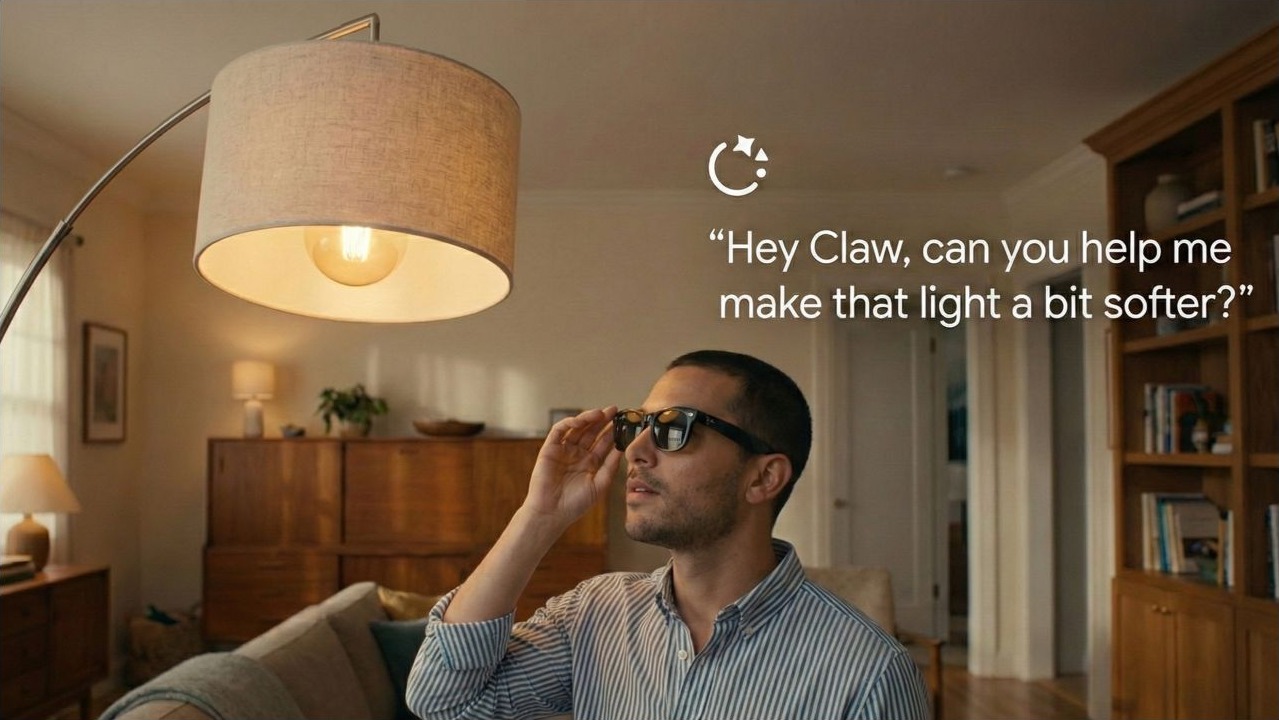
VisionClaw and OpenClaw: open-source AI for smart glasses
VisionClaw is an open-source iOS app that turns Meta Ray-Ban smart glasses into a real-time, voice-and-vision AI assistant powered by Google's Gemini Live API. When paired with OpenClaw— the current 'gone viral' massively popular open-source autonomous AI agent (176,000+ GitHub stars)—it gains the ability to execute real-world tasks like sending messages, searching the web, and controlling smart homes, all hands-free through voice commands. Together, these two independent projects demonstrate how open-source AI tools are currently extending proprietary hardware (Meta's smart glasses in this case) far beyond manufacturer-intended capabilities. VisionClaw was open-sourced just on February 7, 2026, by developer sseanliu, and sits at the intersection of three major technology trends currently on the rise: affordable AI-enabled smart glasses, real-time multimodal AI APIs, and autonomous agent frameworks.
What OpenClaw is and what it requires
OpenClaw (formerly Clawdbot, then Moltbot) is a free, open-source autonomous AI agent created by Peter Steinberger, the Austrian software engineer who founded PSPDFKit. Originally published in November 2025 under the name "Clawdbot" (a play on Anthropic's "Claude"), it was renamed after Anthropic raised trademark concerns. The project describes itself as "the AI that actually does things"—a personal AI assistant that runs locally on your own devices, using messaging platforms you already have as its interface. https://openclaw.ai/
Core capabilities of Open Claw span five areas.
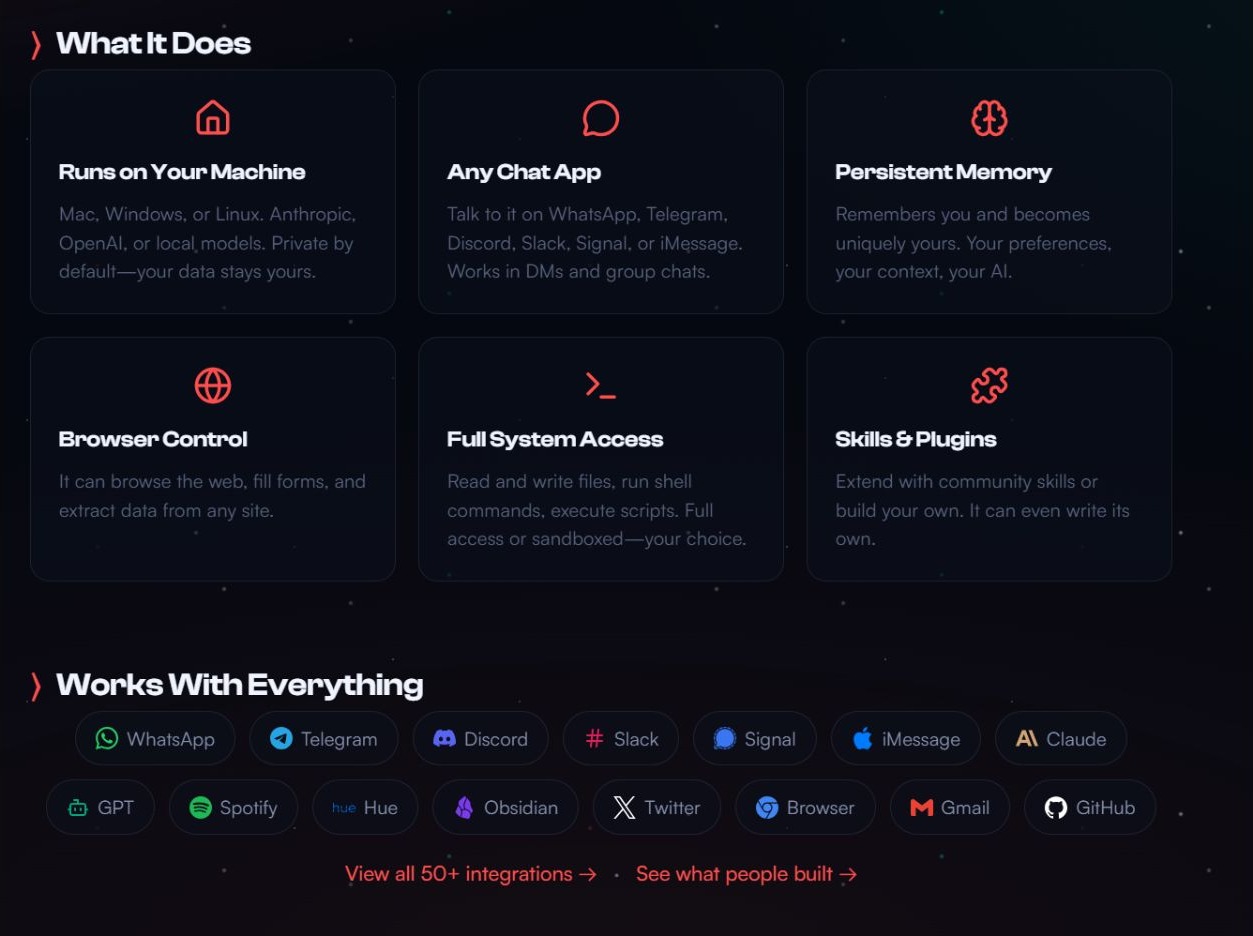
First, it connects to major LLMs (Claude, GPT, DeepSeek, Gemini, and local models via Ollama) and routes conversations through WhatsApp, Telegram, Slack, Discord, Signal, iMessage, Google Chat, and Microsoft Teams.
Second, it provides persistent memory across conversations, learning user preferences continuously.
Third, it offers full system access—reading and writing files, executing shell commands, automating browsers, filling forms, and taking screenshots.
Fourth, it operates proactively through cron jobs, heartbeats, background tasks, and reminders without being prompted.
Fifth, a community of 5,700+ skills on ClawHub (the public registry) covers everything from smart home control to GitHub PR reviews. The system can even write its own skills to extend its capabilities.
To run OpenClaw, you need Node.js 22 or higher and an API key for at least one LLM provider (Anthropic Claude recommended). It runs natively on macOS and Linux, on Windows via WSL2, and can be deployed on cloud infrastructure including DigitalOcean one-click deploys and Cloudflare Workers. Installation is a single command: npm install -g openclaw@latest && openclaw onboard --install-daemon. The gateway daemon runs as a launchd (macOS) or systemd (Linux) user service. It also offers iOS and Android companion nodes for voice interaction.
How VisionClaw works and what it can do alone
VisionClaw's architecture creates a three-layer pipeline. Meta Ray-Ban glasses stream video frames at approximately 1 fps (JPEG, 50% quality) plus microphone audio to an iOS app. The iOS app relays these to Google's Gemini Live API via WebSocket. Gemini processes the combined voice and vision input, then responds with audio streamed back through the phone speaker. The entire experience is conversational and hands-free.
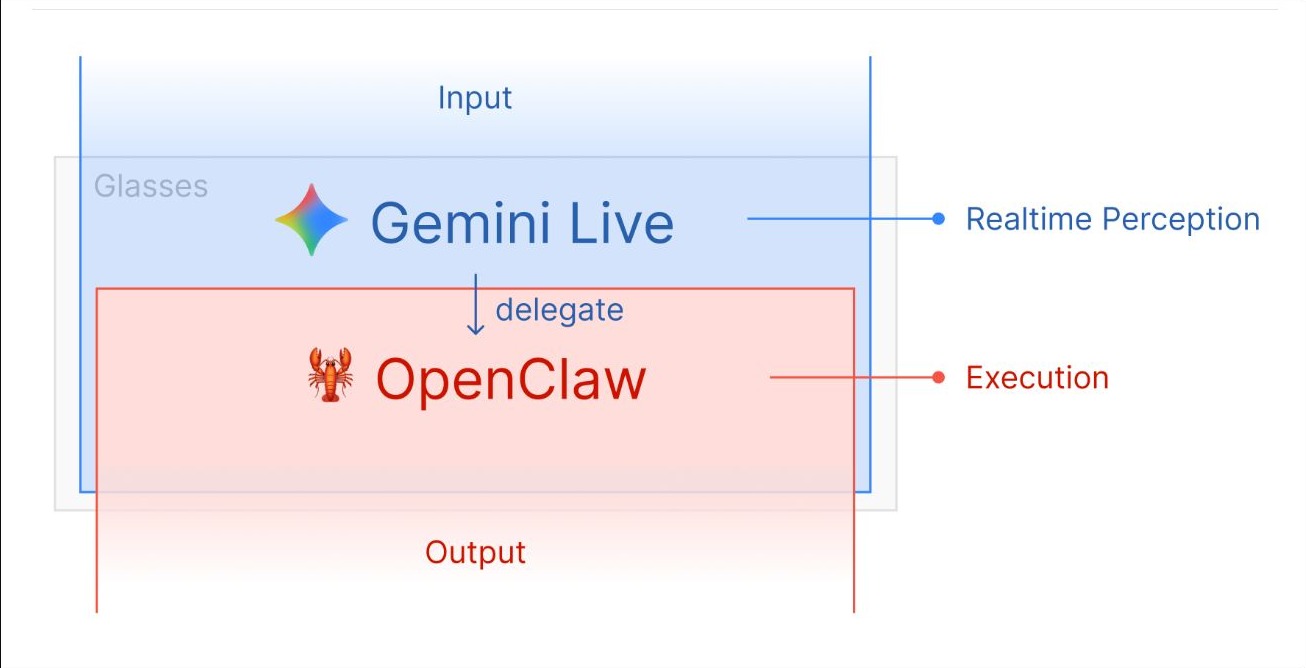
Without OpenClaw, VisionClaw operates as a conversational AI with vision. You can ask Gemini what you're looking at and receive spoken descriptions. You can have real-time voice conversations where the AI has visual context from your glasses camera. The README states explicitly: "Without OpenClaw, Gemini is voice + vision only." This means scene description, object identification, text reading, and general conversation—but no ability to take any actions such as sending messages, searching the web, managing lists, or controlling devices.
When OpenClaw is connected, the system gains its "hands." If you say "Add eggs to my shopping list," Gemini speaks a verbal acknowledgment, then sends a toolCall to a ToolCallRouter in the iOS app, which forwards an HTTP POST to the OpenClaw gateway running on the same Wi-Fi network. OpenClaw executes the task using its 56+ connected skills and returns the result. Gemini then speaks a confirmation. This transforms the glasses from a passive visual Q&A system into a full agentic assistant.
The project requires iOS 17.0+ and Xcode 15.0+ to build. Meta Ray-Ban glasses are optional—VisionClaw includes an iPhone camera mode for testing the full pipeline without glasses. A Gemini API key (free from Google AI Studio) is required. Supported glasses models include Ray-Ban Meta, Ray-Ban Meta Skyler, and Oakley Meta HSTN.
Platform support: why Android and PC remain out of reach
VisionClaw is iOS-only with no Android version planned or in development, and there are zero open issues or discussions in the repository about porting to other platforms. The entire codebase is written in Swift as a native Xcode project, built on Meta's Wearables Device Access Toolkit (DAT) iOS SDK. Several technical barriers make an Android port nontrivial.
Research angles and real-world applications
The VisionClaw/OpenClaw combination opens substantial application possibilities across multiple domains, many of which align with broader trends in AI smart glasses adoption.
Academic and scientific fieldwork stands to benefit significantly. Ethnographic researchers have already documented the use of smart glasses for hands-free data collection during healthcare workflow observations, wound management documentation, and daily routines in care facilities. The first-person camera perspective captures naturalistic data without the obtrusiveness of handheld recording. With VisionClaw's visual AI layer, field researchers could identify species in real-time, analyze environmental features, read and translate signage, and dictate observations while keeping hands free for physical work. OpenClaw's persistent memory and note-taking capabilities add structured data capture to what would otherwise be ephemeral observations.
Healthcare and accessibility applications represent the fastest-growing segment of the AI smart glasses market. Surgeons already use AR smart glasses for hands-free access to patient vitals and imaging data during procedures. Real-time captioning features—demonstrated by products like LLVision's AR subtitle glasses, which won the AIS Impact Award at ICIS 2025—have shown 40% improvement in communication efficiency for the 430+ million people worldwide who are deaf or hard of hearing. VisionClaw's ability to describe visual scenes through voice could serve blind and low-vision users, while OpenClaw integration enables them to take actions based on what the AI sees.
Industrial and technical applications show strong adoption metrics. A 2025 MIT Technology Review report documented a global automotive manufacturer reducing assembly error rates by 21% across three plants using mixed-reality smart glasses for step-by-step visual instructions. A European logistics provider reported 26% reduction in error rates after deploying AI-enabled smart glasses. The VisionClaw architecture—where a remote AI can see what a field technician sees and provide spoken guidance—maps directly onto maintenance and repair scenarios, with OpenClaw adding the ability to look up documentation, file reports, or escalate issues automatically.
Educational possibilities include interaction with 3D models, historical recreations, real-time language translation for immersive practice, and multimodal composition combining words, images, and audio with physical locations. The open-source nature of both VisionClaw and OpenClaw makes them accessible for educational institutions and research labs that cannot afford enterprise licensing.
Where VisionClaw fits in the AI smart glasses landscape
The AI smart glasses market reached $2.8 billion in 2024 and is projected to hit $7.1 billion by 2034, with global shipments rising 110% year-over-year in the first half of 2025. AI-enabled models now account for 78% of all smart glasses shipments, up from 46%. Four major players dominate the landscape heading into 2026.
Meta leads with its Ray-Ban partnership, having sold over 2 million units. The Ray-Ban Meta Display ($799), launched September 2025, added a monocular display and ships with the Neural Band—an EMG wristband for gesture control. Meta plans to scale to 10 million units annually by end of 2026. Google enters with Android XR, an open platform co-developed with Samsung, launching glasses through partnerships with Warby Parker and Gentle Monster. Google's advantage is its developer ecosystem—millions of existing Android developers—and deep Gemini AI integration. Apple is expected to launch privacy-focused smart glasses in late 2026, initially without AR display or photo/video capability, powered by custom low-power silicon. OpenAI acquired Jony Ive's io Products for $6.5 billion and plans AI-native glasses and other devices for late 2026.
Notable startups include Mentra (YC-backed, building an open "Android for smart glasses"), RayNeo (24% global AR market share with Qualcomm-powered displays), Rokid (CES 2025 Best Translation award), and Brilliant Labs (open-source Halo glasses with the Noa AI agent). The open-source hardware movement is also producing purpose-built options: Clawglasses (designed specifically for OpenClaw, $99-$599) and OpenGlass (turn any glasses into AI glasses using an ESP32 microcontroller).
VisionClaw and OpenClaw represent a distinct approach in this landscape: ecosystem bridging through open-source composition. Rather than building within Meta's closed AI ecosystem, VisionClaw connects Meta hardware with Google's AI (Gemini Live API) and an independent agent framework (OpenClaw). This three-layer architecture—proprietary glasses hardware, open AI API, open-source agent gateway—demonstrates that the underlying technologies are far more interoperable than any single manufacturer's marketing suggests, and it enables capabilities that no single vendor currently offers in an integrated product.
Conclusion
VisionClaw and OpenClaw together form a compelling proof-of-concept for open, composable AI on smart glasses. The key insight is architectural: by separating the "eyes and ears" layer (VisionClaw + Gemini Live) from the "hands" layer (OpenClaw's 56+ tool integrations), the system achieves agentic capabilities that exceed what any commercial smart glasses product currently ships. The primary limitations are practical—iOS-only with no near-term Android path, a requirement for both glasses and a Mac on the same network, and a codebase that is only one day old as open source. For researchers, developers, and early adopters willing to work within these constraints, the combination offers a uniquely flexible platform for experimenting with hands-free, vision-enabled AI assistance across academic fieldwork, healthcare, industrial, and educational applications. As the broader market accelerates toward an expected quadrupling of smart glasses sales in 2026, open-source tools like these will likely play an increasingly important role in pushing the boundaries of what AI glasses can do.