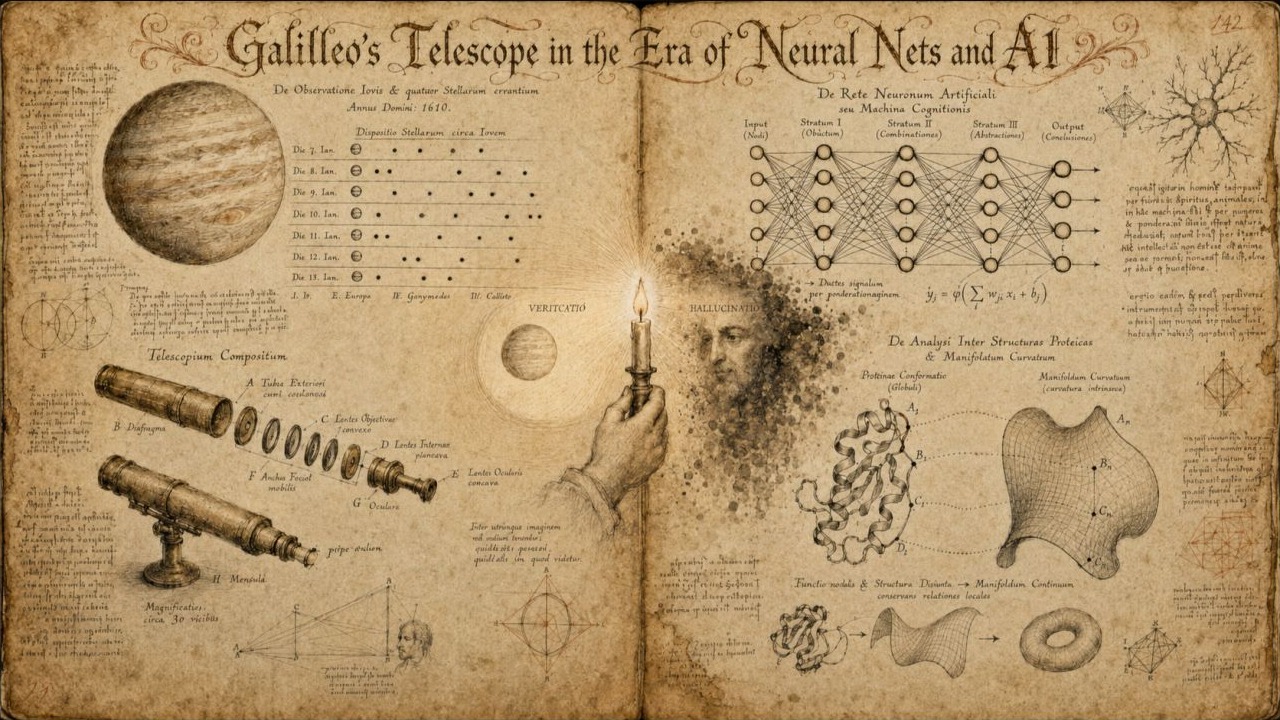
Artificial intelligence can see farther than any of us. It still cannot do the one thing that turns seeing into knowing.
In the winter of 1610, Galileo Galilei pointed a homemade telescope at Jupiter and saw four small stars that no one had ever recorded. They sat in a line beside the planet. He looked again the next night, and the next. They moved. Within a week he understood that they were not stars at all. They were moons, the first ever found to circle another world. That March he published the news in a slim book, Sidereus Nuncius, The Starry Messenger. The printing press, the new medium of the Renaissance, carried it across Europe within months. Galileo had become a broadcaster of the heavens.
Galileo did not believe his own eyes at first. He went back to the four lights night after night. He learned to predict where each would sit before he looked, and the sky kept proving him right. The seeing had taken a single night. The knowing took a week. The vision came in an instant. The checking was slow, patient, and dull. And it was the checking, not the vision, that turned a smudge of light into a discovery.
Four centuries later, we are told that artificial intelligence has learned to do the seeing for us, and to see farther than any person can. The claim is serious, and serious people make it. Geoffrey Hinton shared the 2024 Nobel Prize in Physics for building the methods these machines run on. He says their deepest talent is analogy. Analogy is the knack of noticing that two things from far-apart corners of knowledge share one hidden shape. Consider a protein folding itself into a tight knot. It takes a form a mathematician would know from a completely different subject: the study of curved surfaces, called manifolds. A manifold is a shape that bends and wraps through many dimensions at once. Or consider a stock market, booming and crashing. It rises and falls on the same rhythm a forest keeps as its animals multiply and starve. To a human expert these resemblances stay invisible. No one lives long enough to master both the biology and the geometry, or both the trading floor and the food web. A machine that has read all of it at once can see across the walls between them. That is the gift, and it is a real one. In the past three years it has begun to pay off. It has won a Nobel in chemistry, designed new antibiotics, invented new materials, and produced weather forecasts that beat a century of physics.
And yet seeing the resemblance is the easy half. The same knack that spots a true likeness will just as happily invent a false one. The mind that can match a protein to a curved surface can also match meaning to mere noise. It can find a face in a passing cloud. The Greeks came within a single word of the danger. Their verb phainein meant to bring to light, to make a thing appear. It is the root of phenomenon, a thing that shows itself, and of phantom and fantasy, the things that only seem to. Put apo in front, meaning off or amiss, and you get apophenia: a showing-forth of what was never there. Galileo's four lights might have been a flaw in his lens, a trick of the eye, a wish. What told him they were real was not the first thrilling glimpse. It was the week of going back to check. Every genuine discovery works this way. The flash of insight only begins it. The slow labor of proof is what finishes it, and turns a guess into knowledge.
I. Pride
Every summer, the world's sharpest teenage mathematicians gather for the International Mathematical Olympiad. They are handed six problems so hard that solving four can make a career. In 2024 a machine sat the exam. It solved four. But it could not work in ordinary mathematical language, the language of hunches and rough drafts that people use. It had to translate each problem into a system called Lean. In Lean, a proof is checked the way a key is checked against a lock: every step either fits or it does not, and nothing passes on charm. Lean was a cage that kept the machine honest. In ordinary language it might have talked itself into a beautiful mistake. Working the locks took it, in some cases, three days for a single problem. What came out the far end was not graceful. It was certain.
A year later the same lab returned. This time the machine reasoned in plain mathematical prose, like the teenagers, inside the same four and a half hours. It won gold. The newspapers saw a machine that had grown fluent. The truth was stranger. The cage had not been removed. It had been swallowed. The checking that once stood outside the machine, in Lean's cold gears, had been folded deep inside it. You could no longer watch it work. It was like a pianist's ten thousand hours of scales, which vanish into a performance that sounds like it cost nothing. The week of checking had not been skipped. It had been taken inward. This is the first and faintest version of a word we have not yet earned, and so will leave waiting at the door: synthesis.
II. Matter
Now down a step, out of pure symbol and into the physical world.
In October 2024 the Nobel Prize in Chemistry was split. Half of it went to two researchers at the company DeepMind, Demis Hassabis and John Jumper. They had built AlphaFold. It solved a problem fifty years old: how to read, from the chain of chemical letters that spells out a protein, the three-dimensional shape that chain will fold into. The shape is everything. A protein's shape is what lets it do its work, and a protein folded wrong causes disease. AlphaFold now holds the predicted shapes of more than two hundred million proteins, very nearly every one known to science. Biologists in almost every country use it daily. But notice why they trust it. AlphaFold was not believed because it was clever. It was believed because it was tested, blind, against real protein shapes. Laboratories had worked those out the slow way and kept them hidden from the machine. Again and again, its guesses landed almost exactly right. The hidden shapes were the wall. The blind test was the candle.
The other half of that prize went to David Baker, for the opposite motion. AlphaFold reads shapes that evolution wrote long ago. Baker's lab writes new ones. It designs proteins that have never existed, spells out their chemical letters, and sends the recipe to a laboratory to be built from scratch. By the end of 2025 the lab was building enzymes, the proteins that speed up the reactions of life. Some of them worked almost as well as the ones nature spent a billion years perfecting. Here the candle is not a test score. It is the laboratory bench. The designed protein folds and works in a dish, or it does not. The machine proposes. Reality decides, and it does not care how elegant the proposal was.
The same rule governs new materials. Late in 2023 a system called GNoME proposed more than two million new crystals. Crystals are the orderly stacks of atoms from which batteries and computer chips and solar cells are built. GNoME judged some 380,000 of its new ones stable enough to actually exist. On its own, that was a very long list of guesses. So a robot laboratory at Berkeley took a batch of them and tried to make them for real. Over seventeen days, mixing and heating and measuring on its own, it produced 41 of the 58 it attempted. Other chemists later questioned how many had truly been made cleanly. The argument that followed was not a failure of the project. It was the project working as it should, the field bringing its own candle. A prediction is a cloud. The furnace, and the doubt, are what turn it into a thing.
III. Flesh
Down one more step, to where the stakes are bodies.
A laboratory at MIT had used these methods in 2023 to find a genuinely new kind of antibiotic, the first in decades. It proved the drug was real the hard way, by curing infections in live mice. In 2025 it went further and used the machines to design antibacterial molecules atom by atom. Two of them killed bacteria that shrug off our current drugs, among them MRSA, the resistant staph infection that stalks hospitals. One of them cleared a real MRSA infection in a living mouse. The machine imagined the molecule. The mouse was the judge. Take the mouse away and there is no cure, only a clever drawing.
Then there is the discovery that touches the most lives, every morning, almost unnoticed. On the 25th of February 2025, the European Centre for Medium-Range Weather Forecasts put an AI model into daily operation. It is the most respected forecasting house in the world, and the model now runs beside the physics-based system it had refined for fifty years. The machine beats those equations on many measures, including the paths of hurricanes, by as much as a fifth. And it does so using roughly a thousandth of the computing power. That puts forecasts once reserved for wealthy nations within reach of poor ones. This is the closest thing in our tour to a true scientific revolution. And even here the candle is sewn through everything. The model is trained and graded against a vast record of the real past atmosphere. Its one telltale weakness is exactly the weakness of seeing without checking. Left to itself it smooths the world too much. It will even predict negative rainfall, an impossibility, because it has learned the look of weather without the laws beneath it. So the forecasters fence it in with physics and run it beside the older machine. A model that only blends what it has already seen is fast, and brilliant, and, on its own, quietly unreal.
Lay these stories side by side and a pattern stands out. The pattern is the argument. Sort them not by how clever the machine was, but by how far each result traveled out of pure symbol and into the solid world. The mathematics olympiad sits highest, and most abstract, a victory of pure thought. The proteins and crystals sit lower, in matter. The medicine and the weather sit lowest, in flesh and sky. The results we trust most are not the cleverest. They are the ones dragged furthest down, all the way to a mouse that lived or a storm that came on time. The deeper a guess is forced to answer to the physical world, the more it stops being moonlight and starts being a moon.
IV. The cloud
Why must the candle be carried every single time? Because the very thing that makes the machines brilliant is the thing that makes them dangerous. The two cannot be pried apart.
The trouble has a name, and we have already met its root. In 1958 a German psychiatrist named Klaus Conrad was studying the onset of schizophrenia. He was interested in the moment when a patient begins to feel that everything is connected, that the whole world is thick with private meaning aimed at him. Conrad coined a word for it: apophenia, built from that Greek verb phainein, to bring to light, with apo, amiss, in front. It means the seeing of patterns that are not there. The statistician has a plainer name for the same mistake, the false positive: a signal claimed where there is only noise. We all know its harmless everyday cousin too, the face we see in the moon, or in a cloud, or in the grain of a wooden door. Psychologists call that one pareidolia. It is the same cloud we have been watching all along.
This is not merely a metaphor for what goes wrong with AI. It is exactly what goes wrong. Ask one of these machines a question whose answer lies in territory it has truly studied, and it will find the real pattern. Push it into territory where the facts run thin, and it will hand you something just as fluent and just as confident, and wholly invented. Engineers call this a hallucination, and the word is precise. Our language has always known that the true pattern and the false one are kin. When the pattern is real, we reach for words made of light. We call it insight, a seeing-into. We call it illumination, or enlightenment. We shout eureka. When the pattern is false, we reach instead for words of trickery and drift. Illusion comes from a Latin word meaning to mock. Hallucination comes from a Latin word meaning to wander in the mind. The same motion of the mind makes both. From the outside the two look identical. Only one thing tells them apart: whether the pattern survives contact with the world. Carrying the candle to the wall is that test, and nothing else is.
Nabokov wrote the perfect portrait of a mind with no candle. In his story "Signs and Symbols," a young man is convinced that everything around him, the clouds, the trees, the coats of strangers, is a coded message about himself. The narrator calls it referential mania. It is apophenia turned to torment, a whole universe of meaning that points only back at the sufferer. It is also, read coldly, a picture of a machine left alone with its own patterns. Every sign glows with significance. Every significance loops back to the machine. Nothing anywhere is fastened to a world that could say no.
There is a deeper way to state the danger, and a line of French thinkers stated it. A century ago the linguist Ferdinand de Saussure observed that a word means nothing on its own. "Dog" means what it means only because it differs from "dig" and "log" and "cat." Meaning lives in the differences among signs, inside the closed circle of a language. Later thinkers pushed the idea to its edge. If signs only ever point to other signs, the whole circle might float free of the world, a sealed room of words referring forever to other words. That sealed room is an unnervingly good description of a language model. The machine is trained on nothing but how our words sit beside other words. Left to itself, it is Nabokov's patient with perfect grammar. Verification is the act that cracks the sealed room open and forces the words to answer to something outside them.
The psychoanalyst Jacques Lacan gave that something a name. He divided experience into three orders. The Imaginary is the realm of images. The Symbolic is the realm of language and signs. And the Real is what lies beyond both, what no image or word can fully capture, what pushes back when we are wrong. A machine is a virtuoso of the image and the sign. The one thing it cannot conjure for itself is the Real. The Real has to be handed to it from outside. In the laboratory, the Real goes by a humbler name. We call it ground truth: the measured fact, the mouse, the storm, the protein in the dish, against which every claim is checked.
There is a temptation here so tidy it has to be resisted, and resisting it is the whole lesson in miniature. The mathematician Roger Penrose imagines three worlds: the physical world, the mental world, and a third world of pure mathematics, perfect and eternal. Set his three beside Lacan's three and they seem to chime like struck bells. But press them and they come apart. Penrose is a Platonist. Like Plato, he believes mathematical truths are discovered, not invented. They exist on their own, more permanent than any physical thing, in something like Plato's heaven of perfect forms. The logician Kurt Gödel, the deepest Platonist of all, proved something astonishing along these lines. Within any system of mathematical rules, he showed, there are true statements the rules can never reach. Truth, even in mathematics, overflows our methods for catching it. Lacan's Symbolic order is the opposite of all this. It is not eternal and discovered but human and made, the net of language and law each of us is born into. (Aristotle, Plato's own student, had already split from his teacher here. He denied that forms float in a separate heaven, and placed them inside the things themselves, in the roundness of an actual ball.) To weld Penrose to Lacan is to feel a kinship that the ideas, looked at hard, refuse. It is, in other words, a small and elegant act of apophenia. Even here, while thinking carefully about the danger, the danger is at work. The only cure is the one we keep arriving at. Look harder. Check.
V. The instrument
None of this began with the machines, and remembering that keeps us honest about what is genuinely new. The oldest engine of discovery is the instrument: a tool that takes a way of seeing from one field and turns it on the questions of another.
Galileo's telescope was such a tool. The craft of grinding lenses belonged to the makers of spectacles. He aimed their glass at the sky, and the sky gave up its moons. The microscope, in the same century, opened the opposite frontier, the swarming world too small for the naked eye. Each new instrument did more than answer old questions. It revealed questions no one had known how to ask. And each time, the rule of the candle held. Galileo's moons were believed only once other people, at other telescopes, saw them too.
The strongest form of the move is to smuggle an instrument across the border between two fields. In 1952 Rosalind Franklin took X-ray photography, a technique out of physics, and aimed it at a question in biology. Her image, known as Photo 51, gave the first clear glimpse of the shape of DNA. Two decades later, Candace Pert and Solomon Snyder wanted to know whether the brain held a specific docking site for opium and its kin. They borrowed a method from chemistry. They tagged the drug molecule with a faint radioactive marker, so its binding could be measured. In 1973 they proved the receptor was real, and founded modern brain pharmacology. In each case a way of measuring, carried out of the field that invented it and into another, became a new way of seeing.
The same logic runs through medicine today, and it shows the candle plainly. A doctor facing a hard diagnosis does not lean on a single scan. She gathers an MRI, a CT scan, a PET scan, a biopsy, a genetic test. She trusts the answer most where the separate instruments agree, where the same tumor shows itself through five different windows. One instrument offers a hypothesis. Five that agree offer a fact. Agreement across instruments is the candle by another name.
AI is the newest instrument in this long line, and the line tells us both what it is for and what it needs. Like the telescope, it lets us cross a border we could not cross before: the border drawn around a single human mind. Knowledge has grown so vast that no one person, however brilliant, can stand at the leading edge of more than a few fields at once. The machine has read across all of them. It can carry a method from one field into another in an instant. Fei-Fei Li, the computer scientist who first taught machines to recognize images, likes to point at the oldest precedent of all. Around half a billion years ago, in the event called the Cambrian explosion, living things suddenly evolved eyes. In a geological eyeblink, the number and variety of animals exploded. The power to see the world, many scientists believe, is what drove the leap. Sight was the first instrument any creature ever owned, and it changed everything that followed. To give a machine eyes, Li suggests, is to begin that story over. But the lesson of every instrument since the first eye is a single lesson, and it does not bend. Seeing is not yet knowing. The eye that imagines a predator in the grass and the eye that spots a real one are built exactly alike. What told them apart, across five hundred million years, was which animal was right, and lived.
VI. Synthesis
Now we can take down the word we left waiting at the door.
Synthesis hides a small confusion, and clearing it up explains a great deal. There are two ways to put things together. The first is to add them up. In the branch of mathematics called calculus, to integrate is to sum a vast number of tiny pieces into a whole. Think of a great many thin slices stacked into a single loaf. Everything you end with was already present in the pieces. The second way makes something genuinely new. This was the philosopher Hegel's idea of synthesis: two opposed things meeting and resolving into a third that neither one contained. Hydrogen and oxygen are both gases. Combined, they make water, which is nothing like either. Adding is safe and predictable. True synthesis is creation.
The machines do both. The difference between the two is the difference between when a machine can be trusted and when it cannot. When it works inside familiar ground, filling in a protein shape much like the thousands it has studied, it is essentially adding up the known. This is reliable, and a little dull. But when we ask it to leap somewhere genuinely new, into a gap where it has little to stand on, we are asking for true synthesis. That is exactly where it begins to invent. The safe work and the dangerous work feel identical from the inside. Discovery and hallucination are born in the same instant and wear the same face, until something tests them. This is why our tour of discoveries falls the way it does. Every result that held was a real leap into the unknown. Each was then caught, checked, and proved, and so turned into new solid ground that the next leap can simply add to.
So the genuinely new thing in our moment is not the leaping. People and machines have always thrown out wild guesses. Nor is it raw computing muscle, the blind trying of every possibility in turn. The new thing is the marriage of a clever guesser to a tireless judge. The machine proposes, not at random but from a learned sense of where good answers tend to lie. Then a separate, unforgiving check keeps only the proposals that survive. A psychologist named Donald Campbell once argued that all creativity works this way, in evolution and in human thought alike. Throw out many variations. Keep the few that pass the test. The machines have built that ancient loop out of silicon, and learned to run it faster than any room full of people could. AlphaFold guesses, and the hidden shapes judge. Baker designs, and the bench judges. GNoME predicts, and the furnace judges. The MIT lab invents, and the mouse judges. The machine reasons, and the proof-checker judges. Guess, then test. It is the oldest engine of discovery there is.
There is a reason, in the end, that this has been a story about a week and not a telescope. A telescope can be handed to anyone. The week cannot. The week is the discipline of going back to check, again and again, by a mind willing to be told it is wrong. The machines have made the seeing cheap and the guessing all but endless. What they cannot do for us, what we still have to do ourselves, is supply the world that answers back. Galileo's four moons are exactly where he said they would be, four centuries on, because he doubted them for a week before he believed them for good. The faces in the clouds are gone, every one, because no one ever found them on the wall. The whole future of discovery lies in telling the two apart. That means keeping the candle lit. It means being patient enough, and brave enough, to carry it to the wall and look.
Sources and further reading
The mathematics olympiad. Google DeepMind, "AI achieves silver-medal standard solving International Mathematical Olympiad problems" (2024), describing AlphaProof and AlphaGeometry 2, which solved four of six problems by translating them into the Lean proof assistant, taking up to three days each. And "Advanced version of Gemini with Deep Think officially achieves gold-medal standard at the IMO" (2025): five of six problems, 35 of 42 points, reasoned in natural language within the 4.5-hour limit and certified by the official judges. The methodology behind AlphaProof appeared in Nature (2025).
AlphaFold. J. Jumper et al., "Highly accurate protein structure prediction with AlphaFold," Nature 596 (2021), the system whose CASP14 results were scored blind against experimentally determined structures. The AlphaFold Protein Structure Database (EMBL-EBI and DeepMind) now covers more than 200 million proteins; its 2025 release reports several million users. The 2024 Nobel Prize in Chemistry went jointly to Demis Hassabis and John Jumper for structure prediction.
Protein design. David Baker received the other half of the 2024 Chemistry Nobel for computational protein design. On de novo enzymes approaching natural efficiency and the general RFdiffusion3 model, see the Baker lab and Institute for Protein Design releases and preprints, 2024–2025 (RFdiffusion2/3; macrocycle and binder work in Nature Chemical Biology and Science, 2025).
Materials and the autonomous lab. A. Merchant et al., "Scaling deep learning for materials discovery," Nature (2023), introducing GNoME and its ~2.2 million predicted crystals (~380,000 stable). The companion paper, N. Szymanski et al., "An autonomous laboratory for the accelerated synthesis of novel materials," Nature (2023), reported the Berkeley A-Lab making 41 of 58 attempted compounds in 17 days. Subsequent commentary from crystallographers questioned how many syntheses were clean; the exchange is itself an instance of verification in action.
AI-designed antibiotics. F. Wong et al., "Discovery of a structural class of antibiotics with explainable deep learning," Nature 626 (2024), validated in mouse models. A. Krishnan et al., "A generative deep learning approach to de novo antibiotic design," Cell 188 (2025), describing the designed leads NG1 and DN1 against drug-resistant N. gonorrhoeae and MRSA, with one clearing a MRSA infection in mice. Work from the lab of James Collins at MIT and the Broad Institute.
AI weather forecasting. ECMWF, "ECMWF's AI forecasts become operational" (25 February 2025): the Artificial Intelligence Forecasting System (AIFS), trained and verified against the ERA5 reanalysis, beats the physics-based model on many scores, including tropical-cyclone tracks, by up to ~20%, at roughly one-thousandth of the energy. The physical-consistency failures (over-smoothing, negative precipitation) are documented in ECMWF's own 2025 AIFS technical updates. Foundational work includes R. Lam et al., "GraphCast," Science (2023).
Neural networks and the Nobel. The 2024 Nobel Prize in Physics went to John Hopfield and Geoffrey Hinton for foundational discoveries that enable machine learning with artificial neural networks. Hinton's framing of these systems as engines of analogy appears across his recent public lectures and interviews.
Pattern, true and false. Klaus Conrad coined Apophänie in Die beginnende Schizophrenie (1958). On pareidolia and the statistics of the false positive, any standard treatment will serve. Vladimir Nabokov, "Signs and Symbols" (The New Yorker, 1948), is the source of "referential mania."
Sign, structure, and the Real. Ferdinand de Saussure, Course in General Linguistics (1916), on meaning as difference within a closed system of signs; the later expansions by Roland Barthes, Umberto Eco (unlimited semiosis), and Jacques Derrida (no transcendental signified). Jacques Lacan's three registers, the Imaginary, the Symbolic, and the Real (the last defined as what resists symbolization), run throughout his Seminars.
Discovered or invented. Roger Penrose, The Road to Reality (2004), for the three-worlds picture and his mathematical Platonism. Kurt Gödel's incompleteness theorems (1931) establish that truth outruns provability in any sufficiently rich formal system. The contrast with Aristotle's immanent forms (against Plato's transcendent ones) is standard in any history of metaphysics.
Instruments across borders. On Galileo, Sidereus Nuncius (1610). Rosalind Franklin's "Photo 51" (1952) and its role in determining the structure of DNA. C. Pert and S. Snyder, "Opiate Receptor: Demonstration in Nervous Tissue," Science 179 (1973), founding receptor pharmacology by importing radioligand binding. On vision as the first instrument and the Cambrian "light switch," see Fei-Fei Li, The Worlds I See (2023), and Andrew Parker, In the Blink of an Eye (2003).
Generate and test. Donald T. Campbell, "Blind Variation and Selective Retention in Creative Thought as in Other Knowledge Processes," Psychological Review (1960), the template for the propose-then-verify loop that the modern systems automate. On why no single mind can now reach the frontier of many fields, see Benjamin F. Jones's work on the "burden of knowledge."
#ArtificialIntelligence #ScientificDiscovery #PhilosophyOfScience #AIethics #Innovation #Reproducibility #Variation