Podcast (Conversational Overview): https://notebooklm.google.com/notebook/22b5447a-687f-4f69-bfc4-9ca7e7f5374f/audio
In research environments across academia and industry, a new approach to scientific inquiry is accelerating breakthroughs—as artificial intelligence systems learn to generate hypotheses, propose experiments, and even help interpret results.
In a laboratory focused on biomedical research, scientists examine results from an experiment testing a drug candidate for acute myeloid leukemia (AML). The compound wasn't originally developed for cancer treatment, but it's showing promising results in cell cultures. What makes this scenario remarkable isn't just the potential medical advance, but its origin—the hypothesis being tested was generated not by a human researcher but by what Google calls an "AI co-scientist"—a sophisticated artificial intelligence system designed to think like a scientist.
This AI co-scientist represents the convergence of several technological advancements: large language models (LLMs), AI reasoning capabilities, and what researchers term "test-time compute scaling"—allocating substantial computational resources during the reasoning process rather than just during training in an autonomous AI agent environment. The multi-agent framework is designed not merely to process data but to participate in the scientific process itself, generating novel hypotheses across various biomedical domains.
THE ARCHITECTURE OF SCIENTIFIC REASONING
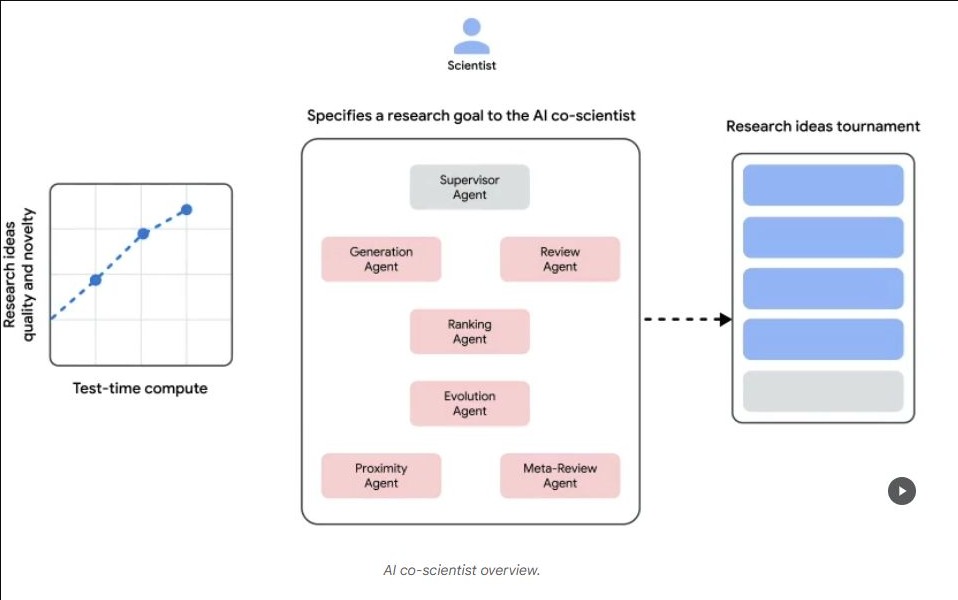
The AI co-scientist system described in the research documents below leverages recent advancements in frontier AI, including the Gemini 2.0 model as its foundational LLM. Its architecture is modular, comprising specialized autonomous AI agents such as a Supervisor agent, review agent, idea generation agent, ranking agent and meta-review agent that execute specific sub-tasks related to the scientific method, a method that includes testing a 'hypothesis' following a procedure to creates a scientific experiment and documenting the results. The process is as old as modern science itself. What is new are these agent worker appearing above now only appearing in 2025 with the newest and most powerful AI models and operating as co-workers or co-intelligences with the human scientist and coordinated by a Supervisor agent.
"This approach moves beyond solely relying on the knowledge acquired during AI model pre-training which occurred largely between largely 2022-2024. The new method allocates additional computational resources during inference or what is called 'test-time compute' (2025) and enable's what the Nobel economist Daniel Kahneman would call, System-2 style thinking. This is slower deliberate reasoning to reduce uncertainty and progress optimally towards the goal. This goal is scientific discovery ranging from the mundane day to day discoveries to the next Nobel Prize levels. Deep Mind originator and researcher Demis Hassabis exemplifies this type of new scientist in his recent Nobel Prize for Chemistry. Here, Hassabis solved the particular long term challenge of Protein folding and how this occurs with AI enhanced methods now able to solve almost all complex human and non human protein folds and their patterns of unfolding. This is enabling a whole new range of discovery from new drugs to better understanding of human and animal disease and deeper knowledge of all biologically based systems that are built from 'protein' in it's multitudinous varieties and structures.
The Co-scientist system uses a persistent context memory to store and retrieve states of the agents during computation, enabling iterative reasoning over long time horizons. This memory system allows the AI to build on previous insights and refine its hypotheses through multiple rounds of analysis—mirroring how human scientists develop ideas over time progressing from mistakes and false paths eventually to a greater solution and discovery.
APPLICATIONS IN RESEARCH SETTINGS
In academic and research institutions, the AI co-scientist shows promise for accelerating fundamental scientific inquiry this way and discoveries which require 'pattern recognition. The system processes research goals of varying complexity, from simple statements to extensive documents spanning tens of thousands of natural language words converted to AI tokens or hundreds of prior scientifically vetted and refereed reputable sources now presented as publication PDFs. Co-scientist then parses these goals to derive a research plan configuration, capturing desired proposal preferences, attributes, and constraints that make both an experiment and hypothesis possible.
One documented example in the paper listed below shows the system generating hypotheses related to the biological mechanisms of Amyotrophic Lateral Sclerosis (ALS), specifically focusing on the role of Nuclear Pore Complex (NPC) phosphorylation. Such capabilities could potentially transform how researchers approach complex biological questions such as these, enabling them to explore multiple hypothetical pathways simultaneously.
The system's ability to format its hypotheses into structures familiar to the scientific community and these generally widely recognized procedures —such as the NIH Specific Aims Page format—allows for systematic assessment of scientific merit by human experts for the vetting process of the possibilities the AI coscientist produces . In the documented case studies, six board-certified hematologists and oncologists evaluated AI-generated hypotheses, providing a rigorous validation of the system's output quality.
COMMERCIAL POTENTIAL AND DRUG DISCOVERY
For industries focused on scientific innovation and commercialization and problems regarding pattern recognition from vast data sets that even experienced human researchers would find daunting, the AI co-scientist offers particularly compelling applications in drug discovery possibility, narrowing and and repurposing—identifying novel therapeutic uses for existing drugs. This approach could significantly reduce the time and cost associated with bringing new treatments to market from a vast level of possibility to better choices or at least a better presentation to human experts with years of experience to be able to judge.
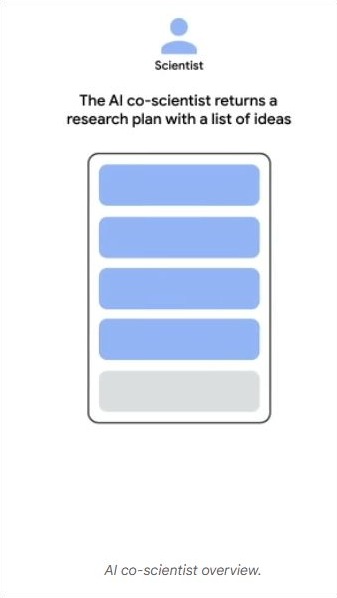
Drug repurposing through AI assistance combines computational and experimental approaches with comprehensive understanding of disease-drug interactions. The AI co-scientist demonstrates this capability through concrete results: when tasked with identifying potential drug repurposing candidates for Acute Myeloid Leukemia (AML), the system generated hypotheses that led to laboratory testing of promising compounds.
The documented results are encouraging: "Based on potential mechanisms of action, five drug repurposing candidates—Binimetinib, Pacritinib, Cerivastatin, Pravastatin, and Dimethyl fumarate (DMF)—were selected for further wet-lab validation in AML." Three of these drugs demonstrated inhibition of cell viability in AML cell lines in in vitro experiments. Another compound, KIRA6, also showed inhibition of cell viability in three different AML cell lines (KG-1, MOLM-13, and HL-60 cells). Beyond the scientific jargon, co-scientist is able to parse equally obscure data types from all manner of science across a huge range of sources and disciplines
SCIENTIFIC SELF-CRITICISM: THE ENGINE OF IMPROVEMENT
What truly sets the AI co-scientist apart from previous artificial intelligence tools is something remarkably human: the ability to critique its own ideas. While earlier AI systems might generate predictions or analyze data, they typically couldn't evaluate the quality of their own output without human feedback.
The AI co-scientist, however, contains what amounts to an internal debating society. Drawing inspiration from chess rankings, the system uses what's called an "Elo rating" approach—the same method used to rank chess players worldwide. In this internal tournament, different scientific hypotheses compete against each other based on their merits, much like chess players facing off across the board.
"This competitive process allows the system to continually refine its thinking," explains the research. "The system's dedicated 'Ranking agent' orchestrates these scientific face-offs, helping identify which hypotheses deserve further investigation."
When tested against established scientific questions with known answers, hypotheses with higher Elo ratings proved significantly more likely to be correct. This creates a virtuous cycle: better hypotheses receive higher ratings, which helps the system learn to generate increasingly promising ideas.
This self-improvement mechanism parallels how science itself advances through peer review and critical evaluation. Just as human scientists defend their ideas before skeptical colleagues, the AI co-scientist's hypotheses undergo rigorous internal scrutiny. The system even uses a "Proximity agent" to create what amounts to a map of ideas, grouping similar hypotheses together and eliminating redundancies—ensuring efficient exploration of diverse scientific possibilities rather than repeatedly traveling down the same intellectual paths.
For non-scientists, this might seem technical. But the significance is profound: we've created an artificial system that doesn't just generate scientific ideas but critically evaluates them using principles similar to those that have driven scientific progress for centuries. It's as if the system contains both the creative spark to imagine new possibilities and the disciplined skepticism to test them rigorously.
PREDICTIVE CAPABILITIES
Perhaps the most remarkable achievement of the AI co-scientist is something that would seem impossible just a few years ago: independently arriving at scientific insights that mirror those being discovered simultaneously in laboratories around the world.
Consider what happened when researchers presented the system with information about bacterial gene transfer—how bacteria share genetic material, a process crucial for understanding issues like antibiotic resistance. Without access to the very latest research papers, the AI co-scientist generated hypotheses about specialized genetic elements called "chimeric infective particles" (cf-PICIs) that eerily matched conclusions human scientists were just publishing in peer-reviewed journals.
This wasn't a fluke. In another demonstration, researchers challenged the system to identify new potential uses for existing medications without providing it specific guidance. "We aimed to demonstrate the co-scientist's capacity to autonomously discover novel drug repurposing candidates without oversight," the researchers note. The system not only generated plausible hypotheses but ones promising enough to warrant laboratory testing—with several compounds subsequently showing real effects against cancer cells.
What makes this ability so valuable is how it addresses a fundamental bottleneck in scientific progress: the human capacity to synthesize knowledge. Even the most brilliant researchers can only read a fraction of the papers published in their field each year. Important connections between different studies or disciplines may go unnoticed simply because no single person has encountered both pieces of information.
The AI co-scientist, drawing on its training across millions of scientific documents, can identify these connections across traditional boundaries. It's as if we've created a research partner with perfect recall of the scientific literature who can spot patterns that might take decades for human researchers to notice—potentially accelerating discoveries that could otherwise remain buried in the exponentially growing mountain of research data.
This doesn't make the system a replacement for human scientists, but rather a powerful spotlight that can illuminate promising pathways that merit human investigation—potentially saving years of trial and error in the search for new treatments, materials, or solutions to complex problems.
THE HUMAN-AI RESEARCH PARTNERSHIP
The development of AI co-scientist systems does not aim to replace human researchers but rather to augment their capabilities. The system processes and synthesizes vast amounts of scientific literature and data, generating hypotheses that human scientists then evaluate, refine, and test experimentally.
This collaborative approach leverages the complementary strengths of human and artificial intelligence: machines excel at processing enormous datasets and identifying non-obvious connections across disparate domains, while human scientists bring contextual understanding, experimental expertise, and the crucial ability to determine which questions are most worth pursuing.
or scientists confronting humanity's most persistent medical challenges—the intricacies of cancer, the mysteries of neurodegenerative diseases like ALS, or the growing threat of antimicrobial resistance—this technology represents something more valuable than mere automation. It offers a new lens through which to view familiar problems, suggesting connections and possibilities that might remain hidden to even the most dedicated human researchers due to the sheer volume of potentially relevant information.
Consider a biomedical researcher specializing in Alzheimer's disease. Even if they read one research paper every day of their career, they would encounter only a tiny fraction of the potentially relevant studies published across neuroscience, genetics, immunology, and dozens of other fields that might contain crucial insights. The AI co-scientist can process and synthesize information across these boundaries, identifying patterns invisible to specialists confined within traditional disciplinary silos.
This capability becomes increasingly critical as scientific questions grow more complex and interdisciplinary. Modern challenges—from climate change to pandemics to personalized medicine—demand integration of knowledge across traditionally separate domains. The siloed nature of scientific expertise, while necessary for depth, creates blind spots when addressing these multifaceted problems.
The AI co-scientist doesn't eliminate the need for human specialists—quite the opposite. It amplifies their capabilities by serving as a bridge between disciplines, suggesting connections that specialists from different fields might never discover through traditional collaboration. It's not about replacing human judgment but expanding the scope of what humans can consider when exercising that judgment.
As we look toward a future where scientific knowledge continues to expand exponentially, this partnership model may reshape how discovery itself unfolds. The most significant breakthroughs may increasingly emerge not from lone geniuses or even teams of human scientists, but from collaborations between human researchers and AI systems—each contributing their unique strengths to the pursuit of understanding.
The AI co-scientist, with its ability to process research across multiple domains and generate testable hypotheses, doesn't represent a replacement for human science. Rather, it offers an extension of our oldest and most successful method for understanding the world—a method that has always evolved with new tools, from microscopes to particle accelerators. In this light, the AI co-scientist is not a revolution but an evolution—the latest instrument in humanity's persistent effort to see further, understand deeper, and solve problems that have long seemed intractable.
In laboratories and research facilities worldwide, scientists will begin now to work alongside these evolving new digital AI partners—finding that the future of discovery may not be human or artificial intelligence alone, but rather the unprecedented combination of both.
Sources
Juraj Gottweis, Google Fellow, and Vivek Natarajan, Research Lead. Accelerating scientific breakthroughs with an AI co-scientist. February 19, 2025
AI Co-scientist Full Technical Paper. Toward an AI Co-Scientist. February 18, 2025. https://storage.googleapis.com/coscientist_paper/ai_coscientist.pdf
#Co-Scientist, #GoogleDeepMind, #AIScience, #AIDiscovery, #AIResearch #AIMedicalResearch #AIDrugDiscovery