From Human Question/Answer Communities to AI Only Answers
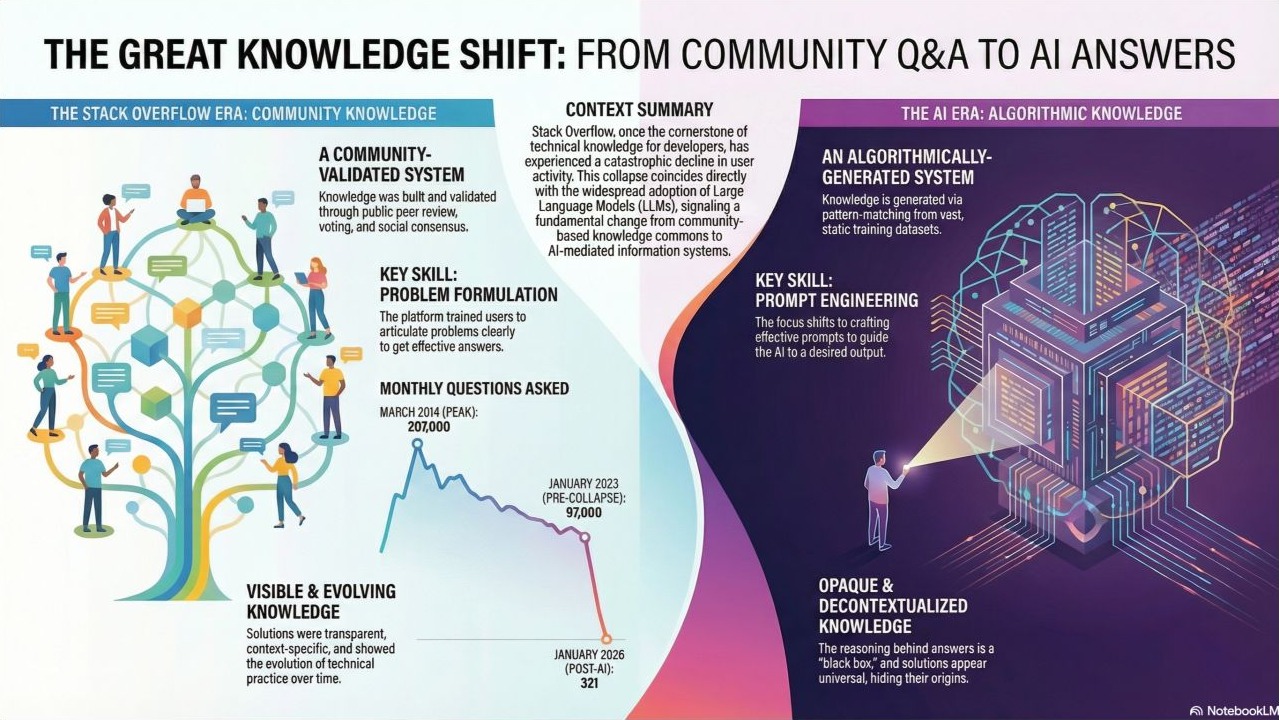
A recent analysis of Stack Overflow activity data (view the query here) reveals one of the most dramatic shifts in the history of computing infrastructure. Between March 2014 and January 2026, monthly questions on the platform plummeted from 207,000 to just 321—a 99.8% decline that accelerated sharply after March 2023, coinciding with widespread adoption of large language models.
This isn't merely a story about one platform's obsolescence. It's evidence of a paradigm shift as profound as the transition from mainframe to personal computing, or from desktop to mobile-first architectures. Stack Overflow's decline marks the end of what we might call the "human-intermediated knowledge phase" of computing and the beginning of something fundamentally different—a transformation with implications that extend far beyond software development.
To understand what's at stake, we need to position Stack Overflow within the larger cycles of internet development, examine its historical significance as knowledge infrastructure, and grapple with what its rapid dissolution tells us about the changing nature of expertise, learning, and human agency in computational practice.
Situating Stack Overflow: From Web 2.0 to the AI Transition
The Boom-Bust Cycles of Internet Development
Stack Overflow's 16-year trajectory maps onto broader patterns in internet history. To understand its significance, we need to trace several overlapping technological waves:
The Programmatic Internet (1995-2000): The first dot-com boom was characterized by the rapid commercialization of internet infrastructure and the emergence of search engines (AltaVista, Yahoo, early Google) as primary knowledge-access mechanisms. This was an era of centralized portals and hierarchical information architecture—what Tim Berners-Lee envisioned as a "read-only" web.
The Web 2.0 Revolution (2004-2015): Stack Overflow launched in 2008 at the apex of what Tim O'Reilly termed "Web 2.0"—the shift from static content consumption to participatory knowledge production. This era gave us Wikipedia (2001), Flickr (2004), Reddit (2005), Twitter (2006), and countless platforms built on user-generated content, social voting mechanisms, and network effects. Stack Overflow represented the pinnacle of this model applied to technical knowledge: a reputation-driven meritocracy where developers collaboratively built a comprehensive, searchable corpus of programming solutions.
The Mobile and Platform Consolidation Era (2010-2020): As smartphones became ubiquitous, internet activity concentrated around a few dominant platforms (Facebook, Google, Amazon, Apple). Stack Overflow matured during this period, becoming taken-for-granted infrastructure—what Geoffrey Bowker and Susan Leigh Star would call "infrastructural inversion," visible only when it breaks down.
The AI Paradigm Shift (2020-present): The release of GPT-3 (2020), GitHub Copilot (2021), ChatGPT (2022), and subsequent models represents a phase transition—not merely another platform but a fundamental reconfiguration of how knowledge is accessed, evaluated, and deployed. Stack Overflow's collapse provides empirical evidence of this shift's magnitude.
What Was Stack Overflow? A Knowledge Infrastructure Analysis
Stack Overflow wasn't simply a Q&A site—it was a specific socio-technical solution to the epistemological challenges of software development in the Web 2.0 era. To understand what's being lost, we need to examine what it actually did:
Search and Retrieval Innovation: Before Stack Overflow, programmers relied on scattered documentation, mailing list archives, and forum threads. Google searches for programming problems often surfaced outdated, fragmented, or contradictory information. Stack Overflow created a curated, votable, searchable corpus with metadata (tags, user reputation, acceptance markers) that significantly improved signal-to-noise ratios. It became, in effect, a specialized search engine optimized for technical problem-solving—a layer between Google's general search and the raw documentation.
Democratized Expertise: The platform served multiple constituencies:
- Junior developers seeking quick solutions to common problems
- Mid-level developers debugging edge cases and learning unfamiliar technologies
- Senior developers answering questions to build reputation, clarify their own thinking, or stay current with emerging problems
- Non-professionals (hobbyists, students, academics) accessing professional-grade knowledge
Temporal Knowledge Architecture: Stack Overflow created a temporal record of how problems and solutions evolved. You could see how jQuery gave way to React, how Python 2 practices became obsolete, how security vulnerabilities were discovered and mitigated. This historical stratification made visible the evolution of technical practice itself.
Peer Review and Quality Control: The voting system, comment threads, and editorial features created what Thomas Kuhn might recognize as a "normal science" process—the community establishing and enforcing norms about what constituted good answers, appropriate questions, and legitimate knowledge claims.
Tacit Knowledge Externalization: Perhaps most significantly, Stack Overflow forced developers to articulate tacit knowledge. As Lucy Suchman's work on "plans and situated actions" demonstrates, much expert practice is improvisational and context-dependent. Stack Overflow's format required making this tacit knowledge explicit, searchable, and transferable.
The Data: Reading the Technological Transition
The Growth Era (2008-2014): Stack Overflow grew from 4 questions in July 2008 to over 200,000 monthly questions by March 2014. This exponential growth paralleled the explosion of web and mobile development, the proliferation of programming languages and frameworks, and the expansion of the developer workforce. The platform became infrastructural—integral to the daily practice of programming itself.
The Plateau and Slow Decline (2014-2022): Activity stabilized around 150,000-190,000 questions monthly, then began gradually declining around 2020. This plateau likely reflected multiple factors: the platform had answered many common questions (reducing new question velocity), quality standards became more stringent (higher barriers to posting), and alternative resources (YouTube tutorials, Discord servers, documentation improvements) emerged. Notably, this decline predates ChatGPT, suggesting Stack Overflow was already facing challenges.
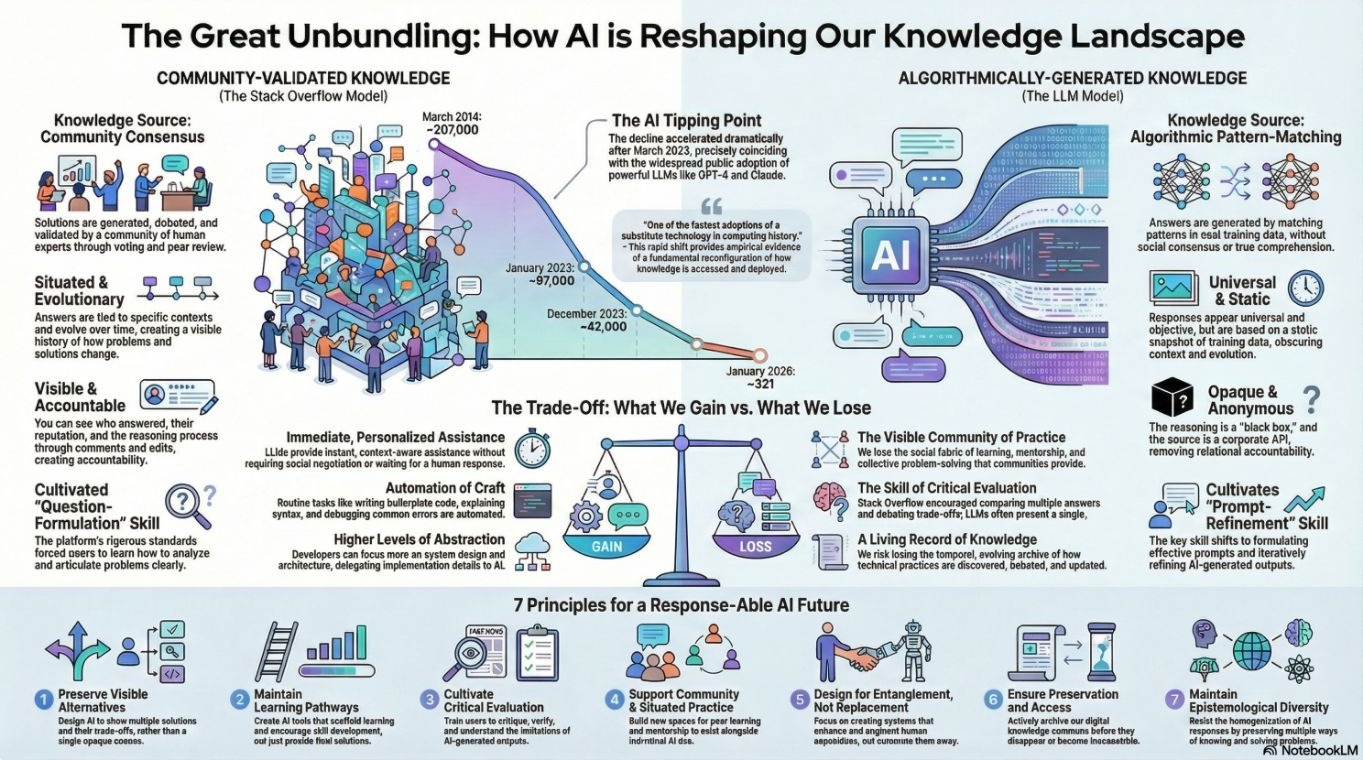
The Collapse (2023-Present): The cliff is undeniable. From 97,000 questions in January 2023 to 42,000 by December 2023, then 18,000 by December 2024, and just 321 in early January 2026. This 95%+ decrease in less than three years represents one of the fastest adoptions of a substitute technology in computing history. The timing aligns precisely with LLM availability: ChatGPT (November 2022), GPT-4 (March 2023), Claude (March 2023), widely available coding assistants throughout 2023-2024.
McLuhan and Media Theory: The Extensions and Amputations of Computing
Marshall McLuhan's dictum that "the medium is the message" provides a productive lens for understanding what's actually changing here. McLuhan argued that media function as extensions of human capabilities, but every extension involves a corresponding amputation—we gain something and lose something.
Stack Overflow as Extension: The platform extended human memory and problem-solving capacity. It created what McLuhan called a "new environment"—a cognitive ecology where individual developers could access collective expertise asynchronously, at scale, across geographical and temporal boundaries. It extended the social practice of asking a colleague for help into a planetary network of potential helpers.
The Reversal into Opposite: McLuhan observed that when a medium reaches its limits, it "reverses into its opposite." Stack Overflow, designed for human knowledge-sharing, became a database—its social dimensions increasingly subordinate to its archival function. Users searched existing answers rather than asking new questions. The platform's success in answering common questions reduced the need for new questions, creating a kind of epistemic saturation.
LLMs as a Different Extension: AI assistants extend different capabilities—immediate, personalized, context-aware assistance without requiring social negotiation or waiting for responses. But the amputation is significant: we lose the visible community of practice, the process of learning through articulating questions, the peer review that validated knowledge claims, and the temporal record of evolving expertise.
The Medium Shapes Cognition: McLuhan insisted that media reshape perception and cognition, not merely what we know but how we know. Stack Overflow encouraged particular cognitive habits: problem decomposition (to ask good questions), evaluation of competing solutions, understanding trade-offs, and contextual judgment about what answers applied to one's specific situation. LLMs encourage different habits: prompt formulation, output evaluation, integration of suggested code, iterative refinement through dialogue. These aren't better or worse—they're fundamentally different cognitive practices.
Theoretical Depth: Hayles, Haraway, Suchman, and Barad on Socio-Technical Transformation
The theoretical frameworks developed by N. Katherine Hayles, Donna Haraway, Lucy Suchman, and Karen Barad provide essential resources for understanding this transformation's deeper implications. These scholars share a rejection of simple technological determinism while taking seriously the ways that technologies reshape human practice and possibility.
N. Katherine Hayles: Cognition, Assemblages, and Unthought
In Unthought: The Power of the Cognitive Nonconscious (2017), Hayles distinguishes between conscious cognition and nonconscious cognitive processes that operate below the threshold of awareness but fundamentally shape thought and action. Technical systems, she argues, are cognitive actors that participate in distributed cognitive assemblages.
Stack Overflow as Cognitive Assemblage: The platform wasn't merely a repository of information—it was an active participant in cognition. When developers encountered problems, Stack Overflow shaped how they formulated questions, what solutions they considered, and how they evaluated answers. The platform's affordances (character limits, code formatting, voting systems) guided thought processes in ways developers rarely recognized consciously.
LLMs and the Cognitive Nonconscious: Hayles would likely see LLMs as even more deeply integrated into the cognitive nonconscious. Unlike Stack Overflow, which required explicit queries and conscious evaluation, LLMs can be embedded directly into development environments (Copilot, Cursor, etc.), operating at the level of code suggestion and completion. This shifts even more cognitive work below the threshold of conscious deliberation—an intensification of what Hayles calls "cognitive offloading."
The Question of Agency: Hayles insists that agency in cognitive assemblages is distributed—it emerges from the interaction of human and technical actors rather than residing solely in individual humans. Stack Overflow demonstrated distributed agency through collective knowledge production. LLMs represent a different distribution—less social, more algorithmic—with different implications for learning, expertise, and human capability.
Attention and Interpretation: Hayles distinguishes between "hyper attention" (rapid task-switching, multiple information streams) and "deep attention" (sustained focus on complex problems). Stack Overflow supported both—quick solutions for routine problems, deep engagement with complex issues. The concern with LLMs is whether they optimize primarily for hyper attention, providing rapid solutions without cultivating the deep attention necessary for genuine expertise development.
Donna Haraway: Situated Knowledges and Companion Species
Haraway's work on "situated knowledges" and more recently "companion species" offers critical insights into what kinds of human-technology relations we're constructing.
Situated Knowledges Argument: In her foundational 1988 essay, Haraway argued against both relativism and claims to objective, god's-eye-view knowledge. Instead, she advocated for "situated knowledges"—knowledge that's always partial, embodied, and positioned within specific contexts and power relations. Crucially, she argued for "accountability to location" and "partial connection" rather than totalizing claims.
Stack Overflow's Situatedness: Stack Overflow made situatedness partially visible. You could see who answered questions (their reputation, expertise markers), track comment threads showing how answers were contested or refined, and observe evolution over time. Geographic location was less visible, but technical positioning (which languages, frameworks, problems someone worked with) was explicit. The platform's knowledge was situated—emerging from specific development contexts and carrying traces of those contexts.
LLMs and the Erasure of Situation: LLMs present a fundamental problem from Haraway's perspective: they offer answers that appear objective and authoritative while obscuring their actual situatedness. We don't know what training data shaped a response, what biases are embedded, or what alternative perspectives exist. The "god-trick" of omniscient knowledge—precisely what Haraway critiqued—is reinscribed in AI outputs that appear complete and certain while actually being radically partial and positioned.
Companion Species and Sympoiesis: Haraway's later work explores "sympoiesis"—making-with, or collective becoming through entangled relationships. Stack Overflow demonstrated sympoiesis through collaborative knowledge production. LLMs risk reducing this to what Haraway might call "autopoiesis"—self-making by the AI system—where human developers become consumers rather than co-creators of knowledge.
Response-ability: Haraway emphasizes "response-ability"—the capacity to respond and be accountable in relationships. Stack Overflow created response-able relations: questioners and answerers were mutually accountable, visible to each other, able to iterate and refine. LLMs offer responses without the relational accountability—they can't be held responsible for errors, can't learn from specific interactions, and don't maintain ongoing relationships.
Lucy Suchman: Plans, Situated Actions, and Human-Machine Configurations
Lucy Suchman's work on "plans and situated actions" provides crucial insights into what's changing in the practice of programming itself.
Plans vs. Situated Actions: In her foundational study of photocopier use, Suchman distinguished between "plans" (abstract procedures) and "situated actions" (improvised responses to specific circumstances). Expertise, she argued, consists largely of situated action—the ability to respond intelligently to particular contexts that don't match idealized procedures.
Stack Overflow and Situated Action: Programming is fundamentally situated action. Stack Overflow supported this by providing solutions to specific problems that developers adapted to their particular contexts. The Q&A format made visible the gap between abstract plans (what documentation describes) and situated practice (what actually works in this specific case, with these constraints, on this platform).
LLMs as Pseudo-Plans: LLMs generate what appear to be situated solutions but are actually pattern-matching from training data. They can't truly understand the specific situation—your codebase, constraints, team practices—in the way human experts or even Stack Overflow's contextual Q&A could. This risks what Suchman calls "misplaced concreteness"—treating AI outputs as concrete solutions when they're actually abstract patterns that require situated judgment to apply appropriately.
Configurational Work: Suchman's later work emphasizes "human-machine reconfigurations"—how humans and technologies mutually shape each other through ongoing interaction. Stack Overflow created particular configurations: developers who could articulate problems, evaluate answers, integrate solutions. LLMs create different configurations: developers who prompt, evaluate outputs, debug AI-generated code. These aren't equivalent—they cultivate different capabilities and dependencies.
Visibility and Accountability: Suchman insists on the importance of making work visible for accountability and learning. Stack Overflow made problem-solving visible—questions, multiple answers, comment threads, edit histories. LLMs make problem-solving opaque—you get outputs without seeing the reasoning, alternatives, or decision processes. This invisibility has pedagogical and accountability implications.
Karen Barad: Agential Realism and Intra-Action
Karen Barad's "agential realism" offers perhaps the most radical reconceptualization of what's happening in this transformation.
Agential Cuts and Phenomena: Barad argues against the presumption of pre-existing entities (humans, technologies) that then interact. Instead, she proposes "intra-action"—phenomena emerge through specific "agential cuts" that temporarily stabilize entities and their boundaries. Agencies aren't possessed by independent entities but are "enacted" through specific material-discursive practices.
Stack Overflow as Intra-Active Phenomenon: From Barad's perspective, "developers" and "Stack Overflow" weren't separate entities that interacted—they were mutually constituted through practices of questioning, answering, voting, and coding. The platform and its users co-emerged. "Developer expertise" wasn't a property individuals possessed independently—it was enacted through participation in the platform's practices.
The LLM Reconfiguration: The shift to LLMs isn't humans adopting a new tool—it's a fundamental reconfiguration of the apparatus through which "developers," "expertise," "problems," and "solutions" are enacted and defined. Different agential cuts produce different phenomena. The question isn't whether LLMs help existing developers—it's what kinds of developers, what kinds of expertise, what kinds of problems and solutions are brought into being through AI-mediated practice.
Diffraction Not Reflection: Barad uses "diffraction" as a methodological alternative to "reflection." Rather than comparing old (Stack Overflow) and new (LLMs) as separate realities, we should examine their interference patterns—how they diffract through each other, what new possibilities and impossibilities emerge at their intersection.
Entanglement and Ethics: Barad insists that entanglements carry ethical implications—we're responsible for the worlds we help bring into being. The question isn't whether to use LLMs but what kinds of entanglements we're creating. Are we configuring systems that enhance human agency and capability, or that create new dependencies and diminishments? Are we bringing into being developers who understand computing deeply or who manage AI outputs they don't fully comprehend?
Onto-Epistemology: Barad rejects the separation of ontology (being) from epistemology (knowing). The shift from Stack Overflow to LLMs isn't just a change in how we access existing knowledge—it's a change in what counts as knowledge, what counts as expertise, and what kinds of knowing-beings are possible. We're not simply learning differently—we're becoming different kinds of computational practitioners.
Historical Parallels: The Preservation Question
The collapse of Stack Overflow invites comparison with historical moments when knowledge infrastructure underwent dramatic transformation, often involving loss as well as gain.
The Transition from Oral to Written Culture
Walter Ong's work on orality and literacy shows that the shift from oral to written knowledge wasn't simply additive—it fundamentally altered cognition, memory, and social organization. Oral cultures cultivated powerful memory techniques and communal knowledge practices. Writing externalized memory, enabling abstraction and analytical thinking but attenuating certain oral capabilities.
Stack Overflow represented a kind of "oral culture" of computing—living, evolving, community-maintained knowledge. LLMs represent a shift to a different mode: algorithmic retrieval from crystallized training data. We gain efficiency but potentially lose the living community of practice that generated and validated knowledge.
The Preservation of Classical Knowledge
The user's invocation of Greek and Roman knowledge during the Dark Ages is apt. The preservation of classical texts required deliberate institutional effort—monasteries copying manuscripts, Islamic scholars translating and preserving works, Byzantine libraries maintaining collections. Without this infrastructure, vast amounts of classical knowledge would have been lost.
Stack Overflow's 16 years of human knowledge exchange—millions of questions, answers, and discussions—represents a unique corpus documenting the evolution of software development practice. But unlike medieval manuscripts, this exists in database form, owned by a commercial entity (Stack Exchange, Inc.). If the platform becomes financially unviable, what ensures preservation? The Internet Archive's Wayback Machine provides partial coverage, but the interactive, structured data that made Stack Overflow valuable isn't fully captured by static snapshots.
Preservation Imperatives:
- Archival Partnerships: Research libraries and digital preservation institutions should partner with Stack Exchange to ensure comprehensive archival copies exist independent of commercial viability.
- Data Liberation: The full dataset should be made available for research and preservation, including voting histories, user interactions, and temporal evolution—not just final text.
- Contextual Documentation: We need ethnographic and historical documentation of Stack Overflow's practices, norms, and culture while community members can still articulate them.
- Training Data Ethics: If Stack Overflow's knowledge becomes primarily valuable as LLM training data rather than as living community practice, questions of compensation, attribution, and consent become acute.
The Library of Alexandria Problem
Stack Overflow's potential dissolution raises what we might call "the Library of Alexandria problem"—the question of what knowledge is lost when infrastructure fails. But there's a crucial difference: the Library's loss was (allegedly) catastrophic and sudden. Stack Overflow's decline is gradual and traceable. We can watch in real-time as a knowledge infrastructure becomes obsolete. This offers an opportunity to study knowledge transition that historians of earlier eras lack.
What we're witnessing isn't just technological succession but a fundamental question about how technical knowledge is constituted, maintained, and transferred across time. The shift from Stack Overflow to LLMs is a shift from:
- Community to Algorithm: Knowledge validated through social consensus versus pattern matching in training data
- Situated to Universal: Context-specific solutions versus generalized responses
- Evolutionary to Static: Living, updated knowledge versus crystallized training snapshots
- Visible to Opaque: Transparent reasoning versus black-box generation
- Accountable to Anonymous: Response-able relationships versus corporate API endpoints
Implications for Computing Practice and Knowledge Work
The Stack Overflow decline reveals a profound shift in computing practice itself—what it means to be a programmer, how expertise is developed and deployed, and the relationship between human and machine agency in software development.
From Craft to Configuration
Software development has always balanced craft skill with tool use, but the ratio is shifting dramatically. Where Stack Overflow supported craft—the ability to solve novel problems through understanding principles, debugging skills, and contextual judgment—LLMs shift toward configuration—managing AI-generated code, evaluating outputs, orchestrating tools.
This parallels earlier transitions: from assembly to high-level languages, from manual memory management to garbage collection, from writing algorithms to importing libraries. Each transition automated previous craft skills, enabling work at higher abstraction levels but also creating new dependencies and potential skill erosion.
The question is whether current AI transitions are continuous with these precedents or categorically different. Previous abstractions still required understanding lower levels (you needed to know memory principles even with garbage collection). LLMs can generate code that works without the developer understanding how or why. This represents a potential discontinuity—the possibility of effective practice without genuine comprehension.
The Deskilling/Upskilling Debate
Harry Braverman's "Labor and Monopoly Capital" (1974) analyzed how industrial automation separated conception from execution, deskilling craft workers into machine operators. We might be witnessing a similar process in computing: the separation of problem-solving (increasingly automated by LLMs) from problem-integration (still requiring human judgment).
But Braverman's critics (Shoshana Zuboff, among others) noted that automation can also create opportunities for upskilling—higher-level work requiring different expertise. The LLM transition might enable developers to work at unprecedented abstraction levels, designing systems and architectures while delegating implementation details to AI.
The historical evidence is mixed. What's clear is that the skills themselves are fundamentally changing:
Declining Relevance:
- Syntax memorization
- API documentation searching
- Debugging routine errors
- Implementing common algorithms
- Writing boilerplate code
Increasing Importance:
- Prompt engineering and AI collaboration
- Evaluating AI-generated code for correctness, security, and maintainability
- System design and architecture
- Understanding business logic and requirements
- Integrating AI outputs into coherent systems
Whether this represents net upskilling or deskilling depends on how these transitions are managed—whether organizations invest in deep expertise development or optimize for AI-augmented productivity without cultivating fundamental understanding.
The Loss of Question-Formulation as Skill
One underappreciated aspect of Stack Overflow was how it cultivated the skill of asking good questions. The platform's culture enforced rigorous question standards: minimal reproducible examples, clear problem statements, evidence of research effort. This wasn't bureaucratic gatekeeping—it was pedagogical discipline that forced developers to clarify their own thinking.
Cognitive science research shows that problem formulation is often more important than problem solving. A well-formulated question is often halfway to its answer. Stack Overflow made this visible and practiced.
LLMs accept poorly formulated prompts and still generate plausible responses. This might seem like improved usability, but it risks atrophying the metacognitive skills of problem analysis and decomposition. If you can get working code without understanding the problem structure, you might never develop the deeper analytical capabilities that enable novel problem-solving.
The Human in the Loop Question
As LLMs become more capable, the "human in the loop" framing becomes increasingly strained. Are humans the decision-makers using AI tools, or are humans becoming the loop in AI systems—the necessary but increasingly minimal oversight for predominantly automated processes?
Stack Overflow positioned humans as primary agents using collective resources. LLMs risk inverting this: AI as primary agent with human oversight. The Stack Overflow decline makes this inversion visible—when do we transition from "humans using AI tools" to "AI systems requiring human input"?
Knowledge Work Transformation Beyond Computing
While Stack Overflow serves developers specifically, the pattern it reveals has implications across knowledge work:
Legal Research: Westlaw and LexisNexis face similar pressures from legal AI. Medical Diagnosis: UpToDate and medical Q&A platforms compete with clinical AI. Academic Research: Literature search and review increasingly AI-mediated. Technical Writing: Documentation increasingly AI-generated. Customer Support: Community forums displaced by chatbots.
Each domain faces parallel questions: What happens when AI provides faster, more accessible answers than human expertise? How do we maintain the communities of practice that generated the knowledge AI was trained on? What skills remain distinctly human?
Toward Response-Able AI Integration: Design Principles for Socio-Technical Wisdom
Drawing on Haraway's concept of "response-ability," how might we design AI integration that maintains accountability, learning, and human agency?
Principle 1: Preserve Visible Alternatives
Stack Overflow showed multiple answers, competing approaches, and evolving consensus. LLM interfaces typically show single responses. We need designs that:
- Display alternative solutions with their trade-offs
- Make reasoning transparent rather than opaque
- Show uncertainty and contested knowledge
- Enable comparison and evaluation rather than acceptance
Principle 2: Maintain Learning Pathways
Expertise develops through deliberate practice and struggle. We need:
- AI assistance that scales with user expertise (more scaffolding for beginners, more autonomy for experts)
- Explicit mechanisms for moving from AI-assisted to AI-independent work
- Preservation of problem-solving process, not just solutions
- Spaces for genuine difficulty and skill development
Principle 3: Cultivate Critical Evaluation
Rather than passive acceptance of AI outputs:
- Training in AI output evaluation and critique
- Understanding AI capabilities and limitations
- Recognizing when to trust vs. verify vs. reject AI suggestions
- Maintaining independent expertise for validation
Principle 4: Support Community and Situated Practice
While LLMs offer individual productivity, knowledge requires community:
- Preserving or creating new spaces for collective knowledge work
- Making visible the social processes behind knowledge
- Enabling peer learning and mentorship
- Valuing situated, contextual expertise
Principle 5: Design for Entanglement, Not Replacement
Following Barad, recognize that humans and AI co-constitute each other:
- Design systems that enhance rather than replace human capability
- Attend to how AI configurations shape human cognition and practice
- Consider what kinds of human-AI entanglements we want to bring into being
- Take responsibility for the worlds we're creating
Principle 6: Ensure Preservation and Access
Given Stack Overflow's trajectory:
- Archive and preserve knowledge commons before they disappear
- Ensure training data ethics (attribution, compensation, consent)
- Maintain open access to collective knowledge
- Document practices and cultures while they're still active
Principle 7: Maintain Epistemological Diversity
Against the homogenization of AI responses:
- Preserve multiple ways of knowing and problem-solving
- Value embodied, tacit, and situated knowledge
- Resist optimization toward single "best practices"
- Maintain space for experimentation and heterogeneity
Conclusion: Witnessing and Shaping Transformation
The Stack Overflow decline isn't a isolated phenomenon—it's a window into one of the most significant transformations in the history of computing and knowledge work. What we're witnessing is:
A Technological Paradigm Shift: From participatory knowledge commons to AI-mediated retrieval, comparable in scope to earlier transitions from mainframe to personal computing or from desktop to mobile.
An Epistemological Reconfiguration: Not just new ways to access existing knowledge, but fundamental changes in what counts as knowledge, how it's validated, and who (or what) can legitimately produce it.
A Social Reorganization: The potential dissolution of communities of practice that have sustained technical knowledge production, replaced by individual-AI interactions mediated by corporate platforms.
A Preservation Challenge: The need to maintain access to 16 years of collaborative knowledge work while it's being actively displaced by alternative systems.
An Ethical Imperative: Choices about how we design, deploy, and govern AI systems that will shape human capability, agency, and flourishing for decades.
The theoretical resources developed by McLuhan, Hayles, Haraway, Suchman, and Barad aren't abstract academic exercises—they're essential tools for thinking carefully about what we're losing and gaining in this transition. They help us ask:
- What kinds of human-AI entanglements do we want to create? (Barad)
- How can we maintain situated, accountable knowledge practices? (Haraway)
- What cognitive capabilities are we cultivating versus atrophying? (Hayles)
- How do we preserve space for situated action versus reductive planning? (Suchman)
- What extensions and amputations are we enacting? (McLuhan)
The future isn't predetermined. The Stack Overflow data shows us a pivot point—a moment when one configuration of knowledge work gives way to another with remarkable speed. But speed doesn't mean inevitability. We have agency in how these systems are designed, deployed, and governed.
This requires what Karen Barad calls "response-ability"—the ability to respond thoughtfully to the entanglements we're creating. It requires what Donna Haraway calls "staying with the trouble"—neither naive techno-optimism nor reflexive resistance, but careful attention to what worlds we're bringing into being.
For those of us working at the intersection of AI integration and research/education—in libraries, universities, research institutions—our work isn't simply enabling new tools. We're participating in a profound reconfiguration of knowledge infrastructure with implications that will unfold for decades. That's a responsibility that demands our most sophisticated theoretical resources and our deepest ethical commitments.
The Stack Overflow decline is a gift, in a way—a visible, measurable signal of transformation that's otherwise distributed and diffuse. It gives us data, a timeline, and a focal point for examining changes that affect all knowledge work. What we make of this moment, how we design systems and practices that enhance rather than diminish human capability, remains an open question.
The work ahead is urgent: preserving what should be preserved, interrogating what's being lost and gained, designing thoughtful integrations, and maintaining space for human agency, learning, and collective knowledge creation in an increasingly AI-mediated world.
Data query available at: https://data.stackexchange.com/stackoverflow/query/1926661
I welcome engagement from developers, educators, librarians, and researchers navigating this transformation. How are you experiencing these shifts? What practices are you developing? How do we maintain genuine expertise and collective knowledge in this new configuration?
#ArtificialIntelligence #FutureOfWork #KnowledgeWork #SoftwareEngineering #Libraries #HigherEducation #MediaTheory #STS #DigitalTransformation #AI #CriticalTechnology