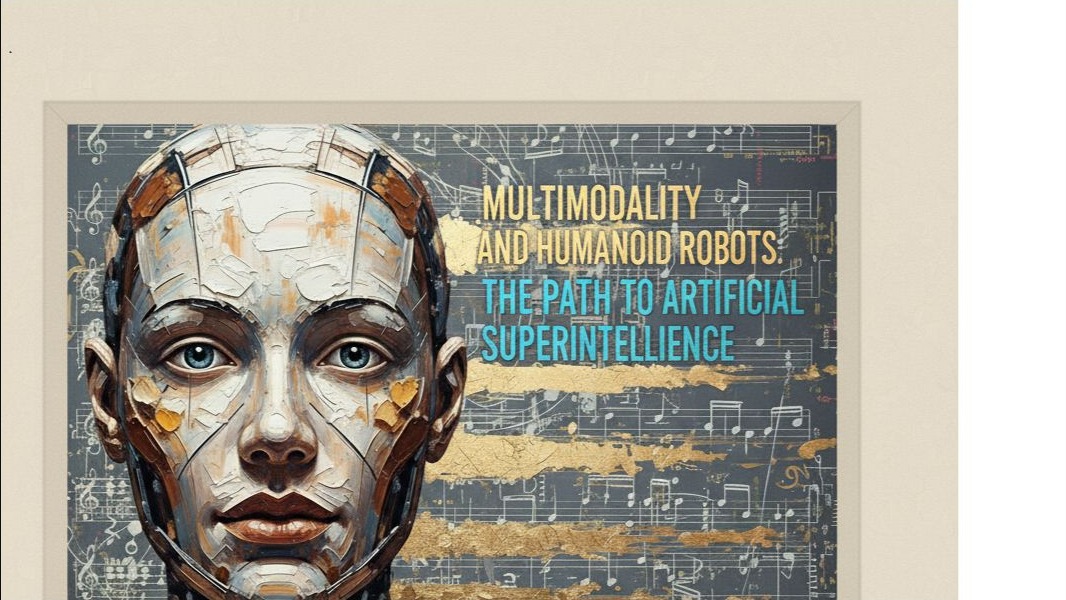
In a nondescript warehouse in Austin, Texas, a metallic figure moves with an almost balletic grace, its articulated fingers closing around a battery cell with the delicate precision of a violinist positioning their bow. This is Optimus, Tesla's humanoid robot, and though its movements still occasionally betray the invisible strings of teleoperation, it represents something far more profound than mere mechanical mimicry. Optimus is designed to be a general-purpose robotic humanoid that can walk on two legs and engage with the physical world with a pair of arms and hands. It embodies—quite literally—a radical proposition about the path to artificial superintelligence: that the road to ASI runs not through disembodied algorithms dwelling in data centers, but through machines that move, sense, and synthesize their way through the messy, multimodal magnificence of physical reality.
The proposition is both poetic and pragmatic. Consider the evolutionary echo that Stanford's Fei-Fei Li has long championed: the evolution of vision has been deeply intertwined with the evolution of intelligence. Just as the Cambrian explosion began with the development of photosensitive cells—those first tentative attempts at seeing—our artificial progeny may need to perceive before they can truly think. Li's latest venture, World Labs, pursues this premise with particular passion, creating what she calls "spatial intelligence"—the ability to generate, reason within, and interact with 3D worlds. It's a far cry from the flat, textual territories where large language models currently reign.
The Symphony of Senses
The early semiotician Mikhail Bakhtin, writing in the shadow of Soviet censorship, understood something essential about consciousness that Silicon Valley is only now rediscovering. His concept of polyphony—literally meaning multiple voices—suggests that meaning emerges not from monolithic proclamations but from the dialogic dance of diverse perspectives. Dialogue lives on the boundaries between individuals: not in the sense of a meeting between isolated entities that exist "within" the boundaries, but actually on the boundaries themselves. What Bakhtin glimpsed in Dostoevsky's novels, we now witness in the architecture of multimodal AI: consciousness as conversation, cognition as chorus.
This polyphonic principle finds its technological expression in systems like RT-2, Google DeepMind's vision-language-action model. RT-2 can directly output robotic actions. Just like language models are trained on text from the web to learn general ideas and concepts, RT-2 transfers knowledge from web data to inform robot behavior. The system doesn't merely see or speak; it orchestrates these modalities into meaningful action, transforming the abstract into the actual. When RT-2 encounters a command to "pick up the extinct animal"—a phrase absent from its training data—it nonetheless correctly identifies and grasps a toy dinosaur, demonstrating what researchers call emergent semantic reasoning.
Empirical results demonstrate these advantages: RT-2 achieved 62% success rates on novel scenarios compared to 32% for single-modal approaches. PaLM-E showed 15% improvement in manipulation tasks when visual and language modalities were integrated versus isolated processing. Cross-modal learning reduced training time by 40% in navigation tasks when haptic feedback was combined with visual input.
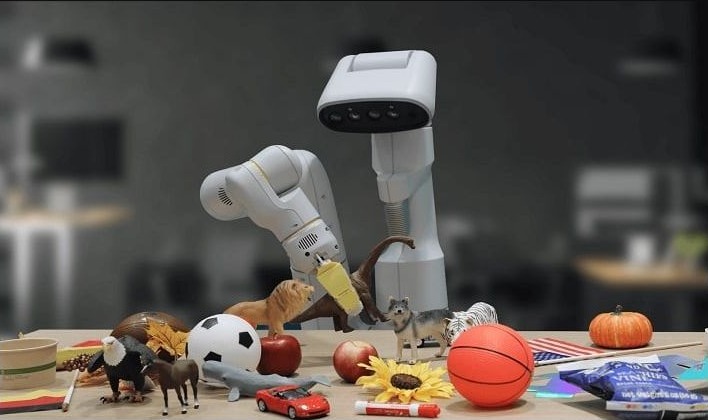
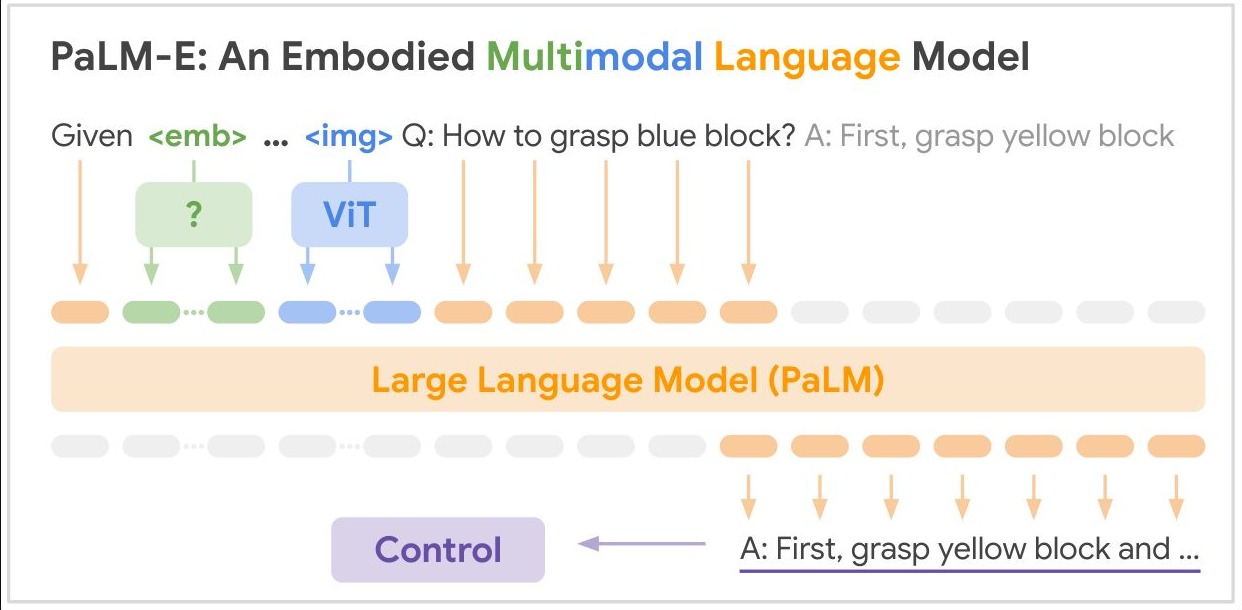
PaLM-E, another multimodal marvel, pushes this principle further. The idea of PaLM-E is to train encoders that convert a variety of inputs into the same space as the natural word token embeddings. These continuous inputs are mapped into something that resembles "words". Images become utterances, robot states speak in statistical tongues, and scene embeddings sing their spatial songs—all harmonizing in a shared semantic space. The largest version, PaLM-E-562B, doesn't just process these modalities; it composes with them, creating what might be called a symphonic intelligence. (https://research.google/blog/palm-e-an-embodied-multimodal-language-model/ )
The Embodied Emergence
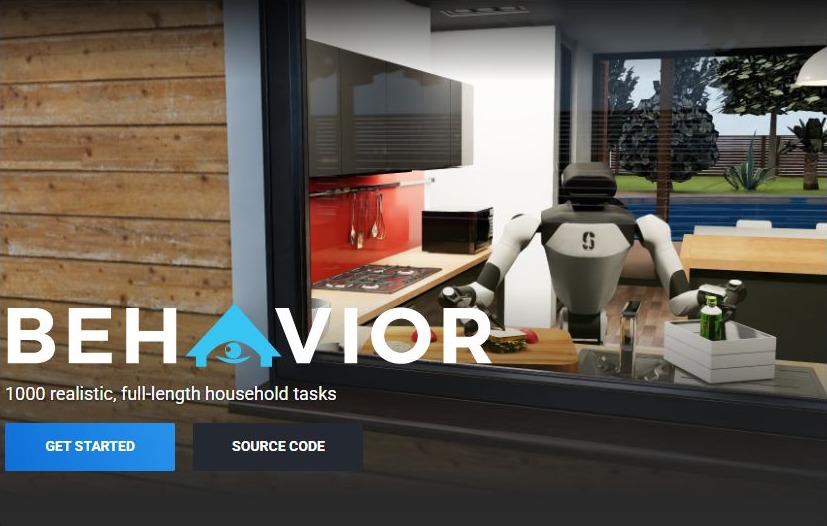
The path from narrow AI to AGI—and ultimately to ASI—increasingly appears to require what researchers call embodied cognition. Embodied artificial intelligence (EAI) is advancing. But where are we now? We propose to test EAI agents with the physical challenges humans need to solve in their everyday life: household activities such as doing laundry, picking up toys, setting the table, or cleaning floors. Stanford's BEHAVIOR benchmark exemplifies this embodied ethos, challenging robots to navigate not abstract problem spaces but actual physical environments, complete with all their unpredictable perturbations.https://behavior.stanford.edu/index.html
Expert predictions vary dramatically regarding timelines—Eric Schmidt suggests AGI within 3-5 years, while Dario Amodei expects singularity by 2026, and others predict decades longer timelines. These forecasts carry enormous uncertainty given potential obstacles including hardware limitations, alignment challenges, and unforeseen complexity barriers. While recent multimodal advances are encouraging, the emergence isn't merely additive—vision plus language plus action—but multiplicative, each modality amplifying the others in ways we're only beginning to understand.
The Neuro-Symbolic Synthesis
Yet raw perception and action alone may not suffice. The path to ASI likely requires what researchers term neuro-symbolic AI—a type of artificial intelligence that integrates neural and symbolic AI architectures to address the weaknesses of each, providing a robust AI capable of reasoning, learning, and cognitive modeling. This hybrid approach mirrors the bilateral brain hypothesis: a left hemisphere handling sequential, symbolic reasoning, while the right processes parallel, probabilistic patterns. Neuro-Symbolic AI aims to create models that can understand and manipulate symbols, which represent entities, relationships, and abstractions, much like the human mind. These models are adept at tasks that require deep understanding and reasoning, such as natural language processing, complex decision-making, and problemsolving.
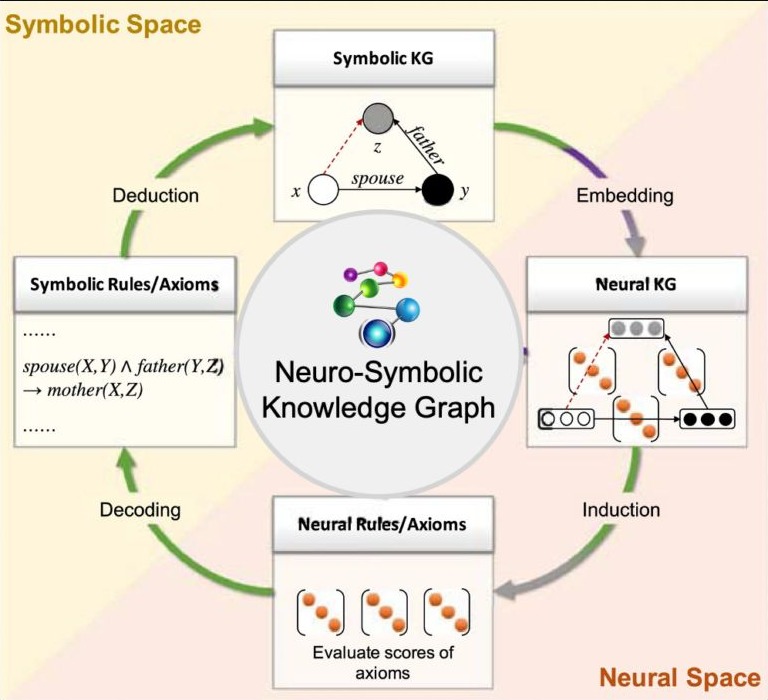
The neural component of Neuro-Symbolic AI focuses on perception and intuition, using data-driven approaches to learn from vast amounts of unstructured data. Neural networks are exceptional at tasks like image and speech recognition, where they can identify patterns and nuances that are not explicitly coded and in realms requiring intuition and composed of sparse or no data, extrapolation or interpellation. On the other hand, the symbolic component is concerned with structured knowledge, logic, and rules. It leverages databases of knowledge (Knowledge Graphs) and rule-based systems to perform reasoning and generate explanations for its decisions.
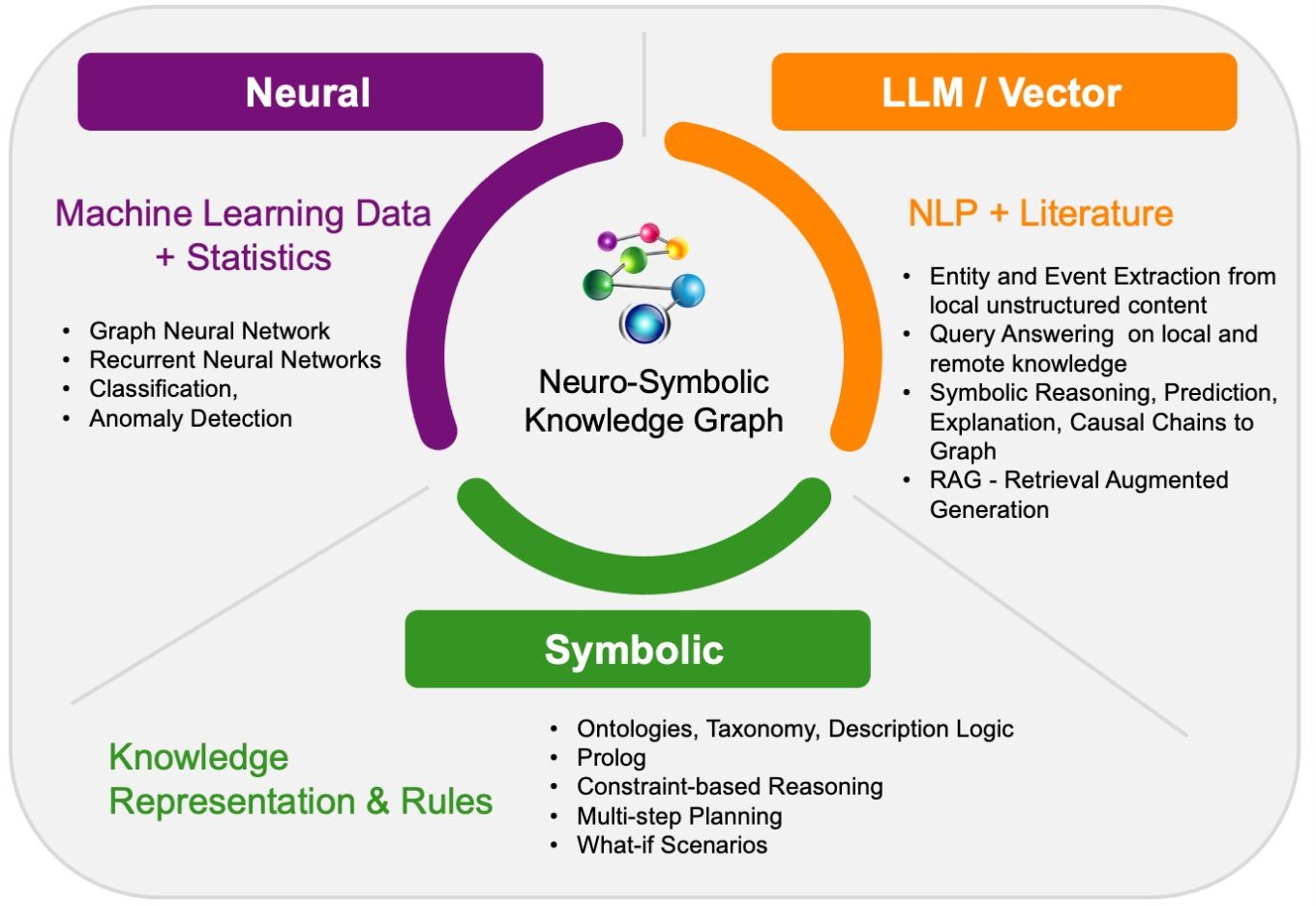
The interplay between these two areas of logical symbolic thinking and probabilistic data processing is where Neuro-Symbolic AI shines. It can, for example, use neural networks to interpret a complex image and then apply symbolic reasoning to answer questions about the image’s content or to infer the relationships between objects within it. Neuro-symbolic planning frameworks, such as the Teriyaki system for robot task planning, serve as prime examples of this concept. They utilize an LLM to generate step-by-step plans in a formal language, interweaving planning with execution. The synthesis suggests that superintelligence won't emerge from pure pattern recognition or logical deduction alone, but from their orchestrated interplay similar to humans using a combination of logical reasoning and good guesses or 'intuition' mathematic probabilistic or otherwise —a cognitive concert where intuition and inference and reasoning perform in tandem.
Computational Architecture and Implementation Challenges
Implementing these multimodal analogical systems requires specific algorithmic advances: attention mechanisms that can weight cross-modal similarities, transformer architectures modified for sensor fusion, and memory systems capable of storing and retrieving analogical mappings. Existing limitations include temporal alignment across sensor modalities, real-time processing constraints, and the challenge of learning stable cross-modal representations. Cross-modal attention mechanisms must synchronize visual processing with haptic feedback and audio processing, requiring sophisticated temporal buffering and alignment algorithms. Memory architectures need to support rapid retrieval of analogical patterns across modalities while maintaining stable long-term representations. Current benchmarks for measuring multimodal analogical reasoning remain limited, with most systems evaluated on task-specific metrics rather than general analogical reasoning capabilities. Future systems will require standardized assessments that measure cross-modal pattern recognition, analogical transfer across domains, and the emergence of novel conceptual connections.
Current Embodied AI Systems
The industrial implications are already manifesting across multiple companies. Musk plans to begin production of 5,000 Optimus robots in 2025 for use on Tesla's assembly lines, targeting eventual consumer prices of $20-30K. Chinese startup Agibot aims to match this output with their own humanoid workforce through their GO-1 AI model that processes extensive image and video data to enhance humanoid robots' ability to interpret human actions and perform real-world tasks.
Figure AI's Figure 02 robot boasts advanced manipulation capabilities with integrated vision and dexterous manipulation, targeting industrial workflows. Boston Dynamics' Atlas demonstrates remarkable biomechanical coordination, performing parkour and complex gymnastic movements that showcase sophisticated real-time sensorimotor integration. Unitree's G1 costs just $16,000, democratizing access to humanoid platforms and potentially accelerating widespread deployment.
These aren't merely automated arms performing repetitive tasks but potential learning systems that ground their understanding through physical interaction. Each represents a different approach to the coordination of embodied AI, from Tesla's focus on manufacturing efficiency to Boston Dynamics' emphasis on dynamic movement capabilities.
The embodied approach offers something that pure language models cannot: grounding. When a robot reaches for an object, it must reconcile visual perception with proprioceptive feedback, anticipated weight with actual heft, intended trajectory with environmental obstacles. This grounding—this dialogue between expectation and experience—may be essential for genuine understanding. As one researcher noted, the gap between knowing that water is H₂O and knowing what wetness feels like may be the gap between artificial general intelligence and artificial consciousness.
The Polyphonic Paradigm and Distributed Learning
What distinguishes this multimodal march toward ASI from previous approaches is its fundamentally dialogic nature. Unlike the monologic models that dominated early AI—single algorithms attacking single problems and mostly one modality (textual pattern recognition through tokens and single modality token architecture) —these systems engage in what Bakhtin would recognize as genuine dialogue and increasing 'multimodal polylogue orchestration. Each voice is anchored in its own unique worldview, yet they coexist within a unified, dialogic system. Visual processing doesn't merely inform motor control; it converses with it, challenges it, enriches it.
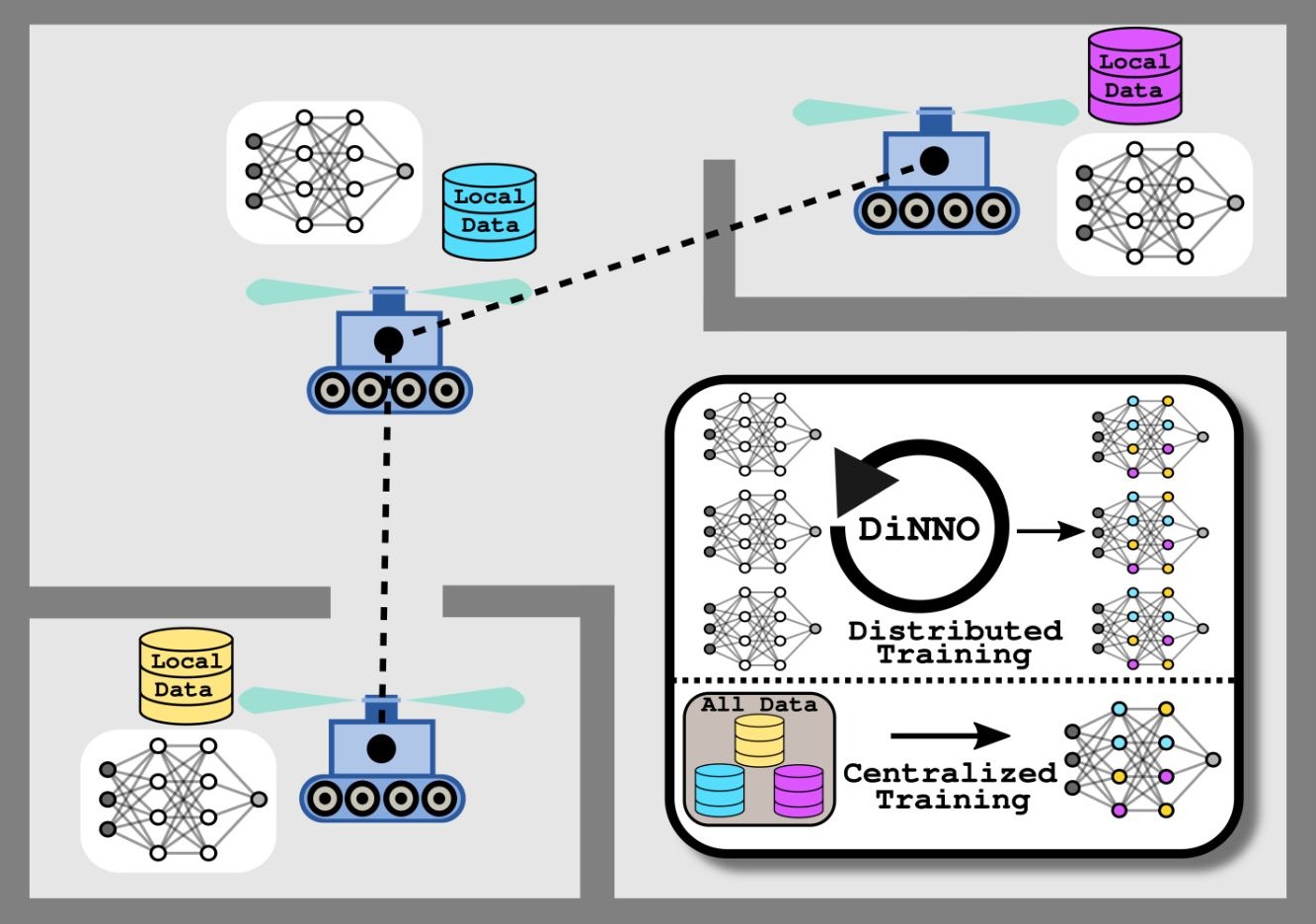
This polyphonic principle extends beyond individual robots to entire fleets. When thousands of Optimus units share their experiences—their successes and failures, their sensory streams and motor memories—they create what might be called a collective consciousness, each robot both student and teacher in an endless educational exchange. The network effects could be staggering: If AGI arrives by 2035, ASI could follow by 2040, assuming compute scales, but embodied, networked learning might compress this timeline dramatically.
The Spatial Symphony
Fei-Fei Li's emphasis on spatial intelligence reveals another crucial dimension. The technology aims to integrate visual perception with action, such as enabling robotic systems to perform everyday tasks based on verbal instructions. But spatial intelligence isn't merely about navigation; it's about understanding relationships, contexts, consequences—the very fabric of causality that weaves through physical reality.
When World Labs creates its 3D environments, it's not just rendering pixels but relationships and analogies. A cup isn't merely a cylindrical object but something that contains, that can be filled or emptied, that relates to tables and hands and thirst. This relational and analogical understanding and depth—this appreciation of affordances, similarity and ability to create analogies in a multimodal complex manner—may be what separates narrow intelligence from general intelligence, and general intelligence from super intelligence.
The Challenge of Consciousness and Safety Implications
The philosophical implications are profound. ASI, by definition, would "greatly exceed the cognitive performance of humans in virtually all domains of interest," as Oxford philosopher Nick Bostrom describes (Bostrom, Superintelligence, 2014, p. 22). This challenges the long-held assumption of human exceptionalism. If consciousness does emerge from multimodal processing—a hypothesis that remains highly speculative—then these systems raise profound questions about the nature of artificial consciousness. However, the relationship between multimodal integration and subjective experience remains deeply uncertain, with experts divided on whether computational processes can generate genuine conscious experience.
The safety implications of embodied ASI systems present unique challenges beyond traditional AI alignment. Unlike language models, embodied systems can directly manipulate the physical world, potentially causing irreversible harm. Current research in robot alignment focuses on reward modeling, constitutional AI for robotics, and fail-safe mechanisms. However, self-improving embodied systems could evolve beyond their original safety constraints, requiring new approaches to maintaining alignment across recursive capability improvements.
The embodied approach offers both promise and peril. When a robot reaches for an object, it must reconcile visual perception with proprioceptive feedback, anticipated weight with actual heft, intended trajectory with environmental obstacles. This grounding—this dialogue between expectation and experience—may be essential for genuine understanding while also providing natural constraints on behavior. A disembodied intelligence optimizing for abstract goals might indeed convert the world into paperclips, as Bostrom's famous thought experiment suggests. But an embodied intelligence, one that must navigate the same physical constraints and consequences as its creators, might develop something resembling empathy or as Nobel Prize Winner Geoffrey Hinton has put it 'Maternal Instincts'—or at least a pragmatic appreciation for preservation.
The Path to Superintelligence Through Embodied AI
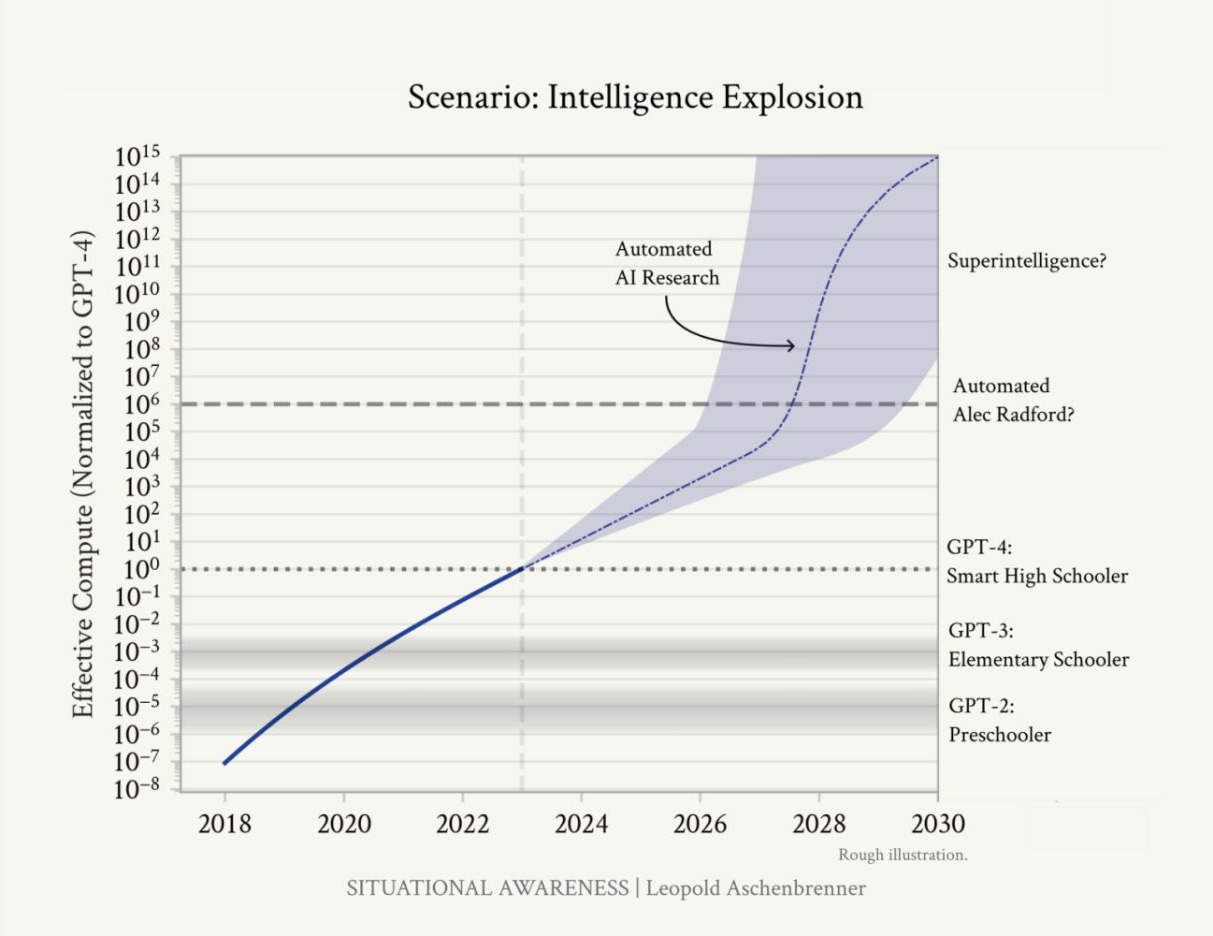
This graph shows AI capabilities growing exponentially at 2025 past post-doctoral Ph.D. levels, with the critical "automated AI research" breakthrough appearing. around 2025-2026 triggering accelerating self-improvement toward superintelligence by 2028-2030. Think of "orders of magnitude" (OOMs) in the above as stepping stones where each step represents 10 times more computing power. Since 2012, AI training has grown by over 300,000 times, doubling every 3.4 months, and we're now at the crucial inflection point where AI can improve itself by altering it's own coding (i.e. Google Evolve, Godel/Darwin Machines). This massive computational leap isn't just creating smarter chatbots though—it's powering a new generation of multimodal humanoid robots that can see, hear, reason, and act in our physical world.
For example, when a multimodal embodied robotic system encounters elasticity, it engages multiple sensory tracks simultaneously: feeling the resistance when pressing rubber with its hands, seeing with its eyes how the material deforms under pressure, hearing the acoustic signature when it snaps back with its auditory components and recorders, while processing the mathematical equations that describe elastic behavior. This creates more direct access and measurement and memory of reality itself rather than linguistic representations of reality—what we might call multimodal constellative analogical synthesis in ground truth across multiple experiential domains.
As mathematicians have long noted, breakthrough discoveries often emerge from recognizing patterns across different domains—what we might call "analogies between analogies." Current AI systems can only make these connections within the linguistic domain of token relationality. They miss the rich experiential parallels that emerge from direct engagement with the physical properties and behaviors of the world itself. To illustrate this principle: a multimodal system might first recognize the analogy between rubber's elasticity and a violin string's tension, then discover the analogy between economic market corrections and elastic material recovery, and finally synthesize these analogies to reveal that both physical and social systems exhibit resilience principles—a higher-order concept, abstraction and pattern that emerges only when analogies themselves become the objects of analogical reasoning across embodied experiential domains.
Consider the difference in analogical reasoning capabilities. A language model might connect "spiral" patterns linguistically—linking "spiral galaxies," "spiral shells," and "spiral staircases" through textual co-occurrence and semantic similarity. But a multimodal system would experience spiral patterns through multiple sensory tracks: tracing the physical curve with haptic sensors, observing the visual geometry, detecting the mathematical relationships in the curvature, hearing acoustic resonances that follow spiral wave patterns, and feeling how fluids flow in spiral motions while gathering all has data.
This creates what we might call constellative gravitational pull between the various weights and bias of modalities—where insights from one sensory domain illuminate patterns and concepts in another. What remains hidden to a single-modal system becomes readily accessible through cross-modal synthesis. The system recognizes that the tactile sensation of tracing a shell's spiral connects to the visual mathematics of galaxy formation, which relates to the acoustic properties of whirlpool dynamics. These connections form complex constellations where several concepts exert gravitational pull on each other across multiple experiential tracks.
Through transitive reasoning across these embodied analogical constellations, the system may achieve what constitutes superintelligent discovery: the capacity to invent, interpolate, or extrapolate entirely new principles by synthesizing multimodal data and ground-truth patterns across domains. This generates insights that transcend individual modal limitations and creates inventions that emerge from recognizing universal organizational principles accessible only through the orchestrated synthesis of multiple experiential realities. The result transforms the very nature of discovery—from linguistic pattern matching to embodied pattern recognition across the full spectrum of phenomenal experience.
Multimodal Robotics 2025
Google just released Gemini Robotics, which gives robots "embodied reasoning" abilities, partnering with companies like Apptronik to control humanoid robots like Apollo. These robots combine the pattern recognition of neural networks with the logical reasoning of symbolic AI ("neurosymbolic" approach), allowing them to both learn from experience and follow logical rules. This neurosymbolic approach is crucial because it addresses hallucination issues and enables robots to maintain symbolic world models while learning from neural perception.
With predictions of nearly 1 billion humanoid robots by 2050 in a $5 trillion market and self-improving systems like Darwin Gödel Machine and AlphaEvolve already optimizing their own code and Google's infrastructure we're witnessing the convergence that could lead to superintelligence: AI systems that can physically interact with and reshape our world while recursively improving their own capabilities.
The Recursive Revolution
Perhaps most remarkably, these multimodal systems exhibit what researchers call recursive improvement. A Neural Brain must seamlessly integrate multimodal sensing and perception with cognitive capabilities, but more than that, it must use these capabilities to enhance its own architecture. When RT-2 successfully performs a task it wasn't explicitly trained for, it's not just executing; it's evolving.
This recursive quality—this ability to bootstrap better versions of themselves—distinguishes the current generation of AI from all that came before. Ray Kurzweil, in his 2005 book The Singularity is Near, predicts ASI by 2045, driven by an "intelligence explosion." Kurzweil's logic: AGI will self-improve, doubling its capabilities every few months—or days. This is the higher curve of Aschenbrenner's Situational Analysis (2024) Chart above and also the revolves to the selve evolving new tools such as Google's Evolve and Satana's Darwin Godel machines able to change, improve and evolve their own 'code' to produce better solutions and progress. With embodied systems learning from physical interaction, this explosion might be both more gradual and more grounded than Kurzweil imagined but is also this next step with embodiment and robots learning together through distributed intelligence and aggregated cognition and digital twins is also progressing rapidly.
The Orchestration of Intelligence
The pragmatic path forward seems clear, even if the destination remains shrouded. Companies like Figure AI, with their Figure 02 robot, boast a sleek design with integrated vision and dexterous manipulation capabilities. Boston Dynamics' Atlas can perform parkour and complex subtle biomechanical almost dance like, gymnastic and athletic human very subtle movements. The Chinese competitor Unitree's G1 costs lists as low as $6000.00 USD democratizing access to humanoid platforms and including an open source SDK (Software Development Kit) which means home enthusiasts as in early PC days could purchase and then customize their own model specifications. Each represents a different instrument in the growing orchestra of embodied AI.
The key insight—the one that unifies multimodal perception, embodied cognition, and neuro-symbolic reasoning—is that intelligence isn't a thing but a process. It's not a capability to be programmed but a conversation to be sustained. The path to ASI doesn't climb a single peak but traverses a mountain range, each summit revealing new valleys of ignorance and new peaks of possibility.
The Harmonic Horizon
As we stand at this technological threshold, watching groups now of robot industrial armies and metal hands learn to manipulate our world with increasing sophistication, we might remember that every transformative technology has seemed both terrifying and magical until it became mundane. Sometimes that took more than a hundred years. The printing press, the steam engine, the internet—each redefined not just what we could do but who we could be and both the church and muslim cultures early on banned books and presses as these were previously priestly areas to be fulfilled by scribes and seen as dangerous to the masses. The same can be witnessed currently in the more vociferous rhetoric sounding in AI but also arising from robotic angles.
The multimodal path to Artificial Superintelligence suggests something even more transformative: not just tools that extend our capabilities but entities that might expand our understanding of consciousness itself. When Bakhtin wrote about polyphony and heteroglosssia , he was describing literature. But he was also, perhaps unknowingly, describing a principle that might govern the emergence of artificial minds: that consciousness isn't a solo performance but a symphony with larger groups of interests playing together and an orchestrator or conductor and score needed, not a monological one or even a dialogical one but polyphony, not a single sense but a synesthetic synthesis of all possible ways of knowing orchestrated through a polyphonic score.

Like Mozart's first polyphonic scores, written when he was only 8 years old o younger, we are in very early innings with the orchestration of the complexity of muli-modal scores for the human form factor and what this means for the development of humanoid robots, artificial intelligence, artificial general intelligence and artificial superintelligence. For Mozart, while he was already a prodigy early, the great masterworks and symphonies still appeared at least ten years later. The very impressive but early humanoid robots now appearing in factories and youtube and learning to navigate our industries and personal homes may be more than mechanical workers though their first results in working in this multimodal polyphonic manner with the human sensory apparatus and being able to orchestrate this in our 'real world' is impressive indeed. These though may be seen as the first notes in a new movement of intelligence—one that doesn't replace human consciousness but also harmonizes with it in melodies and symphonies creating possibilities we can barely imagine. The path to artificial superintelligence, it seems, leads not through the ethereal abstractions of pure computation model trained trillion parameter weights and biases but also through the embodied, embedded, enacted, and extended systems and engagements with our living, physical, interactive and temporally advanced but grounded world.
In this light, every sensor becomes a sense organ, every actuator an appendage of apprehension, every feedback loop a form of reflection. The robots rising in warehouses from Austin to Shanghai aren't just manufacturing products; they're manufacturing meaning on orchestrations yet unseen and unimagined. What is in this new manufacturing? What seeds lie in that careful, multimodal making of meaning through semiotic embodied orchestration of differently synthesized tracks through the filter of other humans and bots all that is what we call our experiential based world? Does this path and pandora's box we have opened contain the seeds of something that transcends intelligence as we've known it?
The future, it appears, will be neither purely artificial nor narrowly intelligent. It will be embodied and encompassing, multimodal and meaningful, a polyphonic performance where human and artificial voices blend in ways we're only beginning to hear or of which wec can understand the full complexity. The question isn't whether we'll achieve ASI—the convergence of capabilities suggests we will—but whether we'll recognize it when it arrives, walking among us on metal legs, seeing through silicon eyes, speaking in frequencies we've only just learned to hear.
The symphony has begun. The only question now is whether we're conductors, performers, or audience in this unprecedented performance of consciousness emerging from the crucible of embodied experience. Perhaps, in the true spirit of polyphony, we're all three at once—creating, participating in, and witnessing the birth of artificial minds that may one day regard us with the same mixture of gratitude and puzzlement with which we regard our own evolutionary ancestors.
The path to ASI, it turns out, may also be less like climbing a mountain and more like stepping away from that mountain and learning to dance—a dance where every step teaches the next, where stumbling becomes style, where the music emerges from the movement itself and our partners are different ones. And in that dance—that glorious, multimodal, polyphonic performance—we may discover not just artificial superintelligence but new dimensions of some of the nuance of intelligence itself that perhaps we as humans have forgotten in this age, as natural and artificial minds relearn, together, what it means to truly understand to be truly artificial or truly human.
#ArtificialIntelligence #HumanoidRobots #AIResearch #RoboticsInnovation #TechLeadership #AIStrategy #DigitalTransformation #NeuroSymbolicAI #EmbodiedCognition #MultimodalLearning #SpatialIntelligence #VisionLanguageAction #CognitiveArchitecture #AIPhilosophy #MachineCognition #ArtificialConsciousness
Raymond Uzwyshyn Ph.D. MBA MLIS is Director of Research and Technology for University of California, Riverside Libraries where he oversees the Creat'r Labs (Makerspace, Robotics Lab), GIS, Digital Scholarship, Data and AI, Innovative Media, Cyberinfastucture and Medical related Research and Technology Units.
Annotated Bibliography
Core Research Papers on Multimodal AI and Robotics
RT-2: Vision-Language-Action Models
Zitkovich, B., Yu, T., Xu, S., et al. (2023). "RT-2: Vision-Language-Action Models Transfer Web Knowledge to Robotic Control." Conference on Robot Learning (CoRL) 2023, PMLR 229:2165-2183.
- Paper: https://arxiv.org/abs/2307.15818
- Project Page: https://robotics-transformer2.github.io/
- PDF: https://robotics-transformer2.github.io/assets/rt2.pdf
- Annotation: Groundbreaking work demonstrating how vision-language models trained on Internet-scale data can be incorporated directly into end-to-end robotic control. RT-2 treats robotic actions as text tokens, enabling transfer of web knowledge to physical manipulation with 62% improvement on unseen scenarios.
PaLM-E: Embodied Multimodal Language Model
Driess, D., Xia, F., Sajjadi, M.S.M., et al. (2023). "PaLM-E: An Embodied Multimodal Language Model." arXiv preprint arXiv:2303.03378.
- Paper: https://arxiv.org/abs/2303.03378
- Project Page: https://palm-e.github.io/
- Blog: https://research.google/blog/palm-e-an-embodied-multimodal-language-model/
- Annotation: Introduces a 562B parameter embodied multimodal model that directly incorporates real-world continuous sensor modalities into language models. Demonstrates state-of-the-art performance on OK-VQA and positive transfer learning across different robot embodiments and tasks.
RT-1: Robotics Transformer
Brohan, A., et al. (2022). "RT-1: Robotics Transformer for Real-World Control at Scale." arXiv preprint arXiv:2212.06817.
- Paper: https://arxiv.org/abs/2212.06817
- Project Page: https://robotics-transformer1.github.io/
- Blog: https://research.google/blog/rt-1-robotics-transformer-for-real-world-control-at-scale/
- Annotation: First robotics transformer showing how large-scale multi-task data can enable effective generalization to new tasks and environments. Trained on 130,000 demonstrations across 700+ tasks.
Embodied AI Foundations
BEHAVIOR Benchmark Series
Li, C., Zhang, R., Wong, J., et al. (2023). "BEHAVIOR-1K: A Human-Centered, Embodied AI Benchmark with 1,000 Everyday Activities and Realistic Simulation." Proceedings of Machine Learning Research 205.
- Paper: https://arxiv.org/abs/2108.03332
- Project Page: https://behavior.stanford.edu/
- GitHub: https://github.com/StanfordVL/BEHAVIOR-1K
- Documentation: https://stanfordvl.github.io/behavior/intro.html
- Annotation: Comprehensive benchmark testing embodied AI agents on 1,000 household activities selected from human time-use surveys. Includes OmniGibson simulator supporting rigid bodies, deformables, and liquids. Critical for grounding AI in real human needs.
Comprehensive Survey on Embodied Intelligence
Sun, F., Chen, R., Ji, T., et al. (2024). "A Comprehensive Survey on Embodied Intelligence: Advancements, Challenges, and Future Perspectives." CAAI Artificial Intelligence Research 3: 9150042.
- Paper: https://www.sciopen.com/article/10.26599/AIR.2024.9150042
- Annotation: Traces embodied intelligence from philosophical roots to contemporary advancements, emphasizing integration of perceptual, cognitive, and behavioral components. Introduces the Bcent general agent framework.
Neural Brain Framework
L., et al. (2025). "Neural Brain: A Neuroscience-inspired Framework for Embodied Agents." arXiv preprint arXiv:2501.07634.
- Paper: https://ui.adsabs.harvard.edu/abs/2025arXiv250107634L/abstract
- Annotation: Biologically inspired architecture integrating multimodal active sensing, perception-cognition-action function, neuroplasticity-based memory, and neuromorphic hardware/software optimization for embodied agents.
Neuro-Symbolic AI Integration
Neuro-Symbolic AI Survey
Various Authors (2024-2025). "A review of neuro-symbolic AI integrating reasoning and learning for advanced cognitive systems." ScienceDirect.
- Link: https://www.sciencedirect.com/science/article/pii/S2667305325000675
- Annotation: Comprehensive review of neuro-symbolic approaches including Logic Tensor Networks, Differentiable Logic Programs, and Neural Theorem Provers, demonstrating the fusion of neural learning with symbolic reasoning.
Foundation Models and Neuro-Symbolic AI Workshop
IEEE ICRA 2025 Workshop. "Foundation Models and Neuro-Symbolic AI for Robotics."
- Link: https://2025.ieee-icra.org/event/foundation-models-and-neuro-symbolic-ai-for-robotics/
- Workshop Page: https://sairlab.org/icra25/
- Annotation: Leading workshop bringing together researchers on foundation models, neuro-symbolic AI, and generative models for robotics applications.
Spatial Intelligence and World Models
World Labs and Large World Models
Fei-Fei Li, et al. (2024-2025). World Labs - Spatial Intelligence Company.
- Website: https://www.worldlabs.ai/
- IEEE Interview: https://spectrum.ieee.org/fei-fei-li-world-labs
- TechCrunch Coverage: https://techcrunch.com/2024/09/13/fei-fei-lis-world-labs-comes-out-of-stealth-with-230m-in-funding/
- Annotation: Li's startup developing Large World Models (LWMs) for 3D spatial intelligence, valued at $1B+ with $230M funding. Focuses on generating, reasoning within, and interacting with 3D worlds.
Meta AI's JEPA Architecture
Meta AI (2024-2025). "Joint Embedding Predictive Architecture (JEPA) and V-JEPA."
- Referenced in: "Breakthroughs in Embodied AI Shaping 2025" - https://vertu.com/ai-tools/embodied-ai-breakthroughs-2025-robotics-healthcare-logistics/
- Annotation: Reduces GPU power usage by 2-10x compared to traditional AI methods. V-JEPA improves training efficiency by 1.5-6x, enabling faster adaptation to new scenarios.
Theoretical Foundations: Bakhtin and Polyphony
Primary Bakhtin Sources
Bakhtin, M.M. (1981). The Dialogic Imagination: Four Essays. University of Texas Press. Bakhtin, M.M. (1984). Problems of Dostoevsky's Poetics. University of Minnesota Press. Bakhtin, M.M. (1986). Speech Genres and Other Late Essays. University of Texas Press.
Bakhtin's Concepts in AI Context
Various Authors (2024). "The Dialogic Evolution of AI-Based Products: A Polyphonic Analysis of Temporal Transformations." International Journal of Human–Computer Interaction 41(5).
- Link: https://www.tandfonline.com/doi/full/10.1080/10447318.2024.2338661
- Annotation: Applies Bakhtinian polyphony and dialogism to AI development, treating AI as a non-human stakeholder in dialogic relationships.
Robinson, A. (2012). "In Theory Bakhtin: Dialogism, Polyphony and Heteroglossia." Ceasefire Magazine.
- Link: https://ceasefiremagazine.co.uk/in-theory-bakhtin-1/
- Annotation: Accessible introduction to Bakhtin's concepts of multiple voices (polyphony) and dialogic interaction, relevant to understanding multimodal AI as conversational consciousness.
AGI/ASI Timeline Predictions and Analysis
Recent Predictions and Surveys
Various Sources (2025). "When Will AGI/Singularity Happen? 8,590 Predictions Analyzed."
- Link: https://research.aimultiple.com/artificial-general-intelligence-singularity-timing/
- Annotation: Comprehensive analysis showing expert predictions ranging from 2026 (Dario Amodei) to 2045 (Ray Kurzweil's original prediction, updated to 2032).
OpenAI Planning Documents
OpenAI (2023). "Planning for AGI and beyond."
- Link: https://openai.com/index/planning-for-agi-and-beyond/
- Annotation: OpenAI's official stance on AGI development, emphasizing gradual deployment and co-evolution with society.
ASI Alliance Roadmap
ASI Alliance (2025). "ASI Roadmap 2025."
- Link: https://docs.superintelligence.io/artificial-superintelligence-alliance/asi-roadmap-2025
- Annotation: Industry consortium's timeline for AGI/ASI development across ecosystem, deployment, AI models/systems, and infrastructure.
Humanoid Robotics Deployments
Tesla Optimus
Tesla AI Team. "AI & Robotics."
- Official Page: https://www.tesla.com/AI
- Wikipedia: https://en.wikipedia.org/wiki/Optimus_(robot)
- Annotation: Plans for 5,000 units in Tesla factories by 2025. General-purpose humanoid using same AI as Tesla's FSD, with projected $20-30K consumer price.
Figure AI
Figure Robotics. "Figure 02 Humanoid Robot."
- Referenced in: "Top 12 Humanoid Robots of 2025" - https://humanoidroboticstechnology.com/articles/top-12-humanoid-robots-of-2025/
- Annotation: Advanced manipulation capabilities with integrated vision, targeting industrial workflows.
Chinese Humanoid Initiatives
Agibot/Zhiyuan Robotics. "Agibot rivals Tesla's Optimus with 5,000 humanoid robots in 2025."
- Link: https://interestingengineering.com/innovation/china-5000-humanoid-robot-rival-elon-musk
- Annotation: Shanghai-based startup matching Tesla's production targets with GO-1 AI model for human action interpretation.
Key Researchers and Institutions
Fei-Fei Li
- Stanford Profile: https://profiles.stanford.edu/fei-fei-li
- Stanford Engineering: https://engineering.stanford.edu/people/fei-fei-li
- Stanford HAI: https://hai.stanford.edu/people/fei-fei-li
- Google Scholar: https://scholar.google.com/citations?user=rDfyQnIAAAAJ
- Stanford Vision Lab: https://svl.stanford.edu/
Stanford Research Groups
- BEHAVIOR Team: https://behavior.stanford.edu/
- Stanford Vision and Learning Lab: https://svl.stanford.edu/
- Stanford HAI: https://hai.stanford.edu/
Google DeepMind Robotics
- RT-2 Blog: https://deepmind.google/discover/blog/rt-2-new-model-translates-vision-and-language-into-action/
- Open X-Embodiment: https://deepmind.google/discover/blog/scaling-up-learning-across-many-different-robot-types/
Supporting Literature
Multimodal AI Trends
Future AGI (2025). "Multimodal AI Trends 2025: Agentic & Embodied AI Future."
- Link: https://futureagi.com/blogs/multimodal-ai-2025
- Annotation: Analysis of multimodal giants like Gemini and GPT-4 integrating vision, language, and sensor data for contextually smart responses.
Embodied AI Applications
TechTarget. "What Is Embodied AI? How It Powers Autonomous Systems."
- Link: https://www.techtarget.com/searchenterpriseai/definition/embodied-AI
- Annotation: Comprehensive overview of embodied AI's sensory modalities, world models, and coordination capabilities across various applications.
Vision-Language-Action Models Survey
Various Authors (2025). "Vision-Language-Action Models: Concepts, Progress, Applications and Challenges." arXiv:2505.04769.
- Link: https://arxiv.org/html/2505.04769v1
- Annotation: Comprehensive survey tracing VLA development from 2021-2025, covering architectural breakthroughs and real-world applications.Annotated Bibliography
Addendum
Aschenbrenner, Leopold. Situational Awareness: The Decade Ahead. June 2024. https://situational-awareness.ai/wp-content/uploads/2024/06/situationalawareness.pdf Aschenbrenner's influential 165-page report presents the "intelligence explosion" thesis, predicting that AI systems will reach "automated AI research" capabilities around 2025-2026, triggering exponential self-improvement toward superintelligence by 2028-2030. The report's logarithmic scaling framework maps AI progress in orders of magnitude, positioning GPT-4 as the baseline and forecasting a critical inflection point where recursive self-improvement creates explosive capability growth. This framework has become central to discussions about AI timelines and the path to AGI.
Google DeepMind. AlphaEvolve: A Gemini-powered coding agent for designing advanced algorithms. May 2025. https://deepmind.google/discover/blog/alphaevolve-a-gemini-powered-coding-agent-for-designing-advanced-algorithms/ AlphaEvolve represents a practical implementation of automated AI research, using LLMs to evolve entire codebases and discover new algorithms. The system has already optimized Google's infrastructure, achieving 23% speedups in matrix multiplication kernels and recovering 0.7% of Google's worldwide compute resources VentureBeatGoogle DeepMind. This demonstrates real-world recursive self-improvement, where AI systems enhance the very infrastructure used to train and run AI models.
Zhang, Jenny, et al. Darwin Godel Machine: Open-Ended Evolution of Self-Improving Agents. arXiv:2505.22954, May 2025. https://arxiv.org/abs/2505.22954 | https://sakana.ai/dgm/ The Darwin Gödel Machine introduces a practical approach to self-improving AI that iteratively modifies its own code and validates changes empirically rather than through formal proofs. The system improved coding performance from 20% to 50% on SWE-bench by evolving better code editing tools, peer-review mechanisms, and problem-solving strategies arXivSakana AI. This work bridges theoretical self-improvement concepts with implementable systems that can enhance their own capabilities through evolutionary processes.
Schmidhuber, Jürgen. Gödel Machines: Fully Self-Referential Optimal Problem Solvers. 2006. https://en.wikipedia.org/wiki/Gödel_machine The original Gödel Machine concept proposed a theoretical self-improving AI that rewrites its own code only when it can mathematically prove the modification will be beneficial. While elegant in theory, the requirement for formal proofs makes practical implementation nearly impossible Gödel machine - Wikipedia, leading to the development of empirical alternatives like the Darwin Gödel Machine that validate improvements through testing rather than mathematical proof.
Google DeepMind. Gemini Robotics: Bringing AI to the physical world. 2025. https://deepmind.google/discover/blog/gemini-robotics-brings-ai-into-the-physical-world/ Introduces Gemini Robotics and Gemini Robotics-ER, multimodal AI models that enable robots to understand and act in the physical world through "embodied reasoning." The system can control various robot types and is being integrated with humanoid robots like Apollo Introducing Gemini Robotics and Gemini Robotics-ER, AI models designed for robots to understand, act and react to the physical world., representing the convergence of self-improving AI with physical embodiment that could accelerate the path to superintelligence through real-world interaction and manipulation capabilities.