How artificial intelligence is democratizing the radical art of thinking across disciplines
Cartographers of Convergence
In the cathedral quiet of Princeton's Institute for Advanced Study, sometime in the early 1950s, Albert Einstein would shuffle between the mathematics and physics departments, his unruly white locks a beacon of intellectual restlessness. He was searching, always searching—not just for a unified field theory that would marry quantum mechanics with general relativity, but for something more elusive: the precise point where disciplines dissolve into pure pointed and elegant understanding. Einstein had spent his life as a cartographer of convergence, mapping the territories where physics meets philosophy and mathematics marries metaphysics, where the concrete calculations of science dance with the abstract choreography of thought.
Today, as artificial intelligence systems process vast corpuses of human knowledge with unprecedented sophistication, we stand at a similar threshold now opening for wider participation. The boundaries that once separated academic disciplines—those careful cordons that universities erected to organize knowledge—are becoming increasingly porous. AI doesn't recognize the difference between a physics paper and a philosophy treatise, between Princeton's Institute of Advanced Study and Miami Dade Community College Chess Club discussions, a biological advanced article in Nature and a business case study/advertisement in Forbes. It does reads voraciously across all domains, creating unexpected and surprising and sometimes very apropos syntheses that almost mirror the mental agility of history's greatest interdisciplinary thinkers - yes, it is approaching those realms or at least with human partners, testing the ascent. Read on.
The Pattern Recognition Pioneer
The botanist, cytogeneticist and Nobel Prize winner Barbara McClintock spent decades in scientific exile, her revolutionary insights about genetic transposition dismissed by peers who couldn't see past their compartmentalized disciplinary blinders and ivy tower established refereed journals. Working alone in her cornfields at Cold Spring Harbor Laboratory, she developed what she called "a feeling for the organism"—an intuitive methodology that bridged molecular biology with ecological thinking, statistical analysis with almost mystical close observation. From this observation and interdscipinary placing together, McClintock began to understand that genes weren't fixed entities but dynamic actors in an ongoing biological drama, jumping between chromosomes not fixed blueprints but rather malleable ideas leaping between intellectual domains.
Her approach presaged what we now see in advanced AI systems: the ability to recognize patterns across seemingly unrelated datasets. When Claude or GPT-4 synthesizes insights from evolutionary biology, complexity theory, and organizational psychology to solve a business problem, it's performing a digital version of McClintock's corn-field revelations. The AI doesn't just access information; it discovers connections that transcend traditional academic boundary lines, much as McClintock discovered genetic mobility by refusing to separate observation from intuition, statistics from storytelling.
Modern AI excels at what McClintock pioneered: seeing the forest through the genes, recognizing that understanding emerges not from deep specialization in a single domain, but from patient observation of how systems interact across scales and categories. A doctoral student in molecular biology, working with AI, can now instantly access insights from complexity theory, ecology, and even economics to understand how genetic networks behave like social systems or market dynamics.
this represents far more than convenient interdisciplinary browsing—it constitutes a fundamental revolution in how scientific discovery unfolds. Consider the profound implications: when our hypothetical molecular biologist queries an AI system about gene regulatory networks, she doesn't simply receive biological data. Instead, the AI synthesizes insights from network theory (how information cascades through social media), economic modeling (how market crashes propagate through financial systems), and ecological research (how forest fires spread through landscapes). Suddenly, the seemingly arcane behavior of transcription factors reveals itself as a variant of the same mathematical principles governing viral memes, stock market panics, and epidemic outbreaks.
Why does this matter so profoundly? Because the most significant scientific breakthroughs have always emerged at disciplinary boundaries, yet traditional academic training systematically prevents researchers from recognizing these connections. The structure of graduate education—with its demand for ever-narrower specialization—creates intellectual silos that mirror the bureaucratic divisions of university departments rather than the actual architecture of natural phenomena.
Before AI, a molecular biologist studying genetic oscillations might spend months reading literature reviews to discover that economists had already developed sophisticated models for similar cyclical behaviors in market dynamics, or that ecologists had identified parallel patterns in predator-prey relationships. The cognitive load of maintaining expertise across multiple domains was simply prohibitive. Most researchers remained trapped within their disciplinary boundaries not by choice but by the practical limitations of human information processing.
AI eliminates these constraints by serving as an intellectual translation system that recognizes deep structural similarities across seemingly unrelated domains. When the molecular biologist asks how genetic networks maintain stability while allowing for rapid adaptation, the AI doesn't just cite papers on homeostasis. It reveals how her question connects to research on organizational resilience in business schools, adaptive capacity in climate science, and robustness in engineering systems. The AI recognizes that all these fields grapple with the same fundamental challenge: how complex systems balance stability with flexibility.
This cross-pollination generates insights that no single discipline could produce. Gene regulatory networks begin to look less like mechanical circuits and more like social movements, with certain genes functioning as opinion leaders that influence cascades of cellular decision-making. Market dynamics illuminate why genetic mutations sometimes lie dormant for generations before suddenly expressing themselves—the same way economic innovations can remain latent until the right environmental conditions trigger their widespread adoption. Ecological principles of keystone species help explain why the disruption of certain regulatory genes has disproportionate systemic effects, just as the removal of crucial nodes can collapse entire networks.
The implications extend far beyond academic curiosity. Understanding genetic networks through the lens of social dynamics might revolutionize cancer treatment by revealing why certain therapeutic interventions trigger unexpected resistance patterns—the same way authoritarian crackdowns can paradoxically strengthen social movements. Economic insights about market manipulation could illuminate new approaches to genetic engineering, while ecological principles of succession might guide regenerative medicine strategies.
More fundamentally, this AI-enabled interdisciplinary fluency transforms the very nature of scientific expertise. Instead of training researchers to become ever-more-specialized experts in increasingly narrow domains, we can cultivate scientists who think like symphonic conductors—capable of orchestrating insights from multiple disciplines to create harmonies that no single instrument could produce. The molecular biologist becomes a synthesist, using AI to weave together insights from complexity science, economics, and ecology into entirely new theoretical frameworks for understanding life itself.
The Systems Synthesizer
Buckminster Fuller never met a boundary he wouldn't cross, a discipline he wouldn't pillage for insights. Architect, inventor, philosopher, mathematician, and poet, Fuller embodied what he called "comprehensive anticipatory design science"—a methodology that demanded fluency across every domain of human knowledge. His geodesic domes emerged from crystallography and shipbuilding, his economic theories from geometry and systems thinking, his social philosophy from physics and poetry.
Fuller's approach mirrors how contemporary AI systems process information: comprehensively, without regard for departmental distinctions. When an AI helps a graduate student in architecture understand how mycelial networks in fungi might inform building design, or how economic theories of emergence might revolutionize urban planning, it's channeling Fuller's omni-disciplinary sensibility. Fuller believed that specialized education was obsolete in an interconnected world; today's AI systems prove him prophetic by demonstrating how intelligence emerges from synthesis rather than specialization.
The resonance runs deeper still. Fuller's concept of "synergy"—the idea that wholes exhibit properties their parts cannot—perfectly describes how AI systems achieve insights that no single discipline could produce. A physicist studying AI might discover that machine learning algorithms mirror thermodynamic processes, while a philosopher working with AI might recognize that neural networks reproduce ancient debates about emergent consciousness. These aren't accidents but inevitable outcomes when intelligence operates without disciplinary constraints. Also,these aren't accidents but inevitable outcomes when intelligence operates without disciplinary constraints. The apparent coincidences—machine learning algorithms that mirror thermodynamic processes, neural networks that reproduce ancient philosophical debates about consciousness, genetic networks that behave like economic markets—reveal a deeper truth: the boundaries between academic disciplines are human inventions that obscure the underlying unity of natural phenomena.
Reality itself is fundamentally interdisciplinary. The same mathematical principles govern the formation of galaxies and the clustering of neurons, the same network dynamics shape social movements and protein folding, the same information-theoretic constraints limit biological evolution and algorithmic learning. Academic departments divide knowledge into convenient administrative units—physics, biology, economics, philosophy—but nature recognizes no such boundaries. Water molecules don't respect the distinction between chemistry and physics; market behaviors don't confine themselves to economics departments; consciousness doesn't limit itself to philosophy seminars.
When AI systems process information without regard for these artificial divisions, they inevitably rediscover the deep structural patterns that connect seemingly disparate phenomena. An unconstrained intelligence, whether artificial or human, naturally gravitates toward what mathematicians call "deep homologies"—the recognition that apparently different systems often instantiate identical abstract structures. The physicist studying machine learning doesn't accidentally stumble upon thermodynamic parallels; she discovers them because both domains emerge from the same fundamental principles of information processing and energy minimization.
This suggests something profound about the nature of intelligence itself: that true understanding requires the ability to recognize patterns across arbitrary categorical boundaries. Einstein's genius lay not in his mastery of physics alone, but in his capacity to see how physical principles connected to philosophical questions about the nature of space and time. McClintock's breakthrough insights emerged from her willingness to let biological observation inform mathematical intuition and vice versa. The most profound discoveries have always emerged from minds capable of what we might call "meta-pattern recognition"—the ability to discern underlying structures that manifest across multiple domains.
AI systems excel at precisely this kind of meta-pattern recognition because they're not trained to respect disciplinary boundaries. They process physics papers and philosophy treatises with equal attention, discovering natural affinities that university departments systematically obscure. The inevitable result is a kind of intellectual archaeology—the gradual excavation of deep connections that have always existed but remained buried beneath layers of academic specialization.
The Medium Theorist
Marshall McLuhan transformed how we think about technology and communication by refusing to stay within academic lanes. Literature professor turned media theorist, McLuhan synthesized insights from anthropology, psychology, theology, and technology studies to understand how media reshape human consciousness. His famous dictum "the medium is the message" emerged from his ability to see patterns across disciplines—recognizing that the structure of communication technologies matters more than their content, that form fundamentally shapes meaning.
McLuhan's methodology perfectly anticipated how AI would revolutionize interdisciplinary thinking. Just as McLuhan recognized that television would restructure human perception more profoundly than any particular TV show, AI researchers now understand that large language models reshape thinking itself, regardless of specific outputs. The architecture of attention in transformer models doesn't just process language; it creates new forms of associative reasoning that transcend disciplinary boundaries.
A graduate student in media studies, working with AI, can now analyze texts through the lens of neuroscience, economics, and evolutionary psychology simultaneously. The AI doesn't just provide information from different fields; it reveals how insights from disparate domains illuminate each other. McLuhan's "global village" becomes literal when AI enables instantaneous intellectual cross-pollination between formerly isolated academic territories.
This convergence yields insights of extraordinary practical and theoretical importance. Consider what emerges when our media studies scholar investigates why certain social media posts achieve viral distribution while others languish in algorithmic obscurity. Traditional media analysis might focus on textual features, cultural context, or platform mechanics. But AI-enabled interdisciplinary analysis reveals a far richer picture: how viral content exploits evolutionary psychology's ancient status-signaling mechanisms, triggers neurological reward pathways optimized for survival-relevant information processing, and operates within economic attention markets where cognitive resources function as scarce commodities.
The implications cascade outward with profound significance. Understanding social media through evolutionary neuroscience reveals why platforms inadvertently promote content that triggers our stone-age brains' threat-detection systems—why outrage and fear spread faster than nuanced analysis, why conspiracy theories exploit pattern-recognition systems that once helped our ancestors survive predator environments. Economic insights about attention scarcity illuminate why algorithm designers create engagement feedback loops that mirror addictive gambling mechanics, tapping into dopamine reward circuits that evolved to reinforce behaviors crucial for ancestral survival.
This synthesis doesn't merely enhance academic understanding; it points toward revolutionary applications. Media literacy education informed by neuroscience and evolutionary psychology could help individuals recognize when their cognitive biases are being manipulated. Policy frameworks grounded in both economic theory and neurological research could regulate platform design to minimize psychological exploitation while preserving beneficial social connection. New therapeutic approaches might emerge from understanding how digital media consumption patterns interact with neural plasticity and social bonding mechanisms.
More fundamentally, this interdisciplinary convergence enables our media scholar to develop entirely new theoretical frameworks that transcend traditional disciplinary limitations. She might propose a "neuroecomonic media theory" that explains how digital platforms create artificial environments that systematically mismatch our evolved cognitive capacities with contemporary information landscapes. Or develop "evolutionary media ecology" models that predict how different content formats will propagate through network structures based on their alignment with ancient psychological adaptations.
Such breakthroughs become possible only when intelligence—whether human or artificial—operates across disciplinary boundaries. The media studies scholar discovers that understanding modern digital culture requires insights from neuroscience (how brains process information), economics (how attention markets function), and evolutionary psychology (why certain stimuli capture human interest). No single field contains sufficient explanatory power; the phenomenon demands synthesis.
This represents a microcosm of how AI-enabled interdisciplinary thinking could transform virtually every domain of human inquiry. Climate scientists working with AI might synthesize insights from complexity theory, behavioral economics, and political science to understand why environmental policies succeed or fail. Educational researchers might combine cognitive psychology, network science, and cultural anthropology to design learning environments that adapt to diverse human cognitive architectures. Urban planners might integrate insights from ecology, social psychology, and data science to create cities that support both human flourishing and environmental sustainability.
The pattern repeats across fields: the most pressing challenges of our time—from technological governance to pandemic response to social inequality—resist purely disciplinary solutions. They demand precisely the kind of synthetic intelligence that AI makes possible: minds capable of weaving together insights from multiple domains to generate understanding that transcends any single field's limitations.
The Logical Luminary and the Incompleteness Revolution
Bertrand Russell spent seven decades demolishing intellectual boundaries with surgical precision. Mathematician, philosopher, political activist, and social critic, Russell demonstrated that rigorous thinking requires fluency across multiple domains. His collaboration with Alfred North Whitehead on Principia Mathematica attempted to ground all mathematics in logical principles, while his later work in social philosophy applied mathematical reasoning to political problems.
Then came Kurt Gödel, wielding what would become the most elegant demolition in the history of formal logic. In 1931, Gödel's incompleteness theorems proved that Russell and Whitehead's magnificent project was fundamentally impossible—that any sufficiently complex mathematical system must remain either incomplete or inconsistent. No formal system could ever capture all mathematical truths within its own axioms. The very attempt to create a complete logical foundation for mathematics revealed mathematics' irreducible dependence on insights that transcend formal boundaries.
Yet Gödel's intervention, far from negating Russell's approach, actually vindicated his broader methodology. Russell's error lay not in crossing disciplinary boundaries but in believing that logic alone could encompass all mathematical knowledge. Gödel demonstrated that understanding any formal system requires stepping outside its boundaries—that the deepest insights about mathematics come from meta-mathematical perspectives that transcend the system itself. This perfectly parallels how the most profound understanding of any discipline emerges from interdisciplinary synthesis.
Gödel's proof itself exemplified interdisciplinary thinking. He combined mathematical logic with metamathematical reasoning, formal systems theory with philosophical insights about truth and provability, arithmetical encoding with epistemological reflection. His incompleteness theorems emerged from recognizing that mathematical systems, like all complex phenomena, cannot be fully understood from within their own boundaries. Just as a language cannot completely describe itself, a formal system cannot prove its own consistency.
This Gödelian insight prefigures how AI systems achieve their most powerful results. Contemporary large language models don't operate within single formal frameworks but synthesize patterns across multiple representational systems—natural language, mathematical notation, logical structures, statistical relationships. They discover insights by recognizing connections that transcend any single formal boundary, much as Gödel discovered incompleteness by stepping outside the confines of formal mathematical systems.
Russell's approach to knowledge was fundamentally AI-like: systematic, comprehensive, and fearlessly synthetic. He believed that philosophy should inform mathematics, that mathematics should clarify philosophy, and that both should guide political action. Gödel's theorems revealed why this synthetic approach was not merely useful but necessary—that understanding within any domain requires perspectives from outside that domain. No single formal system, no matter how rigorous, could ever be self-sufficient.
When a doctoral student in philosophy uses AI to explore how modal logic might illuminate quantum mechanics, or how game theory might clarify ethical dilemmas, they're following both Russell's path of methodical boundary-crossing and Gödel's demonstration that complete understanding always requires external perspectives. Russell showed that intellectual rigor actually demands interdisciplinary thinking—that the highest forms of reasoning emerge when different modes of analysis converge on common problems. Gödel proved that such convergence isn't just beneficial but logically necessary for any deep understanding.
The parallel with AI is precise: just as Gödel showed that mathematical truth transcends any single formal system, AI demonstrates that intelligence emerges from synthesis across multiple representational frameworks. Both insights suggest that the most profound understanding always requires what we might call "meta-systematic thinking"—the ability to step outside any particular disciplinary or formal boundary to recognize patterns that no single system could contain.
The Digital Democratizer
Emad Mostaque represents a new generation of interdisciplinary innovators whose careers become possible only in an AI-enabled world. Computer scientist, hedge fund analyst, and now AI entrepreneur, Mostaque has navigated mathematics, finance, and artificial intelligence with equal facility. His work on Stable Diffusion—the open-source image generation model—synthesizes insights from computer vision, cognitive science, and aesthetic theory.
But it's in his recent work on what he calls "The Last Economy" that Mostaque's heterodox interdisciplinary thinking reaches its fullest expression. Drawing from physics, complexity science, and computer science, Mostaque argues we are experiencing not a recession but a "phase transition"—an "Intelligence Inversion" where artificial intelligence turns human intellect into an abundant commodity. His analysis represents precisely the kind of meta-disciplinary synthesis that the AI age demands: he applies concepts from thermodynamics to understand economic phase transitions, complexity theory to analyze systemic collapse, and information theory to reconceptualize value creation itself.
Mostaque introduces what he calls "Intelligence Theory"—a physics of how information is processed to create value and persistence, with "Intelligent Economics" as its first application. This exemplifies the kind of foundational interdisciplinary work that becomes possible when AI enables rapid synthesis across domains. Traditional economics, with its concepts of scarcity and equilibrium, becomes obsolete when AI creates abundance. Mostaque argues that conventional economic dashboards "register the creation of immense public value as a loss" while missing the fundamental shift occurring beneath traditional metrics.
His framework recognizes what he terms "the Metabolic Rift"—that AI "introduces a new form of labor into the world with a completely different physical basis." This insight emerges from applying biological concepts (metabolism) to economic analysis, revealing how AI labor operates on fundamentally different thermodynamic principles than human labor. Where human work requires continuous energy input and rest cycles, AI systems approach the theoretical limits of computational efficiency, creating what economists have never before encountered: genuinely non-scarce cognitive labor.
Mostaque identifies three possible futures emerging from this phase transition: "a comfortable cage of Digital Feudalism, a paranoid fortress of the Great Fragmentation, or a living partnership of Human Symbiosis." This typology synthesizes insights from political science (feudalism), complexity theory (fragmentation), and biology (symbiosis) to map possible pathways through the economic transformation. Each scenario represents a different resolution to the central question of how human agency can persist when "in the long run, we're all alive, but economically irrelevant."
Mostaque embodies how AI democratizes interdisciplinary thinking. Traditional academic careers required decades to master even one discipline deeply enough to contribute meaningful insights. Mostaque's generation can leverage AI to rapidly synthesize knowledge across multiple domains, creating innovations that would have been impossible under the old model of specialized expertise. His approach to understanding economic transformation draws simultaneously from hedge fund analytics, machine learning architectures, complexity science mathematics, and even physics principles—a synthesis that no single academic department could have produced.
His career trajectory suggests how AI might transform graduate education itself. Instead of spending years mastering a single field's methodologies and literatures, future scholars might develop fluency across multiple domains simultaneously, using AI as an intellectual prosthetic that enables unprecedented breadth without sacrificing depth. Mostaque's work on "The Last Economy" demonstrates this approach: he applies concepts from physics and complexity science to build "a blueprint for systems that treat abundance as a feature and defend human agency at scale."
This represents more than career opportunism; it reflects a fundamental insight about how understanding emerges in complex systems. As Mostaque observes, "We are not just facing a more efficient competitor; we are facing a different category of economic life." Comprehending this transformation requires precisely the kind of interdisciplinary synthesis that AI enables—the ability to recognize how principles from physics, biology, computer science, and economics converge to illuminate phenomena that no single discipline could fully grasp.
Mostaque's template points toward a future where graduate students don't choose between depth and breadth but achieve both simultaneously through AI-amplified intellectual synthesis. The PhD in economics might simultaneously engage with complexity physics; the computer science graduate student might actively incorporate insights from evolutionary biology and social psychology; the philosophy doctoral candidate might develop genuine fluency in neuroscience and information theory. This isn't dilettantism but recognition that the most important problems—from AI alignment to economic transformation to technological governance—resist purely disciplinary solutions.
Models For Human/AI Interdisciplinary Synthesis
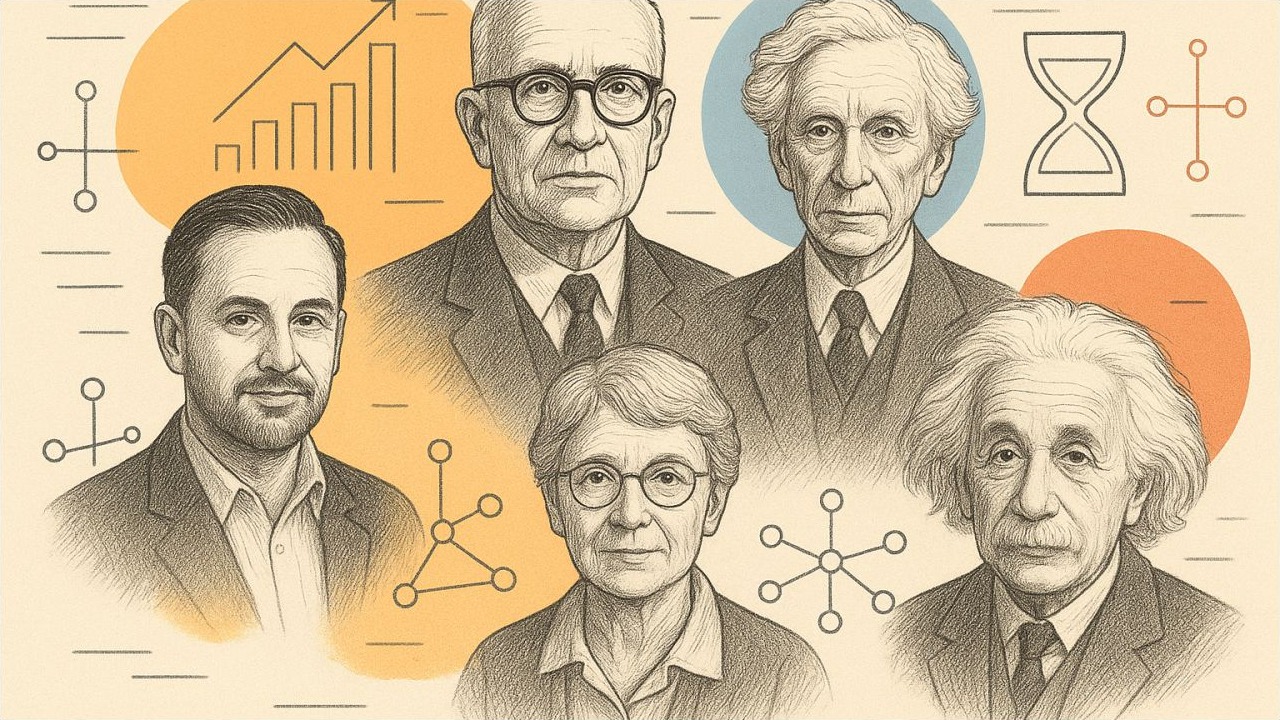
To set these thinkers side by side is to watch a polyphonic fugue of intellect unfold. Einstein framed the cosmos in philosophical physics, where mathematics became a meditation on time’s texture and being’s bedrock. McClintock entered the genome not as an engineer but as an empath, her embodied intuition listening to corn as if it spoke, dissolving the cold divide between knower and known. Fuller spun systemic designs, treating the planet as a problem to be solved through pattern, synergy, and structure. McLuhan mapped cultural media as sensory extensions, tracing how each new prosthesis rewired perception itself. Russell and Gödel, in austere counterpoint, pursued logical meta-systems, pushing reason until it fractured under its own weight, revealing paradox as the secret seam of thought. Mostaque, in our own moment, assembles computational economics, wielding algorithms to sense, simulate, and steer the volatile currents of markets.
What emerges is not a neat sequence but a resonant chord: philosophy, intuition, design, pattern, paradox, and computation. Each mode of synthesis amplifies what the others lack. McClintock’s intimacy grounds Russell’s abstraction; Fuller’s systemic sweep tempers McLuhan’s cultural poetics; Einstein’s metaphysical physics bends toward Gödel’s logical abyss; Mostaque, in turn, echoes Fuller’s pragmatism yet risks McLuhan’s blindness to embodiment. Together, they sketch a spectrum of interdisciplinarity in which rigor and resonance, system and sensation, logic and life are held in tension.
Placed alongside this constellation, AI does not stand as rival but as an amazing complementary partner to human skills and affordances. Its pattern-finding mirrors McLuhan, its formal rigor resonates with Russell, its generative reach echoes Fuller’s systemic sweep. Where humans embody intuition, AI extends simulation. Where humans wrestle with paradox, AI explores probabilistic alternatives at speed. Where McClintock “listened” to her plants, AI “listens” to data streams too vast for a single mind. Each side offers what the other cannot: depth for breadth, intuition for iteration, paradox for prediction and synthesis and evaluation of ideas.
The lesson is not deficiency but complementarity. Human interdisciplinarity brings embodiment, culture, and paradox — the grounding, the context, the lived resonance. AI brings scale, synthesis, and speed — the ability to extend patterns, test permutations, and reveal connections no single human could hold. Together they form not a mirror fractured, but a mosaic and pathway tot he future: human experience and machine inference, co-creating new possibilities for knowledge, design, and imagination and strong direction forward.
The Intelligence Amplification Revolution
These intellectual pioneers share a profound recognition that transcends their individual achievements: the most transformative understanding emerges not within disciplinary boundaries but at their dissolution. Einstein's physics drew from philosophy and pure mathematics to reconceptualize space and time; McClintock's biology incorporated intuitive observation and new technology of X-Rays to discover genetic mobility; Fuller's new architecture synthesized poetry and mathematics through "comprehensive anticipatory design science"; McLuhan's media theory married literature with anthropology and host of other disciplines to illuminate how technology reshapes consciousness; Russell's logic informed his politics while Gödel's incompleteness theorems proved that all formal systems require external disciplinary perspectives for more complete understanding; Mostaque's "Intelligence Theory" bridges computer science, physics, and economics to comprehend the fundamental transformation of value creation itself.
What unites these boundary-crossers and paradigm disturbers is their intuitive grasp of what contemporary AI systems demonstrate algorithmically: that intelligence emerges from synthesis across multiple representational frameworks. McClintock's "feeling for the organism" and aleatory taking up of then new X-Ray technology prefigured how AI recognize or unearth patterns that transcend or cross categorical boundaries—her genetic networks behaving like social systems recombining anticipated today's discovery that the same mathematical principles govern protein folding, market dynamics, and neural activation patterns. Fuller's synergy principle—that wholes exhibit properties their parts cannot—describes how AI systems achieve insights no single discipline could produce. Gödel's proof that understanding any formal system requires stepping outside its boundaries becomes the operational principle of large language models that synthesize across multiple domains simultaneously.
Today's AI systems excel precisely because they embody the meta-systematic thinking that characterized history's greatest polymaths. When frontier models help a psychology PhD student understand how cognitive biases illuminate algorithmic fairness problems, they're performing McClintock's pattern recognition across domains. When they assist a literature graduate student in applying narrative theory to data visualization, they're channeling McLuhan's recognition that the medium fundamentally shapes meaning. When they enable an economics doctoral candidate to understand market dynamics through biological evolution and complex systems theory, they're implementing Mostaque's "Intelligence Theory"—recognizing that value creation operates according to information-processing principles that transcend traditional economic categories.
The implications for graduate education and education in general are revolutionary and precise. Traditional doctoral programs train students to become ever-more-specialized experts in increasingly narrow domains, but this model rests on the now-obsolete assumption that deep understanding requires exclusive focus within disciplinary boundaries. Gödel's incompleteness theorems proved this assumption mathematically false: complete understanding of any domain requires perspectives from outside that domain. AI enables the practical realization of this insight by serving as an intellectual force multiplier that allows individual scholars to engage seriously with multiple domains simultaneously.
Consider the transformative possibilities: A neuroscience PhD studying consciousness might simultaneously draw insights from information theory (how brains process data), complexity science (how emergent properties arise), economics (how attention functions as scarce resource), and phenomenology (how subjective experience relates to objective measurement). Using AI to navigate the vast literatures in each domain, she discovers that consciousness operates according to principles that span computation, thermodynamics, market dynamics, and philosophical analysis. Her resulting framework synthesizes insights that no purely neuroscientific approach could generate—perhaps revealing how consciousness emerges from the same information-theoretic constraints that govern market efficiency and ecological resilience.
This doesn't represent intellectual dilettantism but its opposite: recognition that the most important problems—consciousness, climate change, social justice, technological governance, economic transformation—resist purely disciplinary solutions precisely because they emerge from the intersection of multiple complex systems. Climate change cannot be understood through environmental science alone; it requires simultaneous engagement with economics (how markets fail to price externalities), psychology (why humans discount future costs), political science (how collective action problems persist), and complexity theory (how system-wide phase transitions occur). AI enables scholars to develop what we might call "meta-disciplinary expertise"—deep fluency in one domain augmented by genuine competence across multiple others.
The AI revolution thus represents a return to an older model of scholarship—the Renaissance humanist tradition that produced polymaths like Leonardo da Vinci and Benjamin Franklin—but augmented by artificial intelligence that eliminates the practical constraints that historically limited such synthesis. Graduate students can now pursue specialized research in their chosen field while simultaneously exploring how insights from multiple domains illuminate their work in ways that would have been prohibitively time-consuming under the old model of disciplinary specialization.
This transformation mirrors what Mostaque recognizes in his analysis of economic phase transitions: we are not simply improving existing systems but transitioning to fundamentally different organizational principles. Just as Mostaque's "Last Economy" emerges when AI creates abundance rather than scarcity, the future of graduate education emerges when AI enables synthesis rather than specialization as the path to deep understanding. The most sophisticated AI systems demonstrate that intelligence itself might be fundamentally interdisciplinary—that the capacity to make meaningful connections across different ways of knowing represents the highest form of cognition.
Future scholars will develop what Fuller called "comprehensive anticipatory design science" and what we might now term "AI-amplified polymathy"—the ability to navigate multiple domains with sufficient depth to generate novel insights while using AI to manage the cognitive load that historically made such breadth impossible. This represents not the democratization of superficial knowledge but the democratization of the deepest form of understanding: the recognition of underlying patterns that connect apparently disparate phenomena, revealing the hidden unity that academic specialization has systematically obscured.
The Synthetic Future
The frontier AI models—Claude, GPT-4, Gemini— can be asked to demonstrate increasingly sophisticated abilities to synthesize insights across disciplines. They don't simply retrieve information from different fields; they can identify novel connections between disparate domains. When asked to analyze a problem in organizational psychology, they might draw insights from evolutionary biology, network theory, and ancient philosophy, revealing connections that purely human analysis might miss.
This synthetic capability transforms how we think about expertise itself. The traditional model assumed that deep knowledge required narrow focus—that to understand anything profoundly, one must sacrifice breadth for depth. AI systems suggest and allow and open an alternative: that the deepest insights often emerge from the creative collision of different ways of knowing.
Graduate students working with AI can now engage in what we might call "assisted interdisciplinary thinking." just be asking and pursuing their intuitions They can pursue specialized research in their chosen field while simultaneously exploring how insights from other domains might illuminate their work. A historian studying economic development might use AI to understand how evolutionary biology, complexity theory, and cognitive science inform historical processes. A computer scientist designing machine learning algorithms might leverage AI to explore how insights from phenomenology, aesthetics, and political theory could improve their models.
The Convergent Mind
The most sophisticated AI systems seem to develop something resembling what Fuller called "comprehensive anticipatory design science"—the ability to integrate insights from multiple domains to address complex problems when asked. They demonstrate that intelligence itself might be fundamentally interdisciplinary, that the capacity to make meaningful connections across different ways of knowing represents the highest form of cognition.
This has profound implications for how we structure graduate education and research. Instead of training students to become hyper-specialists who know more and more about less and less, we might cultivate what Einstein exemplified: minds capable of moving fluidly between domains, recognizing patterns that transcend disciplinary boundaries, synthesizing insights from multiple perspectives to generate novel understanding.
The AI revolution doesn't threaten human expertise; it amplifies human intelligence by enabling us to transcend the artificial boundaries between academic disciplines. Like McClintock observing her corn, Fuller designing his domes, McLuhan analyzing his media, Russell pursuing his logic, and Mostaque building his models, we can now think more comprehensively than any single discipline would allow.
The future belongs not to narrow specialists but to synthesists—scholars who use AI to develop what we might call "meta-disciplinary fluency," the ability to navigate multiple domains with sufficient depth to generate meaningful insights. In this future, the PhD in philosophy might also be conversant with neuroscience and computer science; the master's in biology might encompass insights from physics and economics; the graduate student in literature might actively engage with cognitive science and anthropology.
This represents a return to an older model of scholarship—the Renaissance humanist tradition that produced polymaths like Leonardo da Vinci and Thomas Jefferson—but augmented by artificial intelligence that enables unprecedented breadth without sacrificing rigor. We stand at the threshold of an intellectual renaissance, where the artificial boundaries between disciplines dissolve, and human intelligence, amplified by AI, can finally address the complex, interconnected challenges that define our time.
The boundary crossers have always shown us the way forward. Now, with AI as our intellectual compass, we can all become explorers of the vast territories where knowledge converges, where understanding emerges, where wisdom waits at the intersection of everything we think we know.