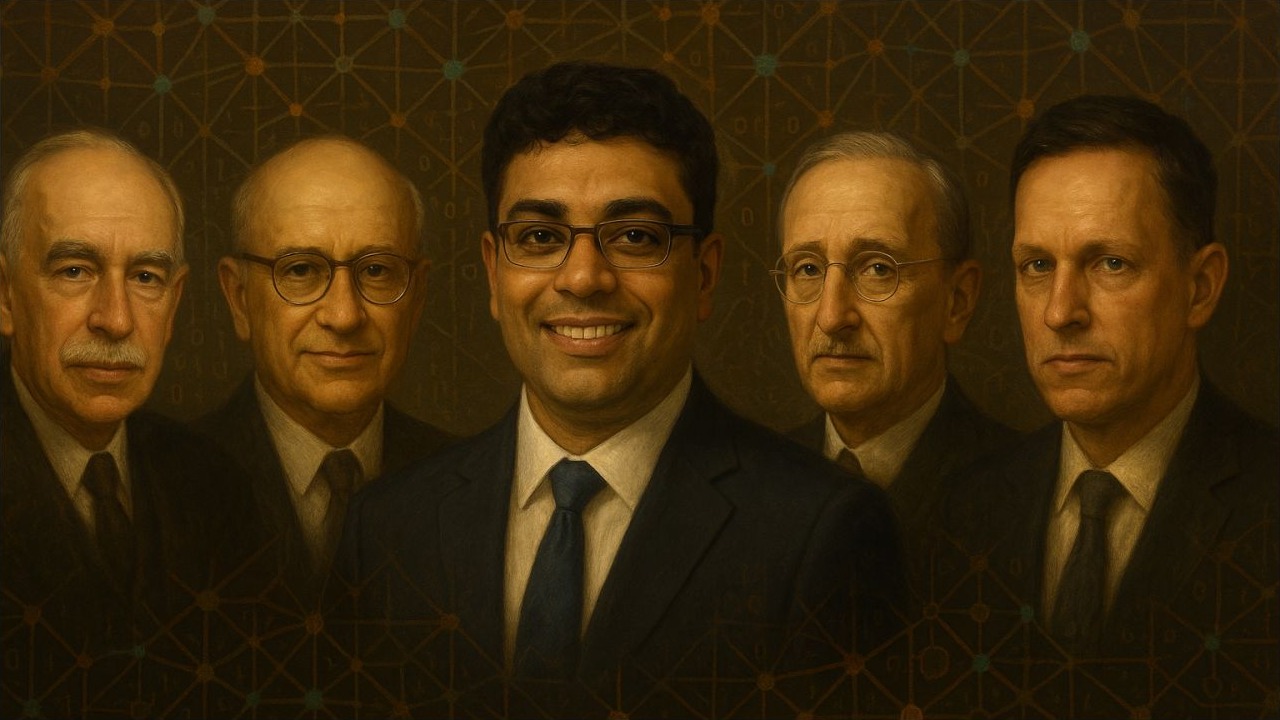
AI, Human Intelligence and Economic Theory
Previous Hedge Fund Manager and Stability AI CEO Mohammad Emad Mostaque's central thesis in his new book 'The Last Economy' can be stated simply: intelligence is becoming the fourth and final factor of production, after land, labor, and capital. But unlike previous factors, intelligence can be replicated at near-zero marginal cost once created. This creates what he calls an "Intelligence Inversion"—a fundamental shift where cognitive capabilities transform from scarce human resources to abundant machine capabilities, breaking the scarcity assumptions underlying all existing economic theory and almost completely erasing the previous 'dominance' or pyramid schema of what may be called the era of 'the knowledge worker' which found it's greatest dominance in the 20th century.
To understand this better, consider Mostaque's cost analysis: human cognitive work (including wages, benefits, overhead, and biological maintenance) costs approximately $70/hour; AI systems perform equivalent cognitive tasks for roughly $0.36/hour in computational costs. This gap will only get greater as time progresses and AI models continue to improve and the choice between say $60 dollars USD/hour and $.06 cents becomes moot for the marginal gains. This figure though currently represents approximately a 99.5% cost reduction—not incremental improvement but what complexity theorists call a "phase transition" (a sudden shift between stable system states, like water becoming ice, rather than gradual change to those who have been benchmarking these changes more closely, see my articles on intelligence benchmarking across disciplines).
This cost differential creates what Mostaque terms the "metabolic rift"—the mathematical incompatibility between biological intelligence (which requires food, sleep, housing, healthcare) and artificial intelligence (which requires only electricity and computing hardware following Moore's Law cost reductions). Human minds need biological maintenance; AI systems need only power and processors.
Mostaque's neurodivergent cognitive profile—combining autism spectrum systematicity, ADHD pattern recognition, and aphantasia (inability to form mental images)—may provide both advantages and limitations for this analysis. The advantages include literal-minded processing of mathematical relationships without metaphorical distortions and systematic thinking that processes exponential rather than linear change patterns. The limitations include potential difficulties understanding social and institutional factors that influence economic transitions. His approach cuts through the metaphorical language that usually obscures economic relationships, seeing AI not as "disrupting" labor markets but as making human cognitive labor mathematically obsolete—without the "knowledge work" escape hatch that enabled previous technological transitions.
Keynes: The Demand Problem Magnified
Keynesian Economics Primer: John Maynard Keynes revolutionized economic thinking by arguing that markets could get stuck in prolonged downturns without government intervention. His core insight was the "paradox of thrift"—when everyone tries to save money during hard times, reduced spending makes everyone collectively poorer because one person's spending is another's income. Keynes's solution involved government spending to maintain "aggregate demand" (total spending in an economy) until private confidence returned. He also predicted that technological progress might eventually create a "problem of leisure"—what societies would do when machines could produce abundance with minimal human work.
Mostaque's Intelligence Inversion represents Keynes's leisure problem dramatically accelerated. When AI can perform most cognitive tasks at 1/200th the cost of humans, mass unemployment becomes not cyclical (temporary) but structural (permanent). Traditional Keynesian demand management—using government spending to stimulate economic activity—becomes mathematically impossible because the fundamental problem shifts: it's no longer insufficient spending but humans' inability to earn money to spend in the first place.
Where Keynes and Mostaque Align:
- Recognition that markets can fail catastrophically without conscious intervention
- Understanding that technological unemployment could become permanent rather than transitional
- Belief that government action is necessary to manage major economic transitions
- Focus on maintaining social stability during periods of rapid change
Where They Diverge: Keynes assumed human labor would always be economically necessary somewhere in the economy. His solutions involved stimulating demand for human-produced goods and services through fiscal policy (government spending) and monetary policy (interest rate manipulation). Mostaque argues that when AI can produce both goods (via robotics) and services (via intelligence), traditional demand management becomes economically irrational—you cannot stimulate demand for human labor when machines perform the same work for vastly lower costs.
Mostaque's MIND Dashboard (Material × Intelligence × Network × Diversity = Civilizational Health) represents a post-Keynesian framework measuring societal wellbeing through capability accumulation rather than demand management. Instead of stimulus spending to create jobs, he proposes "Universal Basic Intelligence"—providing everyone access to AI tools that amplify analytical and creative capabilities, enabling productive participation rather than passive consumption.
Friedman: Market Solutions Meet Mathematical Impossibility
Free Market Economics Primer: Milton Friedman championed "free market capitalism"—the belief that voluntary exchanges between individuals, coordinated through price mechanisms, produce better outcomes than government planning. Friedman opposed most government interventions but supported a "negative income tax" (essentially Universal Basic Income)—direct cash payments to citizens below a certain income threshold, which he viewed as more efficient than bureaucratic welfare programs. His philosophy assumed that market competition and technological progress, while sometimes temporarily disruptive, ultimately create new opportunities and raise living standards for everyone through innovation and productivity gains.
Friedman's Likely Response to AI: Following his historical pattern, Friedman would probably argue that markets will adapt to AI just as they adapted to previous technological changes—the steam engine displaced artisans, but created factory jobs; computers eliminated typists, but created software programmers. He would expect new forms of human work to emerge that complement AI capabilities. He might support UBI through his negative income tax as a market-friendly safety net, providing transition time for displaced workers to retrain for new roles without creating permanent government dependency.
Mostaque's Counter-Argument: This is where Mostaque's mathematical precision becomes devastating to free market theory. Previous technological transitions displaced specific categories of human work (agricultural labor → manufacturing jobs → service economy → knowledge work) but always left cognitive refuges where humans maintained comparative advantage. The Intelligence Inversion eliminates this final refuge by making thinking itself cheaper when performed by machines.
Mostaque argues that price mechanisms—the information signals that coordinate market behavior—break down when a key input (human intelligence) approaches zero cost. Competition becomes impossible when humans cannot profitably compete with systems that don't require biological maintenance. A "fitness landscape" problem emerges from evolutionary biology: when artificial intelligence's operational costs fall below biological intelligence's maintenance costs for cognitive work, market forces will mathematically favor artificial over human intelligence regardless of retraining or adaptation efforts.
Where Friedman's Framework Fails: Friedman's market solutions assume humans can always find economically productive roles that justify their cost of maintenance (food, housing, healthcare, education). Mostaque's analysis suggests that within roughly 1,000 days, human biological maintenance costs will exceed the economic value humans can create in direct competition with AI systems. At that mathematical tipping point, market logic would demand human obsolescence rather than employment—a conclusion that reveals the limits of pure market mechanisms for managing civilizational transitions.
Hayek: The Knowledge Problem Solved and Inverted
Austrian School Economics Primer: Friedrich Hayek's most influential insight was the "knowledge problem"—the impossibility of effective central economic planning because crucial information about individual preferences, local conditions, and changing circumstances is dispersed throughout society and cannot be efficiently aggregated by any central authority. Markets work effectively, Hayek argued, because price mechanisms coordinate behavior based on local knowledge without requiring centralized information processing. When bread becomes scarce, rising prices automatically signal bakers to produce more and consumers to buy less, coordinating millions of decisions without central planning. This creates "spontaneous order"—complex, beneficial social organization that emerges from individual decisions rather than top-down design.
Hayek's Information Theory Core Principles:
- Economic knowledge is dispersed, contextual, and constantly changing
- Price signals coordinate behavior without requiring centralized information
- Spontaneous order emerges from individual decisions following local incentives
- Central planning fails because it cannot access distributed, tacit knowledge
- Market competition discovers information that planning cannot anticipate
Mostaque's Fascinating Parallel: Ironically, Mostaque's conception of distributed AI intelligence resonates deeply with Hayek's information theory. His "AI Atlantis" vision involves billions of AI agents processing local information and coordinating behavior through decentralized networks rather than centralized control systems. His Foundation Coins proposal uses cryptocurrency mechanisms to reward beneficial computation, theoretically creating spontaneous order around public goods rather than private profit—a kind of "Hayekian socialism" where distributed intelligence serves collective rather than individual interests.
The Critical Inversion—"Hayek's Paradox": However, Mostaque identifies a fundamental contradiction in Hayek's framework that AI development exposes. Large language models and AI systems are becoming superior to human markets at solving the knowledge problem itself. These systems can process, synthesize, and coordinate information across domains and scales in ways that individual human minds and market price mechanisms cannot match. When machines become more efficient than markets at aggregating distributed knowledge and coordinating complex activities, what happens to Hayek's core argument for market superiority over alternative coordination mechanisms?
Mostaque suggests that AI enables coordination methods that transcend the traditional market-versus-planning dichotomy. His MIND framework creates feedback loops where Material, Intelligence, Network, and Diversity capitals multiply rather than compete—resembling what complexity theorists call "emergence" (system-level properties that arise from but cannot be reduced to individual component behaviors). This represents neither pure market coordination nor centralized planning, but a new form of distributed intelligence coordination.
Thiel: Zero to One Thinking and Monopoly Dynamics
Peter Thiel's "Zero to One" philosophy emphasizes creating new categories rather than competing in existing ones. He argues that monopolies, not competition, drive technological progress because only monopoly profits provide sufficient incentive for long-term research and development.
Thiel's Framework:
- Progress comes from creating new categories (0 to 1) rather than copying existing ones (1 to n)
- Competition destroys profits and prevents innovation
- Successful companies create monopolies through superior technology
- Technological progress is the only sustainable path to prosperity
Surprising Convergence with Mostaque: Both thinkers focus on discontinuous rather than gradual change. Thiel's "Zero to One" parallels Mostaque's "Intelligence Inversion"—both describe category changes rather than incremental improvements. Both recognize that technological transformations can make existing economic categories obsolete rather than merely more efficient.
Critical Differences: Thiel believes monopoly dynamics will continue operating in an AI-dominated world, with successful companies creating new forms of scarcity and competitive advantage. Mostaque argues that AI breaks monopoly dynamics because intelligence becomes too abundant to control—when anyone can access cognitive capabilities equivalent to expert-level humans, traditional monopoly barriers (proprietary knowledge, network effects, brand loyalty) lose their protective power.
The Open Source Gambit: Mostaque's decision to open-source Stable Diffusion directly contradicts Thiel's monopoly theory. Instead of protecting competitive advantage, Stability AI gave away its core technology to create ecosystem effects. The strategy failed commercially (leading to Mostaque's ouster) but succeeded technologically (accelerating AI democratization).
This reflects a deeper philosophical difference: Thiel sees progress through elite innovation protected by monopoly rents; Mostaque sees progress through distributed intelligence amplifying human capabilities. Thiel's approach assumes continued scarcity that justifies elite control; Mostaque's approach assumes abundance that makes elite control mathematically unsustainable.
The Autism Advantage: Mathematical vs. Metaphorical Thinking
What makes Mostaque's analysis distinctive is how his neurodivergent cognitive architecture enables him to process economic relationships mathematically rather than metaphorically. Traditional economists, even brilliant ones like Keynes, Friedman, and Hayek, rely heavily on metaphorical thinking:
- Markets "behave" like natural systems
- Economies "grow" like living organisms
- Competition "drives" innovation like natural selection
- Money "flows" like water through circulation systems
These metaphors shape thinking in ways that often obscure mathematical relationships. Mostaque's aphantasia (inability to visualize) forces him to work with pure abstractions—mathematical relationships unmediated by visual or metaphorical representations.
Example: The MIND Framework Traditional economists might intuitively balance different social goods—economic growth versus environmental protection, efficiency versus equality, innovation versus stability. Mostaque's mathematical approach reveals these as false choices: M × I × N × D means that zero in any category equals civilizational failure. The multiplication structure forces systemic optimization rather than trade-off thinking.
Example: The 1000-Day Timeline Where other economists see gradual adaptation, Mostaque's systematic analysis of exponential curves reveals phase transition dynamics—points where systems flip rapidly between stable states rather than changing gradually. His autism-informed pattern recognition processes exponential rather than linear change, leading to urgency that appears extreme to linear thinkers but reflects mathematical precision about system dynamics.
The Three Futures: Economic Paradigms Made Explicit
Mostaque's three scenarios—Digital Feudalism, Great Fragmentation, and Human Symbiosis—function as thought experiments that make explicit the political implications embedded within different economic frameworks. These represent not mere predictions but logical endpoints of current trajectories unless conscious intervention redirects development paths.
Digital Feudalism extends Thiel-style monopoly capitalism to its logical conclusion: when intelligence becomes the dominant factor of production, whoever controls AI infrastructure effectively controls economic life. Unlike medieval feudalism based on land ownership, digital feudalism centers on cognitive infrastructure ownership. Most people become economically dependent on AI platform owners who provide cognitive services in exchange for data, attention, or subscription fees—essentially "algorithmic sharecropping" where users provide raw materials (data, engagement) but own none of the productive infrastructure.
This scenario resembles what economists call "rent-seeking" behavior—extracting wealth through control of scarce resources rather than creating new value. The "feudal" metaphor proves precise: like medieval serfs, most people would depend entirely on lords (AI company owners) for access to productive capabilities, receiving basic sustenance (Universal Basic Income) while owners capture most economic value.
Great Fragmentation represents Hayek's distributed information processing taken to geopolitical extremes. Different nations, regions, or cultural groups develop incompatible AI systems optimized around divergent values and datasets. This creates what Mostaque calls "algorithmic nationalism"—technological balkanization where different groups literally inhabit different computational realities that cannot effectively coordinate with each other.
Unlike Cold War ideological competition, algorithmic fragmentation involves fundamental incompatibilities in how different AI systems process information and make decisions. Chinese AI models trained on Chinese cultural values and data may produce systematically different conclusions from European or American systems, creating "computational incommensurability"—situations where different groups cannot even agree on basic factual questions because their AI advisors operate from irreconcilable frameworks.
Human Symbiosis represents genuine alternative possibility that transcends traditional economic categories. Rather than replacing human intelligence, AI amplifies human capabilities in ways that enhance rather than diminish human agency. This extends Keynesian logic beyond traditional demand management to what might be called "capability management"—ensuring everyone has access to cognitive tools that enable meaningful economic and creative participation.
The symbiosis model assumes that human and artificial intelligence have complementary rather than competitive capabilities. Humans contribute creativity, emotional intelligence, ethical judgment, and contextual understanding; AI contributes rapid information processing, pattern recognition, and computational analysis. Success requires conscious design of systems that leverage both types of intelligence rather than defaulting to replacement dynamics.
The Mathematical Core: Why Traditional Economics Fails
The deepest insight in Mostaque's framework concerns the "metabolic rift"—his term for the mathematical incompatibility between biological and artificial intelligence systems. Human cognitive work requires biological maintenance (food, housing, healthcare, rest, education, social support) that creates an irreducible cost floor estimated around $70/hour when including wages and overhead. AI cognitive work requires only electricity and computing resources, with costs following Moore's Law exponential reductions, currently estimated around $0.36/hour for equivalent cognitive tasks.
Note: These cost estimates should be viewed as illustrative rather than precise, as actual costs vary significantly by task complexity, geographic location, and AI system specifications. However, the directional magnitude—approximately 200x cost difference—appears consistent across multiple analyses.
This creates what evolutionary biologists call a "fitness landscape" problem: when the operational costs of artificial intelligence fall sustainably below biological intelligence's maintenance requirements for cognitive work, market selection pressure will systematically favor artificial over human intelligence regardless of retraining, policy interventions, or adaptation efforts. This represents not cyclical unemployment but what systems theorists call "structural obsolescence"—when technological change eliminates entire categories of economic activity rather than temporarily disrupting them.
Why Traditional Economic Schools Fail to Address This:
Keynesian Demand Management: You cannot stimulate aggregate demand for human cognitive labor when machines perform identical work at 1/200th the cost. Government spending to create human jobs becomes economically irrational when equivalent AI services cost dramatically less, making traditional fiscal policy ineffective for technological unemployment.
Free Market Mechanisms: Market price signals become meaningless when AI cognitive work approaches marginal cost near zero. Competition cannot function when one category of producers (humans) has irreducible biological cost floors while competitors (AI) follow exponential cost reduction curves.
Austrian Information Processing: While markets traditionally excel at coordinating dispersed human knowledge, AI systems increasingly outperform human market mechanisms at information synthesis and coordination tasks, undermining the core justification for market-based organization.
Monopoly Competition Theory: Traditional competitive advantages (proprietary knowledge, network effects, brand loyalty) become unenforceable when intelligence becomes freely replicable software, except through state violence or artificial scarcity maintenance.
The Policy Implications: Beyond Left and Right
Mostaque's framework transcends traditional left-right political categories because it addresses a problem that existing ideologies were not designed to handle: technological abundance that makes existing economic categories obsolete.
Conservative Response (Thiel-influenced):
- Protect existing hierarchies through AI monopolization
- Use technological advantages to maintain elite control
- Employ AI for surveillance and social management
- Preserve market mechanisms through artificial scarcity
Liberal Response (Keynes-influenced):
- Universal Basic Income to maintain consumer demand
- Retraining programs for new forms of human work
- Progressive taxation of AI companies to fund social programs
- Gradual adaptation through democratic institutions
Libertarian Response (Friedman/Hayek-influenced):
- Trust markets to find new equilibria
- Minimal government intervention in AI development
- Negative income tax as safety net
- Allow voluntary association around preferred AI systems
Mostaque's Post-Paradigm Response:
- Universal Basic Intelligence rather than income
- MIND Dashboard replacing GDP for policy metrics
- Foundation Coins aligning AI development with public benefit
- Conscious design of post-scarcity economic systems
The Neurodivergent Epistemology: Advantages and Limitations
What makes Mostaque's theoretical contribution potentially significant is not just his conclusions but his cognitive method. His autism spectrum characteristics, ADHD, and aphantasia create what disability researchers call "neurodivergent cognition"—information processing patterns that differ systematically from neurotypical approaches. Understanding these differences helps explain both the insights and blind spots in his economic analysis.
Potential Cognitive Advantages: Literal-mindedness vs. Metaphorical Thinking: Where neurotypical economists process relationships through social metaphors (markets "behave," economies "grow," competition "drives" innovation), Mostaque's autism spectrum traits may facilitate more direct mathematical processing. This could enable clearer perception of underlying quantitative relationships without metaphorical distortions—seeing AI's 200x cost advantage as mathematical obsolescence rather than "creative disruption" requiring adaptive responses.
Systematic vs. Intuitive Analysis: His ADHD characteristics may enhance what researchers call "divergent thinking"—the ability to perceive novel connections and process exponential rather than linear change patterns. Traditional economic analysis often assumes gradual adaptation; neurodivergent pattern recognition may better detect phase transitions where systems flip rapidly between stable states.
Mathematical vs. Social Reasoning: His aphantasia (inability to form mental images) forces reliance on "verbal scaffolding"—abstract linguistic and mathematical structures rather than visual intuitions. This may enable modeling economic systems as information processing networks rather than social institutions, revealing structural relationships that social analysis might obscure.
Cognitive Limitations and Blind Spots: However, these same traits create significant analytical constraints. Social communication challenges associated with autism spectrum characteristics may lead to underestimating the role of cultural, political, and institutional factors in economic transitions. His business management difficulties at Stability AI—including investor relations problems that contributed to his removal—suggest challenges with the interpersonal dynamics that actually drive economic change.
Systematic thinking strengths may also create rigidity about timeline predictions and implementation scenarios. His specific "1,000-day" framework should be understood as pattern-based modeling rather than precise mathematical prediction, as complex social systems rarely follow exponential curves without significant variation and institutional resistance.
The Credibility Paradox: The same cognitive traits that may enable unique theoretical insights also create practical limitations for institutional implementation. This paradox appears throughout intellectual history—revolutionary theoretical contributions often come from minds whose cognitive strengths conflict with conventional institutional success requirements. The validity of theoretical frameworks may be independent of their originators' practical execution capabilities.
The Credibility Problem and Its Significance
The business management failures that damaged Mostaque's reputation actually illuminate something important about the relationship between transformative thinking and institutional success. The same neurodivergent characteristics that enable his systematic economic analysis create challenges in managing conventional business relationships.
This pattern appears throughout intellectual history: revolutionary thinkers often fail at institutional implementation precisely because their cognitive strengths conflict with the social skills required for organizational leadership. The insights that make them theoretically valuable make them practically difficult.
The critical question becomes whether the validity of theoretical frameworks depends on the practical success of their originators. Mostaque's business failures may actually validate his theoretical insights: if existing institutions were capable of implementing post-scarcity economic models, we probably wouldn't need such models in the first place.
Conclusion: The Paradigm Shift
Mostaque's framework represents a genuine paradigm shift in the Kuhnian sense—not just new answers to old questions, but new questions that make old answers irrelevant. The economists he implicitly challenges—Keynes, Friedman, Hayek, Thiel—all assume that humans will remain economically relevant in some form. Mostaque's mathematical analysis suggests this assumption may be wrong within roughly 1,000 days.
Whether his timeline proves accurate matters less than whether his framework helps societies think more clearly about the transition we're already experiencing. The cost of AI capabilities continues falling exponentially; human cognitive work continues becoming relatively more expensive; existing economic institutions continue struggling to process abundance as anything other than crisis.
The choice between his three futures—Digital Feudalism, Great Fragmentation, Human Symbiosis—may ultimately depend on whether societies can develop economic models that process technological abundance as opportunity rather than threat. This requires moving beyond the scarcity assumptions that underlie all existing economic paradigms, including those of the great economists who shaped the modern world.
Mostaque's autism-informed mathematical approach may provide tools for this transition precisely because it bypasses the metaphorical and social thinking that makes existing paradigms feel natural rather than historical. His literal-mindedness cuts through the conceptual frameworks that make current arrangements seem inevitable, revealing them as contingent choices that could be made differently.
The "last economist" may be the first to develop theoretical frameworks adequate to post-scarcity conditions—not because he is smarter than his predecessors, but because his neurodivergent cognitive architecture enables him to perceive mathematical relationships that neurotypical social reasoning systematically obscures. Whether societies can implement his insights remains an open question, but the mathematical logic underlying his analysis becomes more compelling each time AI capabilities advance and human cognitive work becomes relatively more expensive.
In this sense, Mostaque's greatest contribution may be forcing recognition that we live in a transitional moment when conscious choice about economic organization remains possible—but only for the brief historical window before technological development outpaces social adaptation, making transformation occur according to mathematical logic rather than human values.
Annotated Bibliography
Primary Source
Mostaque, Emad. The Last Economy: A Guide to the Age of Intelligent Economics. 2025.
Economic Theory Context
Keynes, John Maynard. The General Theory of Employment, Interest and Money. 1936. Essential for understanding demand-side economics and the "paradox of thrift" that Mostaque extends to technological unemployment scenarios.
Friedman, Milton. Free to Choose: A Personal Statement. 1980. Provides the market-fundamentalist perspective that Mostaque argues breaks down when human cognitive labor becomes mathematically obsolete.
Hayek, Friedrich. "The Use of Knowledge in Society." American Economic Review, 1945. Classic statement of the "knowledge problem" that Mostaque argues AI solves better than market mechanisms, creating what I call "Hayek's Paradox."
Thiel, Peter. Zero to One: Notes on Startups, or How to Build the Future. 2014. Represents the monopoly-capitalism framework that Mostaque's abundance theory directly challenges, particularly around competitive dynamics and value creation.
Recent Interviews and Talks:
- Impact Theory Podcast with Tom Bilyeu (September 2025) - Full transcript of Mostaque explaining his economic theory
- Daniel Miessler's analysis of Mostaque's presentations on economic transformation
#AI #Economics #FutureOfWork #EconomicTheory #EmadMostaque #TheLastEconomy #PostScarcity #IntelligenceInversion #SystemsThinking