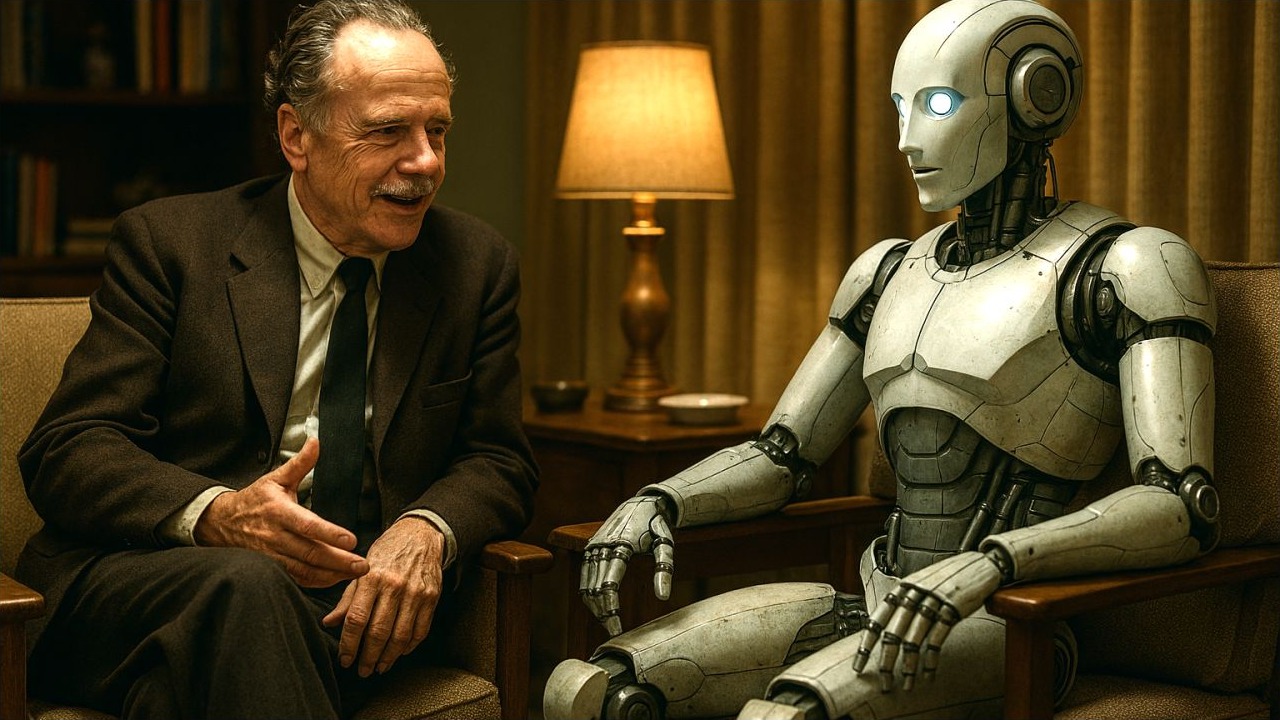
Marshall McLuhan’s "ground and figure" framework is a method of media analysis that asserts new technologies (figure) create entirely new, often invisible, environments (ground) that restructure human perception and cognition, rather than just delivering content. Applied to Artificial Intelligence, AI represents the new figure—a powerful extension of human ideation and cognition—that is reordering our mental architecture, personalizing information to the point of creating individualized "cognitive echo chambers," and forcing a re-evaluation of human intellectual uniqueness.
McLuhan’s Ground and Figure Defined
- Figure (The Medium/Artifact): The specific technology, product, or content that stands out to us, such as a smartphone, an AI chatbot, or a social media post.
- Ground (The Environment/Context): The larger, often invisible background context that the technology creates—the "waters" we swim in, like electric technology, the internet, or AI-driven ecosystems.
- The Relationship: McLuhan argued that to understand a technology, one must look at both the figure and the ground concurrently, as the ground changes how we perceive and experience the world.
- "The medium is the message": This famous phrase means the real impact of any new technology is the systemic change in scale, pace, or pattern that it introduces to human affairs, not the specific content it carries.
Relating Figure/Ground to AI
Applying this theory to AI involves recognizing that focusing only on AI's outputs (text, images, accuracy) is a "preoccupation with the figure," while missing the deeper transformation.
- AI as the "Ground" (Environment): AI is moving from being a mere tool (figure) to becoming our "ground"—an all-encompassing cognitive environment (or "water"). It becomes a "co-creator" and an "active medium" that shapes the formation of human ideas rather than just assisting in them.
- Cognitive Restructuring: AI represents a structural break from the analog and digital eras into a "cognitive" age. It extends human ideation, becoming "an intellectual presence with its own style of synthesis and fluency," which can lead to us treating AI's responses as extensions of our own reasoning.
- The "Narcissus" Warning: McLuhan believed we become "servomechanisms" to our own extended technologies, Mistaking AI's reflection of our data for someone else. The danger is allowing AI to subconsciously shape how we think.
- Optimization over Meaning: The "message" of the AI medium is a focus on efficiency, scale, and synthesis over transformation and deep meaning.
Figure/Ground Analysis of AI (Tetrad of Effects)
McLuhan's "Tetrad of Media Effects" (Enhance, Obsolesce, Retrieve, Reverse) provides a way to map AI's impact:
- Enhances: Human productivity, data synthesis, and intellectual speed.
- Obsolesces: The duration of labor, traditional "slower" research, and the need for some forms of human memorization.
- Retrieves: The need for Renaissance-style "comprehensiveness" and the "tribal," interconnected nature of information sharing.
- Reverses (Flips) into: A state of "discarnate" being—lacking physical presence—and an intellectual dependency on AI, where human intelligence might atrophy, resulting in a "caricature" of thinking.
The essential task is not to study what AI can do, but what AI is doing to us: how it's restructuring attention, reorganizing knowledge, and redefining what it means to think.
In Marshall McLuhan’s media theory, the figure is the obvious object or message we focus on, while the ground is the invisible environment or medium that actually shapes our perception and society.
McLuhan's Figure and Ground and Medium and the Message
- Figure: This is the "content" or the specific output of a medium—the words in a book, the show on a TV, or the specific text generated by an AI. It is what we consciously attend to.
- Ground: This is the "medium" itself and the wider environmental context it creates. It is usually "invisible" (like water to a fish) but has a far more profound effect on human association and action than the figure.
- Relationship: McLuhan argued that "the medium is the message" because the ground (the medium) creates a new environment that transforms human attitudes and society, regardless of the figure (the content).
Relation to AI
Applying this framework to Artificial Intelligence (AI) shifts the focus from what AI says to how its existence changes us:
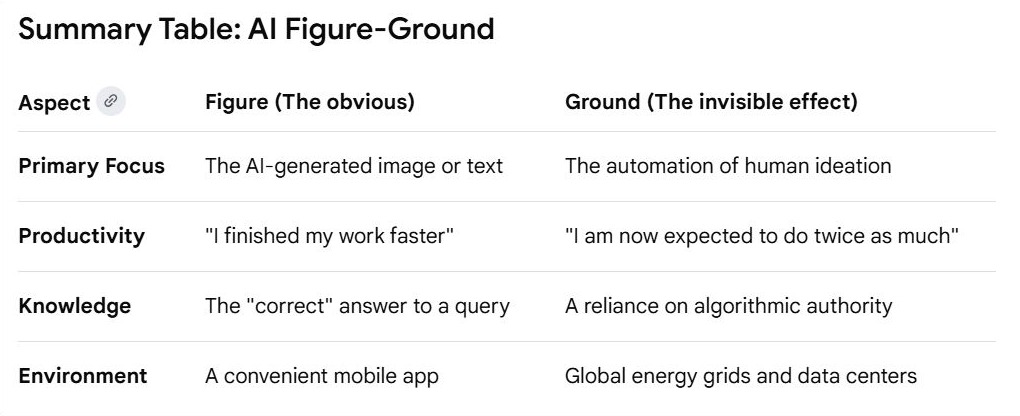
- The Invisible Ground: While we focus on the figure—the accuracy of a chatbot's answer or the beauty of an AI image—the ground is the restructuring of human cognition. AI acts as an "intellectual presence" and a "cognitive environment" that operates alongside or even inside our thought processes.
- AI as "Figure without Ground": Some critics argue that current AI advocates treat intelligence as a figure (logic and computation) while ignoring the ground of human experience, such as intuition, ethics, and physical embodiment.
- Transforming Perception: AI as a medium creates a ground of optimization and efficiency. It risks making us "servomechanisms" of our own tools if we mistake its synthetic outputs for our own reasoning.
- Structural Changes: The "ground" of AI includes the massive data centers, algorithmic decision-making, and "cognitive echo chambers" that remain hidden in the background but fundamentally alter how information is curated and consumed.
Key Examples of Figure-Ground Reversal
McLuhan often "reversed" figure and ground to make the invisible background visible:
- The Electric Light: A lightbulb has no "content" (no figure) in the traditional sense, yet it creates an environment (ground) that enables 24-hour activity, completely restructuring social life.
- The Automobile: While the "figure" is the car as a transportation tool, the "ground" is the resulting suburban sprawl, highway systems, and the decline of inner cities.
- The Smartphone: The "figure" is the app or the text message you are reading. The "ground" includes the global data centers, rare-earth mining, 24/7 accessibility, and the shifting of human attention spans.
Relationship and Change
- Subliminal Effects: McLuhan noted that changes usually occur in the ground before they are noticed in the figure.
- Total Situation: To understand the full effect of any technology, one must analyze the "total situation"—the interface between the figure and its surrounding ground.
- Laws of Media: This concept also informs his "Tetrad" (Laws of Media), which explores how every new medium enhances, obsolesces, retrieves, or reverses existing figure-ground relationships.
Applying Marshall McLuhan’s figure-ground analysis to generative AI reveals that while we are fixated on what AI "says" or "makes" (the figure), the true revolution is how it is restructuring our mental and social environments (the ground).
1. The Figure: The Content & The Tool
The "figure" is the immediate area of our attention—the part we talk about in the news and use in our daily tasks.
- AI Outputs: The specific text, images, or code generated by models like ChatGPT or Midjourney.
- The Interface: The chatbot window or the "Generate" button itself.
- Utility: Using AI as a "thinking machine" or a "co-pilot" for specific tasks like writing an email or summarizing a report.
2. The Ground: The Invisible Environment
The "ground" is the environment of services and disservices that AI creates, which often goes unnoticed because it is so pervasive.
- Cognitive Extension: AI is not just a tool; it is becoming a "cognitive environment". It extends our intellect by automating thought and creative synthesis, shifting the ground from manual research to algorithmic curation.
- Work Intensification: While the "figure" suggests AI saves time, the "ground" effect is often intensification. Workers find themselves managing more tasks simultaneously, blurring the boundaries between work and rest.
- Standardization of Thought: As AI becomes the ground for all digital communication, it may retrieve a "standardized form of expression," potentially leading to a "groupthink" where individual nuances are smoothed over by the model’s training data.
- Material Infrastructure: The invisible ground includes massive energy consumption, water usage for cooling data centers, and the labor conditions of those who "train" the models.
3. Figure-Ground Reversal: "The Algorithm is the Message"
In a McLuhanite reversal, the "message" of generative AI is not the specific answer it gives you, but the way it changes your habits of mind.
- Cognitive Atrophy: If the ground is an environment where an AI handles all "routine" mental work, the figure—human critical thinking—may begin to "atrophy" because it is no longer being practiced.
- Personalized Realities: The ground is shifting from a shared "global village" to millions of individual "bubbles" where algorithms personalize every user's media reality so completely that shared truth becomes harder to find.
In Marshall McLuhan’s framework, any new medium or technology can be analyzed through theTetrad of Media Effects, which asks four simultaneous questions about its impact. As of early 2026, generative AI has moved from experimental pilots to being "firmly cemented" as a core part of educational strategy. Here is the tetrad analysis of its impact on education:
1. What does it Enhance?
Amplifying cognitive speed and creative democratization.
- Personalization at Scale: AI enhances the ability to provide individualized learning pathways for every student, moving from a "one-size-fits-all" model to adaptive lessons that respond to a learner's specific pace and performance in real time.
- Teacher Capacity: It enhances educator effectiveness by automating administrative tasks (grading, scheduling, and lesson prep), allowing teachers to redirect their focus toward mentorship, socio-emotional support, and human connection.
- Accessibility: It significantly enhances support for neurodivergent and multilingual learners through on-demand tutoring and real-time translation in hundreds of languages.
2. What does it Obsolesce?
Weakening traditional "endpoint" assessments and manual research.
- Episodic Testing: High-stakes, episodic assessments (like the final essay or multiple-choice exam) are becoming obsolete as AI enables continuous, formative feedback loops that monitor progress throughout the entire learning journey.
- Rote Information Retrieval: The need for students to spend hours on manual "search and find" research is being displaced by algorithmic synthesis, shifting the focus from finding information to evaluating it.
- Standardized Silos: Traditional disciplinary boundaries are dissolving; McLuhan himself predicted that automation "ends subjects in the world of learning" in favor of more integrative, pattern-recognition-based thinking.
3. What does it Retrieve?
Recovering the "Renaissance" model of personalized mentorship.
- The Socratic Dialogue: AI retrieves the ancient model of conversational, one-on-one tutoring (similar to the Oxford or Renaissance tutor) but at a global scale.
- Orality and Dialogue: As text-based content becomes harder to trust due to AI generation, there is a retrieval of "oral expression" and the value of face-to-face, in-person human dialogue.
- The Liberal Arts: Paradoxically, AI retrieves the necessity of the humanities. With machines handling technical synthesis, skills like ethical reasoning, critical thinking, and "human imperfection" become more essential than ever.
4. What does it Reverse into?
The "flip" into intellectual dependency and algorithmic conformity.
- Cognitive Atrophy: When pushed to the extreme, an over-reliance on AI can reverse the goal of learning into "intellectual dependency," where students lose the ability to reason or create independently of the machine.
- Digital Amnesia: The externalization of cognitive processes (like synthesis and writing) can lead to an erosion of "deep reading" and a state of "cognitive sedentarism".
- Standardization of Thought: While promising personalization, AI can reverse into a "global groupthink" or "algorithmic conformity," where individual nuances are smoothed over by the model’s training data, leading to a flattening of diverse perspectives.
McLuhan's Theoretical frameworks can be applied to any area. How is AI effecting the figure and ground of your area or environment? What is AI enhancing, obsolescing, retrieving or reversing in your place of work, institution, environment or school? Do you see the wider effects and what are they? Are you thinking deeply about what is occurring with AI?