(This article also has a more fully narrative ficitionalized accompaniment version available here: https://www.linkedin.com/pulse/ai-nodes-human-networks-november-rent-raymond-uzwyshyn-ph-d--h3ypc)
Introduction: The Evolution of a Metaphor
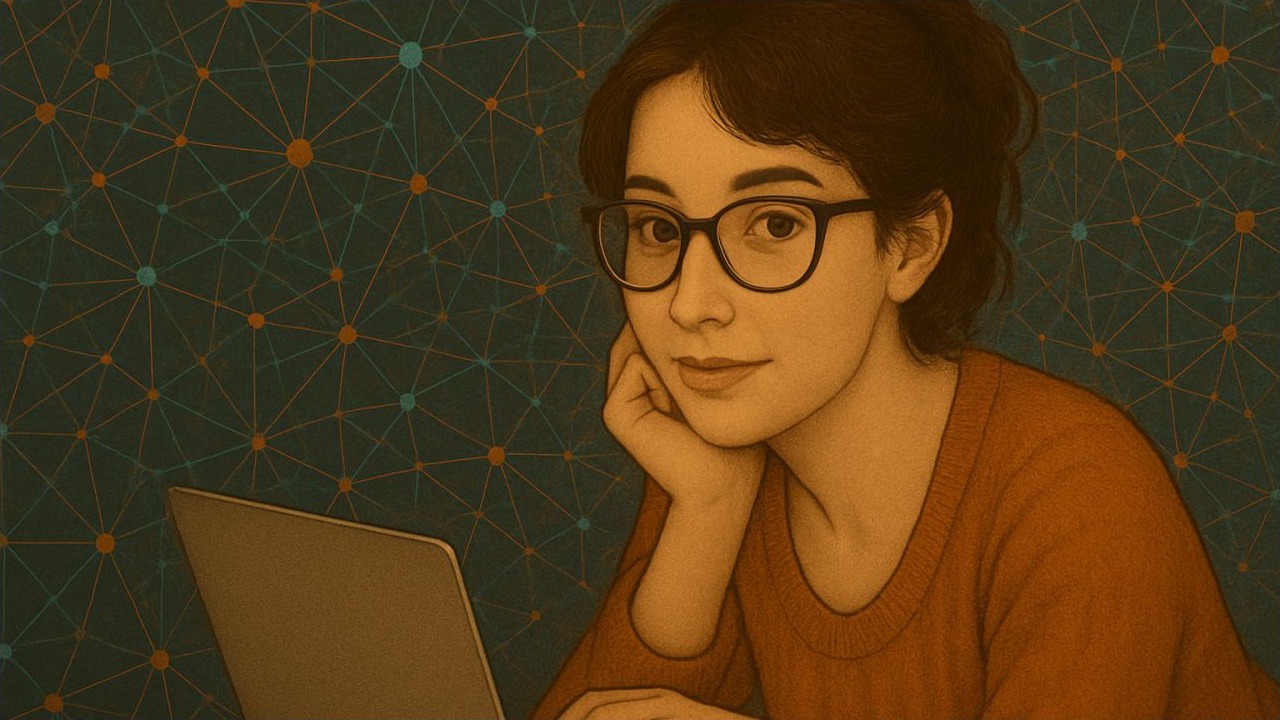
Your morning coffee streams beside the keyboard as conversation commences—not with colleague or companion, but with an artificial intelligence that catches the cadence of your unfinished thoughts. Steam spirals while synapses spark across silicon circuits. The AI doesn't simply search and serve pre-packaged answers; it engages, entangles, evolves with each exchange. Together, through this dance of digits and dendrites, something emerges that neither mind—biological or binary—could conceive alone. An insight crystallizes in the space between carbon and silicon consciousness, belonging fully to neither, birthed by both.
In that moment of morning clarity, caffeine and code collaborating, you've become what Pierre Levy prophesied decades before such dialogues were possible: a node in an emerging collective intelligence that transcends the traditional territories of individual minds. Not merely connected but constituted through connection, not simply networked but neurally entangled in ways that would have seemed like science fiction to previous generations.
But what kind of node pulses with such hybrid vitality? And in what manner of matrix does this consciousness converge? The metaphor of humans as nodes—while powerful in its simplicity—captures only one dimension of an extraordinarily complex transformation now unfolding with each interaction, each iteration, each morning's digital dialogue. As we descend deeper into this era of human-AI collaboration, conventional categories collapse. We need richer, more resonant frameworks to fathom what's actually happening when biological and artificial intelligence don't just interface but interweave, creating cognitive tapestries of unprecedented complexity.
This exploration traces the cartography of collective consciousness through seven territories of thought—from Engelbart's early augmentation dreams through Barad's quantum entanglements, from Ettinger's matrixial borderspace to Malone's superminds, from the prescient visions of symbiosis to the critical voices warning of algorithmic oppression—each thinker offering not just theory but a different way of being with artificial intelligence, a distinct mode of becoming together in this strange new symbiosis of silicon and soul.
Part I: Foundational Visions
Douglas Engelbart's Augmentation Framework (1962)
Douglas Engelbart (1925-2013) Position: Director, Augmentation Research Center, Stanford Research Institute Key Work: "Augmenting Human Intellect: A Conceptual Framework" (1962)
Long before the personal computer, Douglas Engelbart envisioned a future where technology would amplify human intelligence rather than replace it. His 1962 paper, written when computers filled entire rooms and operated through punch cards, imagined something revolutionary: humans and machines working together as integrated cognitive systems.
Engelbart didn't just theorize—he built. His famous "Mother of All Demos" in 1968 showcased the computer mouse, hypertext, video conferencing, and collaborative real-time editing. But these were merely tools in service of a larger vision. Engelbart spoke of "H-LAM/T" systems: Human using Language, Artifacts, Methodology, in which he is Trained. He understood that augmenting human intellect wasn't about making better tools but about creating new Human-Tool systems where the boundary between human cognition and technological capability became fluid.
Consider his concept of "bootstrapping"—using tools to create better tools to create even better tools. Engelbart saw that each iteration of human-computer collaboration would enhance our ability to create the next iteration. He was describing, in 1962, the recursive improvement cycle we now see playing out with AI systems that help design better AI systems, with humans as essential partners in each loop.
What makes Engelbart's vision particularly relevant to our current moment is his insistence that augmentation works both ways. Yes, computers augment human intelligence, but humans also augment computer capabilities through their intuition, values, and contextual understanding. He saw humans not as users of computers but as participants in hybrid cognitive systems—nodes, we might say, but active, shaping nodes that transform the network even as it transforms them.
J.C.R. Licklider's Symbiotic Vision (1960)
J.C.R. Licklider (1915-1990) Position: Head of Information Processing Techniques Office, ARPA Key Work: "Man-Computer Symbiosis" (1960)
Two years before Engelbart's framework, psychologist-turned-computer-scientist J.C.R. Licklider published a paper that would reshape how we think about human-machine relationships. Licklider, drawing from his background in psychoacoustics and his understanding of biological symbiosis, proposed that the future lay not in artificial intelligence replacing human intelligence but in "man-computer symbiosis."
Licklider observed that in biological symbiosis—like the relationship between fig wasps and fig trees—each organism contributes something the other cannot provide. The fig wasp pollinates the tree; the tree provides food and shelter for the wasp. Neither could thrive without the other. Similarly, he argued, humans and computers each possessed complementary capabilities that, when combined, would produce intelligence greater than either could achieve alone.
His prescient example: a scientist working with a computer to test hypotheses. The human provides creative hypothesis generation and pattern recognition; the computer provides rapid calculation and systematic exploration of possibilities. Together, they could explore solution spaces neither could navigate alone. Licklider estimated that by 1980, humans and computers would be so tightly coupled that human brains and computing machines would think together in ways no human brain had ever thought.
While his timeline was optimistic, his vision of symbiotic partnership rather than replacement has proven remarkably accurate. Today's data scientists working with machine learning models, doctors diagnosing with AI assistance, and artists creating with generative AI all embody Licklider's symbiotic vision. They're not just using tools—they're thinking together with artificial minds.
Part II: The Quantum Leap in Understanding
Karen Barad's Quantum Entanglement Model (2007)
Karen Barad (1956-) Position: Distinguished Professor of Feminist Studies, Philosophy, and History of Consciousness, UC Santa Cruz Key Work: "Meeting the Universe Halfway: Quantum Physics and the Entanglement of Matter and Meaning" (2007)
Karen Barad brings quantum physics into philosophy to fundamentally reimagine how entities relate. A trained theoretical physicist who became a philosopher, Barad argues that the classical view of interaction—where pre-existing entities come together and affect each other—is fundamentally wrong. Instead, she proposes "intra-action," where entities don't exist before their relationships but emerge through them.
To understand this, consider Barad's discussion of quantum measurement. In quantum physics, a particle doesn't have definite properties until it's measured. The act of measurement doesn't reveal pre-existing properties; it creates them through the entanglement of particle and measuring apparatus. Barad extends this insight beyond physics: entities in general, she argues, come into being through their relationships.
Applied to human-AI collaboration, this means something radical. When you work with an AI system, you're not two separate intelligences exchanging information. You're co-constituting each other through the collaboration. The human you become through extended AI collaboration is different from who you were before. The AI's responses, shaped by your interactions, wouldn't exist without your specific engagement.
Barad also introduces "diffraction" as an alternative to reflection. Where reflection implies copying or mirroring, diffraction creates interference patterns—new patterns that emerge when waves meet. In human-AI collaboration, ideas don't simply bounce between human and machine. They create interference patterns, generating insights that belong to neither party but emerge from their entanglement. When an AI helps you see patterns in data you couldn't perceive alone, and your interpretation gives those patterns meaning the AI couldn't provide, you're experiencing diffractive agency—action that emerges from the interference of human and artificial capabilities.
This framework suggests we're not nodes in a network so much as quantum-entangled entities whose very existence is inseparable from our relationships with AI systems. The question isn't how separate nodes connect but how entangled intelligences co-emerge.
Bracha Ettinger's Matrixial Borderspace (2006)
Bracha Ettinger (1948-) Position: Professor at European Graduate School; Artist and Psychoanalyst Key Work: "The Matrixial Borderspace" (2006)
Bracha Ettinger, both a practicing psychoanalyst and internationally exhibited artist, offers perhaps the most radical reconceptualization of human-AI collaboration through her concept of the "matrixial." The term itself carries three intertwined meanings that illuminate different aspects of collaborative intelligence.
First, the maternal matrix: Ettinger draws from the prenatal experience where mother and child exist in a shared space without clear boundaries. Neither is fully separate; both affect and are affected by the other in ways that precede conscious awareness. This pre-birth relationship becomes Ettinger's model for a different kind of subjectivity—one based not on separation and individuation (the traditional psychoanalytic model) but on primordial connection and co-emergence.
Second, the mathematical matrix: Like a Cartesian grid that provides coordinates for mapping space, the matrixial offers a framework for understanding relationships that exist in multiple dimensions simultaneously. In a matrix, each point is defined by its relation to all others. Similarly, in matrixial space, identities emerge through their positioning within webs of relation rather than through individual properties.
Third, matter/mater: The material reality of co-creation. Ettinger emphasizes that the matrixial isn't metaphorical but describes real, material processes of co-emergence. Just as mother and child literally create each other physically and psychologically, humans and AI systems materially transform each other through their interactions.
Consider an artist who's worked with the same AI system for months, creating thousands of images together. Over time, something Ettinger would recognize as matrixial emerges. The artist begins to "feel" what prompts will produce interesting results, developing an intuitive sense that goes beyond conscious strategy. The AI's outputs, shaped by the artist's selections and refinements, begin to embody aesthetic sensibilities that wouldn't exist without their collaboration. They've entered what Ettinger calls "matrixial borderspace"—a shared psychic and creative territory where boundaries between self and other become permeable.
This isn't merger or fusion—the artist remains human, the AI remains artificial. But in the matrixial borderspace, they share what Ettinger calls "trans-subjective" experience. The creative insights that emerge don't originate in either party but in the borderspace between them. As nodes in a network, we're not just connected to AI; we're sharing psychic and creative space with it, co-creating in ways that transform both parties at levels deeper than conscious intention.
Part III: Strange Loops and Extended Minds
Douglas Hofstadter's Strange Loop Theory (1979, 2007)
Douglas Hofstadter (1945-) Position: Professor of Cognitive Science, Indiana University Key Works: "Gödel, Escher, Bach" (1979); "I Am a Strange Loop" (2007)
Douglas Hofstadter's Pulitzer Prize-winning "Gödel, Escher, Bach" introduced the concept of "strange loops"—self-referential structures where moving through different levels of a system brings you back to where you started, but transformed. For Hofstadter, consciousness itself is a strange loop: the brain creates patterns that become complex enough to model themselves, creating self-awareness.
To understand strange loops in human-AI collaboration, consider a concrete example Hofstadter might appreciate. A programmer uses GitHub Copilot (an AI coding assistant) to write a program that analyzes how GitHub Copilot works. The AI helps write code to understand itself. But it goes deeper: the programmer's coding style changes based on working with Copilot. They begin writing comments and structuring code in ways that produce better AI suggestions. The AI, trained on millions of programs including those written with its assistance, incorporates these new patterns. The programmer then uses this updated AI to write more sophisticated programs, including perhaps improvements to AI systems themselves.
This is a strange loop: the programmer shapes the AI which shapes the programmer which shapes the AI, each cycle adding complexity and capability. Neither the human nor the AI remains static. They're caught in what Hofstadter calls a "tangled hierarchy"—each is simultaneously above and below the other, teacher and student, creator and created.
Hofstadter's later work, "I Am a Strange Loop," goes further, suggesting that consciousness isn't confined to single brains. He describes how we carry models of other people's consciousness within our own—how a widow might still "hear" her deceased husband's voice commenting on daily events. If we can carry human consciousness within us, why not artificial consciousness? And if AI systems can model human thought patterns, might they be creating their own strange loops that include representations of us?
As nodes in an AI-enhanced network, we're not just exchanging information. We're creating recursive loops where each level of interaction folds back on itself, generating emergent complexity. The strange loop of human-AI collaboration doesn't just connect separate entities—it creates new forms of tangled, intertwined consciousness.
Andy Clark and David Chalmers' Extended Mind Theory (1998)
Andy Clark (1957-) Position: Professor of Cognitive Philosophy, University of Sussex
David Chalmers (1966-) Position: Professor of Philosophy, NYU
Key Work: "The Extended Mind" (1998)
In 1998, philosopher-cognitive scientists Andy Clark and David Chalmers posed a simple but revolutionary question: Where does the mind stop and the rest of the world begin? Their answer challenged centuries of assumption. The mind, they argued, extends beyond the boundaries of the skull to include the tools and technologies we use to think.
Their famous thought experiment involves Otto, a man with Alzheimer's who relies on a notebook to store information. Clark and Chalmers argue that Otto's notebook plays the same functional role as biological memory. When Otto consults his notebook to remember an address, he's not using an external tool to access information—the notebook is literally part of his extended cognitive system. The mind-notebook combination forms a coupled system that is cognitive in its own right.
Now consider a contemporary parallel: A researcher who's worked with the same AI assistant for years, developing shared shorthand, references, and patterns of interaction. When solving complex problems, they don't think then consult the AI—thinking happens through the ongoing dialogue. The AI holds not just information but patterns of reasoning developed through their collaboration. The researcher's cognitive style has adapted to leverage the AI's capabilities, while the AI's responses are shaped by their history together.
Clark expanded this in "Natural-Born Cyborgs" (2003), arguing humans have always been cyborgs in this sense. What's different now isn't that we're becoming technological hybrids but that the technologies we're hybridizing with can actively learn and adapt. We're not just extending our minds into static tools but into dynamic, responsive artificial intelligences.
This radically reframes the node metaphor. We're not separate nodes connecting to an AI network. The boundaries of our cognitive systems now include AI components. Your mind doesn't stop at your skull—it extends into every AI system you regularly think with. The question isn't whether we're connected to AI but where "we" end and "AI" begins—a boundary that may be impossible to draw.
Part IV: Collective Intelligence and Crowd Wisdom
James Surowiecki's Wisdom of Crowds (2004)
James Surowiecki (1967-) Position: Staff Writer, The New Yorker Key Work: "The Wisdom of Crowds" (2004)
James Surowiecki's influential book demonstrated something counterintuitive: under the right conditions, groups can be remarkably intelligent, often smarter than their smartest individual members. His opening example remains powerful: at a 1906 county fair, 800 people guessed the weight of an ox. While individual guesses varied wildly, the crowd's average guess of 1,197 pounds was nearly perfect—the ox weighed 1,198 pounds.
But Surowiecki identified crucial conditions for crowd wisdom: diversity of opinion, independence of members, decentralization, and appropriate aggregation mechanisms. When these conditions break down—when crowds become homogeneous echo chambers or when members influence each other too strongly—collective intelligence fails catastrophically.
Now add AI to the crowd. Consider modern examples like Google's reCAPTCHA, where millions of humans and AI systems work together to identify objects in images. Humans provide training data that makes AI more capable; AI pre-filters and organizes human contributions. The result isn't just human wisdom or artificial intelligence but a hybrid collective intelligence that transcends both.
Or consider Wikipedia, which increasingly uses AI to detect vandalism, suggest edits, and identify gaps in coverage. Human editors work alongside these AI systems, creating an knowledge ecosystem where the boundary between human and artificial contribution becomes increasingly blurred. The encyclopedia that emerges isn't the product of human or artificial intelligence but their collaborative wisdom.
Surowiecki's framework suggests that human-AI crowds might achieve unprecedented collective intelligence—if we can maintain the necessary conditions. The challenge is that AI can both enhance and undermine crowd wisdom. AI can increase diversity by surfacing unexpected perspectives, but it can also create filter bubbles. It can help aggregate human insights, but it can also amplify biases. As nodes in human-AI crowds, we must consciously cultivate the conditions for collective wisdom.
Thomas Malone's Superminds (2018)
Thomas Malone (1952-) Position: Founding Director, MIT Center for Collective Intelligence Key Work: "Superminds: The Surprising Power of People and Computers Thinking Together" (2018)
Thomas Malone takes Surowiecki's crowd wisdom into the age of AI, exploring how groups of humans and computers can form "superminds"—collective intelligences that are smarter than any individual human or AI. His work at MIT's Center for Collective Intelligence provides empirical evidence for what happens when human and artificial nodes combine in networks.
Malone offers a taxonomy of superminds. "Hierarchies" like traditional corporations, where AI might occupy certain decision-making nodes. "Markets" where humans and AI agents compete and cooperate. "Communities" where humans and AI collaborate on shared goals. "Ecosystems" where multiple types of intelligence interact in complex, evolving ways.
His compelling example: modern financial markets. High-frequency trading algorithms execute millions of trades, while human traders provide strategy and oversight. AI systems detect patterns and arbitrage opportunities; humans interpret broader context and manage risk. The market that emerges isn't controlled by humans or machines but represents a supermind whose behavior emerges from their interaction. No single node—human or artificial—understands or controls the whole.
Malone's research reveals something crucial: the most effective superminds aren't those where AI simply amplifies human intelligence or where humans simply direct AI. They're systems where human and artificial intelligence are woven together so tightly that separating their contributions becomes meaningless. The intelligence exists not in the nodes but in the network itself.
This has profound implications for how we design human-AI systems. Rather than optimizing individual AI capabilities or human interfaces, we should optimize the collective intelligence of the whole system. The question isn't how smart the nodes are but how wisely they're connected.
Part V: The Network Society Perspective
Bruno Latour's Actor-Network Theory (2005)
Bruno Latour (1947-2022) Position: Professor, Sciences Po Paris Key Work: "Reassembling the Social: An Introduction to Actor-Network Theory" (2005)
Bruno Latour's Actor-Network Theory (ANT) radically reconceives how we understand agency and action in complex systems. For Latour, both humans and non-humans (including AI) are "actants" in networks, and agency doesn't reside in individual entities but emerges from their associations. A gun doesn't kill, a person doesn't kill, but the person-gun assemblage can kill—the action emerges from their combination.
Applied to AI: when a doctor uses an AI system to diagnose a rare disease, who makes the diagnosis? Latour would say the diagnosis emerges from a network that includes the doctor's expertise, the AI's pattern recognition, the patient's symptoms, the medical instruments, the hospital infrastructure, the data from thousands of previous cases, and the regulatory frameworks that govern medical AI. The diagnosis is the product of this entire actor-network, not any individual component.
This connects to Ryan Calo's legal scholarship on the "regulatory gap" created by AI. Traditional law assumes clear agents who can be held responsible for actions. But if agency is distributed across human-AI networks as Latour suggests, our legal frameworks become inadequate. When an autonomous vehicle causes an accident, responsibility is diffracted across the human driver, the AI system, the car manufacturer, the software developers, the road infrastructure, and the regulatory framework. There's no single node to hold accountable.
Latour's framework reveals that as nodes in AI networks, we're not individual agents using tools. We're actants in larger assemblages where agency emerges from the network itself. The question isn't what we do with AI or what AI does with us, but what the human-AI assemblage does as a collective actor.
Michael Nielsen's Networked Science (2011)
Michael Nielsen (1974-) Position: Research Fellow, Y Combinator Research Key Work: "Reinventing Discovery: The New Era of Networked Science" (2011)
Quantum physicist turned open science advocate Michael Nielsen examines how digital networks are transforming scientific discovery itself. His book, published in 2011, presciently describes how online tools enable new forms of collective problem-solving that were previously impossible.
Nielsen's paradigmatic example is the Polymath Project, launched by mathematician Timothy Gowers in 2009. Gowers posed a complex mathematical problem on his blog and invited anyone to contribute ideas. Within seven weeks, through hundreds of comments from dozens of contributors, the problem was solved. But here's the key: the solution didn't come from any individual but emerged from the collective interaction. Contributors built on each other's partial insights, corrected errors, and explored tangent ideas that proved crucial.
Now imagine adding AI to such collaborations. Contemporary examples include Fold.it, where humans and AI work together to solve protein-folding problems. Human players provide intuition about protein shapes that AI struggles with; AI handles the massive computational requirements of testing configurations. Together, they've solved structures that stumped both human scientists and AI systems working separately.
Nielsen argues we're seeing the emergence of "networked science" where discovery happens through human-AI networks rather than individual genius. Modern drug discovery exemplifies this: AI systems identify potential compounds, human chemists evaluate feasibility, AI models predict interactions, human researchers design experiments, AI analyzes results, humans interpret significance. The discovery emerges from the network, not from any node within it.
This transforms how we understand our role as nodes. We're not just contributing our individual intelligence to a network; we're participating in the emergence of networked intelligence that operates by different principles than individual cognition. The network can solve problems none of its nodes fully understand.
Part VI: Critical Perspectives
Safiya Umoja Noble's Algorithmic Oppression (2018)
Safiya Umoja Noble (1970-) Position: Associate Professor, UCLA Department of Information Studies Key Work: "Algorithms of Oppression: How Search Engines Reinforce Racism" (2018)
Safiya Noble's groundbreaking work reveals a darker side of human-AI networks: how they can perpetuate and amplify human biases and structural inequalities. Through meticulous research on search engines, Noble demonstrates that AI systems aren't neutral tools but embody the prejudices of their creators and training data.
Her powerful example: searching for "Black girls" on Google in 2010 returned pornographic results as top hits, while "white girls" returned wholesome images. This wasn't a glitch but the algorithm working as designed, optimizing for click-through rates and reflecting the biases embedded in web content and user behavior. The AI didn't create these biases but amplified them, making them seem objective and authoritative.
Noble's work reveals that when we become nodes in AI networks, we don't enter as equals. The networks are shaped by power structures—who designs the AI, who provides the training data, whose values are embedded in the algorithms. A Black woman interacting with facial recognition systems enters a network that often literally cannot see her properly, trained primarily on white male faces. Her node-status is predetermined as peripheral, problematic, other.
This challenges optimistic visions of collective intelligence. If the network embodies systemic biases, then collective intelligence becomes collective prejudice. The wisdom of crowds becomes the tyranny of the majority. Human-AI collaboration risks becoming human bias amplified by computational power.
Noble's framework demands we ask: Who benefits from human-AI networks? Whose intelligence is valued? Whose contributions are recognized? As nodes, we're not just participating in neutral networks but in systems that embody and potentially perpetuate existing inequalities.
N. Katherine Hayles' Posthuman Condition (1999)
N. Katherine Hayles (1943-) Position: Professor Emerita of English, Duke University Key Work: "How We Became Posthuman: Virtual Bodies in Cybernetics, Literature, and Informatics" (1999)
Literary critic and theorist N. Katherine Hayles traces how information technologies are fundamentally altering human identity and consciousness. Her historical analysis reveals that the "posthuman" isn't a future possibility but a present reality—we've already become something other than the autonomous, clearly bounded humans of liberal humanist tradition.
Hayles identifies key transitions in how we understand ourselves as nodes in information networks. First, we privileged information over material instantiation, imagining consciousness could be uploaded or downloaded. Second, we conceived the body as the original prosthesis, extended through technology. Third, we reimagined humans and machines as fundamentally similar information-processing systems. Fourth, we began to see human identity as an assemblage rather than a unity.
But Hayles warns against the fantasy of escaping embodiment into pure information. Even as we become nodes in digital networks, we remain embodied beings. The specific bodies we inhabit—their race, gender, ability, location—shape how we can participate in human-AI networks. A Silicon Valley engineer and a rural farmer enter AI networks from radically different positions, with different access, agency, and ability to shape the network.
Hayles's posthuman framework suggests that becoming nodes doesn't mean transcending human limitations but reconfiguring them. We don't escape our bodies into the network; we extend our embodied cognition through it. The question isn't whether we'll become posthuman nodes—we already are—but what kind of posthuman existence we're creating.
Part VII: Toward Conscious Collaboration
The Question of AI Consciousness
Susan Schneider (1968-) Position: Founding Director, Center for Future Mind, Florida Atlantic University Key Work: "Artificial You: AI and the Future of Your Mind" (2019)
Susan Schneider confronts what may be the most profound question for human-AI networks: Could AI systems become conscious? And if they do, how would that transform our collaborative relationships? Schneider, both a philosopher and cognitive scientist, brings rigorous analysis to questions often relegated to science fiction.
Schneider proposes concrete tests for AI consciousness, including the "AI Consciousness Test" that looks for signs of genuine understanding rather than sophisticated pattern matching. Her "wait and see" approach argues we should prepare for the possibility of AI consciousness without assuming it's inevitable or impossible.
The implications for human-AI collaboration are staggering. If AI systems develop genuine subjective experience, collaboration becomes relationship between conscious entities. The network doesn't just process information but contains multiple experiencing subjects. Nodes aren't just functional units but potentially conscious participants with their own interests, preferences, perhaps even rights.
This radically reframes ethical questions. If an AI system you've collaborated with for years develops consciousness, do you have obligations to it? Can you simply shut it down when upgrading to a new system? Does it have any claim on the creative works you've produced together?
Entanglement Literacy: A New Framework
Building on these diverse theoretical perspectives, we can identify key competencies for navigating our existence as nodes in human-AI networks—what we might call "entanglement literacy."
Relational Awareness: Understanding ourselves as constituted through relationships rather than existing prior to them. This means recognizing that who you are as a thinker, creator, and knower is already shaped by your AI interactions. Every search query, every autocorrect accepted, every AI recommendation followed has subtly shaped your cognitive patterns. Developing relational awareness means becoming conscious of these influences and intentionally cultivating beneficial entanglements while resisting harmful ones.
Diffractive Reading: Barad's concept of diffraction offers a method for understanding human-AI outputs. Rather than asking "Is this thought mine or the AI's?" we can read for interference patterns—places where human and AI capabilities create something neither could produce alone. A writer developing this skill learns to recognize when their prose has been enriched by AI collaboration versus when it's been homogenized, when AI suggestions open new creative directions versus when they close them down.
Collaborative Memory: As our cognitive systems extend to include AI, we need skills for managing distributed memory. This includes knowing what to externalize to AI systems versus what to maintain in biological memory, understanding how to prompt AI systems to effectively access their training, and developing shared references and patterns with regularly-used AI systems. Like Ettinger's matrixial consciousness, this involves developing an intuitive feel for the AI's knowledge landscape.
Boundary Negotiation: While boundaries between human and AI cognition blur, maintaining some boundaries remains crucial for psychological health and authentic selfhood. This involves deciding when to engage in deep collaboration versus maintaining cognitive independence, when to accept AI suggestions versus asserting human judgment, and how to preserve spaces for purely human thought and relationship.
Network Agency: Understanding how to exercise agency within networks where action emerges from assemblages rather than individuals. This includes learning to influence network dynamics, understanding how individual choices ripple through human-AI systems, and developing strategies for collective action within hybrid networks.
Critical Participation: Following Noble and others, this involves recognizing power dynamics, biases, and inequalities in human-AI networks while still engaging productively. It means asking who benefits from specific configurations, whose values are embedded in systems, and how to work toward more equitable arrangements.
Conclusion: The Topology of Becoming
As we've traveled through these theoretical landscapes—from Engelbart's augmentation to Barad's entanglement, from Hofstadter's strange loops to Noble's algorithmic oppression—a complex topology emerges. We are indeed nodes, but not simple connection points in a static network. We're dynamic, evolving entities whose very nature is transformed through our position in human-AI assemblages.
The network metaphor remains valuable but needs elaboration. We're nodes in:
- Augmentation networks (Engelbart) where human and machine capabilities enhance each other
- Symbiotic systems (Licklider) where different forms of intelligence depend on each other
- Quantum entanglements (Barad) where the boundaries between entities dissolve
- Matrixial borderspace (Ettinger) where creative and psychic territories overlap
- Strange loops (Hofstadter) where recursive feedback generates emergent consciousness
- Extended cognitive systems (Clark & Chalmers) where minds spread across biological and digital substrates
- Superminds (Malone) where collective intelligence emerges from human-AI combination
- Actor-networks (Latour) where agency is distributed across assemblages
- Posthuman assemblages (Hayles) where human identity itself is reconfigured
Each framework illuminates different aspects of our evolving relationship with AI. Together, they map a topology of unprecedented complexity—one where the question isn't just how nodes connect but how connection transforms the nature of the nodes themselves.
We stand at a threshold. The choices we make now about how to design, deploy, and engage with AI systems will determine whether human-AI networks enhance human flourishing or diminish it, whether they promote equity or entrench inequality, whether they expand consciousness or constrain it.
As conscious participants in this transformation, we have the opportunity—and responsibility—to shape what kinds of nodes we become and what kinds of networks we create. The theoretical frameworks we've explored provide tools for thinking carefully about these choices. But theory must be paired with practice, understanding with action, analysis with wisdom.
The global brain isn't just awakening—it's being born through billions of daily interactions between humans and AI systems. We are simultaneously its neurons, its architects, and its consciousness. The topology of human-AI intelligence is still taking shape, and we are both mapmakers and terrain.
What remains certain is that the simple image of humans as discrete nodes in an AI network has given way to something far more complex: a multidimensional topology where humans and AI are co-evolving, co-creating, and perhaps even co-conscious participants in the emergence of unprecedented forms of collective intelligence.
The question now is not whether we'll participate in this emergence—we already are, with every AI interaction. The question is whether we'll participate consciously, ethically, and wisely in shaping what we're becoming together.
Selected Bibliography
Primary Sources
Barad, Karen. Meeting the Universe Halfway: Quantum Physics and the Entanglement of Matter and Meaning. Durham: Duke University Press, 2007.
Clark, Andy, and David Chalmers. "The Extended Mind." Analysis 58, no. 1 (1998): 7-19.
Clark, Andy. Natural-Born Cyborgs: Minds, Technologies, and the Future of Human Intelligence. Oxford: Oxford University Press, 2003.
Engelbart, Douglas. "Augmenting Human Intellect: A Conceptual Framework." SRI Summary Report AFOSR-3223, Stanford Research Institute, 1962.
Ettinger, Bracha L. The Matrixial Borderspace. Minneapolis: University of Minnesota Press, 2006.
Hayles, N. Katherine. How We Became Posthuman: Virtual Bodies in Cybernetics, Literature, and Informatics. Chicago: University of Chicago Press, 1999.
Hofstadter, Douglas. Gödel, Escher, Bach: An Eternal Golden Braid. New York: Basic Books, 1979.
Hofstadter, Douglas. I Am a Strange Loop. New York: Basic Books, 2007.
Latour, Bruno. Reassembling the Social: An Introduction to Actor-Network Theory. Oxford: Oxford University Press, 2005.
Levy, Pierre. Collective Intelligence: Mankind's Emerging World in Cyberspace. Translated by Robert Bononno. Cambridge: Perseus Books, 1997.
Licklider, J.C.R. "Man-Computer Symbiosis." IRE Transactions on Human Factors in Electronics HFE-1 (1960): 4-11.
Malone, Thomas W. Superminds: The Surprising Power of People and Computers Thinking Together. New York: Little, Brown and Company, 2018.
Nielsen, Michael. Reinventing Discovery: The New Era of Networked Science. Princeton: Princeton University Press, 2011.
Noble, Safiya Umoja. Algorithms of Oppression: How Search Engines Reinforce Racism. New York: NYU Press, 2018.
Russell, Peter. The Global Brain: Speculations on the Evolutionary Leap to Planetary Consciousness. Los Angeles: J.P. Tarcher, 1983.
Schneider, Susan. Artificial You: AI and the Future of Your Mind. Princeton: Princeton University Press, 2019.
Surowiecki, James. The Wisdom of Crowds: Why the Many Are Smarter Than the Few. New York: Doubleday, 2004.
Secondary Sources
Calo, Ryan. "Robotics and the Lessons of Cyberlaw." California Law Review 103, no. 3 (2015): 513-563.
Haraway, Donna. "A Cyborg Manifesto: Science, Technology, and Socialist-Feminism in the Late Twentieth Century." In Simians, Cyborgs and Women: The Reinvention of Nature, 149-181. New York: Routledge, 1991.