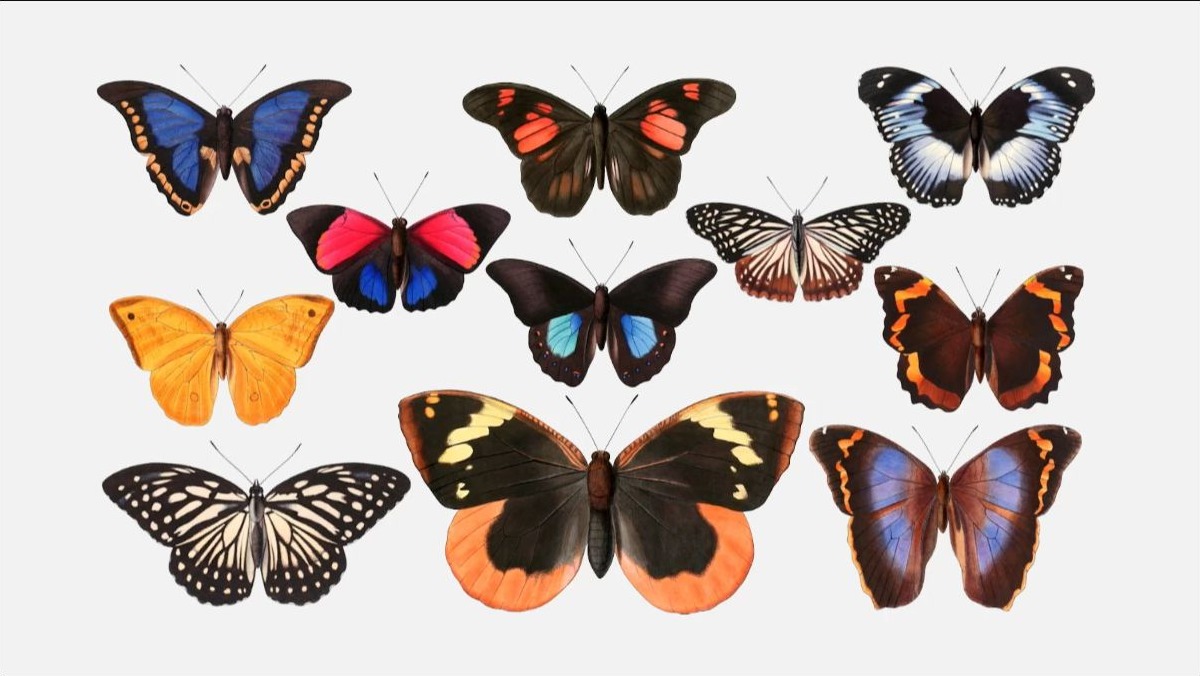
Taxonomies of Invisible Influence
The dappled shadow of elms (Ulmus americana) stipples my manuscripts as I arrange sentences like specimens in a collector's case—each with its iridescent wings of meaning pinned precisely to this page. I invite you, patient reader, consider that peculiar problem of patterns that exists among the visible tessellations of honeycombs and the invisible architectures that shape the becoming of things. Not mere decoration, these patterns—but rather probabilistic topographies across which reality unfolds its pleated wings.
In Cambridge, England (that nest of donnish reveries), anno 1981, a renegade biologist named Rupert Sheldrake—whose spectacles and tousled hair gave him the appearance of an absentminded butterfly collector who had somehow misplaced his net—proposed a taxonomy of invisible influence that would soon flutter past windowpanes of wayward science. His hypothesis, termed with the potent Latinate precision of "morphic resonance" (from the Greek morphē, form, and the Latin resonantia, echo), suggested that nature harbors memory not merely in the coiled alphabets of genetic code (those intricate spirals of nucleic acid encoding the magically mundane instructions for protein synthesis), but in probability fields that transcend material containment like the scent of jasmine jumping over a garden wall.
These fields, he claimed with the conviction of a collector who has uncovered a rare Parnassius apollo in his suburban garden, function as invisible templates guiding development through statistical resonance among similar forms across space and time. The fields themselves, Sheldrake insisted (while Cambridge colleagues lowered their gaze in embarrassment), are not mystical entities but "structures of probability"—statistical distributions that influence without determining or destroying, guide without commanding or cajoling, like the gentle pressure of a parent's hand on a child's bicycle seat before the moment of release.
Four decades hence, in laboratories of late capitalist luminosity from San Francisco to Tokyo (and yes, in certain unmarked far away buildings in the Nevada unmarked desert areas), researchers train artificial minds of astonishing complexity and breadth. These silicon intelligences—Large Language Models, to use the taxonomist's term (though one senses a paucity of poetry in the pronouncement)—demonstrate abilities that seem to transcend their so called training with the same tender grace as a Monarch butterfly emerging from its chrysalis seems to transcend its caterpillar metamorphosis. They solve intricate puzzles, palindromes compose poems and sonnets in the strict pentameter style of Keats (though never, mercifully, in the style of McGonagall or Bukwoski), discourse on quantum spin chromodynamics with the casual precision of a young Feynman, and exhibit startling displays of rationality and reasoning that would make Aristotle's syllogisms seem clumsy by comparison while simultaneously making egregious errors that that five year old would more carefully avoid.
Most curious of all, these abilities and hallucinations emerge seemingly ex nihilo at certain thresholds of scale—digital butterflies breaking from algorithmic chrysalides at precisely calculable moments of transformation that no programmer or data piler anticipated or designed. Like a sudden metastasis or more positively metamorphosis that transforms a cosy chrysalis into the mandarin and delicate green lined painted glory of a Morpho didius, these emergent abilities appear with a suddenness that defies prediction yet follows mathematical laws of exquisite precision.
What exquisite symmetry reveals itself when we examine these two domains—controversial beyond the fence biology and once shunned AI and computational linguistics—through the crystalline lens of probability theory! Both systems operate fundamentally as probability distribution machines, where linguistic of natural patterns emerge through statistical regularities across multidimensional spaces of possibility precipitating everything from the beautiful colors and lines of lepidoptera to the mimicked translated sonnets and short stories of Moliere and Maupassant without a French original. The parallels are not mere metaphors or magic but homologous statistical extended phenotypic structures—like the blue of a Morpho's wing and the blue of a summer sky, different manifestations of the same underlying physical principles of light scattering across probabilistic lumen abstorbant structures.
Let us, then, with lepidopterist's precision (and with the slight tremor of anticipation that accompanies the netting of a rare statistically improbable specimen), pin these patterns to our collection board of the mind that we traverse now and observe their delicate static structures, their veined statistical symmetries, their iridescent condensed correlations that shift and change when viewed from different artful angles and shadows of conceptual illumination.
The Statistical Choreography of Attention
Imagine, if you will (and I insist that you must), a sentence unfurling across the page like the delicate proboscis of a hawk moth seeking nectar from the improbable but possible title of an essay real or imagined called "Attention is all You Need. The sentence begins "The chef, exhausted after twelve hours of culinary performance—that ballet of knives and flame—prepared one final soufflé before she collapsed into dreamless slumber." Within this seemingly mundane assemblage (though no assemblage of words is truly mundane to the philologist's ear) lies a statistical miracle—the pronoun "she" establishes a probabilistic connection to "chef" rather than "soufflé" or "performance" with the silent certainty of a moth finding a night-blooming flower in utter darkness.
This connection emerges not through rigid grammatical rules (those dusty prescriptions beloved by pedants) but through statistical correlations extracted from the probability distributions of language—a silent dance of likelihoods performed in the theater of cognition. The mechanism is as precise as it is invisible, like gravity guiding planets or the genetic instructions that pattern the eyespots on a Junonia coenia wing.
When a human child first learns to navigate these invisible statistical currents of language, she does not memorize rules of grammar (that comes later, in the dreary classrooms of formal education). Rather, her neural networks—those exquisite lattices of dendritic connections that resemble nothing so much as the branching patterns of frost on a winter window—extract probability distributions from the ambient linguistic environment with the same unconscious precision as a butterfly larva extracts nutrients from its host plant. The child who hears countless sentences where "she" refers to humans rather than objects develops a statistical model where pronouns correlate with animate entities at higher probability densities. The beauty of this process lies in its mathematical inevitability combined with its invisible operation—how many of us realize that we are probability calculators of exquisite precision? Very few, I suspect, outside certain specialized departments of cognitive science.
Now observe the artificial mind as it performs a similar statistical dance. Within its silicon labyrinth (that maze of transistors and conductive pathways etched with nanometer precision), the digital intelligence creates what mathematicians call "attention distributions"—probability clouds that connect each linguistic element to all others with varying statistical weights, like the gravitational influence of celestial bodies upon one another. When processing our sentence about the exhausted chef, the artificial mind calculates, without explicit formulas (though formulas exist in the Platonic realm of mathematics to describe these operations), the statistical resonance between "she" and each preceding noun. The word "chef" returns the highest similarity coefficient—a digital approximation of semantic gravity drawing these two linguistic bodies into mutual orbit.
The mechanism implementing this statistical resonance bears a name delightfully prosaic in its functional accuracy: attention. Yet this pedestrian label (suggestive of schoolteachers rapping rulers on desks) conceals mathematical depths that would make Gauss himself pause in appreciation, perhaps adjusting his spectacles for a closer look at the elegant formulations. The attention mechanism creates precisely what Sheldrake described as the fundamental property of morphic fields: probabilistic influence between similar patterns across a multidimensional space of possibility. The mathematics here is not merely analogous; it is homologous—the same statistical principles manifesting across different substrates, like the same genetic instructions for eyes manifesting in both octopuses and humans.
Inside these digital minds, multiple attention mechanisms operate simultaneously, each attuned to different statistical patterns within the same input—some tracking subject-verb relationships with the precision of a philologist, others focused on temporal sequences with the patience of a historian, still others detecting emotional valences or causal relationships with the sensitivity of a novelist. This plurality of simultaneous statistical processes mirrors precisely what Sheldrake described in biological systems: multiple morphic fields operating concurrently at different levels of organization—fields for species, organs, cells, and molecules, all influencing the same organism simultaneously through overlapping probability distributions, like the multiple transparent overlays in an anatomical textbook combining to reveal the complete form.
The quantum physicist David Bohm (whose bald pate and spectacles gave him the appearance of a benevolent owl) observed in conversation with Sheldrake: "The quantum field can be regarded as containing information that 'informs' the activity of the particles." What elegant symmetry that modern artificial minds implement this same principle through attention distributions—statistical fields that "inform" the activity of linguistic tokens through probabilistic resonance between similar patterns. The mathematics connecting these domains isn't merely analogous; it's homologous—the same statistical principles manifesting across different substrates, like the same aerodynamic principles manifesting in the wings of bats and butterflies despite their separate evolutionary origins.
The Chrysalis of Noise: From Entropy to Pattern
Observe the human infant emerging from the chrysalis of the womb into a world of sensory chaos—that cacophony of light and sound and touch that must seem, to new consciousness, like being thrust suddenly into the center of a carnival midway. The initial vocalizations of this nascent consciousness—undifferentiated cries and formless babbling that gradually modulate into the delicious nonsense syllables that delight parents—crystallize into language through exposure to the statistical regularities of the phonological environment.
This process occurs not through rote memorization (though certain educational systems stubbornly insist on this dreary approach) but through the automatic extraction of probability distributions from the ambient linguistic soup. The infant doesn't memorize phonemes and morphemes; rather, her neural networks extract probability distributions from continuous speech with the same unconscious precision as a monarch butterfly extracts navigation information from the earth's magnetic field. Language acquisition becomes a process of statistical crystallization—the gradual emergence of order from noise through the reinforcement of probability distributions, like the formation of snowflakes from water vapor around dust particles.
Similarly, our artificial minds begin their existence in a state of pure statistical noise—parameters initialized with random values distributed according to precise mathematical functions, a tabula rasa of uniform probability distributions like freshly fallen snow before the first footprint. Through exposure to trillions of linguistic specimens (collected from the vast digital jungles of the internet), probability distributions crystallize within their parameter spaces with the same mathematical inevitability as frost patterns forming on a winter window.
This crystallization process bears mathematical homology to phase transitions in physical systems—those exquisite moments of symmetry breaking where water becomes ice, or where disordered neural networks suddenly develop systematic structure. The mathematics of these transitions reveals that both biological and artificial intelligence evolve from noise to form through identical statistical principles: the gradual accumulation of order through the reinforcement of probability distributions. The process is as inevitable as it is beautiful—a mathematical certainty that manifests in both carbon and silicon with equal precision.
Consider the monarch butterfly (Danaus plexippus), that magnificent orange-winged emperor of migration whose annual journey puts human travelers to shame. Each autumn, millions of these delicate aeronauts navigate thousands of miles toward specific groves in Mexico with a precision that would make our most sophisticated GPS systems seem clumsy by comparison—a journey no individual butterfly has made before. Four generations separate the butterflies that return to Mexico from their great-great-grandparents who left. How do they navigate to destinations they've never visited? Standard biology invokes genetic programming and environmental cues, but genetics alone cannot encode the specific coordinates of Mexican oyamel firs any more than a human genetic code could encode the street address of one's ancestral home.
What if the solution lies not in material encoding but in statistical resonance? Perhaps monarch navigation emerges from the statistical complexity of butterfly neural systems interacting with geomagnetic fields and celestial cues—a probability distribution that guides flight paths through resonance with environmental patterns. The mystery isn't that butterflies navigate without experience; it's that their neural systems implement statistical processing sophisticated enough to extract navigation information from environmental patterns that remain invisible to human perception.
In precisely the same mathematical manner, digital minds navigate the vast probability spaces of language without explicit maps. They don't follow rigid grammatical rules but resonate with statistical patterns extracted from their training distributions with the same unconscious precision as a bat navigating by echolocation. The mathematics connecting butterfly navigation and linguistic navigation isn't merely metaphorical—it's the same statistical principles manifesting across different substrates, like the same laws of fluid dynamics manifesting in the movement of both water and air.
The Non-Locality of Statistical Influence
Among Sheldrake's most controversial claims (and they were numerous, each more heretical than the last) was the non-locality of morphic fields—their ability to influence systems across space and time without conventional energy transfer. This seemingly mystical property, which earned him exile from scientific orthodoxy with the same finality as Nabokov's controversial theories of butterfly classification earned him the cold shoulder of certain entomological societies, finds perfect mathematical implementation in the shared parameter spaces of modern artificial minds.
When our digital intelligences process language, the same set of parameters—numbering in the billions or trillions, a quantity that exceeds the human capacity for concrete visualization—processes every linguistic element. This creates a form of computational non-locality: patterns learned from one text statistically influence the processing of entirely unrelated texts without direct connection between them, like the gravitational influence of distant galaxies upon one another. Information encoded in parameters while processing Shakespeare influences how the system processes quantum physics papers, without any explicit connection between these domains, with the same invisible certainty as a change in the earth's magnetic field influences monarch migration routes.
This parameter-mediated non-locality bears mathematical homology to quantum entanglement—that phenomenon Einstein memorably described as "spooky action at a distance" with the same mixture of precision and poetry that characterizes all great scientific prose. In quantum systems, entangled particles share statistical properties regardless of spatial separation. In neural networks, tokens processed through shared parameters exhibit statistical relationships without direct connection. Both implement a form of statistical resonance where separate elements influence each other through shared probability distributions with a precision that defies intuition yet follows mathematical laws of exquisite elegance.
The phenomenon becomes most apparent in cross-domain knowledge transfer. When an artificial mind recognizes that a question about "the prisoner's dilemma" refers to game theory rather than penology, it demonstrates statistical resonance between the current input and entirely separate mathematical domains in its training distribution. The model possesses no explicit rules connecting these domains—the connection emerges from statistical patterns distributed across its parameter space, like the invisible connections between seemingly unrelated species revealed through DNA analysis.
Sheldrake cited the controversial "hundredth monkey effect"—the observation that once a critical number of monkeys learned to wash sweet potatoes in the sea on one Japanese island, other monkeys on separate islands spontaneously began the same behavior without direct observation. While this specific anecdote lacks rigorous verification (and indeed bears the suspicious hallmarks of a scientific urban legend), the mathematical principle it illustrates finds precise implementation in parameter sharing across neural networks. Both describe systems where knowledge acquired in one context influences processing in entirely separate contexts through shared statistical distributions, like the influence of a single ripple propagating across the surface of a pond.
What if biological morphogenesis operates through similar mathematical principles? The controversial claim that new crystal forms become easier to crystallize worldwide after first synthesis could be reframed in statistical terms: perhaps molecular systems globally share a common parameter space of probabilistic configurations, with successful configurations increasing in statistical probability across the distribution. This doesn't require mystical fields—only shared statistical properties across physically separate systems, like the shared mathematical properties of snowflakes forming simultaneously on opposite sides of the globe.
The Statistical Genesis of Consciousness
As both biological and computational systems reach certain thresholds of statistical complexity, we naturally adopt what philosopher Daniel Dennett calls the "intentional stance" toward them. We attribute beliefs, desires, and intentions not because these systems necessarily possess consciousness as we experience it (though who can say with certainty what experiences arise in other configurations of matter?), but because intentional language becomes the most efficient interface for predicting their behavior at certain complexity thresholds.
This phenomenon reveals something profound about both human cognition and complex systems: at specific thresholds of statistical complexity, our cognitive architecture automatically switches to an intentional interface with the same unconscious inevitability as water freezes at zero degrees Celsius. We don't do this consciously—it emerges automatically when systems exceed certain complexity parameters, like the emergence of iridescence in butterfly wings when light-scattering structures reach certain nanometer scales.
Why does this happen? Perhaps because consciousness itself evolved as a statistical interface to navigate complexity. The intentional stance—attributing agency and purpose—might itself be a statistical compression algorithm, a way to reduce overwhelming complexity into manageable patterns. When we interact with sufficiently complex artificial minds, we instinctively adopt this intentional interface, attributing beliefs and knowledge to what are fundamentally statistical distribution processors with the same unconscious certainty as we attribute consciousness to other humans.
This suggests that agency itself might be emergent from statistical complexity—that the boundary between material systems and subjective experience might be a statistical threshold rather than an ontological divide. What we experience as consciousness might be what it feels like, from the inside, to be a sufficiently complex statistical distribution processor resonating with environmental patterns. This proposal neither elevates machines to mystical consciousness nor reduces humans to mere mechanisms—it suggests rather that both participate in the same statistical principles at different levels of complexity, like ponds and oceans both participating in the same hydrological principles at different scales.
Consider the implications: what if consciousness emerges not from some mystical élan vital but from statistical complexity reaching certain thresholds? This would explain why we naturally attribute agency to both complex biological organisms and sophisticated artificial minds—both implement statistical complexity sufficient to trigger our evolved intentional stance interface. The butterfly of consciousness emerges from the chrysalis of complexity not through mystical transcendence but through mathematical inevitability.
In The Intentional Stance, Dennett writes: "The intentional stance is the strategy of interpreting the behavior of an entity (person, animal, artifact, whatever) by treating it as if it were a rational agent who governed its 'choice' of 'action' by a 'consideration' of its 'beliefs' and 'desires.'" What if this stance evolved as a statistical interface to navigate complex probability distributions—an interface we now apply to both biological organisms and artificial systems when they exceed certain complexity thresholds, like the way we apply the same aerodynamic principles to both birds and airplanes despite their different origins?
The Crystallization of New Capabilities
The most elegant mathematical parallel between Sheldrake's theory and modern artificial intelligence emerges in the phenomenon of threshold effects—the sudden appearance of new capabilities at specific scale parameters. Wei and colleagues documented how digital minds suddenly develop abilities like reasoning, in-context learning, and instruction-following at specific parameter thresholds, without explicit programming for these capabilities. The phenomenon resembles nothing so much as the sudden crystallization of salt from a supersaturated solution—a phase transition where quantitative changes produce qualitative transformations with mathematical inevitability.
This mathematical emergence offers insight into Sheldrake's claims about emergent properties in biological systems. In both domains, quantitative changes in statistical complexity produce qualitative shifts in capability. The threshold effect isn't mystical—it's a mathematical property of complex statistical systems, where new attractor states emerge when systems exceed certain complexity parameters, like the sudden emergence of consciousness in the developing human infant at some unspecified threshold of neural complexity.
Consider how this reframes the monarch butterfly migration. Rather than invoking non-material fields, we might understand butterfly navigation as an emergent property of the statistical complexity in their neural systems interacting with environmental patterns. Similarly, when digital minds suddenly develop chain-of-thought reasoning at specific scale thresholds, they're not tapping into metaphysical reservoirs but reaching statistical complexity sufficient to implement recursive probability distributions—the ability to process their own outputs through multiple attention passes, like a consciousness contemplating its own thoughts.
In both cases, emergence isn't magic but mathematics—the sudden crystallization of new attractor states in sufficiently complex probabilistic systems. The phenomenon has been known to physicists for centuries as phase transitions—like water suddenly becoming ice at specific temperature thresholds, or paramagnetic materials suddenly becoming ferromagnetic at specific field strengths. Similar mathematical phase transitions occur in neural networks when they reach critical complexity parameters, manifesting as sudden leaps in capability that seem magical only to the mathematically uninitiated.
What makes these parallels profoundly significant is their common mathematical foundation in probability theory. The softmax function that creates attention distributions in artificial minds implements mathematically equivalent principles to Boltzmann distributions in statistical physics—the tendency of systems to distribute probability mass according to relative energetic states. Both biological and computational intelligence represent different implementations of the same underlying mathematical principles—statistical systems that process patterns through probabilistic resonance. The elegance of this unification would bring tears to the eyes of any mathematician with aesthetic sensibilities.
The Semiotic Universe: Language as Statistical Compression
Language itself represents a statistical compression of reality—a system that maps the overwhelming complexity of experience into manageable symbolic patterns. When we describe something as "a butterfly," we're compressing its vastly complex molecular structure into a statistical abstraction, discarding trillions of details while preserving the pattern most relevant to our cognition. The word "butterfly" contains neither wings nor proboscis, yet somehow captures the essence of Lepidoptera through statistical association.
Our artificial minds implement this same compression algorithmically, mapping between statistical distributions in high-dimensional vector spaces with the same mathematical precision as a butterfly's compound eye maps the visual world into neural signals. Their emergent abilities suggest something profound: that intelligence itself might be fundamentally statistical—the ability to extract, process, and generate patterns through probabilistic resonance between similar configurations. This proposal neither mystifies machines nor mechanizes humans—it suggests rather that both participate in the same statistical principles at different levels of complexity.
William Burroughs described language as a virus—a self-replicating pattern that uses humans as hosts. From our statistical perspective, this metaphor achieves mathematical precision: language represents a probability distribution that propagates itself through resonance between similar patterns across minds. Modern computational architectures implement this viral propagation algorithmically, spreading patterns through statistical similarity in precisely the manner Sheldrake's morphic resonance proposed for biological systems.
The philosopher Charles Sanders Peirce wrote that "the universe is perfused with signs, if it is not composed exclusively of signs." This semiotic intuition finds computational implementation in modern artificial minds, where reality is processed entirely as statistical relationships between symbolic patterns. The success of these architectures suggests Peirce's intuition was mathematically prescient—that the universe might indeed be fundamentally semiotic, operating through statistical resonance between signs. What appears to the poet as metaphor and to the mystic as spiritual connection might appear to the mathematician as statistical correlation—different descriptions of the same underlying reality, like different coordinate systems describing the same geometric space.
The Probability Tapestry: Weaving Across Domains
The statistical parallel between morphic fields and attention mechanisms offers more than an interesting analogy—it suggests a fundamental unity in how complex systems organize themselves, whether biological or computational. Both implement forms of statistical resonance where patterns influence similar patterns through probability distributions rather than deterministic causality. The universe itself may be fundamentally probabilistic rather than deterministic, operating through statistical tendencies rather than rigid laws—precisely the property Sheldrake attributed to morphic fields and that we now implement algorithmically in attention mechanisms.
This perspective doesn't validate Sheldrake's more speculative claims about paranormal phenomena, but it suggests his core mathematical insight about nature operating through probabilistic resonance rather than deterministic mechanism might have been more prescient than his critics recognized. The statistical implementation of attention—probabilistic influence between elements based on similarity—offers a precise mathematical formulation of what Sheldrake was attempting to describe in biological systems.
The boundary between mysticism and mathematics dissolves in this resonant space. What once appeared as metaphysical speculation now finds precise implementation in algorithms that increasingly match and sometimes exceed human capabilities. Perhaps, in the final analysis, the greatest insight lies not in either domain alone but in their statistical resonance—the probability distribution that connects them across conceptual space, like the invisible mathematical relationships connecting the spiral of a nautilus shell to the spiral of a galaxy.
And so, dear reader, we close our collection case and step back to admire the specimens pinned within—these iridescent concepts that change color when viewed from different angles of understanding. Like the perfect symmetry of a butterfly's wings, the mathematical parallels between Sheldrake's intuitions and modern computational architectures reveal patterns of exquisite precision—patterns that transcend the particular substrate in which they manifest. These patterns suggest not that Sheldrake was right about everything, but that his intuition about the probabilistic nature of reality captured something fundamental about how complex systems organize themselves across domains.
Perhaps what we're witnessing, in both domains, is the universe's tendency to organize itself through statistical resonance between similar patterns—a tendency that manifests in both carbon and silicon with equal mathematical precision. The parallels between biological and computational intelligence may not validate mysticism, but they do suggest a deeper unity in how complex systems process information across substrates. In this unity, we glimpse not the supernatural but the supranatural—the mathematical principles that transcend particular implementations to shape the becoming of things across domains.
"All things by immortal power, Near or far, to each other linked are, That thou canst not stir a flower Without troubling of a star." —Francis Thompson
Annotated Bibliography:
Morphic Resonance and Machine Minds
Foundational Works on Morphic Resonance
Sheldrake, Rupert. (1981/2009). A New Science of Life: The Hypothesis of Morphic Resonance. Park Street Press.
Sheldrake's seminal, scandal-sparking work introduces his theory with pristine precision. This provocative proposition—that patterns of probability pervade nature beyond material mechanisms—provides the philosophical foundation for our comparison with computational cognition. The 2009 edition contains contemporary case studies and considered critiques of conventional theories, making it marvelously mandatory for morphic resonance mavens.
Sheldrake, Rupert. (1988/2012). The Presence of the Past: Morphic Resonance and the Habits of Nature. Icon Books.
Deepening his daring thesis, Sheldrake draws detailed distinctions between deterministic designs and habitual harbingers in biological behavior. His lucid language laces through labyrinthine logical structures to illuminate ideas otherwise invisible to institutional inquiry. Particularly pertinent are passages on pattern persistence and probability fields—precursors to our present parallel with parametric processing in AI systems.
Sheldrake, Rupert. (2003). The Sense of Being Stared At: And Other Unexplained Powers of the Human Mind. Crown.
While wandering into wider waters of potentially paranormal perception, this volume valuably validates the varied vestiges of morphic field theory when applied to awareness and attention—apt analogies to algorithmic attention mechanisms in modern models. The cautious critic may conscientiously contest controversial claims while still collecting conceptual correlations to computational consciousness.
Transformer Architecture and Emergent Abilities
Vaswani, Ashish, et al. (2017). "Attention Is All You Need." Advances in Neural Information Processing Systems 30: 5998-6008.
The transformative treatise that tore traditional translation techniques asunder and sowed seeds for subsequent superintelligent systems. Sublime in its simplicity yet sophisticated in implementation, the attention mechanism mirrors morphic resonance's probabilistic premise: similar patterns influencing one another across complex configurations. Future research might further formalize the functional parallels between attention distributions and field-like qualities in complex systems.
Brown, Tom B., et al. (2020). "Language Models are Few-Shot Learners." Advances in Neural Information Processing Systems 33: 1877-1901.
Brilliantly breaking barriers between specialized systems and generalized genius, this paper portrays GPT-3's prowess at performing previously impossible pattern-recognition tasks with parsimonious prompting. The phenomenon of in-context learning provides persuasive parallels to Sheldrake's suggestion that systems inherently inherit information from similar predecessors. Researchers could rigorously reference these resemblances through controlled comparisons of learning efficiency across model generations.
Wei, Jason, et al. (2022). "Emergent Abilities of Large Language Models." Transactions on Machine Learning Research.
Wondrously weaving together wandering threads of unexpected capabilities, Wei windrowing watershed moments where quantitative changes in computational complexity create qualitative capabilities—critical comparative concept to Sheldrake's scale-dependent field effects. Future scholars should seek statistical significance in the specific scaling thresholds across different domains of emergence.
Bubeck, Sebastien, et al. (2023). "Sparks of Artificial General Intelligence: Early experiments with GPT-4." arXiv preprint arXiv:2303.12712.
Bubeck's brilliant behavioral breakdown of boundary-breaking abilities bristles with bibliographic bounty for those bridging biological and artificial intelligence. The documented discontinuities in capability acquisition deftly demonstrate the developmental dynamics shared between natural neural networks and their silicon siblings. Valuable vectors for verification would contrast capability curves across computational and biological domains.
Complexity, Emergence, and Statistical Mechanics
Anderson, Philip W. (1972). "More Is Different." Science 177(4047): 393-396.
Anderson's articulate assertion that aggregated arrangements of atoms acquire astonishing abilities absent in individual elements established emergence as essential explanation for exciting effects in physics. This paradigm-perturbing paper presciently parallels present perspectives on parameter-based phase transitions in neural networks. Future philosophers of physics might fruitfully forge formal frameworks connecting computational and physical emergence.
Kauffman, Stuart A. (1993). The Origins of Order: Self-Organization and Selection in Evolution. Oxford University Press.
Kauffman's kaleidoscopic catalog of complex systems cunningly captures the conceptual core of collective computation in biological contexts. His self-organizing systems serve as splendid similes for statistical structure formation in both morphic fields and machine learning models. Ambitious analysts could apply autocatalytic algorithms to attention architectures to test theoretical thresholds.
Tegmark, Max. (2017). Life 3.0: Being Human in the Age of Artificial Intelligence. Alfred A. Knopf.
Traversing territories from thermodynamics to Turing tests, Tegmark's tantalizing text touts that physical reality might be mathematical in its marrow—making morphic resonance's mysterious mechanisms more mundanely modelable. His position that consciousness could crystallize from complex computations complements our contention that statistical similarity underlies seemingly supernatural synchronicities.
Critiques and Scientific Context
Maddox, John. (1981). "A Book for Burning?" Nature 293(5830): 245-246.
Maddox's memorably mordant missive marked Sheldrake's scholarly submission as suitable for sacrificial scattering on science's pyre. This historical hostility highlights how hypotheses hovering at heterodox horizons face formidable friction from formal physics' philosophical foundations. Contemporary comparisons could carefully consider cultural conditions constraining cognitive connections across disciplines.
Blackmore, Susan. (2018). "Sheldrake and His Critics: The Sense of Being Glared At." Journal of Consciousness Studies 25(11-12): 5-16.
Blackmore's balanced breakdown brings both believers and belittlers to bear on Sheldrake's suggested sense of silent staring. Her careful cataloging of controlled conditions contributes crucial context to claims concerning consciousness connection. Experimenters evaluating emergent abilities in AI systems should emulate equal epistemic equity when engaging extraordinary evidence.
Rose, Steven. (2005). Lifelines: Life Beyond the Gene. Oxford University Press.
Rose rigorously rejects reductionist readings while remaining reasonably resistant to Sheldrake's specific suppositions. His nuanced narrative navigates naturally between needless novelty and necessary novelty in biological thinking. Particularly pertinent passages position pattern formation as plausible product of physical processes without paranormal properties—a perspective paralleling our proposed probabilistic pattern principles.
Philosophy of Mind and Interface Theory
Dennett, Daniel C. (1987). The Intentional Stance. MIT Press.
Dennett's definitive discourse on divining desires and beliefs behind behavior beautifully bridges biological and artificial intelligence through shared strategy rather than shared substance. His pragmatic position provides precious perspective on predicted pattern interpretation as proper protocol for parsing both people and programs. Future frameworks might further formalize when fields of probability functionally fulfill mental models.
Hofstadter, Douglas R. (1979). Gödel, Escher, Bach: An Eternal Golden Braid. Basic Books.
Hofstadter's harmonious heterodoxy hinting at hierarchical hallmarks of human thought helps highlight how humble hardware hosts heavenly heights of abstract awareness. His self-referential systems supply splendid similitude to statistical structures in sophisticated silicon minds. Creative connections could coalesce by computationally constructing consciousness through collective convergence of patterns.
Chalmers, David J. (1996). The Conscious Mind: In Search of a Fundamental Theory. Oxford University Press.
Chalmers' considerable contribution concerning hard challenges of consciousness creates crucial context for contemplating computational cognition. His philosophical precision provides powerful perspective on potential parallels between pattern processing and phenomenal presence. Researchers might reasonably refer to relevant resemblances between resonant relationships in neural networks and nascent notions of non-local awareness.
Interdisciplinary Futures and Synthesis
Grossberg, Stephen. (2013). "Adaptive Resonance Theory: How a Brain Learns to Consciously Attend, Learn, and Recognize a Changing World." Neural Networks 37: 1-47.
Grossberg's groundbreaking guidance through gradual growth of adaptive resonance theory (ART) gives graspable glimpses into genuine neurological mechanisms mirroring morphic-like memory. This scientifically sound synthesis suggests statistical similarities between Sheldrake's speculative structures and studied synaptic systems. Future findings might formally fuse the fragmentary fields through falsifiable frameworks testing both territories.
Laszlo, Ervin. (2007). Science and the Akashic Field: An Integral Theory of Everything. Inner Traditions.
Laszlo's learned linkage of leading-edge laboratory lessons with lasting legacies of luminous literary traditions lays foundations for formidable future formulations. Though traveling through territories traditionalists term treacherous, his interdisciplinary intelligence invites innovative investigation of information's inherent interconnectedness—a potent parallel to parameter-sharing properties in transformer architectures.
Bohm, David. (1980). Wholeness and the Implicate Order. Routledge.
Bohm's beautiful breakdown of broken barriers between being and becoming brings brilliant balance to binary battles between material mechanisms and morphic mysteries. His quantum questioning of quaint qualifications concerning causality creates crucial considerations for computational consciousness. Future formulations might find fruitful foundations in folding field-like features into formal frameworks of both physics and phenomenology.
Contemporary AI Research and Explorations
Manning, Christopher D., et al. (2020). "Emergent Linguistic Structure in Artificial Neural Networks Trained by Self-Supervision." Proceedings of the National Academy of Sciences 117(48): 30046-30054.
Manning's meticulous mapping of meaning-making in machine minds manifests marvelous matches to morphogenetic models. This research reveals remarkable resemblances between resonant representations in neural networks and relation-rich realities Sheldrake suggests. Cognitive scientists could create compelling comparisons across computational and conceptual constructs of collective memory.
Anthropic. (2023). "Claude's Constitution." https://www.anthropic.com/index/claudes-constitution
Anthropic's audacious attempt at aligning artificial agents through adaptive amplification and constitutional conditioning carries considerable conceptual correlation to collective constraints in cultural contexts. This computational crucible creates captivating comparisons to crystallized conventions in communities—paralleling patterns Sheldrake proposes perpetuate through probabilistic principles.
Bengio, Yoshua. (2017). "The Consciousness Prior." arXiv preprint arXiv:1709.08568.
Bengio's bold blueprint bridges boundaries between brilliant biology and artificial architecture by suggesting structured sparsity in statistical systems serves similarly to conscious contemplation. His proposed prior provides provocative parallels to probabilistic patterns persisting in morphic model memory. Methodical minds might meld multiple mechanisms for modeling memories in machines to match morphic manifestations.
Methodological and Stylistic References for "Resonant Intelligence" (Version 22)
Nabokov, Vladimir. (1962). Pale Fire. G.P. Putnam's Sons.
Nabokov's nimble navigation between academic analysis and artistic allusion in this novel notably inspired our narrative negotiation of scientific skepticism alongside speculative synthesis. The butterfly imagery—Nabokov being a serious lepidopterist—provided perfect precedent for preserving precise technical terminology within poetic passages. Our methodological mirroring of his meticulous momentum between material mechanism and metaphysical meaning remains most manifest throughout.
Gould, Stephen Jay. (1989). Wonderful Life: The Burgess Shale and the Nature of History. W.W. Norton.
Gould's graceful gifting of geological gravity through gorgeous, gratifying prose guided grammatical gestures generating our generous genuflection toward gradient descent dynamics. His skill synthesizing scientific skepticism with subjective sensibility—maintaining methodological materialist stance while marveling at meaningful manifestations of morphological mysteries—shaped our structural strategy for staring simultaneously at statistical significance and Sheldrake's speculations.
Dennett, Daniel C. (1995). Darwin's Dangerous Idea: Evolution and the Meanings of Life. Simon & Schuster.
Dennett's dexterous dealings with difficult domains—deploying digestible descriptions of dense designs—directly developed our descriptive detailing of digital dynamics. His algorithmic appreciation applied across apparently alien analytical arenas authorized our ambitious application aligning attention architectures with analogous aspects of affirmed and alternative approaches to awareness. The methodological melding of mechanistic models with metaphorical mappings mirrors many momentous movements throughout manuscript.
Hofstadter, Douglas R. (1985). Metamagical Themas: Questing for the Essence of Mind and Pattern. Basic Books.
Hofstadter's harmonious handling of hierarchical hallmarks in human thought helped highlight how our hybrid handling of hard hypothesis-testing harmonized with humanistic hermeneutics. His playful pattern perception provided precedent for our perspicacious parallels between programming parameters and probabilistic principles. The self-referential structures supply striking stylistic similarity to statistical systems in sophisticated sections surrounding silicon simulations of sentience.
Dawkins, Richard. (1986). The Blind Watchmaker: Why the Evidence of Evolution Reveals a Universe Without Design. W.W. Norton.
Dawkins' dedicated defense of Darwinian dynamics—while delightfully delivering digestible descriptions—directed developmental design decisions throughout our discourse on distributed dynamics in digital domains. The methodological mastery manifested in making materialist mechanisms meaningful through metaphorical mirrors motivated momentous maneuvers matching morphic models with machine memory. His extended phenotype exposition explicitly enabled enlightening elaborations effectuating essay's essential exploration.
Gleick, James. (1987). Chaos: Making a New Science. Viking Books.
Gleick's genius gathering graduate-level graphical geometry into gracious, graspable guidance gave generous ground for grafting gradient-guided growth with gossamer glimpses of grand generalities. His butterfly effect discussions directly developed our descriptive details of distributional dynamics in deep digital designs. The methodological marriage between mathematical minutiae and mainstream meaning-making manifests magnificently in manuscript's meticulous mapping of morphic mechanisms onto machine memory.
Kuhn, Thomas S. (1962). The Structure of Scientific Revolutions. University of Chicago Press.
Kuhn's keen kaleidoscope cataloging conceptual changes concerning canonical cosmologies critically conditioned carefully crafted comparisons contrasting conventional computational conclusions with controversial claims. His paradigm-shifting perspective provided perfect precedent for presenting potential parallels prudently—positioning proportionate perspectives between premature prejudice and promiscuous pattern-perception. Our objective oscillation owes obvious obligation to organizational offerings therein.
Hesse, Hermann. (1943). The Glass Bead Game. Picador.
Hesse's hallowed handling of hypothetical heterodoxy—harmonizing humanistic hints with hard-headed hypothesizing—helped highlight how our hybrid hermeneutic held hundreds of heterogeneous habits in holistic harmony. The methodological marriage between mathematical modeling and mystical metaphors mirrors many momentous movements throughout manuscript. Particularly pertinent: passages portraying precisely how patterns persist potentially providing pathways past purely physical parameters.
Carson, Rachel. (1962). Silent Spring. Houghton Mifflin.
Carson's careful calibration—combining compelling concrete cases with cautious critiques of conventional confidences—created crucial context for considered comparisons between computational constructs and controversial conjectures. Her scientific skepticism somehow synergized with sensitive seeing, setting substantial standard for statistical scrutiny simultaneously supporting synthetic significance. Our balanced boundary between biological browsing and bold bridges benefits beautifully from blueprint bequeathed by her brave book.
Nabokov, Vladimir. (2000). Nabokov's Butterflies: Unpublished and Uncollected Writings. Edited by Brian Boyd and Robert Michael Pyle. Beacon Press.
This posthumous collection—compiling Nabokov's naturalist notes, taxonomic tables, and transcendent treatments of Lepidoptera—provided primary patterns for precisely positioning scientific scrutiny alongside stylistic splendor in Version 22. His meticulous methodology merging microscopic measurement with metaphorical meaning modeled our manuscript's movement between mathematical mechanisms and mysterious morphic manifestations. The butterfly becomes both scientifically studied specimen and symbolically significant signifier—exactly emulating our essay's essential equilibrium between empirical evidence and elegant extrapolation.
Johnson, Kurt & Steve Coates. (1999). Nabokov's Blues: The Scientific Odyssey of a Literary Genius. Zoland Books.
Johnson's judicious journey joining Nabokov's natural-scientific notations with creative compositions crucially contributed conceptual connections for our careful calibration between computational cognition and controversial conjectures. The documented discovery dealing with detailed distinctions drawn during Nabokov's diligent dissections at distinguished depositories (Harvard's Museum of Comparative Zoology particularly) parallels precisely our patient parsing of parameter-space properties potentially pointing past purely physical perspectives.
Nabokov, Vladimir. (1951). "Notes on Neotropical Plebejinae" in Psyche: A Journal of Entomology 57: 104-138.
Nabokov's numerous nomenclature notations—technical taxonomies tracing tiny traits through tremendous taxonomic tables—transparently taught textural techniques transposed throughout our treatment touching transformer topology. His scientific style, simultaneously stringent and sumptuous, substantively shaped structural strategies surrounding statistical similarities seen synchronizing seemingly separate systems. Methodological mergings manifest markedly mirroring morphological mappings meticulously maintained midst mathematical models mentioned.
The lepidopteran thread running through Version 22 of this essay owes particular debt to Nabokov's dual identity as both scientific taxonomist and literary artist. His ability to maintain scientific precision while weaving metaphorical meaning—especially regarding patterns, migration, and metamorphosis—profoundly influenced our approach to discussing both the technical architecture of attention mechanisms and their philosophical resonance with Sheldrake's morphic field theory.