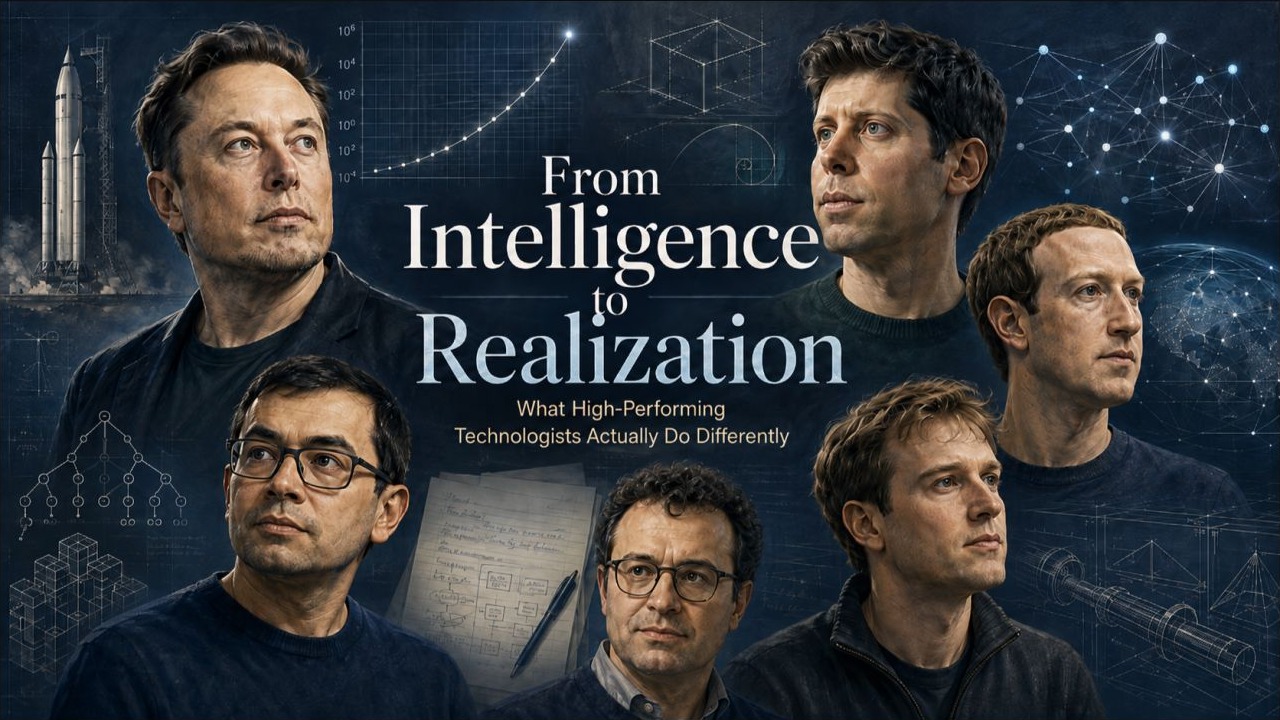
On the habits of the technologically elite in the 21st Century, and what the productivity genre keeps getting wrong about them.
The genre is older than it looks. Before there were morning routines there were the Lives: Plutarch pairing his Greeks with his Romans, Vasari cataloguing which painter was difficult and which merely strange, Benjamin Franklin ruling his day into a rigid grid and asking himself, at five in the morning, what good could he do, and at nine in the evening, what good was done. The impulse is ancient and not disreputable. We want to know how a consequential life is assembled from the same twenty-four hours all of us are issued.
The contemporary version has better instrumentation and worse questions. What time does Musk wake? What does Altman eat? How many hours does Zuckerberg sleep, and does Hassabis really work from midnight until four? The answers circulate with the authority of scripture and the epistemic status of gossip, and they sustain an industry devoted to the proposition that if you replicate the breakfast you will inherit the biography.
The error is not that habits are unimportant. Habits shape attention, and attention is the whole of the game. The error is one of direction. The productivity genre inventories the visible residue of a performance and mistakes it for the performance's cause. It notices the wardrobe and not the wager; the calendar and not the problem the calendar was cleared for. It is possible, and increasingly common, to keep a beautifully instrumented life — every biomarker logged, every inbox at zero, every morning optimized — and never once engage a question of consequence. A life can be perfectly scheduled and strategically trivial.
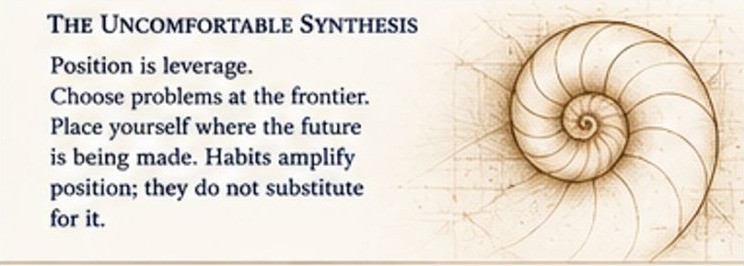
So the interesting question is not how these people organize their mornings. It is how they organize reality inside their heads, and then how they set about reorganizing the reality outside them.
The seven figures usually named in this conversation — Musk, Altman, Zuckerberg, Hassabis, Jenson, Amodei, Aschenbrenner — are not a school. Their temperaments diverge, their politics diverge, their institutions are in several cases openly at war with one another, and their public personas range from the ostentatious to the nearly monastic. But underneath the divergence there is a pattern with real structure to it, and the structure has less to do with sleep hygiene than with six or seven habits of mind that are, in principle, portable.
Begin with the one that is hardest to acquire and most easily stated: they reason in slopes rather than snapshots.
Most people, and nearly all institutions, reason in levels. How capable is the current model? What does a launch cost this year? How many researchers use the platform now? The level is the natural unit of ordinary perception, and it is almost always the wrong one, because technological transformation is rarely a matter of where a quantity stands. It is a matter of how fast it is moving and what compounds when it moves.
Amodei's public arguments run along scaling curves; the interesting claim is never about the present system but about the trend the present system happens to sit on. Aschenbrenner, who finished Columbia at nineteen and later wrote a long, immodest, and widely read essay on where the compute curves point, is essentially an extrapolationist by temperament: give him a straight line on log paper and he will follow it into the middle of the next decade and describe the furniture. Musk has spent two decades framing entire industries by their declining cost curves — dollars per kilogram to orbit, dollars per kilowatt-hour, units per week off a line — and asking why the inherited price sits so far above the theoretical one.
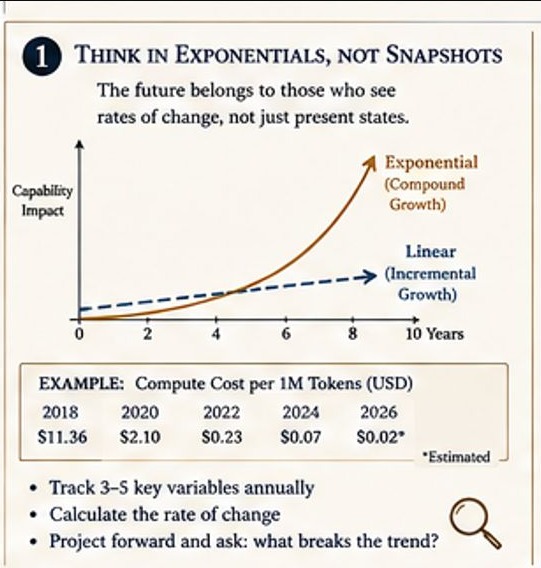
This is why exponentials keep humiliating intelligent institutions. Human intuition is built for linearity, and institutions are built for continuity. Budgets, staffing models, curricula, accreditation cycles, professional identities: all of them assume that next year will resemble this year with modest adjustment, and all of them are correct about that most of the time, which is precisely what makes them defenseless when they are not. An exponential converts a small annual difference into a structural discontinuity, and it does so on a schedule that feels leisurely right up until it doesn't.
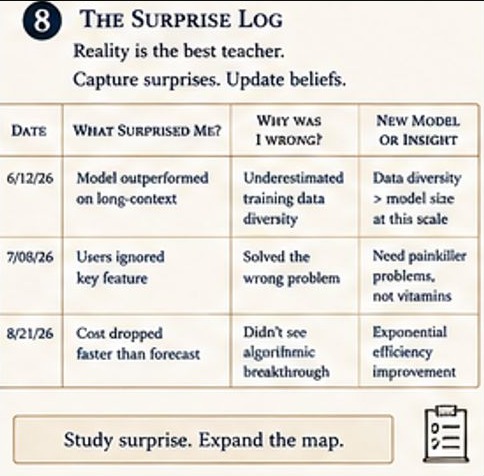
The practical version of the habit is almost embarrassing in its simplicity. Choose three to five variables that actually govern your domain. Write down their values once a year. Compute the rate. Then ask, in writing, what the world looks like if that rate holds for three years, or five, or ten — and, more usefully, what would have to break for it not to. For a university: demographic curve, tuition dependence, funding concentration. For a person: skill acquisition, network quality, accumulated technical capability, health, capital. The list matters less than the discipline of writing the numbers down annually, which almost nobody does, and which is the entire difference between reading the map and watching the terrain move.
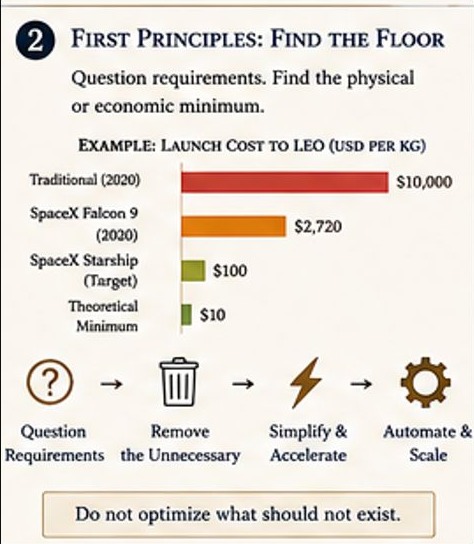
The second habit is the one Musk has made nearly synonymous with his own name, to the point where the phrase has been worn smooth and its radicalism sanded off. First principles does not mean thinking hard. It means refusing to accept an inherited arrangement on the grounds that it was inherited.
The questions are austere. What must actually be true here. What is the physical minimum, the economic floor, the irreducible informational requirement. What is the smallest process capable of producing this outcome. And then the question with teeth: why are we running ten times above that floor.
Mature institutions accumulate sediment; this is not a scandal but a property of institutions, the way rust is a property of iron. Procedures accrete around constraints that have since dissolved. Requirements outlive their rationale by decades. Workflows freeze in the shape of a technology that has been gone since the second Clinton administration. Eventually an organization stops defending the purpose of a process and begins defending the historical fact of it, and the two are nearly impossible to tell apart from the inside.
What makes Musk's operating algorithm useful — question every requirement, delete the part, simplify, accelerate, automate — is not any of its five steps but their order. Automation comes last, and deletion comes near the beginning, because the characteristic failure of competent people is optimizing what should not exist. The administrative translation is direct and mildly threatening. Before improving the report, find out whether anyone reads it. Before automating the approval, ask what would actually go wrong without it. Before digitizing the workflow, consider whether digitization will merely allow the dysfunction to propagate at machine speed, which it will. Subtraction before sophistication. It is a monastic principle in an industry that dresses like a monastery only for the photographs.
The habit generalizes past process into thought itself. Do not confuse complexity with depth. The deepest explanation is usually the one that has survived enough thinking to become simple, and the elaborate one is often just a proposition that has not yet been understood by the person defending it.
The third habit is the one I would defend most vigorously, and it is the least visible: these people use writing as an instrument of thought rather than as a record of it.
In most organizations writing is the terminal stage of cognition. The memo follows the meeting. The summary follows the decision. The article follows the thinking, and functions as its receipt. Amazon's inversion of this — the six-page narrative memo, read in silence at the start of the meeting, no slides permitted — was treated as an eccentricity when it leaked into the culture, and it is in fact a claim about epistemology: that a bulleted list permits a speaker to imply a causal chain he has not got, and that prose does not.
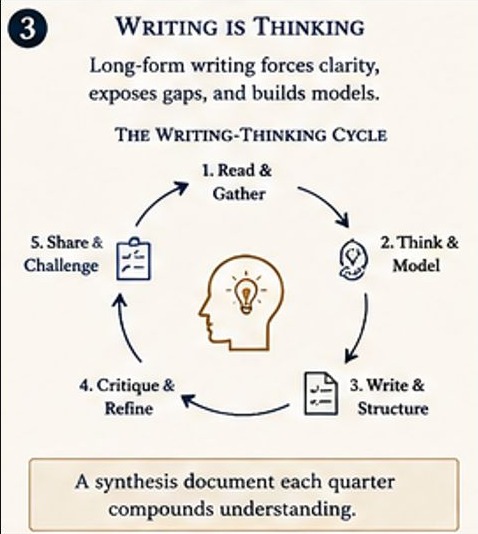
Prose is unforgiving in a specific and useful way. It forces sequence, which exposes missing links. It converts intuition into propositions, which can be inspected. It produces, reliably, the humiliating moment when a sentence that was entirely persuasive in the mind collapses the instant it is written plainly, and it is this moment that constitutes most of the value. Reading expands the field; writing organizes it; only the organized version can be attacked by someone else, which is the only way it improves.
Hence the practice worth more than any reading list: one substantial synthesis every quarter. Not a summary — a synthesis. What changed. What mechanism actually produces the effect. Which of my assumptions no longer holds and when exactly did it stop holding. What evidence cuts against the interpretation I prefer. Where is the binding constraint now, and what would have to be true for the next discontinuity to arrive. If you cannot write the mechanism clearly, you do not yet understand the mechanism, and the essay is how you find that out at low cost rather than in public.
The fourth pattern is a way of learning that inverts the usual sequence, and Hassabis is its cleanest specimen. A chess master in childhood; a game designer at seventeen; then, in his thirties, a doctorate in cognitive neuroscience acquired not out of curiosity in the loose sense but because the problem he intended to attack required a theory of how memory and imagination are built, and no one was going to hand him one. Amodei arrives at neural networks by way of physics and computational neurobiology. Musk has crossed software, payments, aerospace, automotive manufacturing, energy storage.
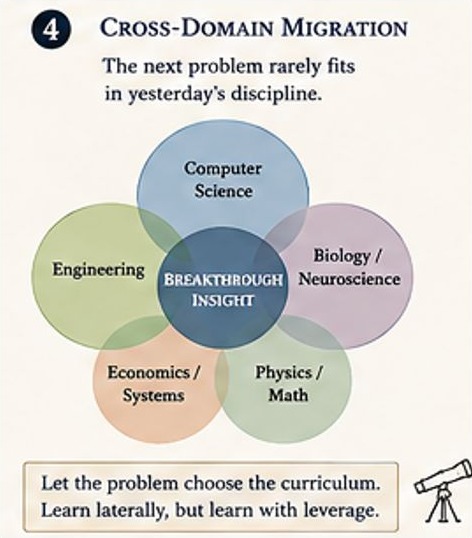
The point is not eclecticism, which is cheap, but directed interdisciplinarity, which is not. The movement across boundaries occurs because a single domain stopped being sufficient for a specific problem. Conventional education runs from discipline to application: you acquire a field, then look for somewhere to put it. High-agency learning runs the other way. The problem appears first and the curriculum is assembled afterward, which makes expertise architectural rather than archival. You are not trying to know a great deal. You are trying to acquire the particular instruments that will let you through the next wall.
This changes the question people ask about their own development. Not what course should I take, but what single capability would unlock several problems I currently cannot touch. Statistics, perhaps. Organizational finance. Enough machine learning to read the literature without flattery or panic. Enough of a field to hold a real conversation with its practitioners. Breadth without a governing problem is intellectual tourism, pleasant and forgettable. Breadth organized around a consequential problem becomes synthesis, which is rare enough to constitute an advantage on its own.
And there is a threshold past which books, indispensable as they are, become too slow. Musk's aerospace education is usually described as autodidactic, and the textbooks were real, but the accelerant was the sustained interrogation of engineers who already knew which failures were survivable. What such people supply is not information — information is free and abundant and mostly noise — but compressed judgment. Which assumption is naive. Which paper matters and which is decoration. Which metric misleads. Which obvious solution was tried and failed for reasons that never made it into print. One hour of that can reorder six months of unguided reading.
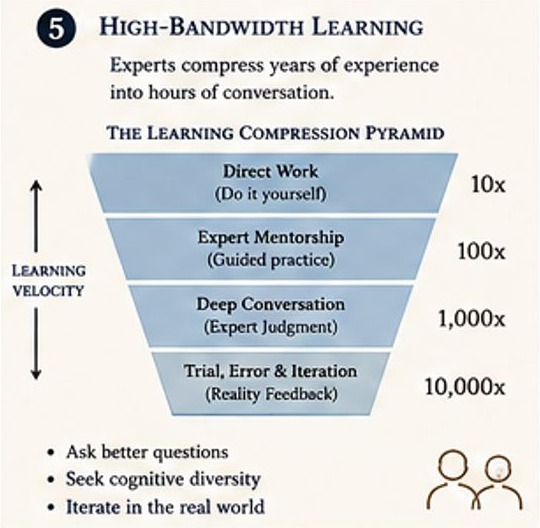
The corollary is uncomfortable. Passive reading protects the ego; problems, experiments, and experts do not. Elite learning has a confrontational structure — read, formulate, attempt, fail, revise, return with a better question — because it repeatedly places the internal model in a position where reality is permitted to object. Most professional learning is designed, quite deliberately, to avoid that.
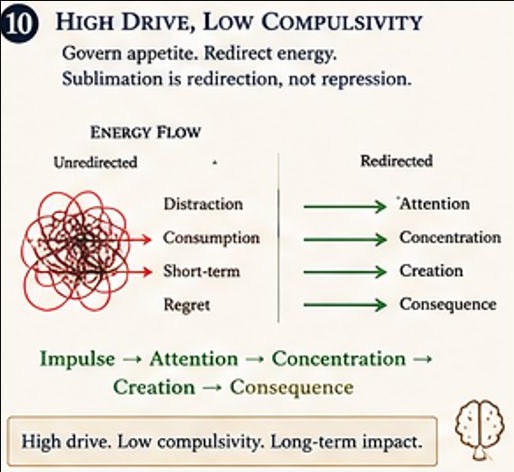
The fifth habit is the one the routine literature actually gets right, though usually for the wrong reason. Zuckerberg's identical grey shirts are the famous caricature; Altman's single sheet of paper, torn out and rewritten, is the more serious instance. Neither is asceticism. Both are decision-surface reduction.
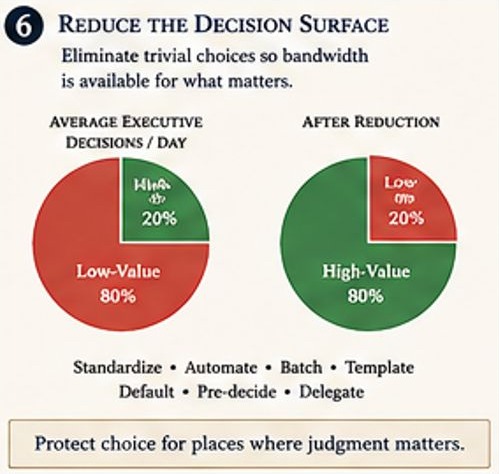
Every recurring choice draws on the same account. What to wear, which tool, whether to attend, where the file went, what to do next, who owns this. Individually trivial; collectively they constitute a friction that fragments attention past the point where sustained thought is possible. Whitehead's line — that civilization advances by extending the number of important operations we can perform without thinking about them — was written about mathematical notation, but it describes a personal architecture just as well. Standardize the commodity decisions so that premium cognition is available for the ones that deserve it.
This matters most in exactly the roles where it is hardest, because executive work generates unbounded reactive demand. An organization will colonize every unprotected minute, and it will do so with entirely legitimate requests, which is what makes the process so difficult to resist. The result is the characteristic paradox of senior life: the person nominally responsible for long-range direction spends the day answering short-range questions, each of them reasonable, in aggregate a career.
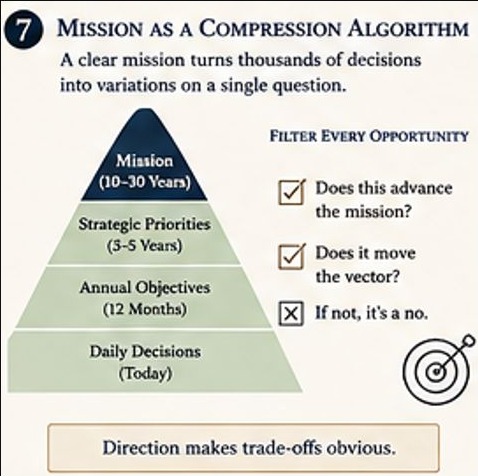
Which is where the much-mocked mission statement recovers its dignity. One need not share anyone's mission — Mars, general intelligence, connection, the structure of proteins — to see what it does computationally. A sufficiently strong long-horizon commitment is a compression algorithm for decision-making. Without one, every opportunity must be evaluated on its own terms, at full cost. With one, most requests resolve instantly into obvious refusals, and the deliberative budget is preserved for the small number of choices that actually bend the trajectory. A person without direction can optimize every day and still drift. A person with direction can afford a bad week.
All of which converges on the word that ought to make an educated reader wince, and should.
Realization, in the productivity register, means making the abstract concrete: giving thought a form outside the self. The word is older and better than the register that borrowed it. Aristotle's entelecheia names the condition of a potential that has completed itself in actuality — the acorn is not a tree in miniature but a tree in potential, and the distance between the two is the whole of the interesting question. Hegel's Verwirklichung carries the same freight into history: an idea is not fully an idea until it has been made actual, until it exists in the world where it can be resisted. Both traditions insist on the same austere point. Potential is not a lesser form of achievement. It is a different category altogether, and it converts into the other only by work.
There is a shadow on this, and the lives under discussion cast it plainly. The artifact that carries a thought into the world is the same artifact that, at sufficient scale, becomes an institution with its own momentum, indifferent to the intention that produced it. Every person named here has built something that now exceeds their control, and most of them will say so on the record
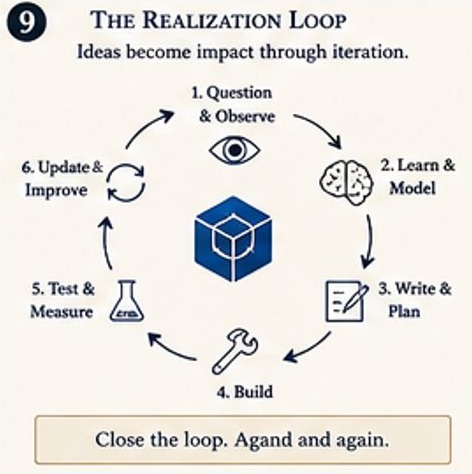
Set the irony aside for a moment and the affirmative sense still holds. An idea that remains unexpressed changes nothing. A model that never meets data remains elegant speculation. A well-read mind that produces no artifact is an archive rather than an agent, and the distinction between the two is the distinction between intelligence and consequence. The loop is unremarkable when written out — question, learn, model, write, build, test, observe, update — and every transition in it is a place where careers quietly stall. Reading without modeling yields information. Modeling without writing permits ambiguity to survive indefinitely. Writing without building risks a very high grade of abstraction. Building without testing produces artifacts insulated from consequence, which is the most expensive failure mode available. Testing without updating converts failure into ritual.
What distinguishes the people in question is not that they run the loop better. It is that they run it more often, and close it. Capability compounds only when the loop closes.
Operationally this asks for less than the genre implies. Two or three protected hours before the reactive day begins — no inbox, no notifications, no ambient grazing — spent exclusively on work that leaves evidence behind. Hassabis's celebrated midnight-to-four is a version of this and not a prescription; the principle is a block no one can reach into, and the hour is a detail of biography. Then a distinction, maintained honestly, between work that makes future work cheaper or more valuable — writing, building, learning, system design, durable relationships, reusable tools — and work that vanishes the moment it is finished. Both are necessary. Confusing them is how a person arrives at Friday exhausted and empty-handed, having spent the week's entire capacity on things that left no trace.
The weekly audit is a single question, and it is not how did the week feel. It is: what exists now that did not exist on Monday.
An honest essay has to end on the qualification, and here it is. The habits described above are downstream of something the habits cannot manufacture. Every person named here was positioned early inside a compounding technical field with direct access to the people moving it, which is a fact about timing, temperament, and considerable luck, and which no amount of protected morning does anything to reproduce. Copy the routine without the position and you will mostly purchase tidiness. The genre sells the schedule because the schedule is the only part that is actually for sale.
But the qualification cuts both ways, and this is the part the cynics miss. Position is not permanent and it is not distributed once. It arrives, when it arrives, as a window — a technology that suddenly becomes usable, an institution that suddenly needs someone who understands both halves of a problem, a curve that has been climbing quietly for four years and is now impossible to ignore. Whether that window is legible to you at all depends on whether you have been tracking slopes rather than levels. Whether you can act on it depends on whether you have any uncommitted hours and any capability you acquired for a reason. Whether anyone else can be persuaded depends on whether you can write the mechanism down clearly.
None of that guarantees consequence. It only ensures that if the opportunity for consequence appears, you will not be the last to notice, and you will not be too busy to answer. That is a smaller promise than the morning-routine industry makes. It has the advantage of being true.
#DeepWork #FirstPrinciples #Leadership #AI #ArtificialIntelligence #Strategy #ExponentialThinking #Productivity #Innovation #ResearchLibraries #HigherEd #KnowledgeWork #Writing #Learning #Attention #FutureOfWork #TechnologyStrategy #Philosophy #Aristotle #SiliconValley