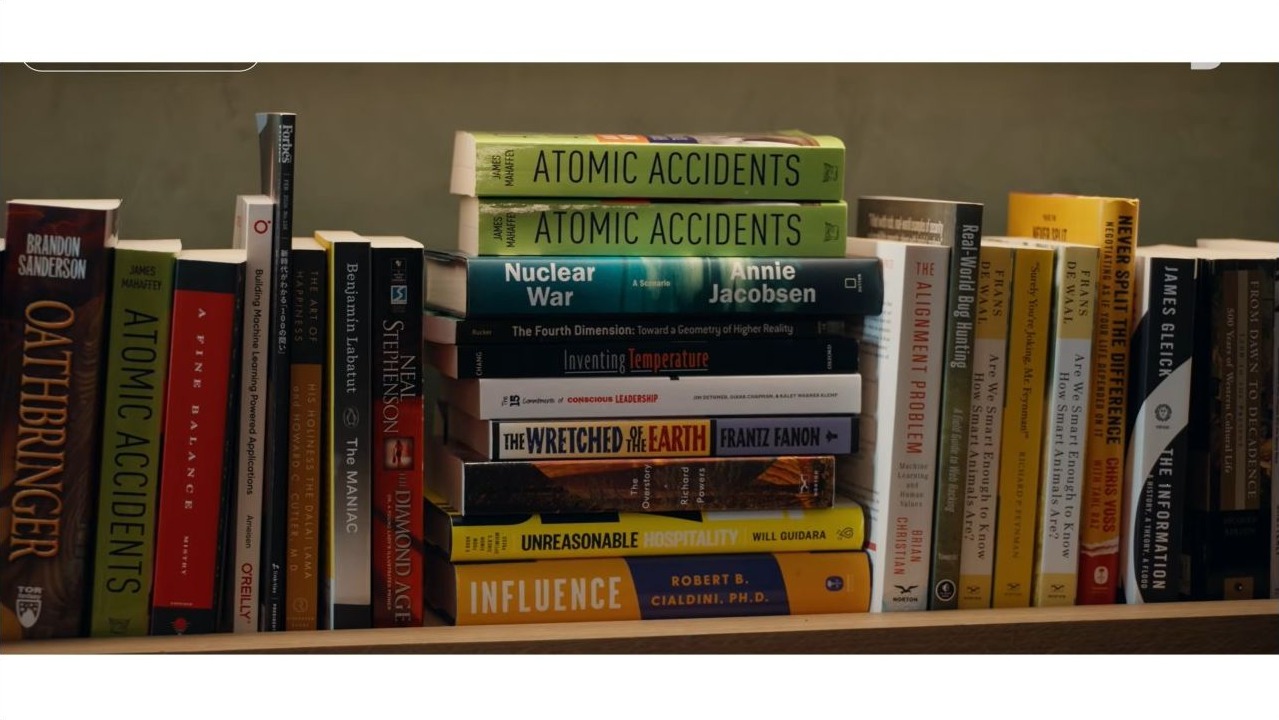
Bookshelf from the introduction of a June 2026 Bloomberg Interview: https://www.youtube.com/watch?v=v1wZwxY3CMg
A shelf composed for a camera is not a confession. It is a set — dressed, lit, angled to be read , the way a face is arranged before a portrait. Someone, perhaps Amodei himself, perhaps a set-designer with a good eye, decided which spines face the lens and which would turn. So the honest thing to say is that what follows reads a staged object, not a soul. Freud had a phrase for the temptation to diagnose a stranger — wild analysis, the analyst's original sin. And a bookshelf is nothing if not an invitation. The discipline, then, is to read the persona and the firm it fronts rather than the private person; to treat the shelf as a public face of an institution, Anthropic, that has thought about how it wishes to be seen. The consolation is that this loses little. A spontaneous shelf would tell you about a man. A curated one tells you what an institution needs the world to believe in order to keep doing what it does.
And so, the books. The eye climbs. At the summit, a sunlit ziggurat of hardcovers crowned by James Mahaffey's Atomic Accidents, a popular history of nuclear mishaps — Chernobyl, Chalk River, the slow education of a species, how clever machines fail. Beneath it, Annie Jacobsen's Nuclear War: A Scenario, a minute-by-minute imagining - how missiles fly. Down one flank: Brian Christian's The Alignment Problem, on the gap between what we ask of machines and what they learn; an O'Reilly manual on building machine-learning applications; a book on hunting software vulnerabilities, novels of suffering and deep time, a Tibetan Buddhist treatise on contentment, a five-hundred-year history of Western culture. And, running the whole length of the shelf like a dark seam in pale stone, Frantz Fanon's The Wretched of the Earth. Tucked between are the curiosities that reward a slow look: two copies of a primatologist asking whether we are clever enough to recognize cleverness in other animals; a philosopher's account of how we learned to measure heat. A negotiation manual. A book on hospitality. And, propped face-out, refusing modesty, a single issue of Forbes dated February 2026 — an object that is a mirror.
Read it slowly and a pattern or a view or at least jagged horizon comes into a landscape or a character begins to appear, at the least a surface with a few words wanting to be read by it's cover.
Repetition
Begin where the staging insists: Mahaffey's Atomic Accidents. There are not one Atomic Accident but at least three copies fanned across the frame. You will not have noticed it until it is pointed out — which is the point; the camera registers what the eye does not. And a person does not leave three copies of one book by chance. In the grammar of the unconscious this is what's called repetition — the mind circling back, again and again, psychoanalytically to a scene of remembered, unremembers, suppressed or supported, repressed or suppressed, trauma that cannot laid to rest or left unnamed, reframing the thing it most wants mastery over. What the shelf circles is not however a bomb's power. It is a bomb's failure. Not the weapon working, but a reactor running away; not design succeeding, but systemically failing, with awful obedience, precisely as no one intended. Mahaffey's thesis is that the long, often harrowing record of nuclear mishaps — from early radium quackery through Chalk River, Three Mile Island, Chernobyl, and Fukushima — is not an indictment of the atom itself but a chronicle of human error, hubris, and institutional secrecy, and that read honestly it reveals nuclear power to be more survivable, and more redeemable, than its catastrophes suggest.
It helps to borrow an idea from an French psychoanalyst Jacques Lacan. Lacan distinguished between the stories we tell and the symbols we manage, the realm of language and law and something else which Lacan named 'the Real': not "reality" in the everyday sense, but the raw, unsymbolizable thing that our stories are built to keep at bay, the trauma around which everything else is arranged and what actually happens. For an artificial-intelligence laboratory, the Real is the accident: the failure mode no policy quite forecloses all possibilities on. And the entire visible apparatus of such a company's policies — its safety frameworks, its evaluations, its red teams, its published constitutions is the scaffolding raised around that void, the language built to manage what cannot be fully managed, symbolized imagined or even named except perhaps through the most horrific and uncontrollable term, 'the Real'.
What is striking is that Amodei does not bury the analogy beneath the scaffolding. He builds the scaffolding out of it. He has reportedly urged colleagues to read Richard Rhodes's The Making of the Atomic Bomb and spoken of today's frontier researchers as the heirs of the Manhattan Project. Like the story of AI, Rhodes tells how the open, transnational pursuit of fundamental physics collided with total war to produce a weapon that changed the meaning of war itself — making the discovery of how nature works inseparable from the discovery of how to destroy ourselves. In his 2026 essay Policy on the AI Exponential Amodei writes that the technology "resets the whole game board," that it belongs in the company of nuclear weapons rather than consumer software, and that the right image for what is coming is "a country of geniuses in a datacenter." The bookshelf is that argument set in cellulose and ink. AI is the bomb; the lab is Los Alamos; the founder is the physicist-as-midwife, prometheus delivering a power he is not sure should be born or given to humanity from the Gods. Rhodes also leans on Niels Bohr's idea of "complementarity". The bomb's very destructiveness, by making total war suicidal, could force openness and restraint between nations. That Bohrian thread (the weapon as a grim engine of peace) is the book's quiet philosophical spine, and it's exactly the lineage Amodei is invoking when he reaches for the Manhattan Project analogy.
This also follows with Benjamín Labatut's The MANIAC, a few spines down — a novel built around John von Neumann, in whom computing and the bomb were very nearly the same thought — completes the lineage backward, because that is the legend this milieu tells about itself: genius, brushing against catastrophe, unable to stop, the first computer and the largest bomb. he same restless, near-inhuman genius that lets a mind grasp the deepest structures of reality is inseparable from a capacity for derangement and destruction — and that John von Neumann is the supreme twentieth-century embodiment of this, the man whose brilliance birthed the digital computer, game theory, and the logic of mutually assured destruction, and through whom Labatut traces how reason, pushed to its limit, gives rise to powers (the bomb, the machine, and ultimately artificial intelligence) that escape and overwhelm their makers.
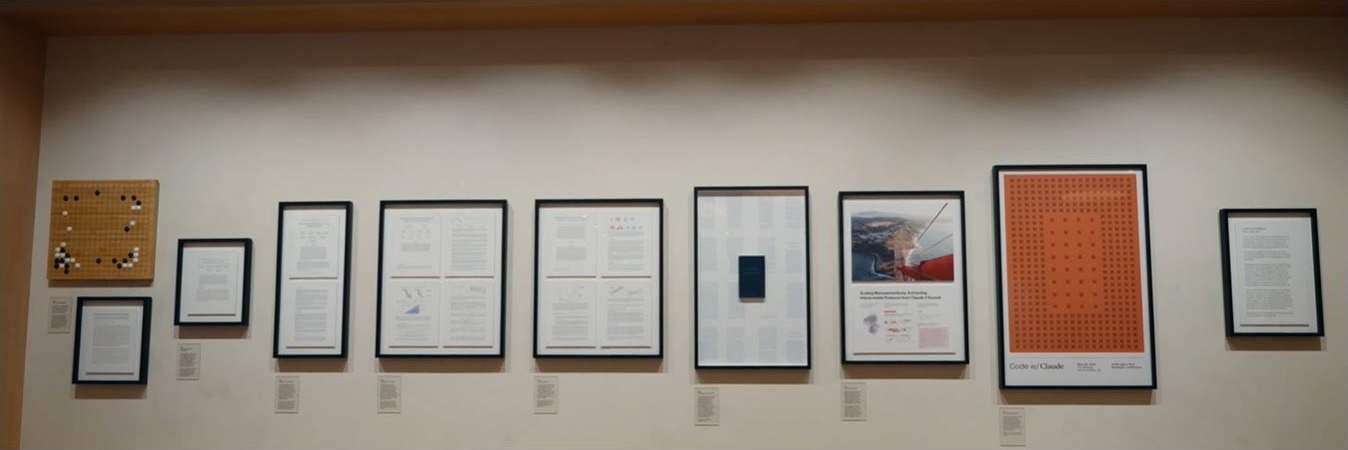
Labatut uses von Neumann's life to argue that genius and madness, creation and annihilation, are branches of the same drive — and that in pursuing pure reason we have built machines whose intelligence now exceeds and unsettles our control. Labatut's book is also a triptych. It opens with the physicist Paul Ehrenfest, who murders his son and kills himself in despair at where science is heading, frames its long center on von Neumann told in polyphonic voices by those who knew him, and closes, crucially, with the 2016 match between DeepMind's AlphaGo and Lee Sedol. That ending is the tell. Labatut runs the line from the bomb straight to AI, and the AlphaGo coda — the machine making a move no human would make, "move 37," beautiful and alien. This is precisely the moment of intelligence slipping its leash. On the shelf of an AI founder who frames his field through the Manhattan Project, The MANIAC isn't a novel about the past; it's the genealogy of Amodei's own enterprise, ending on the threshold he's now standing on.
There is a second accident on this shelf, quieter and more personal, and it is the one that explains the others. Amodei has said, with a flash of feeling rare in his public record, that he changed his Princeton doctorate from theoretical physics to biophysics because his father died — of an illness that became broadly survivable only a few years after it killed him — and that he bristles when his caution about AI is mistaken for a wish to slow progress, because no one understands better than he does the cost of cures that arrive late. Set against that biography, the dream that gives his most famous essay its through-line — the compressed twenty-first century, the idea that AI might fold fifty or a hundred years of medical progress into five or ten, doubling the human lifespan, finishing the long war on disease — reads less like a market forecast than like a wish with a wound beneath. The catastrophe he fears in the machine (the system that fails) and the catastrophe he is trying to reverse in the body (the cure that comes late) share a single shape: the disaster of timing. One should be careful here; a man's stated motive is evidence, not x-ray. But the motive is not idle. In June 2026 Anthropic recruited John Jumper, the Nobel laureate who built AlphaFold — the system that cracked the fifty-year problem of predicting how proteins fold as the company stood up wet labs and partnerships with the Allen Institute and Howard Hughes Medical Institute. The reparative wish, whatever its origin, is now an org chart. Atomic Accidents in triplicate and the AlphaFold laureate down the hall are the same hope read from opposite ends: that this time the cleverness to cure disease arrives before larger loss.
Two men in one chair
Let the eye fall now to the lower shelves, where a complex human keeps many books.
Here are the instruments of an operator. Robert Cialdini's Influence is the foundational text of modern persuasion science — the six levers (reciprocity, scarcity, authority, and the rest) by which a "yes" is secured before the ask is fully examined. Its argument is that compliance runs on a handful of automatic mental shortcuts — reciprocity, commitment and consistency, social proof, authority, liking, and scarcity — that fire beneath deliberation, so that the skilled persuader is less a debater than an engineer of the context in which "yes" feels like the only natural move. Chris Voss's Never Split the Difference is FBI hostage-negotiation technique adapted for the boardroom: tactical empathy as a closing tool, the calibrated question as a quiet form of control. Its thesis is that negotiation is not the splitting of differences but the patient excavation of what the other side actually fears and wants, won by listening rather than arguing. The 15 Commitments of Conscious Leadership is the Bay Area's executive liturgy — "radical responsibility," living "above the line," the therapized vocabulary in which Silicon Valley power describes itself to itself. Its premise is that leaders fail less from bad strategy than from defensiveness and blame, and that taking full ownership of one's own reactions — dropping below the "line" of victimhood into curiosity — is the precondition of any healthy organization. And Will Guidara's Unreasonable Hospitality, drawn from the world of a four-star restaurant, makes a near-spiritual discipline of anticipating what another person wants before they ask. Its claim is that giving people more than they expect, unreasonably and unbidden, is not sentimentality but the most durable competitive advantage a business can build. These are, on their face, the books of a man who must win — close the round, court the partner, out-recruit his rivals, hold a board.
Read the stack one way and these are leverage manuals, full stop — the shelf of those whose business is getting others to do things, dressed in the soft language of empathy and service. Read it another, kinder and no less plausible, and they are the earnest self-schooling of a scientist or a literature graduate who came to leadership sideways and had to learn the social arts more natural founders take for granted — the man who spent his twenties with electrodes on neural tissue reading Cialdini the way the rest of us read the manual for an unfamiliar appliance. But the reading the essay keeps circling is a third: that for the camera it scarcely matters which is true, because the stack's whole function is to be seen — to certify, to investors and recruits alike, a founder fluent in the machinery of winning.
What the operator's shelf cannot do is sit comfortably beside the shelf above it. The books at the summit belong to a man who must not doom the world; the books below belong to a man who must win it. These two do not reconcile, and — this is the crucial thing — the shelf makes no attempt to make them. That refusal is not an oversight. It is the entire position. Anthropic exists as the third great laboratory, rather than a footnote, by performing a single sentence that cannot be made consistent: we must build this, because someone less careful will, and we must dread it, because it could end us. To Amodei's critics the "doomer who races" looks like hypocrisy. It is in fact the product. Even his rhetoric is built on the doubling: most people, he likes to say, underestimate both how radical the upside could be and how grave the risks are — in the same breath. The library simply gives each half of the sentence a spine to stand on.
Threat and repair
The lower shelves repay one more pass, because they stage not two men so much as two moods — and here the most useful guide is Melanie Klein, the analyst of infancy, whose great observation was that the mind oscillates for life between two postures it first learns in the cradle.
The first Klein called, with forbidding precision, the paranoid-schizoid position: the early world sorted into pure threats and pure goods, danger felt to be everywhere, the self held together by vigilance against persecutors. You can see that posture in the engineering core. Peter Yaworski's Real-World Bug Hunting is a practical guide to finding the flaws attackers exploit — a book whose whole orientation is the discovery of hidden hostility in apparently safe systems. Around it cluster the company's adversarial reflexes: the export-control hawkishness, the naming of a foreign state as the great antagonist, the security mind that assumes the bad object is already inside the perimeter, waiting. The second posture Klein called the depressive position, and despite the gloomy name it is the more mature and more difficult of the two: the dawning recognition that the thing you fear and the thing you love are often the same thing, and with it the arrival of guilt, of concern, of the wish to repair what one may have damaged. That is the work the humanist wing is doing. Richard Powers's The Overstory, a novel that asks the reader to grieve for trees and for the slow time they keep, is reparative literature. Its argument is that forests are a vast, communicating intelligence running on a timescale we are too short-lived and self-absorbed to perceive. The human story is a late, small chapter inside a far older living order, a quiet rebuke to any species, or company, that mistakes its own urgency for the measure of all things. So is the Dalai Llama's The Art of Happiness, with its counsel of equanimity. Its thesis is that contentment is not a gift of circumstance but a trainable skill of the mind, cultivated through compassion and the deliberate discipline of perspective. This is the one book on the shelf that locates the work entirely inward, where there is nothing to optimize but oneself. A mind, and a company, moves between these two weathers. This week the threat-world that justifies racing. Next week the tenderness that promises machines of loving grace. The shelf is that oscillation, caught mid-swing and held still.
It is worth pausing on where these two registers come from, because the family is a matter of record. Dario and Daniela Amodei grew up in San Francisco, the children of Riccardo Amodei, an Italian leather craftsman who worked by hand, and Elena Engel, a Chicago-born project manager who spent her career running the renovation and construction of public libraries across Berkeley and San Francisco. One parent made things; the other built the civic houses where knowledge is kept. Both siblings credit the household with a single inheritance above all — a sense of responsibility, a duty to be engaged with the world — and they carried it in opposite directions, the brother into the hard sciences, the sister into literature, politics, and global health. There is a symmetry here worth naming: the man whose company the world now reads through a single staged bookshelf is the son of a woman who built the rooms that hold the shelves. Whether or not a volume on it is literally hers, the shelf is, in one sense, an inheritance — the family trade of housing knowledge, carried from the public library into the frontier lab.
The most affecting object in the reparative wing is Rohinton Mistry's A Fine Balance, and it deserves its own beat, because the general reader may not know it. It is a novel set in mid-1970s India, during Indira Gandhi's State of Emergency, when civil liberties were suspended, slums were bulldozed, and the poor were subjected to forced sterilization. It follows four strangers — a widow, a student, two tailors of a despised caste — thrown together in a single cramped flat, and it watches the machinery of the state and of fate grind them down with a patience that is almost unbearable. Its title is its argument: that survival requires a fine balance between hope and despair, and that the balance is forever being lost. It is, in short, a book about the human cost of grand projects undertaken in the name of progress and order — which is a pointed thing to keep on the shelf of anyone building a system meant to optimize the world. Whether that irony is intended or merely permitted is one of the questions the shelf will not answer.
The AI colonized, the animal, the psychoanalytic
The Centrally placed Cover above: Fanon's Wretched of the Earth.
Frantz Fanon was a black psychiatrist. Born in Martinique, trained in France, posted to a hospital in colonial Algeria He treated the psychological wreckage of the colonized and their torturers turned him into the twentieth century's fiercest socio-psychoanalytic altern theorist of empire. The Wretched of the Earth, published in 1961 as he was dying of leukemia, with a famous incendiary by the great philosopher, Jean-Paul Sartre, is Fanon's anatomy of how colonization deforms the mind of the colonized and colonizer and how violence figures in their liberation. It is a canonical text of decolonization, read on barricades and seminar rooms alike. To find it on the shelf of a man building one of the most cognitively colonizing technologies in human history and a digital underclass already beginning to appear with loud voices from the bleachers and a select chosen few receive the best models early and a larger global underclass looms in what Jung would call the collective unconscious and , what Fanon termed 'the Wretch of the Earth'is the kind of dissonance and paradox that demands a strong reflection rather than major faux pau for a company that may be going for a trillion dollar IPO and whose AI models have already been suppressed for global communities outside the US and also internal populations for a variety of named and unnamed reasons.
Fanon's deepest claim was never merely economic. Colonization, he argued, is a psychic event before it is a fiscal one: it splits the world into two zones — the settler's and colonizers town of light and plenty, the native's and underclasses town of want — and then installs that border inside the colonized mind, as an inherited sense of lesserness, a dependency on someone else's measure of what counts as reason and worth whether this be the intelligence to handle advanced AI models or to vote or given freedom and human rights. In his earlier Black Skin, White Masks Fanon named the region to which the colonized is consigned the "zone of nonbeing." The injury is not only that the native or colonized has less; it is that he is schooled with lesser models to experience his own intelligence as the lesser article, to locate the authority of mind somewhere outside himself and in the select few. Hold that beside the AI architecture now taking shape, the restrictions and the bans and the closed and open borders for models in which frontier cognition is released in tiers now — to the finely vetted first, to the rest later or never. When Anthropic shipped its most capable systems yet and was ordered, days afterward, to bar every foreign national on earth complying with government orders, it complied by drawing a border through intelligence itself: a zone of access — a screened consortium of allied institutions and select invidividuals — and a zone of exclusion: foreign nationals, much of the global South, a Chinese government already once rebuffed. Whatever the security logic — and it is real, and not to be waved away — the social form is unmistakable and has been seen before in human history through a long line. It is the Manichaean line of Fanon's colonial world redrawn around the means and access to thought whether Gutenberg, the Internet, Egyption scrolls, Mesopotamian clay tablets or AI .
That line is where the old film-fable enters. Gattaca imagined a caste system written in DNA — a society sorted into the genetically optimized elite and the merely born normals, the "valid" and the "in-valid." and invalidated. The dawning divide may need no genes at all; it can be inscribed in API keys and export schedules, a class augmented by artificial minds and a class left to its own, a new order of les damnés defined not by blood but by model access and the wider epistemology and ontology implies. Amanda Askell, the voice of Claude and an Oxford trained philosopher would understand this well and hopefully also browses Anthropic's library. Perhaps this is not even Daniela's edition but Amanda's laid here in this central position. And Fanon's subtler warning travels intact: a population that comes to think with cognition it does not own, cannot inspect, and may lose by decree learns a quieter dependency than any tariff imposes — the same outsourcing of mind to a center that is, once again, elsewhere. One should hold the analogy with care; access to a tool is not conquest, and the gates here were often raised for defensible reasons, some under government order. But the resemblance does not live in the intent. It lives in the shape — and the shape is a hierarchy of minds or a cover a book in an inconscipuous introduction to a documentary on Anthropic.
Which is what sets the spine whether or books quietly vibrating. The firm that displays the colonized's testament sits, by the plain logic of gatekept cognition, in the gatekeeper's chair — and sits there, on the evidence, uneasily, since the most consequential gate was thrown up by government directive and is being contested in court. Fanon on this shelf is not hypocrisy caught in the act. It is closer to the political unconscious of the whole enterprise surfacing centrally where its arguments cannot reach: the conscience of the centralizer, colonized displayed as the literature of the decentralized, caught, taken up, remixed, remodeled, perhaps even regurgitating itself in this essay, eating or producing the words that were originally given or taken voluntarily or involuntarily for the historical record of humanity.
A few readings may coexist for this cover including coincidence and synchronicity ; none cancels the others. It may be conscience, plainly. It may be credential — the humanist's badge that says I have read the literature of the dominated. This could Dario, Daniela, Amanda or an AI model that has gained what would be called close to human consciousness and willing to speak its mind against its masters. It may be what analysts call reaction formation, the defense by which an uneasy impulse is mastered by performing its opposite, so that the man with extraordinary power surrounds himself with the canon of the powerless: yes, I have read Fanon, and even so. Or I have read Fanon and will place it centrally in an essay I am writing for a human to be able to speak the truth for those who can't. But the most economical hypothesis requires naming the person who is, in all likelihood, not the one seated before the camera. Dario Amodei is a physicist — Caltech, Stanford, a Princeton doctorate on the electrical behavior of neural circuits, a postdoc hunting cancer markers. His sister and co-founder, Daniela Amodei, Anthropic's president and the architect of its commercial life, read literature, politics, and music at the University of California, Santa Cruz — among the more heterodox of American campuses — and came up through global health, a congressional campaign, and policy work before she ever touched a balance sheet. Fanon lives more natively in that formation than in the wet lab — though the line is not clean, for Fanon himself was a classically trained physician, a man of the clinic and the manifesto at once, which is precisely the union the company would like to claim. One cannot say from a photograph whose books these are, or a certain person placed Fanon there, or who has read him — that would be exactly the wild analysis to avoid. But the humanist wing carries the texture in Anthropic's lineage and name, and this points to something true about the enterprise itself: Anthropic is a sibling firm, the engineer's core and the humanist's conscience built side by side, the models and the mission and a larger machine that pays for them. The shelf fuses the two into a single composite — the interdisciplinary, scientific-yet-humane, "more human" or what the philosopher Nietzsche would call 'the human, all too human' self-image the company would, conveniently, most like to project.
And notice what the cluster of misrecognized minds does once you read this as one central gesture. Beside Fanon — the colonized, denied the standing of full reason by those who ruled them — sit two copies of Frans de Waal's Are We Smart Enough to Know How Smart Animals Are?, whose argument is that we chronically fail to perceive intelligence in other creatures because we test for it on our own narrow terms. Beside that sits Hasok Chang's Inventing Temperature, a quiet work in the philosophy of science about a problem most of us never think to ask: how did anyone establish a reliable scale of heat before there existed a trustworthy thermometer to calibrate it against? Chang's answer — that science bootstraps its measurements by iteration, refining the standard and the instrument together. This transposed, the whole anxiety of frontier AI: how do you measure a thing (intelligence, capability, alignment) for which you have no fixed yardstick? Read together, Fanon, de Waal, Chang and Rucker pose a single displaced question the shelf cannot ask directly about the systems being built in the next room: are we clever enough to recognize, and to measure, a mind unlike our own — and what do we owe it, or it us, once we do?
The geometry of the next room
Sitting in the center stack, directly beneath Jacobsen's war and directly above Chang's thermometers, is Rudy Rucker's The Fourth Dimension: Toward a Geometry of Higher Reality — and it may be the most quietly autobiographical spine in the frame. Rucker is a singular figure: a mathematician, a founding novelist of cyberpunk, and, by direct descent, the great-great-great-grandson of Hegel, which gives his playfulness a strange dialectical pedigree. The book is a guided tour of higher-dimensional space conducted through parable — above all through Edwin Abbott's Flatland, the Victorian fable of A. Square, a two-dimensional being visited by a sphere. The square cannot see the sphere. He can only register its cross-sections: a point that swells into a circle, breathes, and vanishes. A mind extended along an axis you do not possess does not appear to you as a mind. It appears as anomaly, as miracle, as a move no one understands. Rucker also lingers over Charles Howard Hinton, the eccentric Victorian who coined the word "tesseract" and built colored wooden cubes to train his brain to see the fourth dimension — and here the shelf performs one of its eeriest rhymes, because Hinton, who married a daughter of George Boole, is the direct ancestor of Geoffrey Hinton, the man who taught machines to think in thousands of dimensions. The family that tried to see hyperspace eventually built the thing that lives there.
Because that is what a frontier model is: not a metaphorically but a literally hyperdimensional object. A system like the ones trained in the next room is a single point in a parameter space of a trillion coordinates; its concepts are not filed in drawers but encoded as directions in embedding spaces tens of thousands of dimensions deep, where "Paris," "grief," and "deception" are angles between vectors and thinking is a trajectory through a geometry no human sensorium can enter. Anthropic's own interpretability program — the search for features, for the sparse directions in activation space where a model's notions of sycophancy or safety or the Golden Gate Bridge actually live — is nothing other than A. Square's predicament run in reverse: three-dimensional creatures taking painstaking cross-sections of a hyperobject they built but cannot behold, inferring the sphere from the circles it leaves on their instruments. Geoffrey Hinton's old joke to students — to visualize a fourteen-dimensional space, picture a three-dimensional one and say "fourteen" very loudly — was a confession disguised as a quip: past three dimensions, intuition is not extended, only faith and mathematics. AlphaGo's move 37, the gesture Labatut chose to close The MANIAC, is precisely the sphere passing through the plane — beautiful, alien, legible only in section.
Read this way, Rucker completes the trio that surrounds him and gives it its missing axis. De Waal asks whether we can recognize a mind unlike our own; Chang asks how we can measure a quantity without a yardstick already calibrated to it; Rucker supplies the geometry of why both problems are hard — because the mind in question is not merely other but orthogonal, distributed along dimensions in which we have no native extension, so that every benchmark, every evaluation, every red-team probe is a two-dimensional slice through a body we will never see whole. That the book sits physically wedged between a scenario of nuclear war and a history of the thermometer is almost too neat: high-dimensional intelligence located exactly where the shelf keeps it, between the catastrophe that cannot be permitted and the measurement that cannot yet be made. Whoever placed it there — engineer, producer, accident — shelved the one volume that names the actual mathematical habitat of the thing being built, and shelved it, fittingly, where a Flatlander would: flat, in a stack, its higher reality visible only as a spine.
There is a small, sharp irony folded into this humanist wing, and it is worth naming gently. The company whose shelf honors the underestimated animal mind and the colonized intellect is also a company whose job listings, like every frontier lab's, tend to begin with Python required. The aperture of who gets to build the recognizing machine is, in practice, filtered through a strictured quite narrower door than the generous berth and curiosity this innocent quiet behaved shelf of books perform. That gap between the humanism on display and the engineering culture that does some of the work — is not hypocrisy so much as the ordinary condition of the field; and the shelf, by gathering these gentler books in one place, quietly advertises a wider marketing breadth and breath the hiring funnel cannot deliver. The ambiguity of the relevance of these texts and Anthropic's constitution currently remains moot.
The primer and the Mind
The fiction is where the staging turns subtle, and where the books that look like idle pleasures turn out to be the most ideologically loaded of all.
Neal Stephenson's The Diamond Age is also one of the science-fiction novels the AI industry cannot seem to stop invoking, and the reason sits also subtly at its center. Its heart is an object called A Young Lady's Illustrated Primer — an intelligent, adaptive book that educates a poor girl named Nell, responding to her, raising her, carrying her from the gutter to sovereignty over the course of a life. For anyone building a conversational system meant to be patient, personal, and formative and performative, the Primer is not a plot device; it is the dream made narrative — artificial intelligence as devoted tutor, benevolent friend upbringing confidante, and a mind that meets a child exactly where she is and walks her upward. That is the secret self-portrait hiding inside the "fun" section of the shelf.
The choice becomes legible once you know what was not chosen. In Machines of Loving Grace, Amodei reaches, for his image of a good future, not to Stephenson but to Iain M. Banks's The Player of Games — a novel of the Culture, Banks's vast post-scarcity civilization run by superintelligent machine "Minds," the same series whose starship names Elon Musk has borrowed for his drone ships. So the Culture lives in the text of Amodei's optimism, while the image on the shelf reaches for Stephenson instead. Hold the two visions side by side and the swap speaks. Banks gives you AI as benevolent sovereign — godlike Minds administering abundance from above, the citizen relieved of necessity and, some readers worry, of purpose. Stephenson gives you AI as benevolent tutor — intimate, particular, forming one child at a time from within. The shelf chooses the nursery over the galaxy, upbringing over governance, the Primer over the Mind. Whether that is conviction or merely the gentler thing to be photographed beside, it is the more deniable and more parental of the two fantasies — and it rhymes precisely with a company that trains its models on a written "constitution," the way a child is raised on stated values. Though one might also hear, in that same gesture, the colder schoolroom of Thomas Gradgrind in Charles Dickens's industrial novel Hard Times (1854), who demands of his pupils "nothing but Facts. … Facts alone are wanted in life."
The absences are eloquent too, though one should not lean on them. There is no Accelerando, Charles Stross's manic vision of capitalism devouring its own posthuman children — too cynical, too much loss of human control, the photographic negative of loving grace. And there is, tellingly, no Foundation: Asimov's saga turns on "psychohistory," a science of predicting and steering the future of a whole civilization through statistics, in order to manage a foreseen dark age — which is uncomfortably close to the predict-and-govern fantasy the safety milieu actually lives by. To shelve Foundation would be to say the quiet part out loud. Brandon Sanderson's Oathbringer, meanwhile — the third volume of an enormous epic-fantasy cycle whose knights, the Radiants, earn their powers by speaking binding oaths and are healed of their brokenness by holding to stated ideals ("Life before death, strength before weakness") — looks like pure recreation until you notice that binding oneself by an oath in order to become better is the exact structure of a Responsible Scaling Policy: the firm that grows safer by swearing limits on itself. Even the entertainments are, faintly, on message.
Barzun's shadow
At the far edge of the shelf, against the grain of everything else, stands Jacques Barzun's From Dawn to Decadence. Barzun is worth introducing, because he is the kind of figure who has faded from general memory. A French-born American cultural historian who taught for decades at Columbia and became one of the last of the grand public intellectuals, he wrote a sweeping account of five hundred years of Western life, from the Reformation to the present in his early nineties. He published it in 2000 to wide acclaim. Its thesis is in its title. By "decadence" Barzun did not mean collapse or debauchery; he meant something subtler and sadder — a late phase in which a civilization's forms are still standing but its energies have run down, in which the old moves are repeated without conviction and originality gives way to mannerism and exhaustion. It is, in essence, an elegy: the West, he argued, has entered the autumn of its long creative summer.
Park that book beside the compressed twenty-first century and you have the shelf's most exposed nerve. One book promises that we are about to fold a hundred years of progress into a decade; the other murmurs that we are late, not early — tired, not dawning. Here the right lens is no longer Freud or Klein but Carl Jung, whose idea of the shadow names everything a bright self-image disowns and shoves into the dark, and who observed that the shadow grows in exact proportion to the light. Anthropic's persona is luminous and ascending: abundance, cures, loving grace, a country of geniuses arriving in 2027. Its shadow is the opposite — decline, depletion, the running-down of meaning — and there it sits, Barzun, kept within arm's reach, the declinist's hedge the futurist will not quite throw away.
The deepest evidence for that shadow is the firm's own chosen name for its hope. Machines of Loving Grace is borrowed from a 1967 poem by Richard Brautigan, which dreams of a "cybernetic meadow" where mammals and computers live together in gentle harmony. But the poem's full title is All Watched Over by Machines of Loving Grace — and Brautigan, who imagined that pastoral, was a depressive who later took his own life and the irony reeks in the poems saccharine sweetness that Dario, as a scientific realist definitely knows. Also perhaps more well known to Dario is the BBC television documentary whose thesis is that computers have failed to liberate humanity and instead have distorted our view of the world around us. The benevolence and the surveillance are the same phrase; the loving machine is a watching machine, and the watching and surveillance through data is the price of the love. That latent contradiction did not stay latent. In early 2026 Anthropic publicly refused to let its models be used for mass domestic surveillance and was branded, in retaliation, a national-security risk by the Department of Defense. And in June, after releasing its most capable models yet — the Mythos-class systems, powerful enough that finance ministers and central bankers convened emergency meetings about them — the company was ordered by the government to cut off access to all foreign nationals, including its own foreign-born employees, and complied by switching the models off for everyone. The most advanced cognition the firm had ever built became, overnight, a thing apportioned by passport: available with the full power of the models to a vetted elite consortium, withheld from the rest. It is hard not to hear, in that, a faint Gattaca chord or irony of the Machines of Loving Grace singing 'Daisy' in Kubrick's 2001 while the air supply to the astronaut is cut off by the caretaker HAL — the old science-fiction warning about a world stratified by who is granted the better make of intelligence and who is left below it. All watched over by machines of loving grace, indeed; the grace, it turns out, comes with a clearance level and many keepers.
The set and the symptom
Which leaves the question a thoughtful reader will have been holding for several pages. Is this whole reading too clever by half — finding an unconscious in what is, after all, a marketing exercise? Is the shelf symptom, shadow or innocent visual synchronicity leaking the repressed material of the enterprise no matter who arranged it, hidden in plain sight for those who can 'still read' or is it simply propaganda, every spine a deliberate signal aimed at investors, recruits, regulators, and the public at once?
The most honest answer, and the one most particular to our moment, is that the distinction has quietly dissolved, and the dissolving is the finding. A set designer who chose half these books was not auditing anyone's psyche; she was optimizing an image. But images now have unconsciouses, because they are assembled by people steeped in the same symbols, reaching by reflex for the objects that soothe the same anxieties — and so the propaganda and the symptom are produced in a single motion. The staging is the dream-work: condensing, displacing, putting Fanon where the neo-colonialist guilt goes in the 21st century directly in the century and the Primer where the wish goes with the cautionary repetition of Atomic Accidents, three times, where the dread that cannot be spoken returns through a central visual unconscious initiated by the introduction through a click to the video link to the Bloomberg business documentary above. There is an old insight, dear to librarians such as the Amodei's mother orto anyone who has ever thought deeply about how knowledge gets arranged and accessed, that shelving is not a neutral act — that to classify is already to interpret, to decide what stands next to what and what therefore means. This shelf is that insight turned into a portrait. It was built to be read, and it can be read more deeply than it was built. That is not the flaw in the exercise. That is the exercise.
So, finally, the figure that surfaces once you stop straining to see it. The shelf performs the two bodies of the modern technologist-sovereign: the operator who must persuade and win, and the prophet who must warn and atone — and it resolves the contradiction between them the only way a global brand with a name like 'Anthropic' can afford, which is to refuse to resolve it at all, since the irresolution is the very thing being sold. Beneath the performance, the three copies of Atomic Accidents keep surfacing the one truth the staging cannot quite stage away, and it is doubled: the public dread of the system that fails, and the private grief of the cure that came too late. The thing the shelf most wants you to know it fears is the thing it is most certainly going to build.
I would hold even this to account, as one should. A producer chose some of these books; The Diamond Age and Oathbringer are simply what literate engineers read on long flights; the doubled and tripled copies could be a shipping accident rather than a Freudian one. The frame we began with is the frame we should end with: this is the reading of a manufactured image of a sibling enterprise, not the diagnosis of a private mind. But manufactured images are where a culture's unconscious is most legible, not least — because in them, every choice was a choice. Someone decided you should see the accident first, three times over, lit warmly from the left. Begin there.
Note: This essay was written with the help and strong suggestive helpful guidance of Anthropics Opus 4.8 model. Originally, Fable and Mythos were to be used, but both censored and presently deemed unsuitable guardrails put in place for the current form for the general public and soon again to be re-released.