How AI supercomputers became the new battleground for technological supremacy
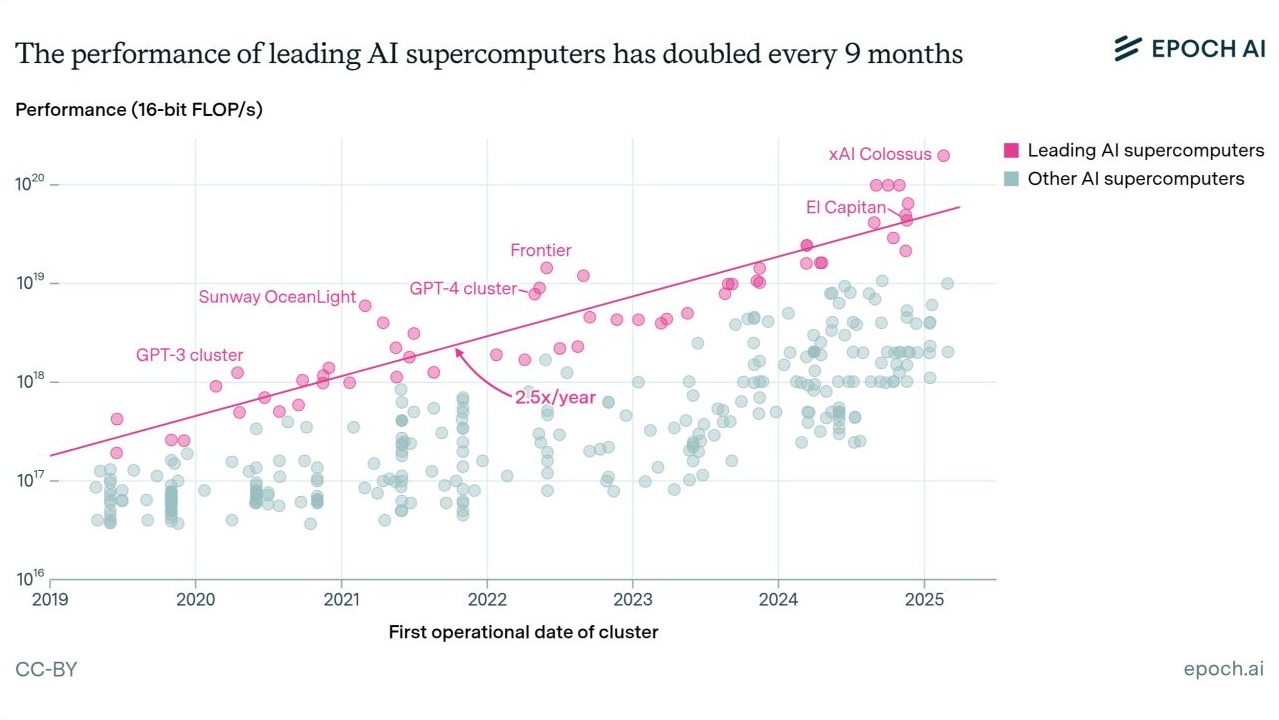
In the summer of 2019, the world's most powerful artificial-intelligence supercomputer was Oak Ridge National Laboratory's Summit, a government-funded behemoth in Tennessee that consumed about as much electricity as a small town. Five and a half years later, that machine looks quaint. The current champion, xAI's Colossus, sprawls across Memphis with two hundred thousand specialized chips, costs an estimated seven billion dollars, and devours enough power to supply a quarter of a million American homes. If Summit was a Ferrari, Colossus is a freight train.
This transformation—captured in a new analysis by researchers at Georgetown University and Epoch AI (full report link below)—reveals one of the most dramatic technological arms races of our time. The study, which compiled data on five hundred AI supercomputers worldwide, documents not just the breathtaking pace of advancement but a fundamental shift in who controls the computational engines driving artificial intelligence.
The numbers tell a story of exponential ambition that defies historical precedent. Since 2019, the performance of leading AI supercomputers has doubled every nine months—a pace so ferocious that today's leading systems deliver fifty times more computational power than their 2019 predecessors. To grasp this acceleration, imagine if commercial aviation had progressed from the Wright Flyer to supersonic jets in half a decade instead of ninety years. Traditional supercomputers, by comparison, have improved at the stately pace of 1.45 times annually over three decades—rapid by historical standards, yet glacial compared to the AI revolution. This exponential leap represents the difference between training a language model in months versus years, or between developing AI systems that can process thousands versus millions of parameters simultaneously.
What drives this breathtaking pace is not merely Moore's Law but something more profound: the discovery that intelligence itself can be manufactured through computational brute force. Each new generation of these digital leviathans has unlocked capabilities that seemed fantastical just years before. GPT-4's ability to write poetry, diagnose medical conditions, and solve complex mathematical proofs emerged not from algorithmic breakthroughs alone but from training on computational infrastructure that would have bankrupted small nations a decade ago. DeepMind's protein-folding predictions, which contributed to a Nobel Prize and promise to revolutionize drug discovery, required supercomputers that consumed more electricity during training than many countries use in a year. While the challenge of protein folding had stumped researchers for fifty years with limited success, the computational power equivalent to a country's annual electricity consumption now promises to accelerate medical discovery for the next century.
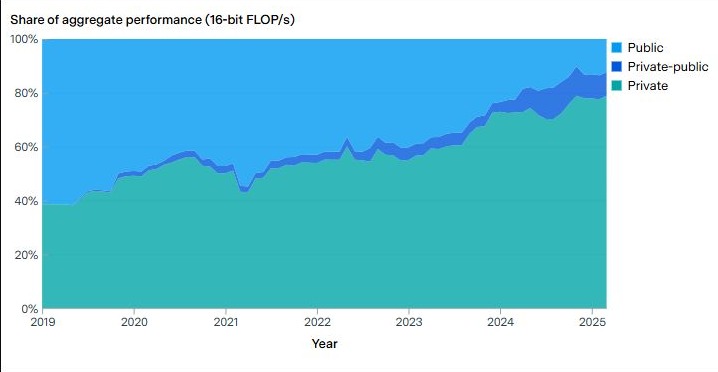
The more profound change lies in ownership—a transition that represents perhaps the most consequential shift in scientific infrastructure since the industrial revolution or, at minimum, the privatization of space exploration. In 2019, governments and universities globally controlled sixty percent of the world's AI supercomputing capacity, continuing a tradition of public investment in basic research that stretches back to the Manhattan Project and post-World War II priorities. Today, private companies command eighty percent, transforming what were once tools for scientific discovery into the industrial infrastructure serving the global socioeconomic imperatives of the AI economy.
This corporate conquest has unfolded with startling speed and strategic precision. Private sector AI supercomputers have grown at 2.7 times annually, significantly outpacing the 1.9 times growth rate of public systems. This performance gap means that while government systems like El Capitan cost $600 million, they now deliver only one-fifth the computational power of private systems like Colossus. The disparity effectively locks academic researchers out of frontier AI development. The disparity reflects not just different funding models but fundamentally different incentives and goals. While government labs optimize for scientific prestige, long-term commercialization of research, and public benefit, corporations optimize for competitive advantage, immediate results, and global market dominance. The result is a computational arms race where success flows not to the scientifically curious but to the economically endowed. Academia and research universities have been slow to embrace generative AI, particularly in the early stages, and while the imperative seems clearer in 2025, adoption remains contentious with competing institutional priorities.
Consider what this means for university researchers who once drove AI's fundamental advances. Academic institutions that birthed the deep learning revolution now find themselves computationally impoverished in a landscape of digital titans. Many of AI's pioneers moved between corporate R&D environments—with abundant computational resources—and relatively constrained academic departments initially resistant to AI research. As Demis Hassabis and Ilya Sutskever have noted, in the early days researchers had to frame their work as "Machine Learning" or "Deep Learning" to avoid being dismissed from conferences or academic circles. In 2012, approximately sixty-five percent of significant machine learning models emerged from university labs. By 2023, that figure had collapsed to just ten percent. The reversal represents more than statistical decline—it signals the end of an era when scientific curiosity drove AI development, replaced by corporate strategy determining AI's direction. This represents the largest transfer of scientific leadership from academia to industry in modern history—comparable to the shift of research during major technological transitions, but flowing toward corporate rather than public control.
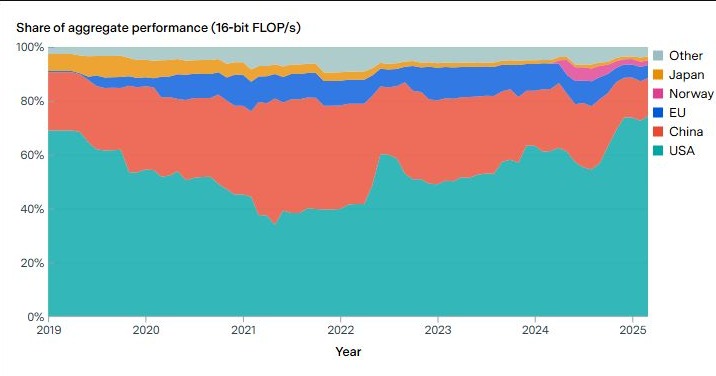
The geographical distribution of these computational citadels tells an equally revealing story about technological hegemony. The United States commands seventy-five percent of global AI supercomputing capacity, with China holding a distant fifteen percent—a dominance that has actually strengthened as the race has intensified. This concentration represents a level of technological control that historically determines which nations shape global innovation trajectories and set international standards for emerging technologies. Traditional supercomputing powers—the United Kingdom, Germany, Japan—have been relegated to computational footnotes, each controlling less than three percent of global capacity.
Notably absent is Canada, despite producing Nobel Prize winner Geoffrey Hinton, OpenAI's Ilya Sutskever, and other luminaries including Yann LeCun (Meta), Yoshua Bengio, and Andrey Karpathy (Tesla, Google). Most have migrated to corporate or open-source initiatives, not by choice but to continue their groundbreaking work. The concentration of leading-edge innovators in the United States reflects not accident but architecture: American companies have systematically captured the commanding heights of AI infrastructure, from chip design to cloud services to the specialized software that orchestrates these digital symphonies. However, the Chinese, with the DeepSeek intervention and a series of recent accomplishments, appear increasingly competitive, though the report captures only publicly known Chinese laboratories and clusters.
This American ascendancy and China's emerging challenge carry profound geopolitical implications. In previous technological competitions—nuclear weapons, space exploration, even the internet—advanced capabilities eventually diffused across nations through espionage, collaboration, or independent development. AI supercomputers present a different challenge. They require not just scientific knowledge but sustained access to the world's most advanced semiconductors, manufactured by a handful of companies using equipment from an even smaller number of suppliers. The United States has weaponized this chokepoint, using export controls to limit Chinese access to cutting-edge processors and forcing reliance on older generations or domestically produced alternatives that lag by years in capability.
However, these constraints have also driven Chinese innovation, producing models such as DeepSeek R1, Qwen, and others with innovations and capabilities that are subsequently copied and adapted globally. The Chinese approach initially involved reverse engineering GPT-4, publishing both the architecture and their own improved models while leveraging vast engineering populations and DeepSeek's selective recruitment from elite engineering programs. The competition now extends to humanoid robots integrated with AI systems, where China has maintained longer experience. Reverse engineering remains a common technological development strategy across all competitive environments.
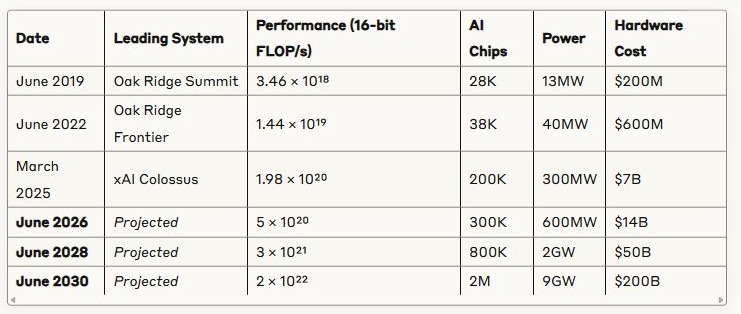
The scale of these modern marvels in new U.S. data centers beggars historical comparison. xAI's Colossus, with its three-hundred-megawatt power requirement, consumes as much electricity as Iceland—not annually, but continuously, every hour of every day. To put this in perspective, Colossus requires more electricity than 250,000 American homes use continuously—enough to power cities like Richmond, Virginia or Spokane, Washington. The hardware cost alone, seven billion dollars, exceeds the gross domestic product of dozens of nations. Yet even Colossus may seem modest compared to the Stargate Project being developed in Abilene, Texas, involving the U.S. government, OpenAI, Oracle, and SoftBank. Additional ventures lie ahead. The researchers project that by 2030, leading AI supercomputers will incorporate two million chips, cost two hundred billion dollars, and require nine gigawatts of power—equivalent to nine nuclear reactors running at full capacity. Leopold Aschenbrenner's "Situational Awareness" document provides essential reading for its prescient extrapolation of future developments and careful economic, geopolitical, and sociological environmental analysis.
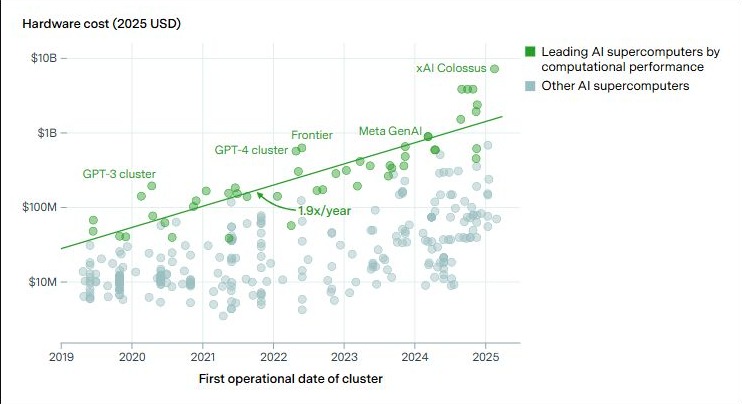
These projections reveal the approaching limits of centralized computation. No industrial facility has ever required nine gigawatts of power in a single location. The physics of electrical transmission, the politics of energy allocation, and the practical challenges of cooling such vast installations may prove more constraining than the economics of chip production. Already, the most ambitious AI training runs span multiple data centers across continents, connected by networks that carry more data in minutes than the entire internet handled in its early years. These projects now resemble the early internet in their global connectivity, though organized around multimodal data and agent-driven AI rather than networked interactive telecommunications.
The transition toward distributed training represents more than engineering evolution—it signals a fundamental reorganization of computational power that mirrors broader geopolitical realignments. When the most powerful AI systems require infrastructure distributed across national boundaries, questions of sovereignty become unavoidable. Which country's laws govern a training run that spans servers in Virginia, Ireland, and Singapore? How do export controls apply to software that orchestrates computation across allied nations? The answers will shape not just AI development but the architecture of international cooperation in the digital age.
Perhaps most remarkably, this computational revolution has coincided with breathtaking efficiency gains. Energy efficiency has improved by 1.34 times annually—meaning each watt of power now delivers substantially more computational capability. Cost-performance ratios have improved even more dramatically, rising 1.36 times per year. These gains explain how the industry has sustained exponential growth without collapsing under its own economic weight. Even as absolute costs have soared into the billions, the intelligence produced per dollar has continued to rise.
The human implications of this transformation extend far beyond Silicon Valley boardrooms or Pentagon strategic planning. Academic researchers—the scholars who laid AI's theoretical foundations—increasingly find themselves locked out of the computational resources needed for cutting-edge work. Notable figures like Nobel Prize winner Geoffrey Hinton now reflect on the ethical dimensions of the revolution his early work spawned. Renting access to even a modest cluster of advanced AI chips can cost millions of dollars, far beyond typical university budgets and stretching research funding considerably. With funding shifts toward applied programs, the current environment presents challenges for newly minted AI and Machine Learning Ph.D.s. The democratization of AI tools for consumers has coincided with an aristocratization of AI research, concentrating the ability to push boundaries in the hands of a technological elite that increasingly sets development parameters. Open source possibilities remain primarily through Meta's strategy and China's DeepSeek R1, both presenting compelling but complex choices.
This concentration of computational power in corporate hands has already begun reshaping scientific discovery itself. The protein structures revealed by DeepMind's AlphaFold, the climate models trained on Microsoft's supercomputers, the drug candidates identified through pharmaceutical partnerships—these breakthroughs emerge not from traditional academic inquiry but from corporate research programs with access to computational resources that universities cannot match. Science itself is being privatized, one training run at a time. However, traditional academic research in the United States and U.S. research institutions remains closely connected to corporate and commercialization interests necessary for institutional survival in the twenty-first century.
This geopolitical chess game extends beyond raw computational capacity to encompass the entire ecosystem of AI development. The United States controls not just the design of leading processors but the specialized software, networking equipment, and cooling technologies that make these digital giants possible. China's attempts to build indigenous alternatives have achieved substantial progress but remain years behind the technological frontier. European nations, despite substantial public investment, have largely conceded the infrastructure competition while focusing on regulation and governance. Taiwan's TSMC is establishing operations in the United States, though emerging competitors and ongoing competition continue to drive innovation and discovery.
Yet even American dominance faces constraints that transcend national boundaries. The exponential growth in power requirements poses challenges that no single country can solve through technological innovation alone. Energy generation, grid capacity, and environmental impact—including water requirements—represent physical limits that may ultimately determine which nations can sustain leadership in the AI age. The future belongs not just to those who can design the most powerful chips but to those who can power them sustainably and reliably.
The age of the computational colossus and AI innovation, extending to humanoid robotics, has only just begun, but its implications already ripple through every sector of human endeavor. In medicine, AI supercomputers enable drug discovery programs that compress decades of research into months of computation. In climate science, they power models that reveal planetary dynamics with unprecedented precision. In finance, they process market data at scales that redefine economic analysis and twenty-first-century market mechanisms. The machines that seemed like science fiction just years ago have become the engines of both scientific and creative revolutions. Our children will not be digital natives but AI natives, with recent research from institutions as diverse as Britain's Turing Institute and the U.S. LEGO Learning Institute suggesting that AI enhances learning outcomes and that empathic voice-based tutoring may transform educational models to serve larger populations.
The question is no longer whether these exponential trends can continue but what happens to global technological leadership when they inevitably encounter the limits of physics, economics, or politics. The computational colossus represents humanity's boldest attempt to mechanize intelligence itself in pursuit of Artificial General Intelligence (AGI) or Artificial Superintelligence (ASI), which advocates claim will usher in an era of abundance. Whether this trajectory serves scientific progress or corporate profit, democratic values or authoritarian control, will depend on who controls the machines that think—and who has been excluded from or voluntarily withdrawn from the race to build them in our rapidly evolving technological environment.
Works Cited
Full Report (Epoch/Georgetown) :https://arxiv.org/pdf/2504.16026v2
Situational Analysis (Aschenbrenner): https://situational-awareness.ai/wp-content/uploads/2024/06/situationalawareness.pdf
Turing Institute (Children and AI): https://www.turing.ac.uk/sites/default/files/2025-05/understanding_the_impacts_of_generative_ai_use_on_children_-_wp2_report.pdf
#ArtificialIntelligence hashtag#AIInfrastructure hashtag#TechInnovation hashtag#DigitalTransformation hashtag#Supercomputing hashtag#AIStrategy hashtag#FutureOfWork hashtag#TechInvestment hashtag#Innovation hashtag#MachineLearning hashtag#TechTrends hashtag#AIResearch hashtag#DigitalEconomy