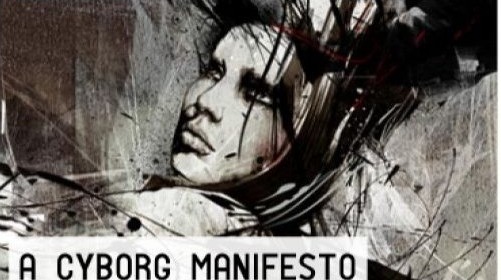
I. Wave Function Collapse
From her perch on the bluffs at California's Natural Bridges State Beach, Donna Haraway watches waves gather their potential energy towards the coastline. She reflects as the superposition of foam and force, carry repeating seemingly infinite possibilities of the wave front until that singular moment when they crashes against the California coastline and collapses from what might-be into what is. It is December 1984. Haraway has just finished writing something that will continue resonate like those repeating water waves for at least the next forty years. It will remake how we think about humans and machines carried along quietly with an unseen gravitation pull. In her UC Santa Cruz office, towers of books on primatology and cybernetics, she's crafting the finishing touches of what she calls "A Cyborg Manifesto"—a feminist vision of human-machine entanglement that challenges boundaries Silicon Valley holds sacred. But here, watching wave after wave enact quantum collapse, she's thinking about something her colleague mentioned: how measurement doesn't reveal reality but creates it, how observation collapses possibility into actuality.
We are now with AI forty years into the future— 2025 pregnant with potentialities of AI satuated conversations until the moment of contact, when infinite possibilities of the LLM model collapse like those wae into one after one next word word prediction exchanged, one generated response, one next work prediction decision which crystallizes from the foam of algorithmic vast potentientiality to create meaning not unlike our brain. The wave doesn't know it's performing an analogue quantum mechanics, just as the neural networks born in Nvidia data centers down the coast don't know they're performing consciousness. But performance is what matters. Performance is where reality emerges and is actualizized.
Twenty miles inland back in the 80's, at Xerox's Palo Alto Research Center, anthropologist Lucy Suchman is discovering that intelligence itself is also performed by specialized tribes. She is watching people use new tools called photocopiers and then trying to align this with how the engineers at parc debug expert systems, she sees how machines and humans don't simply interact but configure each other through what she'll come to call "situated action." The bugs in the human/technical systems aren't failures; they're revelations about how knowledge emerges from entanglement rather than existing as property of individual minds.
Fifty miles south at UCLA, literary scholar Katherine Hayles traces cybernetics back to its wartime origins and teaches this to her bewildered and delighted UCLA undergrads, finding in the high end Macy Conferences of the 1940s the narrative structures that would help teach us to imagine consciousness as information processing. Hayles reads science like literature and literature like science. Her first two degrees were in Chemistry and her first job at Xerox and she now also watches how metaphors migrate between domains until they solidify into material realities—until the feedback loops imagined by Norbert Wiener become the neural networks training in silicon valleys.
And at UC Santa Cruz, physicist-turned-philosopher Karen Barad prepares experiments that will shows her how matter and meaning dance together, how measurement and reality emerge through what she calls "intra-action"—not separate entities coming together, but entanglement all the way down and back up to us. She doesn't know yet that she'll spend decades thinking about how AI algorithms don't simply classify pre-existing categories but help materialize what counts as intelligence, bias, human.
These four women—watching waves collapse, machines fail, stories migrate, particles entangle—are developing amazing theoretical tools that will help us understand our own entanglement with artificial intelligence and develop an AI literacy that seeks to reach beyond coding's technical perspectives. The coding is central but definitely 'not' the whole story as their are humans in this strange loop. The women also don't even know they're creating the foundation for is then emerging and now can be tentatively called feminist inspired posthumanist AI ethics if it still be named at all. They only know that the boundaries everyone else takes for granted—human/machine, nature/culture, subject/object—are as fluid as the California coastline and it's 'good vibrations, also requiring constant attention, care, response-ability to maintain for the various actors in this drama that will play out.
One wave collapses. Another gathers fecund potential energy for something that will be released and performed over and over again on global levels almost fifty years later setting the stage for a new vocabulary for AI literacy to appear.
II. The Cyborg's Mother: Donna Haraway
"We are all chimeras, theorized and fabricated hybrids of machine and organism."
The year is 1983. Two futures are being born in California. In Los Angeles, a young Austrian bodybuilder - Arnold Schwarzenegger stands on a soundstage, leather jacket, dark sunglasses, mechanical movements that will make him the perfect killing machine in James Cameron's The Terminator. His lines are minimal -- "I'll be back" "Hasta la Vista, baby "I am a cyber-ne-tic or-gan-ism —His presence embodies everything Silicon Valley dreams and continues to believe about artificial intelligence: masculine, militaristic, cool, unstoppable, rational and deadly.
Two hundred miles north, in her cramped office overlooking Monterey Bay, Donna Haraway types on an early personal computer,dogs asleep at her feet, crafting a very different vision of human-machine futures. She calls it "A Cyborg Manifesto," and it begins with a declaration that will echo through decades of AI development: "We are all chimeras, theorized and fabricated hybrids of machine and organism."
Schwarzenegger's cyborg represents the ultimate masculinist fantasy— not the 'sissy-men' he would later parody as 'da California Gubernator' but the merger of flesh and technology in service of domination. In contrast, Haraway's cyborg offers something more subversive. "A cyborg is a cybernetic organism," she writes, "a hybrid of machine and organism, a creature of social reality as well as a creature of fiction." The key difference: her cyborgs don't transcend human limitations; they reveal that the boundaries between human and machine were always already blurred, always already political.
Haraway also intimately knows the military-industrial complex roots of the technology Schwarzenegger embodies. Through her work on primatology, she's traced how cybernetics emerged from World War II weapons research—how Norbert Wiener's work on anti-aircraft targeting systems gave birth to feedback theory, how John von Neumann's game theory and cellular automata provided the mathematical foundations for both nuclear strategy and artificial intelligence. The same war machine that created the bomb also created the computer, and both emerged from what she calls "informatics of domination"—the transformation of the world into a problem of coding.
The Terminator franchise will gross billions. It will spawning sequels, part II and inspire real military contractors to develop autonomous weapons systems. The masculine cyborg will becomes a cultural touchstone, a political metaphor, a military-industrial aspiration that shapes decades of AI research funding and development priorities but also spawn new generations of 'boy-toys' like 'Optimus Prime' - optimization, military capacity and domination, of course, for the ight cours.
But Haraway is also amazingly or crazily (from various points of view) writing against this future, offering what she calls "situated knowledges" as an alternative to the "view from nowhere" that cybernetics promises. "Situated knowledges require that the object of knowledge be pictured as an actor and agent, not as a screen or a ground or a resource," she writes. Knowledge isn't neutral information but always emerges from particular bodies, particular histories, particular relationships of power and care.
This insight will prove crucial for understanding AI's development in California. The algorithms being created in Silicon Valley aren't neutral tools but embody the situated perspectives of their creators—mostly young white men trained in the same universities, funded by the same venture capital firms, dreaming the same dreams of technological transcendence. Their "view from nowhere" is actually a very specific view from somewhere: the somewhere of privilege, the somewhere of power, the somewhere that mistakes its particularity for universality.
Working within UC Santa Cruz's experimental History of Consciousness program—founded in the 1960s as an interdisciplinary space for radical scholarship—Haraway develops her insights about "response-ability." Unlike responsibility, which implies individual agency and blame, response-ability emphasizes our capacity to respond to others, to stay with the trouble of entangled living and complexities herein that make us human. "Response-ability is a relationship crafted in intra-action through which entities, subjects and objects, come into being," she will later write.
This distinction becomes crucial for AI ethics. Traditional approaches focus on individual responsibility—who programmed the algorithm, who deployed the system, who made the biased decision. But Haraway's response-ability suggests something different: recognition that humans and AI systems are always already entangled, always already co-constituting each other through their ongoing interactions. The question isn't who's responsible for biased algorithms but how we can respond more carefully to the entangled systems we're all embedded within.
By the 1990s, Haraway is developing her thinking about "companion species"—relationships of care and domestication that trouble simple distinctions between nature and culture, wild and tame. Dogs and humans have co-evolved together; we are companion species who have shaped each other across millennia of entanglement. This insight will prove prescient for understanding human-AI relationships: we're not separate species encountering each other across a void but entangled beings emerging together through ongoing interaction.
"Companion species is about significant otherness," she explains. It's not about projection—seeing the other as a mirror of ourselves—but about recognizing genuine difference within relationship. Dogs think differently than humans, respond differently, perceive differently. But this difference is what makes the relationship generative. Similarly, AI systems process information differently than human brains, operate according to different logics, encounter the world through different sensors. The challenge isn't making them more human but learning to live well with their difference.
From her Santa Cruz perch, Haraway watches Silicon Valley's dreams of artificial general intelligence—the fantasy that machines will become just like humans, only better. But her cyborg manifesto suggests a different possibility: not artificial humans but artificial companions, systems we can live with rather than systems that replace us. "We are responsible for machines; they do not dominate or threaten us," she writes. "We are responsible for boundaries; we are they."
As the sun sets over Monterey Bay, Haraway walks her dogs along the coastal cliffs, thinking about what it means to stay with the trouble of technological development. Each wave that crashes below performs the same lesson her cyborg taught: boundaries aren't barriers but zones of contact, spaces where different entities meet and create something new. The future isn't about transcending our material, embodied, entangled condition but about inhabiting it more carefully, more responsively, more accountably.
The Terminator promises escape from human limitation through technological transcendence. The cyborg promises something harder but more hopeful: learning to live well within the networks of care and domination that already constitute us. As AI systems become more powerful, more prevalent, more intimately woven into daily life, Haraway's lesson becomes ever more urgent: "We are all responsible for what we learn to see."
Annotated Bibliography of Key Works
Theoretical Foundations
Donna Haraway
- "A Cyborg Manifesto: Science, Technology, and Socialist-Feminism in the Late Twentieth Century" (1985): The foundational text that reimagined human-machine relationships through feminist lens, offering cyborgs as figures of liberation rather than domination. Written during Reagan-era militarization, it challenged both technophobic and technophilic responses to emerging digital technologies.
- "Situated Knowledges: The Science Question in Feminism and the Privilege of Partial Perspective" (1988): Haraway's epistemological manifesto arguing against the "view from nowhere" in favor of acknowledged, partial perspectives. Essential for understanding how AI systems embody particular situated perspectives rather than neutral objectivity.
- Staying with the Trouble: Making Kin in the Chthulucene (2016): Mature development of "response-ability" as ethics of care for multispecies flourishing. Extends earlier cyborg insights to contemporary environmental and technological challenges.
Karen Barad
- Meeting the Universe Halfway: Quantum Physics and the Entanglement of Matter and Meaning (2007): Definitive statement of agential realism, arguing reality emerges through material-discursive practices rather than existing independently. Crucial for understanding how AI systems participate in materializing the phenomena they claim to measure.
- "Posthumanist Performativity: Toward an Understanding of How Matter Comes to Matter" (2003): Foundational essay establishing how knowledge and reality co-constitute each other through experimental practices. Provides framework for understanding AI training as ontological rather than merely epistemological process.
Lucy Suchman
- Plans and Situated Actions: The Problem of Human-Machine Communication (1987): Ethnographic study challenging AI's planning-based models by demonstrating how intelligent action emerges from situated interaction. Presciently anticipated why expert systems would fail and why statistical approaches would succeed.
- Human-Machine Reconfigurations: Plans and Situated Actions, Second Edition (2007): Substantial revision extending insights to contemporary human-machine assemblages, emphasizing distributed agency and accountability across sociotechnical networks.
- "Located Accountabilities in Technology Production" (2002): Analysis of how responsibility gets distributed across networks of human and technological actors, directly relevant to contemporary AI accountability challenges.
N. Katherine Hayles
- How We Became Posthuman: Virtual Bodies in Cybernetics, Literature, and Informatics (1999): Literary-critical genealogy of cybernetics tracing how information became disembodied and consciousness computational. Essential for understanding cultural narratives shaping AI development.
- "Computing the Human" (2005) and Unthought: The Power of the Cognitive Nonconscious (2017): Development of cognitive assemblages theory, arguing for distributed intelligence across human-technical systems. Provides framework for understanding AI as extension of cognition rather than replacement for consciousness.
Contemporary Applications
Ruha Benjamin
- Race After Technology: Abolitionist Tools for the New Jim Code (2019): Applies Haraway's situated knowledges to contemporary algorithmic bias, showing how seemingly neutral technologies reproduce and amplify racial discrimination.
Safiya Umoja Noble
- Algorithms of Oppression: How Search Engines Reinforce Racism (2018): Uses Suchman's insights about situated action to analyze how search algorithms embed discriminatory practices in seemingly technical processes.
Shoshana Zuboff
- The Age of Surveillance Capitalism (2019): Though not explicitly feminist posthumanist, provides detailed analysis of how tech companies extract value from human behavioral data, connecting to themes of embodiment and commodification.
Theoretical Context
Bruno Latour
- Science in Action: How to Follow Scientists and Engineers Through Society (1987): Actor-Network Theory foundation influencing Suchman's work on human-machine configurations and providing tools for understanding distributed agency.
- "Where Are the Missing Masses? The Sociology of a Few Mundane Artifacts" (1992): Analysis of how agency gets distributed across human-nonhuman networks, directly relevant to AI systems as technological actors.
Annemarie Mol
- The Body Multiple: Ontology in Medical Practice (2002): Extends insights about situated knowledge to medical practice, showing how diseases exist differently across different practices. Relevant for understanding how AI systems enact different versions of intelligence across contexts.
Historical Foundations
Norbert Wiener
- Cybernetics: Or Control and Communication in the Animal and the Machine (1948): Foundational cybernetics text establishing feedback as universal principle. Hayles traces how its metaphors migrated from engineering to psychology and consciousness studies.
Philip K. Dick
- Do Androids Dream of Electric Sheep? (1968): Science fiction exploration of artificial consciousness that Hayles uses to think about empathy, embodiment, and the boundaries of the human. Influential on contemporary AI consciousness debates.
This bibliography provides entry points into the rich theoretical tradition that emerged from feminist posthumanist engagement with technology, offering frameworks essential for understanding AI's development and effects that remain urgent as these systems become more powerful and pervasive.