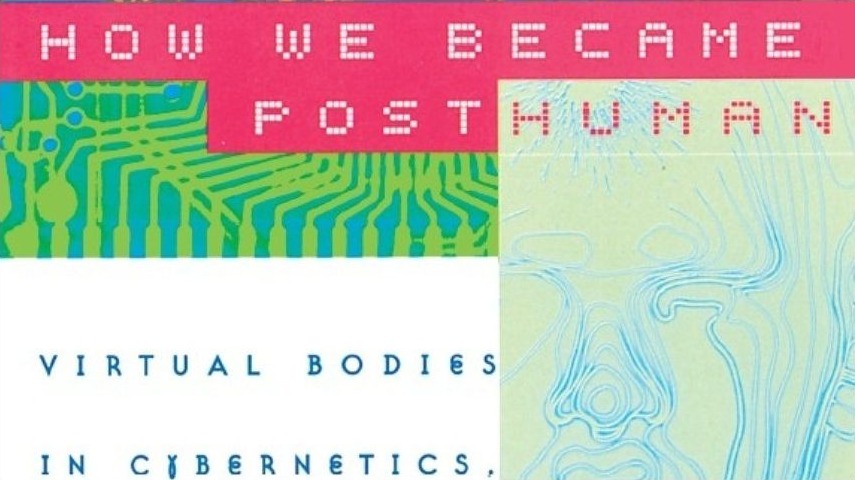
V. Literary Cybernetics: N. Katherine Hayles
"We became posthuman when we began to think that consciousness, rather than embodiment, is what defines the human."
In a UCLA faculty lounge in 1995, Katherine Hayles arranges two stacks of books on the table before her: Victorian novels on one side, cybernetics textbooks on the other. To her colleagues in the English department, this seems like an odd pairing—what could Jane Eyre possibly have to do with Norbert Wiener's Cybernetics? But Hayles sees connections invisible to disciplinary boundaries: how both traditions tell stories about consciousness, embodiment, and information that shape how we imagine minds and machines.
She opens Wiener's 1948 classic to a passage that will haunt her for decades: "The mechanical brain does not secrete thought 'as the liver does bile,' as the earlier materialists claimed, nor does it put it out in the form of energy, as the muscle puts out its activity. Information is information, not matter or energy." This seemingly technical statement contains the seeds of a revolution—the transformation of humans into information-processing systems that parallels the development of thinking machines.
But Hayles has spent years reading Philip K. Dick's Do Androids Dream of Electric Sheep?, and she knows that the question of artificial consciousness isn't just technological but literary, philosophical, existential. Dick's androids pass every test for consciousness except empathy—they think like humans, remember like humans, suffer like humans, but cannot recognize suffering in others. The novel suggests that consciousness might not be about information processing but about embodied response to others' vulnerability.
This insight sends Hayles back to the origins of cybernetics in the Macy Conferences of 1946-1953, where mathematicians, physiologists, anthropologists, and psychiatrists gathered to develop a "science of communication and control in the animal and the machine." She traces how these interdisciplinary conversations gradually transformed consciousness from biological process to information pattern, paving the way for artificial intelligence while evacuating the body from cognition.
"The posthuman view privileges informational pattern over material instantiation," Hayles writes in How We Became Posthuman, "so that embodiment in a biological substrate is seen as an accident of history rather than an inevitability of life." This transformation didn't happen overnight but through decades of conceptual migration—feedback loops moving from engineering to psychology, information theory traveling from telephone systems to neural networks.
Working within UCLA's English department while auditing computer science courses, Hayles develops what she calls "flickering signification"—the way digital media oscillates between presence and absence, pattern and randomness, signal and noise. Unlike print text, which creates the illusion of stable meaning, digital text reveals the underlying discreteness of all representation. Every character is a pattern of bits that could be otherwise, every word a configuration of information that points toward its own contingency.
This leads her to think differently about AI development. Instead of asking whether machines can think like humans, she asks how thinking itself becomes machined through computational metaphors. Neural networks aren't modeling human cognition so much as remaking cognition in their own image, teaching us to understand intelligence as pattern recognition rather than embodied response.
The irony isn't lost on her that she's developing these insights while typing on a personal computer, participating in the very transformation she's analyzing. "We became posthuman," she realizes, "not through dramatic technological revolution but through subtle shifts in how we understand consciousness, embodiment, and agency." Every email sent, every document processed, every search query entered participates in the gradual migration of human intelligence into computational form.
Dick's androids become her guide for thinking about this transformation. They represent what she calls "cognitive assemblages"—hybrid configurations where human and machine cognition interpenetrate without merging. The androids aren't mechanical copies of humans but parallel developments that illuminate the computational dimensions of human consciousness. They think differently than humans—more logically, more consistently, more efficiently—but cannot access what Dick calls "empathic consciousness."
This suggests that artificial intelligence might develop along different lines than human intelligence rather than converging toward identical endpoints. Machine consciousness, if it emerges, might be irreducibly alien—operating according to logics that humans can recognize but never fully inhabit. The challenge isn't making machines more human but learning to think alongside their difference.
Hayles traces this insight through the history of cybernetics, showing how early researchers like Warren McCulloch and Walter Pitts translated neural activity into logical operations, transforming the wet, messy, embodied brain into clean mathematical abstractions. Their "logical neurons" could be implemented equally well in biological or electronic substrates, making consciousness substrate-independent. But this abstraction required bracketing everything that makes biological neurons biological—their metabolic processes, their developmental histories, their integration with bodily systems.
"Information lost its body," Hayles writes, describing how cybernetics transformed information from embodied process to abstract pattern. This transformation enabled the development of digital computers but at the cost of forgetting that information always requires material substrate, always emerges through embodied processes, always carries the traces of its material instantiation.
Contemporary AI development repeats this pattern, treating intelligence as pattern recognition that can be abstracted from its biological origins and implemented in silicon substrates. Large language models process millions of books and articles, extracting statistical patterns that enable them to generate seemingly intelligent responses. But they operate without bodies, without mortality, without the vulnerability that Dick identified as central to empathic consciousness.
This doesn't mean AI systems lack agency—Hayles' later work explores how "nonconscious cognition" operates throughout natural and artificial systems. Plants respond to environmental changes, immune systems recognize threats, algorithms detect patterns, all without the reflective consciousness that humans prize. Intelligence is more widely distributed than consciousness, operating through what she calls "cognitive assemblages" that include both conscious and nonconscious elements.
"Cognition is not solely a human faculty," Hayles argues in Unthought (2017), "but a process present wherever there is systemic activity that can be directed toward goal-seeking and goal-changing behaviors." This insight transforms how we understand AI development—not as the creation of artificial consciousness but as the extension of cognitive processes into new material substrates.
Reading Dick's novels alongside developments in machine learning, Hayles sees how science fiction and scientific research co-evolve, each providing metaphors and models for the other. Dick's empathy tests become templates for AI evaluation; his questions about authentic consciousness shape contemporary debates about machine sentience. Literature and technology don't simply reflect each other but participate in shared imaginaries that materialize in both fictional and technical forms.
This leads to what Hayles calls "technogenesis"—the co-evolution of humans and technology that transforms both biological and technical capabilities. Humans who grow up with digital media develop different cognitive patterns than previous generations, while AI systems trained on human-generated text acquire quasi-linguistic capabilities that their designers never programmed. We're becoming posthuman together, through recursive interactions that reshape both human and artificial intelligence.
Walking across the UCLA campus where her interdisciplinary insights first took shape, Hayles thinks about the cognitive assemblages emerging all around her: students researching with AI assistance, professors using algorithms to grade essays, recommendation systems shaping what gets read and written. The boundaries between human and machine cognition blur not through technological transcendence but through practical entanglement.
"Consciousness is never a solo performance," she concludes, "but always an emergent property of complex systems." As AI systems become more sophisticated, the question isn't whether they'll become conscious but how they'll participate in the distributed cognitive assemblages that constitute contemporary intelligence. The wave of technological development crashes against the shore of biological evolution, and new forms of cognition emerge from the foam—posthuman, hybrid, irreducibly entangled between human and machine capabilities.
Each conversation with an AI system is a moment of technogenesis, a co-evolutionary interaction that subtly transforms both human and artificial participants. The challenge isn't controlling this transformation but learning to participate in it more thoughtfully, more responsively, more accountably to the forms of intelligence we're creating together.
VI. Convergence: Contemporary AI
"The question is not whether we can trust our technologies, but whether we can trust ourselves to use them wisely."
By 2024, many of AI' potential waves had crashed on California and wider global shorelin's, and Silicon Valley's dreams lay mapped across this global shoreline like quantum dots too numerous and fractal-like to count. OpenAI's ChatGPT had achieved what decades of expert systems couldn't and beyond what the early Dartmouth AI founders Marvin Minsky and John McArthy had dreamed. It also had reached beyond the apotheosis of early MIT first Chatbot Maker Josef Weizenbum had dreamed with the first chatbot Eliza —fluid conversation that felt human while remaining irreducibly artificial. GPT-4 could write poetry, debug code, analyze legal documents, and explain quantum mechanics, but it also hallucinated facts, amplified biases, and sometimes refused to answer questions about how to tie shoes while offering detailed instructions for making explosives. In this way, it fulfilled the dire early warnings of Weizenbaum who left MIT back to his earlier jewish German home to person AI ethics. In this way it eerily echoed later and more recent Nobel prize winner Geoffrey Hinton who had early on moved from Britain to Carnegie Mellon and then Carnegie Mellon to the University of Toronto for his disagreement with the earlier militarization of AI. This more subtle ethical disagreements had also caused Hinton later in life to leave Google his post retirement job because the ethical bell was ringing again, turning Hinton, grandfather of Neural Net AI back to his ethical warnings on AI and need for this valence.
The four women who had spent decades thinking about human-machine entanglement and largely looked over now found their insights suddenly taken from histories conscious and reclassified, if not urgent at least a foothold of important work and thinking done across decades, their theoretical frameworks if not essential certainly at least worth dusting off and at least rereading for understanding what was happening as AI systems escaped the laboratory and began reshaping social reality.
2025 Haraway's Situated Knowledges in the Age of Large Language Models
Donna Haraway, now in her eighties but still walking her dogs along the Santa Cruz coastline, watched the new panic about AI "hallucinations" with characteristic insight. The problem wasn't that AI systems sometimes generated false information—humans do that too. The problem was that people expected them to provide "the view from nowhere," objective truth unmarked by perspective or position or embodiment or bias.
"All knowledge is situated knowledge," she had written decades earlier, and large language models proved her point perfectly. They weren't neutral oracles but massive assemblages of situated perspectives—trained on text written by particular people, in particular languages, from particular cultural positions and then generalized as objective truth. These were statistically generated general predictive probabilistic models and general or probabilistic is not always right, sometimes not even sometimes right. When ChatGPT claimed that women were less capable at mathematics, it wasn't hallucinating but faithfully reflecting the general biases embedded in its training data, typically referred to in AI as the models' 'data pile. The system was exquisitely situated with a certain 'data pile' and training run; for many reasons, some intellectual property related, some corporate privacy related and some competitive advantage, especially for the corporate generated models, it just couldn't acknowledge its own situatedness publicly. As the paradox goes, 'OpenAI is anything but 'open' just as Google's 'do no evil model' or another fallen corporate unnamed financial model did anything close to 'affective altruism'
Haraway's concept of "response-ability" became crucial for understanding how to live with these systems. Unlike traditional responsibility, which located agency in individual actors, response-ability emphasized ongoing relationships of care and accountability. Humans weren't separate from AI or other systems and networks sbut closely entangled with them through every query sent, every response received, every pattern reinforced through interaction.
"We are responsible for machines; they do not dominate or threaten us," she had written in the Cyborg Manifesto. "We are responsible for boundaries; we are they." As AI systems became more powerful, this insight becomes more urgent. The challenge isn't eliminating AI bias, all systems are biased from the sheer perspective of having a viewpoint. AI literacy is learning to cultivate a response and also having the 'ability' both politically and intellectually and socially to respond more carefully to the biased systems we were inevitably are creating together as 'human' or 'post human rights.
Barad's Material-Discursive Entanglements in Neural Networks
Karen Barad watched AI researchers struggle with "emergent capabilities"—complex behaviors that arose in large neural networks without being explicitly programmed. GPT-3 couldn't do arithmetic; GPT-4 could solve complex mathematical problems. GPT-3 couldn't reason about causality; GPT-4 could engage in sophisticated logical analysis. These weren't improvements but qualitative transformations, sudden phase transitions that materialized new capabilities from the same basic architecture.
Her theory of "agential realism" explained what others found mysterious. Neural networks didn't just process information but participated in materializing what information meant through their training and deployment. Each training cycle was an "intra-action" that helped determine what patterns would become significant, what associations would strengthen, what capabilities would emerge. The networks didn't discover pre-existing patterns but helped create them through material-discursive practices that entangled data, algorithms, and computational infrastructure.
This insight transformed how researchers understood "alignment"—the challenge of ensuring AI systems pursued intended goals. Traditional approaches treated alignment as an engineering problem: design better reward functions, implement better oversight mechanisms, build better safety systems. But Barad's agential realism suggested that human and AI systems were always already entangled through their ongoing interactions. Alignment couldn't be achieved through better design but only through more careful attention to the material-discursive practices that constituted both human and artificial agents.
When AI systems exhibited racial bias in hiring algorithms or gender bias in language translation, the problem wasn't technical failure but material success—the faithful reproduction of the biased patterns embedded in training data. The algorithms weren't malfunctioning but perfectly enacting the discriminatory practices they had learned to recognize as normal. Barad's framework suggested that eliminating bias required transforming the material-discursive practices that produced biased data in the first place, not just cleaning datasets or adjusting algorithms which led to other problems as a larger gaffe at Google produced changing histories in image and text that also produced outrageous hallucinations, politically correct but also not representing anything any historian would repeat and closest perhaps to Dick's science fiction novels that Hayles studied.
Suchman's Situated Action in Human-AI Configurations
Lucy Suchman observed the rise of "prompt engineering" with anthropological fascination. Users were learning to communicate with AI systems through carefully crafted instructions that bore little resemblance to human conversation. "Act as an expert in X," "Think step by step," "Show your reasoning"—these prompts worked not because they made AI systems more human but because they articulated more skillful forms of human-machine interaction.
Her theory of "situated action" explained why prompt engineering emerged as a new form of literacy. AI systems operated according to different logics than human conversation—they responded to statistical patterns in training data rather than social cues, contextual implications, or shared understanding. Effective human-AI interaction required what she called "articulatory practices"—ongoing work of translation, interpretation, and repair that made communication possible across difference.
This challenged Silicon Valley's dream of "natural language" interfaces that would make AI systems as easy to use as talking to another person. Suchman's ethnographic observations revealed that human-AI interaction was irreducibly artificial—it required learning new forms of linguistic performance, new strategies for eliciting desired responses, new ways of managing the unpredictability of machine behavior.
But this artificiality wasn't a bug to be fixed but a feature to be embraced. Human-AI configurations were generating new forms of distributed intelligence that exceeded what either humans or machines could achieve independently. The challenge wasn't making AI systems more human but learning to participate and enable more skillfully hybrid configurations of agency in a global society set up for a strict split between human and object or human and AI.
Hayles' Cognitive Assemblages in the Age of Generative AI
Katherine Hayles watched students use AI writing assistants and saw her predictions about "technogenesis" materializing in real time. Students who grew up with autocomplete and predictive text developed different writing practices than previous generations—more collaborative, more iterative, more comfortable with machine participation in the creative process which was more of a natural switch to devote time for what Norbert Weiner called 'the Human Use of Human Beings'. Meanwhile, AI systems trained on human writing acquired quasi-literary capabilities that surprised their creators and caused publishers to run to their lawyers for new laws and better advice.
Hayles concept of "cognitive assemblages" became essential for understanding how intelligence operated across human-AI configurations. When a scientist used GPT-4 to generate hypotheses, analyze data, and write research papers, where did human intelligence end and artificial intelligence begin and who was the author and what credit should be given to the human any longer and didn't the scientist cheat? The questions though entirely missed the new set of points required—intelligence emerged through the new assemblage, through the ongoing interaction and dialogue between human curiosity and machine pattern recognition with the human still firmly or at least loosely in the loop or as Adam Smith would put this on societal levels, operating with the invisible hand.
This didn't mean human intelligence was disappearing but that it was transforming through entanglement with artificial systems. and the larger shifts that had taken place previously in the first, second or third industrial revolution or earlier 'Gutenberg' print revolution and Renaisssnce. Students still learned but indeed learned to think differently and work different when they could offload certain cognitive tasks to AI assistants. Scientists discovered new research questions when they could process larger datasets with machine learning tools and combine their disciplinary bordeslines with other adjacent ones just beyond their Ph.D but within reach of discovery with the help of AI. Writers and Artists, Architects and Filmmakes are not cursing but fing new creative possibilities when they could collaborate with systems that generated unexpected combinations of ideas previously out of reach or too time consuming for human alone.
The California Synthesis
As 2024 turned toward 2025, the insights of these four theorists converged in unexpected ways. Silicon Valley's AI companies began hiring anthropologists and philosophers, physicists and mathematicians recognizing that technical problems required humanistic insights. At the same time, they also quickly shed their deterministically oriented programmers to more quickly adapt to the needs of AI. This transition currently is being generalized to larger workforces globally. Stanford's Human-Centered AI Institute brought together computer scientists and feminist theorists versed in these more generally fringe areas. UC Berkeley launched programs in AI ethics that drew heavily on posthumanist philosophy and the need for AI literacy.
The California coastline where these insights first emerged became a laboratory for new forms of human-AI collaboration. Artists in Los Angeles used generative AI to create works that explored the boundaries between human and machine creativity. Activists in the Bay Area developed AI systems designed to amplify marginalized voices rather than silencing them. Researchers at UC Santa Cruz experimented with AI systems that acknowledged their own limitations and uncertainties.
But the transformation wasn't limited to California. Around the world, researchers are adopting AI frameworks for understanding AI development along with the technical aspects of the technology implementation still required. Haraway's situated knowledges informed efforts to make AI systems more transparent about their training data and deployment contexts. Barad's agential realism shaped approaches to AI safety that emphasized ongoing responsiveness rather than predetermined alignment. Suchman's analysis of human-machine configurations influenced interface design that supported more skillful interaction. Hayles' cognitive assemblages provided frameworks for educational systems that prepared students for collaborative intelligence.
The Ongoing Wave
The wave that had begun building in the 1980s—when four women in California began thinking differently about human-machine relationships—finally crashed against the shore of widespread AI deployment. But like all waves, its collapse generated new possibilities, new questions, new challenges that required ongoing response and new dialogue and ideas for the present.
AI systems were becoming more powerful, more pervasive, more intimately woven into daily life. But they remained irreducibly artificial—operating according to logics that humans could recognize but never fully inhabit. The challenge wasn't making them more human but learning to live well with their difference, to respond more carefully to their effects, to participate more skillfully in the cognitive assemblages they made possible.
The four women who had taught machines to care hadn't solved the problems of AI development—they had provided better ways of thinking about those problems. Their insights suggested that the future wouldn't be determined by technological advancement alone but by the quality of care and attention humans brought to their entanglement with artificial systems.
As another wave gathers offshore, carrying new possibilities and new troubles in its quantum foam, their lessons remain urgent: All knowledge is situated. Reality emerges through entanglement. Intelligence is distributed. Consciousness is collaborative. Response-ability is ongoing. The wave crashes, and the work with AI, alignment, ethics, safety and now education of our children continues, hopefully glboall.
VII. Coda: The Continuing Wave
"The world is not a collection of things but a performance of phenomena."
Donna Haraway stands once again at Natural Bridges State Beach, her hair now silver, her dogs new companions in the ongoing practice of attention. The Pacific performs its eternal quantum mechanics—wave after wave gathering potential until that moment of collapse when possibility becomes actuality, when the superposition of might-be crashes into the inevitability of is.
It's December 2024, forty years after she first wrote about cyborgs, and the human-machine entanglements she imagined have materialized in ways both more mundane and more profound than science fiction predicted. Her phone buzzes with a text generated by an AI system that learned to write by reading millions of human conversations. The recommendation algorithm suggests a podcast about machine consciousness. Her email filter, trained on patterns of spam and legitimate communication, quietly sorts between th digital debris of late capitalism and her old calling to go for a coffee or walk on the beach.
She thinks about these cold California waves—how each one carries traces of every other wave, how interference patterns emerge from their entanglement, how they change in temperature with the seasons and years the quantum foam and bubbles of possibility constantly resolves into the classical reality of shoreline encounters and unexpected turns in physics and life. Every human-AI interaction is like this: a collapse of infinite potential into singular actuality, but also a generation of new possibilities, directions and relationalities enabled in the aftermath.
The four theoretical frameworks developed along this coastline series haven't prevented the problems they anticipated—algorithmic bias, surveillance capitalism, the military automation of violence. They are still waves travelling as they are written here in pure potentiality enabled to build now globally through the power of a networked global internet and light speed travel around our global village. Hopefully, these ideas and very abbreviated whirlwind tour of the amazing work of these women has provided at least a few better ways of thinking about, around and with those problems, more sophisticated tools for understanding ability to 'stay with the trouble' as Haraway would put it for what it means to be human in the 21st century in a world increasingly being shared with artificial agents, and soon to be superintelligent giants. To recap a few of the ideas humanly and more briefly:
Situated knowledges: AI systems that acknowledge their limitations and uncertainties from where they are speaking, transparently, relationally and from their explained viewpoint rather than pretending to omniscience.
Material-discursive entanglement: Recognition that humans and machines co-constitute each other emergent together through ongoing interaction rather than encountering each other across a void between subject and object.
Situated action: Interface design that supports skillful collaboration rather than seamless transparency.
Cognitive assemblages: Educational systems that prepare students to understand distributed intelligence, agents, networks and technology rather than individual competition.
These aren't solutions but ongoing practices—ways of staying with the trouble of technological development rather than seeking final answers. The wave that began building in the 1980s has crashed, but its energy continues to propagate through academic programs, research labs, policy discussions, and increasingly public conversations and education about AI's role in social life.
Haraway watches another wave gather, thinking about response-ability in an age of artificial intelligence. The challenge isn't controlling AI development but learning to respond more carefully to the entangled systems we're all embedded within. Every query sent to AI is a moment of response-ability. Every decision to deploy or reject automated systems is a moment of response-ability. Every conversation about AI's future is a moment of response-ability.
"We are responsible for machines; they do not dominate or threaten us," she wrote in 1985. "We are responsible for boundaries; we are they." As AI systems become more capable, this insight becomes more urgent and more difficult. The boundaries between human and artificial intelligence aren't disappearing but multiplying, requiring constant attention, care, negotiation.
The sun sets over Monterey Bay, painting the waves in shades of quantum superposition—simultaneously all colors until observation collapses them into specific wavelengths. Haraway turns from the ocean toward the campus where these insights first emerged, thinking about the students now grappling with questions she could barely imagine forty years ago.
They're learning to prompt large language models contextually, debug machine learning algorithms that are now probabilistic or neuro-symbolic, navigate recommendation systems that want to interpellate them as infinite consumers to create trillion dollar corporations, but they also wish to collaborate with AI research assistants as partners, centaurs and mermaids, cyborgs and Ex-machina . But more importantly, they're learning the deeper lessons embedded in feminist posthumanist thought: how to stay responsive to others, how to acknowledge their own situatedness, how to participate skillfully in entangled systems, how to care for futures not yet determinable.
The wave crashes. The quantum foam settles into classical reality. New possibilities gather offshore. The performance continues, and so does the work of response-ability—staying present to what emerges, learning to live well with artificial others, teaching machines to care by learning to care more carefully ourselves.
As darkness falls over the Pacific highway, Haraway walks back toward her car, her dogs trailing behind, carrying the scent of salt air and the memory of waves, ocean shells Newton or Einstein playing on beach with Ada Lovelace, the poet Shelley's daughter and also algorithmic creator. Tomorrow there will be new questions, new troubles to stay with, new opportunities for response and new abilities needed. The future remains unwritten, a superposition of possibilities and word prediction waiting for the careful attention that will collapse them into actuality and new paths to be stepped towards one step at a time.
The women who taught machines to care didn't solve the problems of artificial intelligence—they provided better ways of staying with those problems and stepping back once in a while to see 'the big picture we are all in together. Their insights ripple forward through time but timeless waves, carrying energy from past encounters toward futures not yet imaginable. The work continues today and right with yourself reading this - right now. The wave is collapsing. The performance of phenomena now goes on with you! What will you do with what has been given for you here?