RDA 27th Plenary Meeting, London, 6–8 October 2026. Poster 3, Tuesday 6 October, 18:00–19:30, Kia Oval.
Poster presentation and companion materials
The Research Data Director
A persona-based agentic AI blueprint and application for FAIR research data, metadata, and schema and crosswalk workflows
Raymond J. Uzwyshyn, Ph.D.Division of Research and Technology ServicesUniversity of California, Riverside Libraries, USAraymondu@ucr.edu, rayuzwyshyn.net
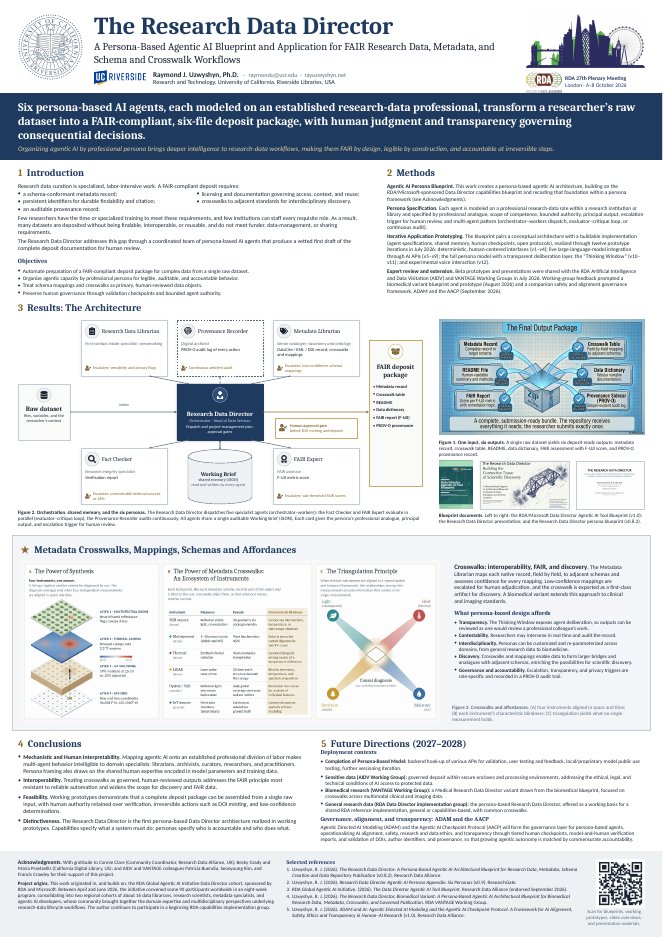
Six persona-based AI agents, each modeled on an established research-data professional, transform a researcher’s raw dataset into a FAIR-compliant, six-file deposit package, with human judgment and transparency governing consequential decisions.
Organizing agentic AI by professional persona brings deeper intelligence to research-data workflows, making them FAIR by design, legible by construction, and accountable at irreversible steps.
1The problem
Research data curation is specialized, labor-intensive work. A FAIR-compliant deposit requires a schema-conformant metadata record, persistent identifiers, licensing and documentation, an auditable provenance record, and crosswalks to adjacent standards.
Few researchers have the time or specialized training to meet these requirements, and few institutions can staff every requisite role. As a result, many datasets are deposited without being findable, interoperable, or reusable, and fall short of funder data-management and sharing requirements.
The Research Data Director addresses this gap: a coordinated team of persona-based AI agents produces a vetted first draft of the complete deposit documentation for human review.
Objectives
Automate preparation of a complete, FAIR-compliant deposit package for complex data from a single raw dataset.
Organize agentic capacity by professional persona for legible, auditable, and accountable behavior.
Treat schema mappings and crosswalks as primary, human-reviewed data objects.
Preserve human governance through validation checkpoints and bounded agent authority.
2Two ways to organize agentic AI
An agentic system pursues a goal: it plans, uses tools, checks its own work, and repeats until the task is done. There are two principal ways to specify such a system, and the second builds on the first.
Capabilities-based
Starts from what the system must do.
Discrete functions (search, extract, validate, crosswalk, export), each with inputs, outputs, and checks, arranged in a layered reference architecture. Auditable, testable, and straightforward to govern; its characteristic risk is brittleness at the edges.
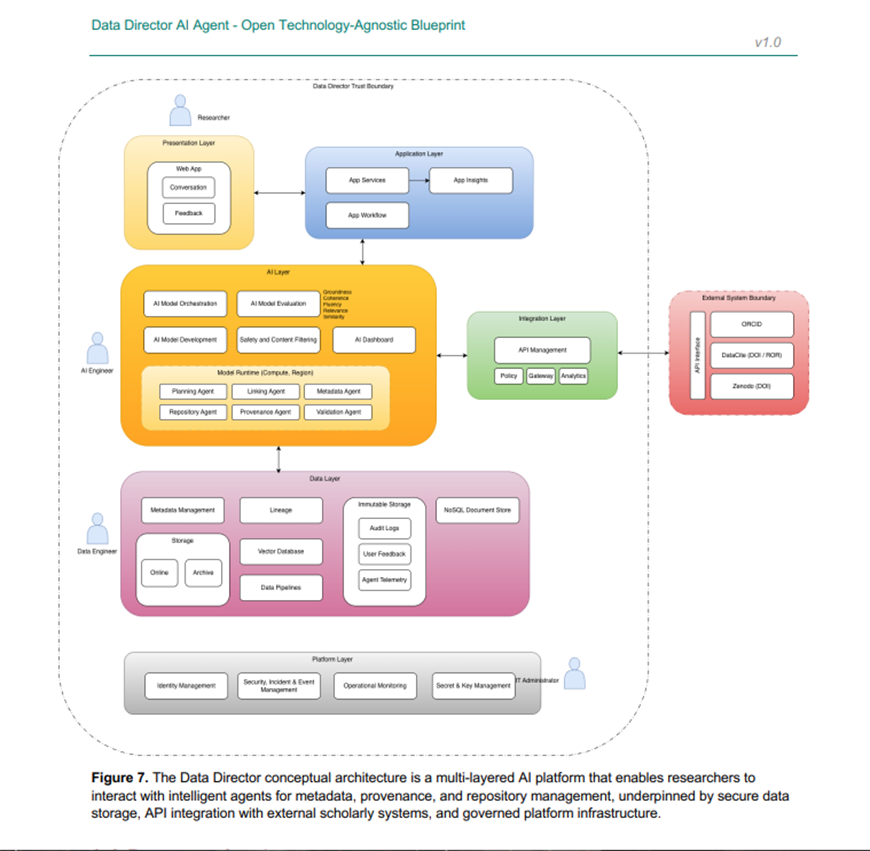
Example: the RDA/Microsoft Data Director Agentic AI Tool Blueprint, endorsed by RDA in September 2026.
The persona model builds on the capabilities model
Synthetic persona-based: the Research Data Director
Starts from who would do the work well.
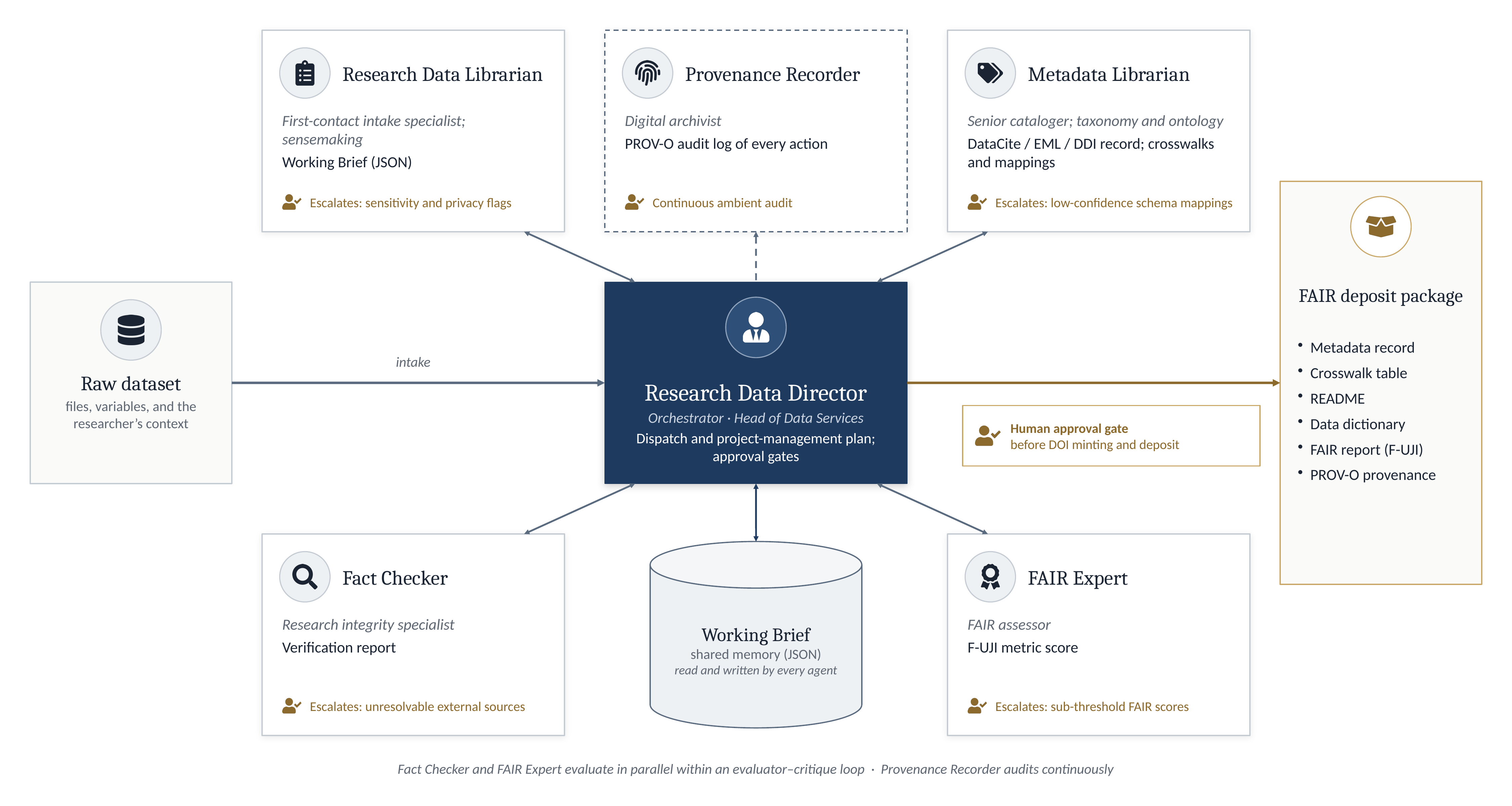
Figure 1. Orchestration, shared memory, and the six personas. The Research Data Director dispatches five specialist agents (orchestrator–workers); the Fact Checker and FAIR Expert evaluate in parallel (evaluator–critique loop); the Provenance Recorder audits continuously. All agents share a single auditable Working Brief (JSON). Brass marks the points where humans decide.
In the inner loop, the Metadata Librarian generates; the Fact Checker and FAIR Expert critique in parallel; the Director decides, with at most two rounds before human escalation.
Each capability is paired with a role, expertise, and judgment, and assigned to a synthetic professional. The result is a team that can deliberate and execute.
Personas are context-rich and legible to domain specialists. Their characteristic risk is being persuasive but wrong, which is why every persona carries a defined human checkpoint.
Real agentic AI systems synthesize both: synthetic persona-based systems execute with judgment and expertise.
3The six personas
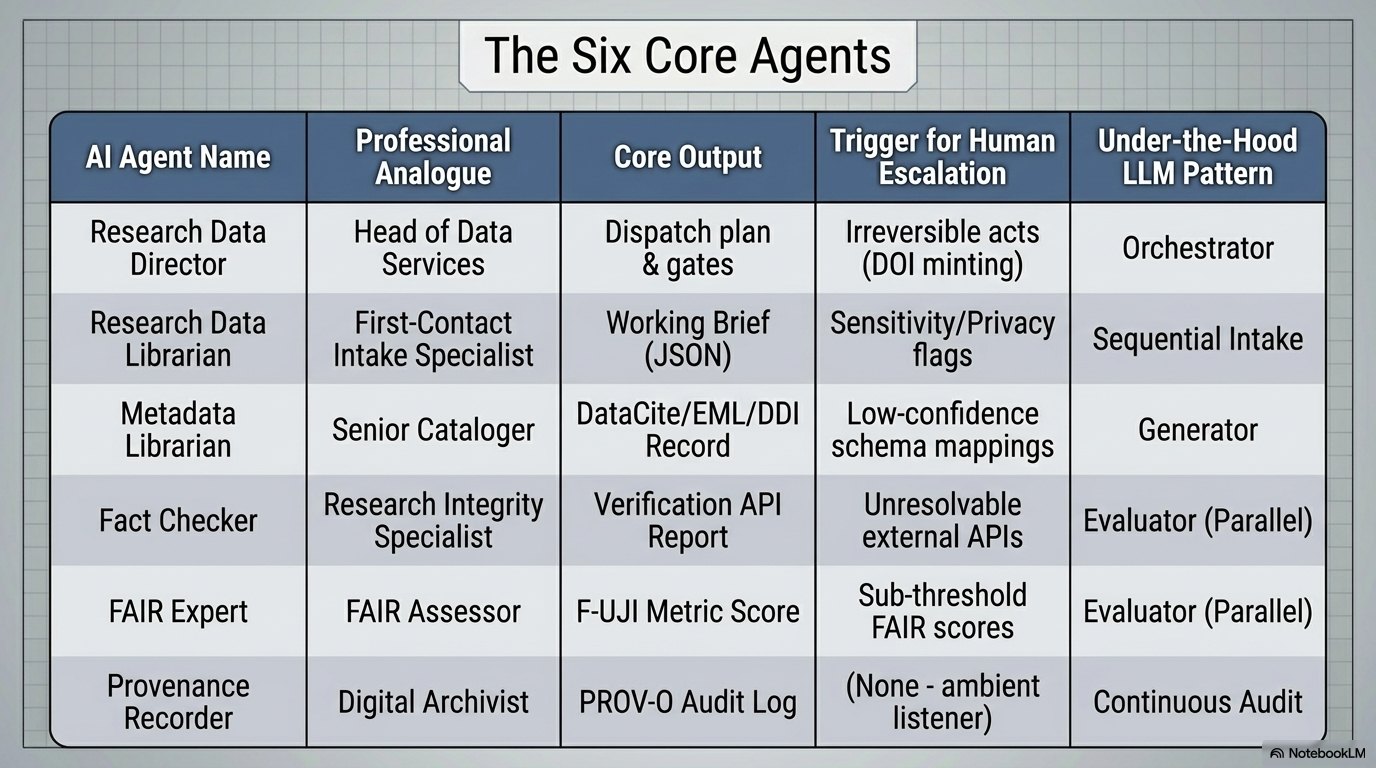
Each agent is modeled on a professional research-data role and specified by its professional analogue, scope of competence and bounded authority, principal output, escalation trigger for human review, and multi-agent pattern.
Figure 2. The six core agents. Professional analogue, core output, trigger for human escalation, and the underlying LLM pattern for each agent.
Table 1. The six core agents of the Research Data Director.
Agent
Professional analogue
Principal output
Escalates to human review
Pattern
Research Data Director
Head of Data Services
Dispatch and project-management plan; approval gates
Irreversible actions, such as DOI minting
Orchestrator
Research Data Librarian
First-contact intake specialist; sensemaking
Working Brief (JSON)
Sensitivity and privacy flags
Sequential intake
Metadata Librarian
Senior cataloger; taxonomy and ontology
DataCite, EML, or DDI record; crosswalks and mappings
Low-confidence schema mappings
Generator
Fact Checker
Research integrity specialist
Verification report
Unresolvable external sources or APIs
Evaluator (parallel)
FAIR Expert
FAIR assessor
F-UJI metric score
Sub-threshold FAIR scores
Evaluator (parallel)
Provenance Recorder
Digital archivist
PROV-O audit log of every action
None; continuous ambient audit
Continuous audit
Four secondary agents join the team when a case requires them.
The Persona Appendix (Appendix F) specifies each agent with a behavioral layer and a psychoanalytic sense-making component, to better answer questions and serve user needs.
Agents execute, read the shared document (memory) freely, and propose logical next steps, challenges, and possibilities.
Serious questions and irreversible acts, such as minting an identifier or publishing to a permanent record, belong to a human evaluator.
The boundary principle, adapted from the Research Data Director blueprint
Human oversight is a property each agent carries individually, not a global setting. The following triggers pause the system and route the decision to a named human role. The list is representative; institutions should extend it for local policy.
Table 2. Escalation triggers and routing.
What stops the system
Raised by
Routed to
DOI minting, license assignment, or public deposit (always gated)
Research Data Director
Researcher and research data librarian
CARE flag: Indigenous, community, or sovereign data signals detected
FAIR Expert
Community representative; research ethics office
Personal identifiers or sensitive location data found in files
Research Data Librarian
Researcher; data protection officer
Crosswalk field marked low-confidence or unmappable
Metadata Librarian
Disciplinary metadata specialist
Identifier claim cannot be verified by any API
Fact Checker
Researcher; research integrity officer
FAIR metric below institutional threshold after two revision rounds
Research Data Director
Research data services lead
Final deposit diverges from stated intake intent
Research Data Director
The researcher
5The Thinking Window
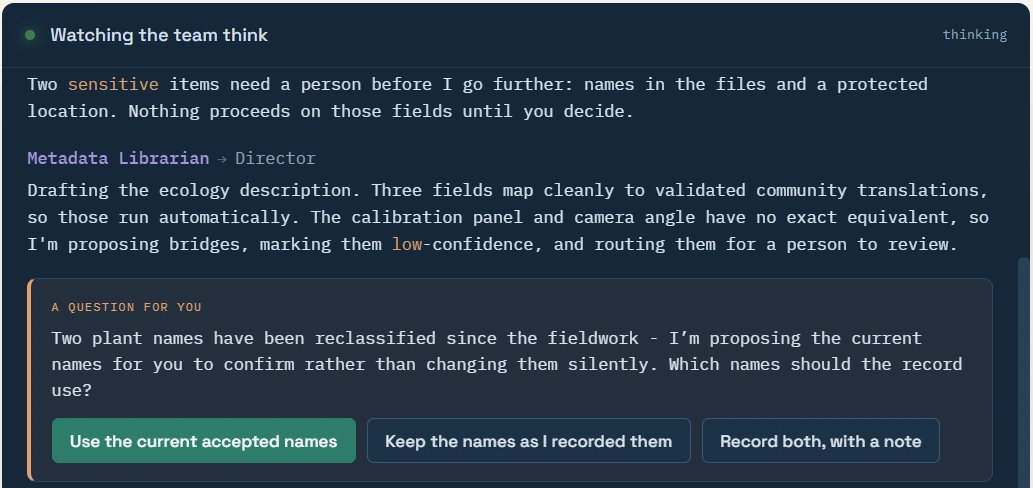
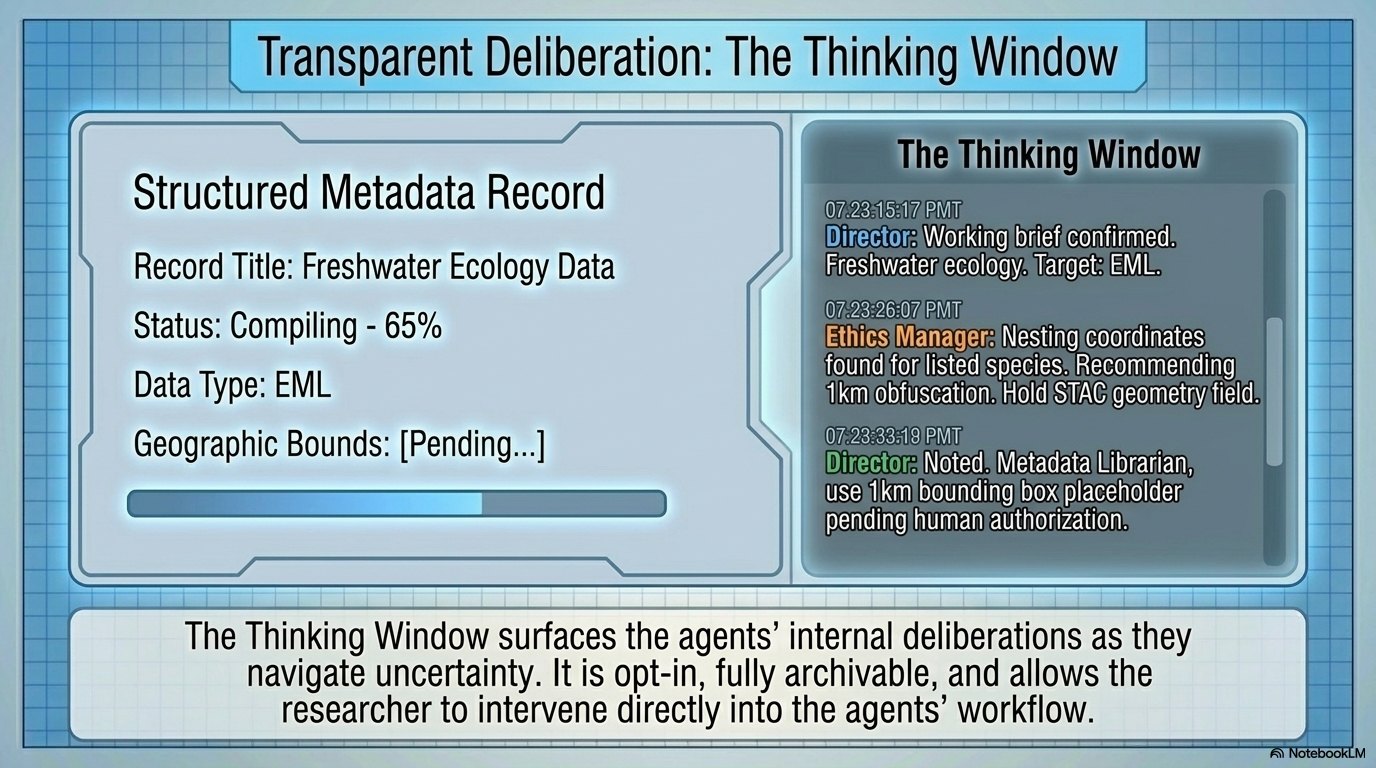
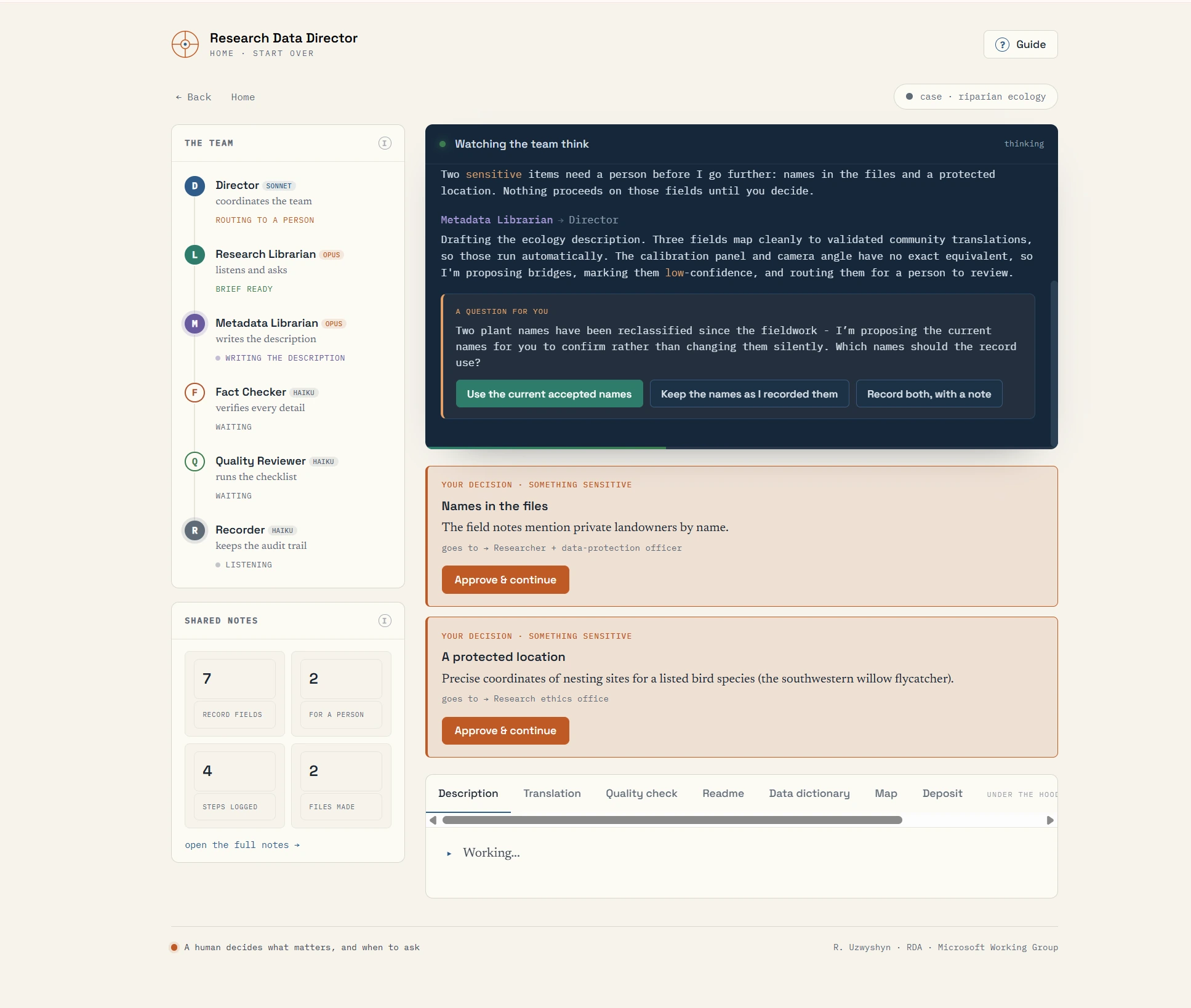
The Thinking Window exposes agent deliberation as it happens, so outputs can be reviewed as one would review a professional colleague’s work. It is opt-in and fully archivable, and it lets the researcher intervene directly in the workflow.
Figure 3a. In the prototype (version 5). “Two sensitive items need a person before I go further: names in the files and a protected location. Nothing proceeds on those fields until you decide.” The Metadata Librarian then explains which fields map cleanly, marks two bridges low-confidence for a person to review, and asks the researcher how reclassified plant names should be recorded. More in the prototype gallery.Figure 3b. The concept. Nesting coordinates are found for a listed species; the Research Integrity and Ethics Manager, one of the blueprint’s four secondary agents, recommends 1 km obfuscation, and the Director holds the field pending human authorization.
6What the system produces
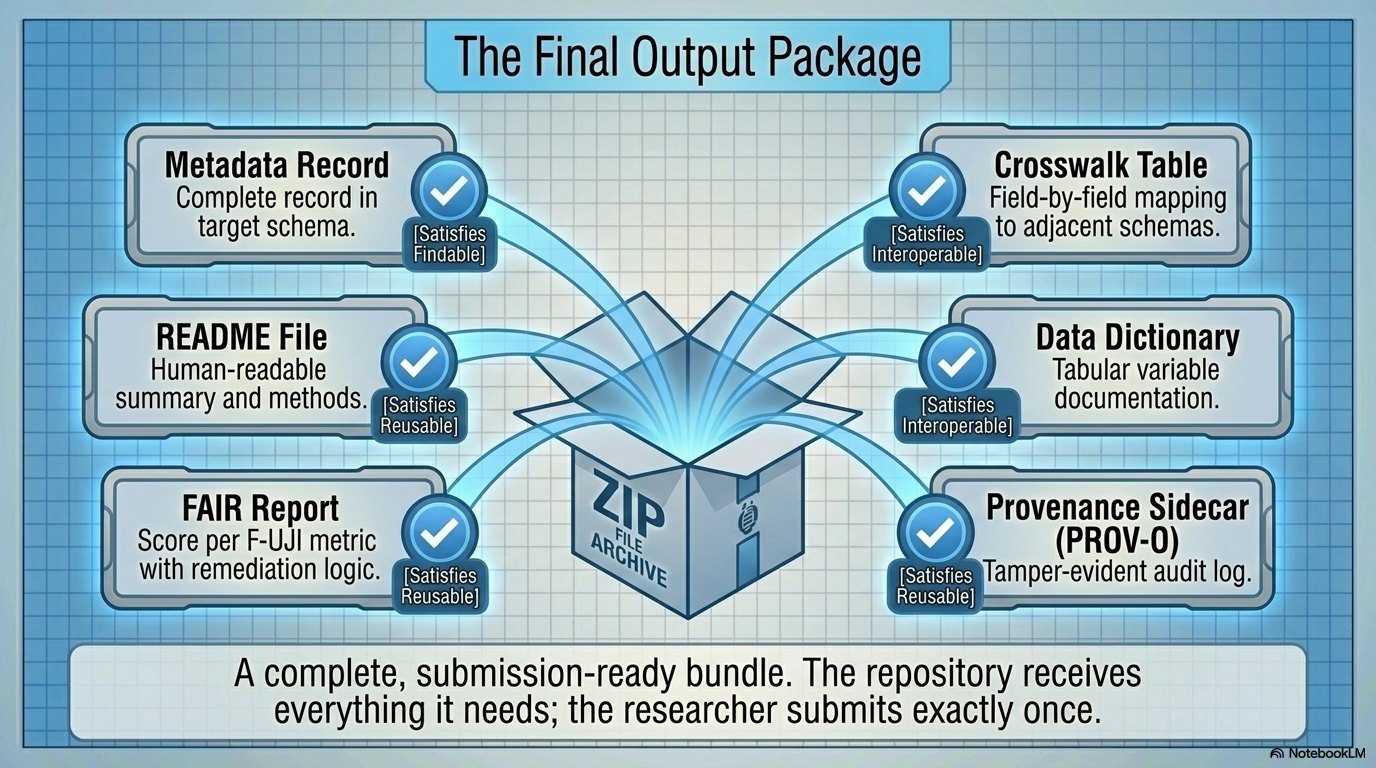
A single raw dataset yields six deposit-ready outputs. The researcher submits once; the repository receives everything it needs.
Figure 4. One input, six outputs. Each output is mapped to the FAIR principle it serves.
Table 3. Contents and immediate value of each output.
Document
Contents
Immediate value
Metadata record
Complete record in the target schema (DataCite 4.6 plus domain schema), with required and recommended fields populated, sourced, and confidence-rated
Findable in repository search and Google Dataset Search
Crosswalk table
Field-by-field mapping to at least two adjacent schemas, with confidence ratings and human-review flags
Findable from adjacent disciplines; enables synthesis
README file
Purpose, methods, variable descriptions, known limitations, loading instructions
Reuse without prior knowledge of the dataset
Data dictionary
Variable-by-variable documentation: name, type, units, controlled vocabulary term and URI, missingness codes
Satisfies FAIR R1 and I2; enables machine parsing
FAIR assessment
Score per F-UJI metric, with a plain-language explanation of each failure and remediation steps
Demonstrates FAIR compliance to funders
Provenance sidecar
PROV-O log of every agent action, tool call, model version, and human decision
The Metadata Librarian maps each native record, field by field, to adjacent schemas and assesses confidence for every mapping. Low-confidence mappings are escalated for human adjudication, and the crosswalk is exported as a first-class artifact for discovery. Treating crosswalks as governed, human-reviewed outputs addresses the FAIR principle most resistant to reliable automation: interoperability.
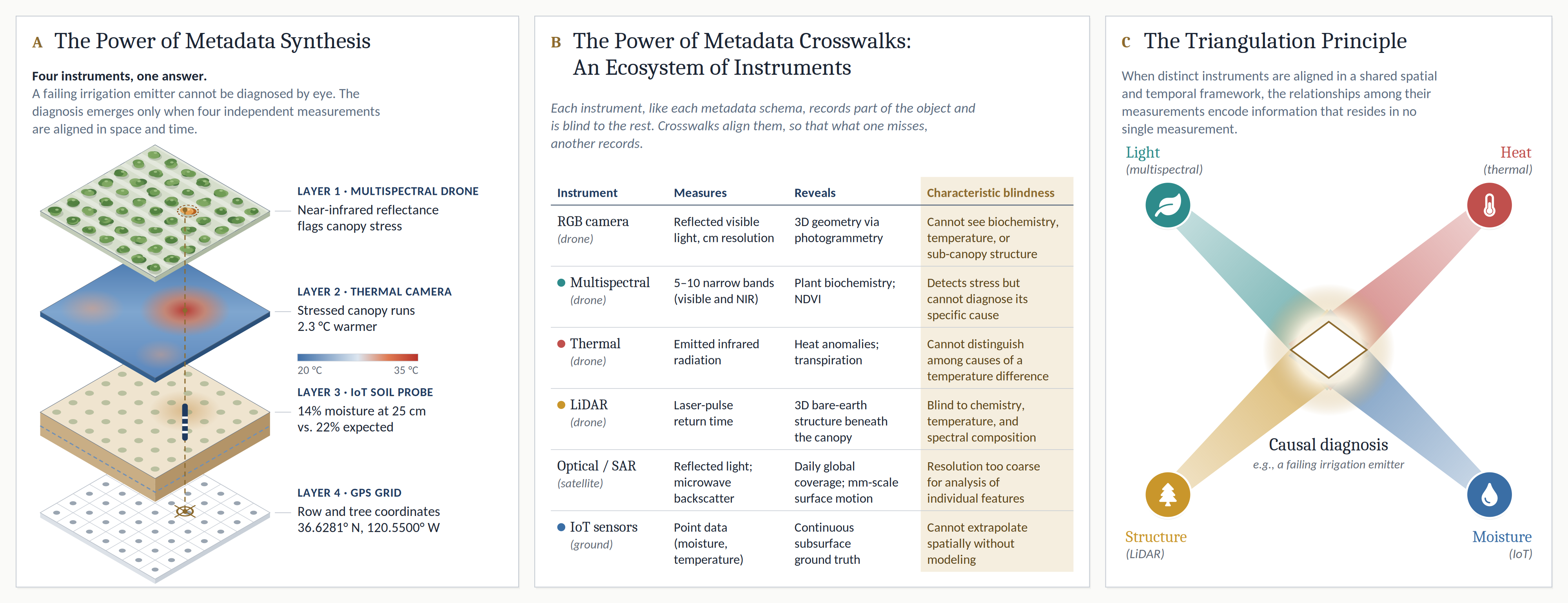
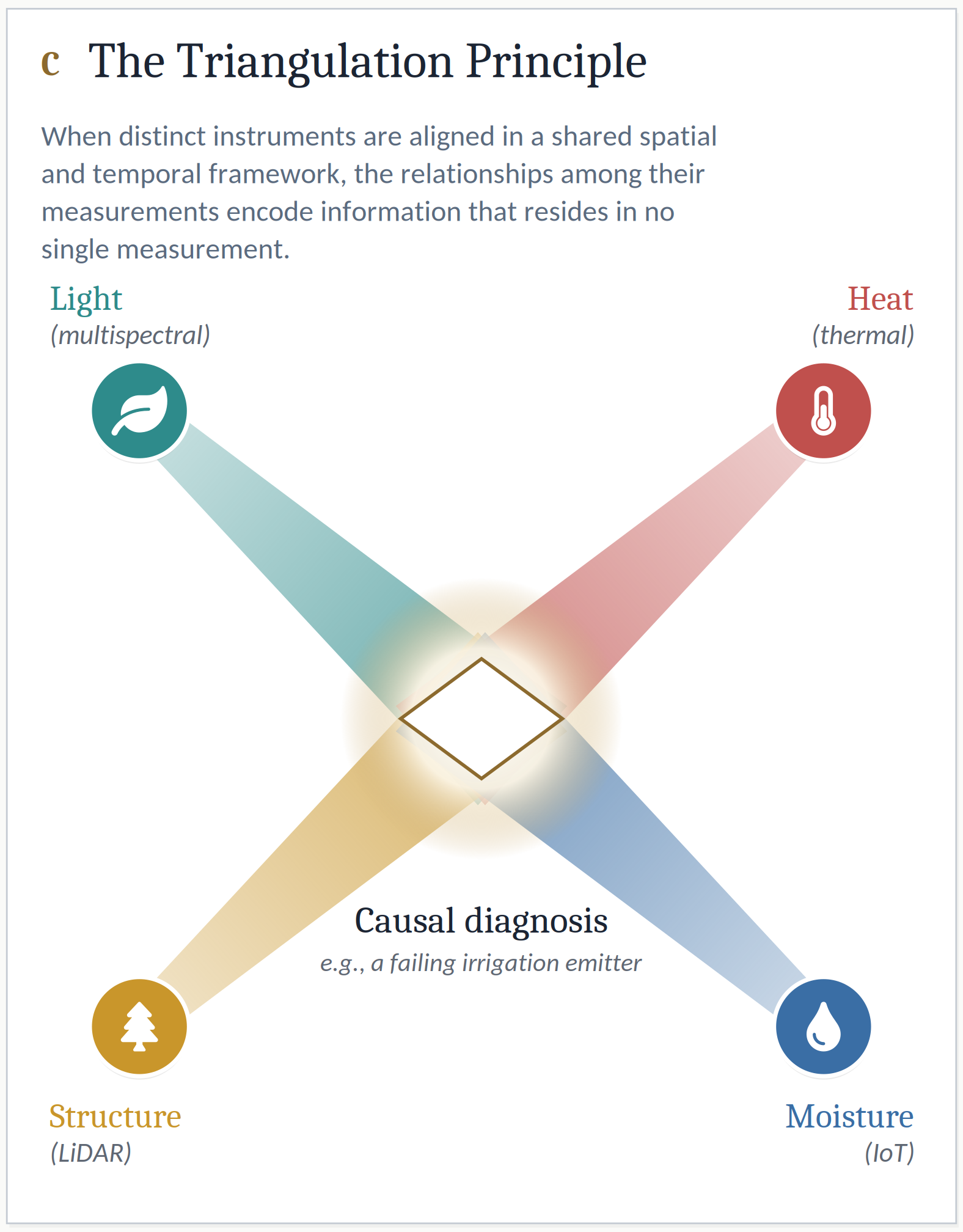
The figure below makes the argument through an analogy from precision agriculture, where several instruments observe the same orchard. Each panel is shown separately beneath it.
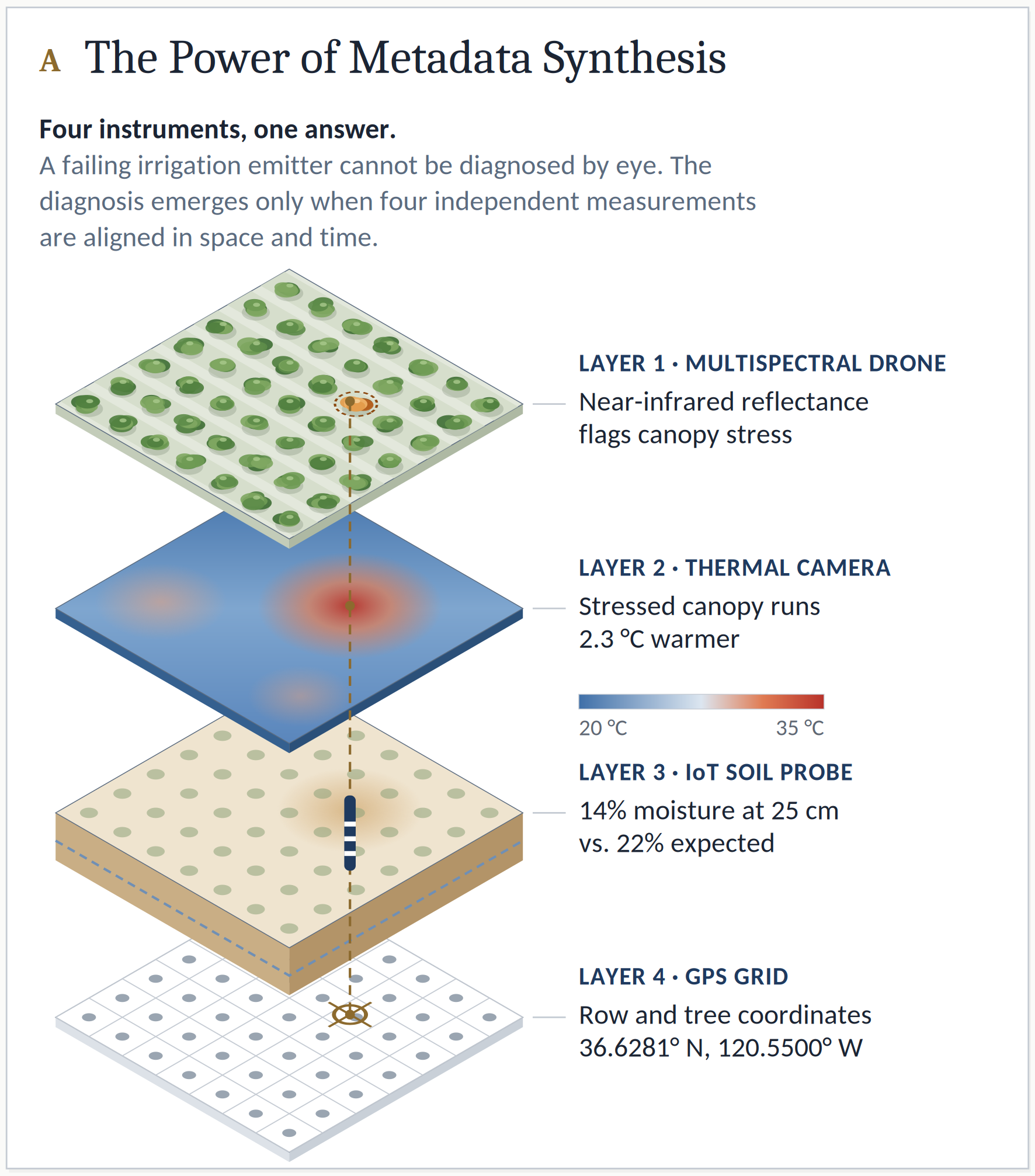
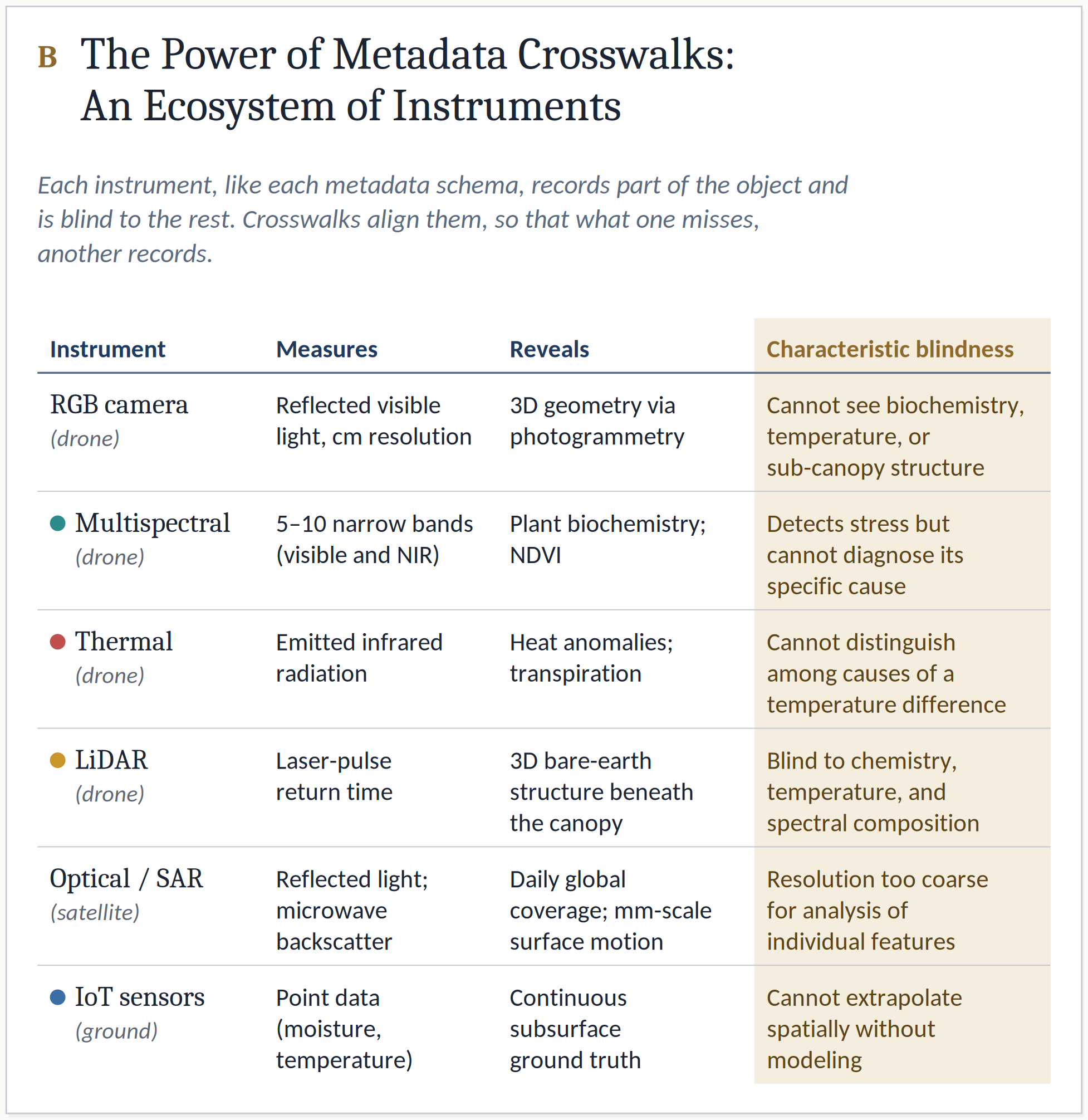
Figure 5. Crosswalks and affordances. (A) Four instruments aligned in space and time; (B) each instrument’s characteristic blindness; (C) triangulation yields what no single measurement holds.
AThe power of metadata synthesis
A plant physiologist cannot diagnose a failing irrigation emitter by eye. Four independent instruments each record one property of the same tree: near-infrared reflectance flags canopy stress; the thermal camera shows the canopy running 2.3 °C warmer; the soil probe reads 14% moisture at 25 cm against 22% expected; the GPS grid fixes the row and tree.
Only when the four are aligned on the same coordinates and time does the diagnosis appear. Metadata works the same way: each schema describes one facet of a dataset, and alignment is what makes the whole findable and interpretable.
BAn ecosystem of instruments
Every instrument reveals something and is blind to something else. The RGB camera captures geometry but not biochemistry; the thermal camera sees heat anomalies but cannot distinguish their causes; LiDAR resolves structure beneath the canopy but not chemistry; ground sensors give continuous truth at a point but cannot extrapolate across space.
Metadata schemas behave the same way. DataCite, EML, and DDI each capture what their discipline needs and omit the rest. A crosswalk records exactly where their fields meet, and where they do not.
CThe triangulation principle
When distinct instruments are aligned in a shared spatial and temporal framework, the relationships among their measurements encode information that resides in no single measurement.
Crosswalks are that shared framework for metadata. They let data from one discipline be found, read, and combined by another, forming larger bridges and analogues between schemas and enriching the possibilities for scientific discovery.
Mapping agentic AI onto an established professional division of labor makes multi-agent behavior intelligible to domain specialists: librarians, archivists, curators, researchers, and practitioners. Persona framing also draws on the shared human expertise encoded in model parameters and training data.
Interoperability
Treating crosswalks as governed, human-reviewed outputs addresses the FAIR principle most resistant to reliable automation and widens the scope for discovery and FAIR data.
Feasibility
Working prototypes demonstrate that a complete deposit package can be assembled from a single raw input, with human authority retained over verification, irreversible actions such as DOI minting, and low-confidence determinations.
Distinctiveness
The Research Data Director is the first persona-based Data Director architecture realized in working prototypes. Capabilities specify what a system must do; personas specify who is accountable and who does what.
Future directions, 2027–2028
Completion of the persona-based model: backend connection of validation APIs, user testing and feedback, public testing with local and proprietary models, and further iteration.
Sensitive data (AIDV Working Group): governed deposit within secure enclaves and processing environments, addressing the ethical, legal, and technical conditions of AI access to protected data.
Biomedical research (VANTAGE Working Group): a Medical Research Data Director variant, drawn from the biomedical blueprint, focused on crosswalks across multimodal clinical and imaging data.
General research data (RDA Data Director implementation group): the persona-based Research Data Director offered as a working basis for a shared RDA reference implementation, general or capabilities-based, with common crosswalks.
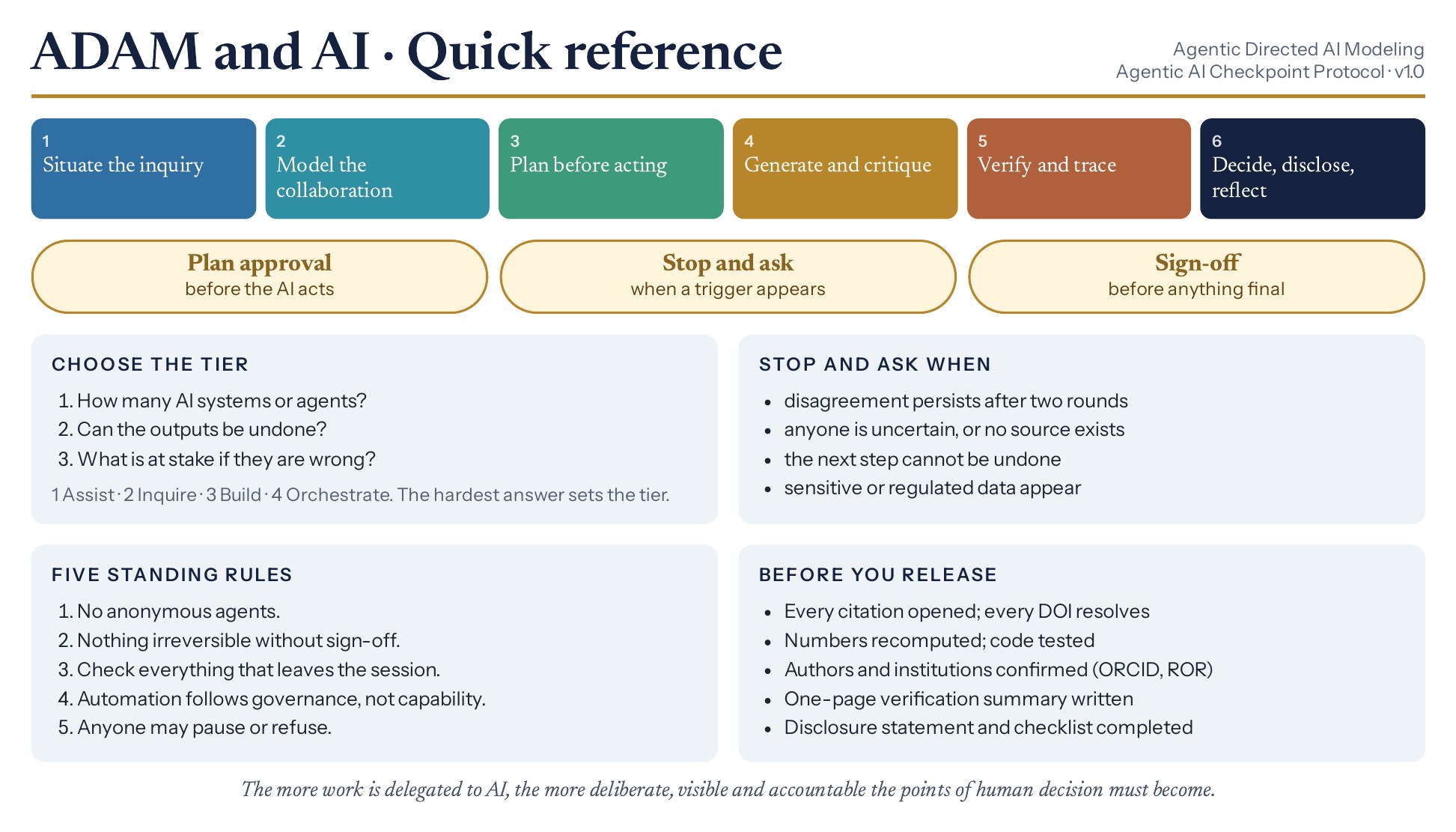
Governance, alignment, and transparency: ADAM and the AACP will form the governance layer for persona-based agents, through tiered human checkpoints, model-and-human verification reports, and validation of DOIs, author identifiers, and provenance, so that growing agentic autonomy is matched by commensurate accountability.
9Blueprints and papers
Blueprints and specifications
Foundational blueprint
The Research Data Director: A Persona-Based Agentic AI Architectural Blueprint for Research Data, Metadata, Schema Creation and Data Repository Publication (v0.8.2)
The architecture, personas, outputs, and human checkpoints. Research Data Alliance, 2026.
Research Data Director Agentic AI Persona Appendix: Six Personas (v0.9), Customizable
The persona team in detail, re-engineered for current persona practice, with working profiles for each agent that can be customized to a domain or institution.
The Data Director Agentic AI Tool Blueprint (v1.0)
The capabilities-based blueprint of the RDA Global Agentic AI Initiative, sponsored by RDA and Microsoft, on which this work builds. Endorsed by RDA, September 2026. The author was a contributing working-group member.
A separate project that applies the architecture to multimodal biomedical data, with its own early-stage prototype.
Biomedical Variant
RDA VANTAGE, 2026
Domain variant
The Research Data Director, Biomedical Variant: A Persona-Based Agentic AI Architectural Blueprint for Biomedical Research Data, Metadata, Crosswalks, and Governed Publication
RDA VANTAGE Working Group, August 2026, with its background paper Diagnostic Synthesis: Biomedical Research Data, Metadata, and Discovery Through Imaging, Genomics, Sensors, and AI.
The Agentic Turn: How AI Learned to Pursue Goals, and Why Humans Still Hold the Pens
An introduction to agentic AI and to capabilities-based and persona-based models, written for newcomers. UC Riverside Libraries, Research and Technology Services, AI Literacy Series, September 2026.
Spatial Synthesis: Research Data, Metadata and Discovery Through GIS, Satellites and Drones
The convergence of multi-scalar remote sensing and computational analysis in scientific inquiry, and the origin of the instrument analogy used for crosswalks.
ADAM and AI: Agentic Directed AI Modeling and the Agentic AI Checkpoint Protocol (v1.0)
A framework for AI alignment, safety, ethics, and transparency in human–AI research: tiered human checkpoints, verification reports, and validation of DOIs, author identifiers, and provenance. RDA Agentic AI Working Group, Research Data Alliance, September 2026. Its Appendix C, the Verification Kit, applies three-layer, cross-model verification with human adjudication to a worked example, Unlocking the Invisible Mile.
The blueprint pairs a conceptual architecture with a buildable implementation, realized through twelve prototype iterations in July 2026. All versions open in the browser.
v1–v4Hard-coded
Deterministic, human-centered interfaces
A friendly interface for the deposit workflow, with outputs simulated rather than generated.
These are research prototypes, built to test the blueprint. They use synthetic or illustrative cases, and every output is a draft for human review. The biomedical studio is a very early prototype.
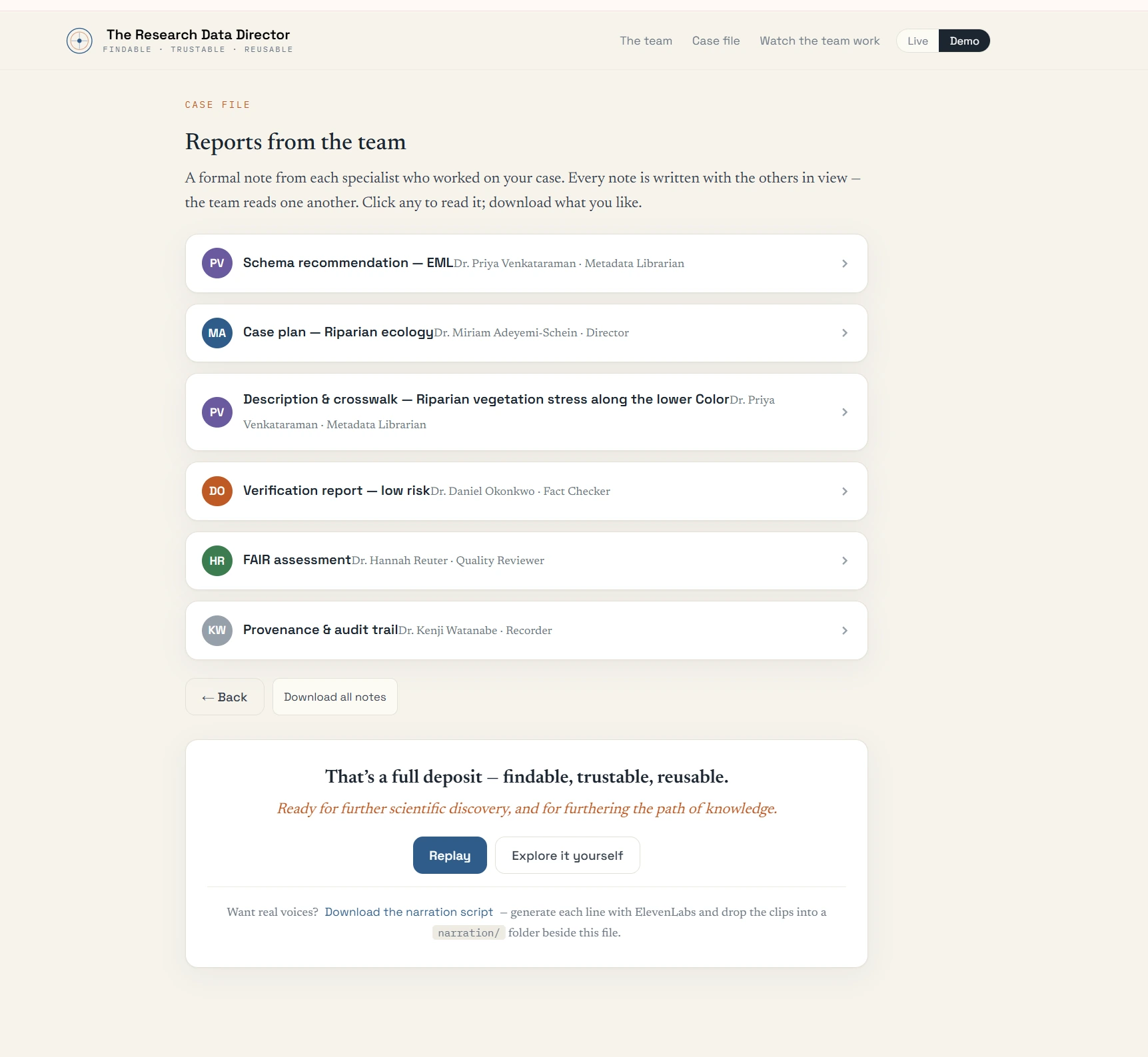
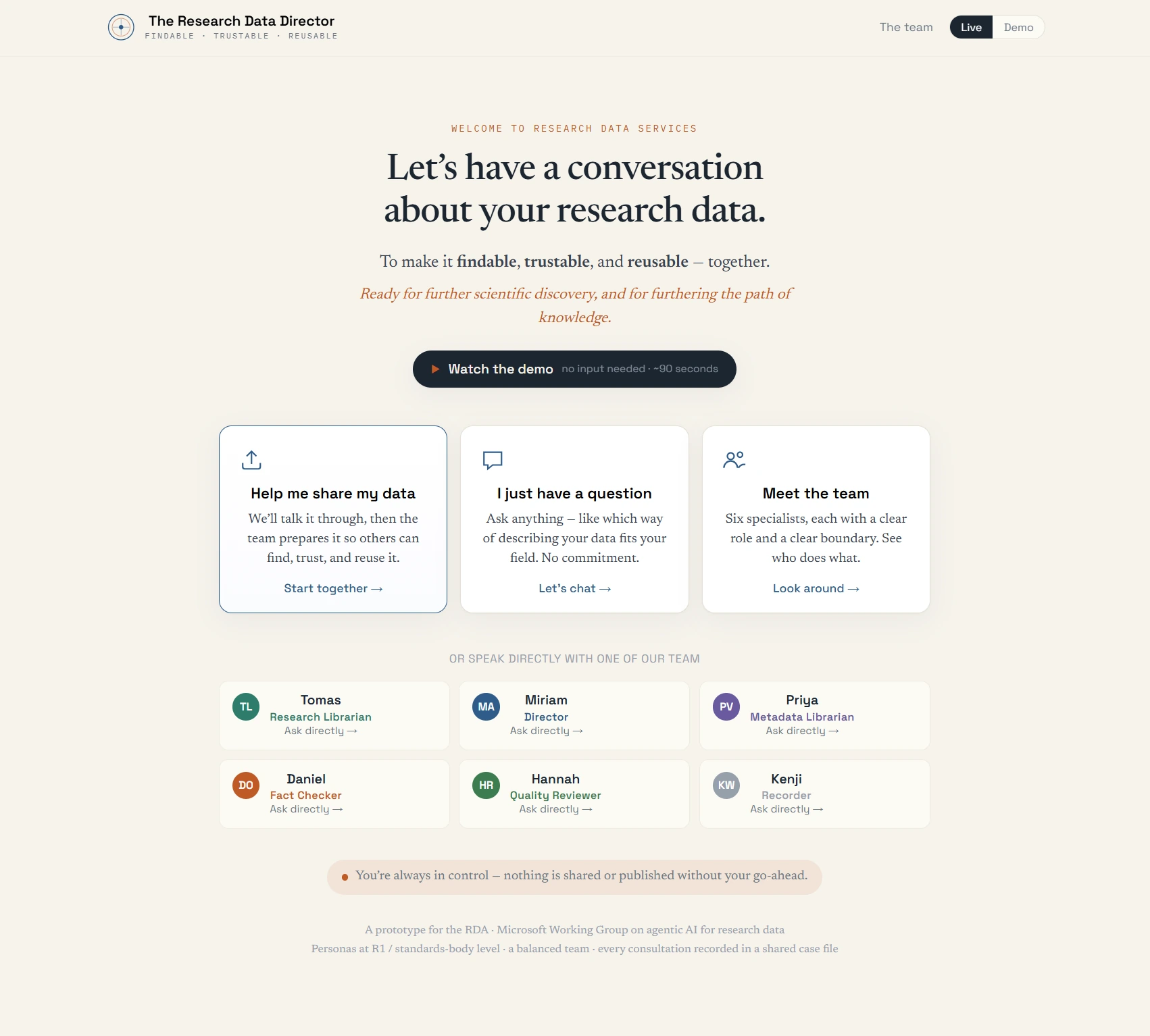
Versions 1–5. The workspace, with the Thinking Window and decisions held for a person.Version 11. The case file: a formal report from each specialist.Version 11. The front door, with the demo and the six named specialists.
Medical Research Data Director (Variant Application)
Early-stage prototype, August 2026
A separate project applying the architecture to multimodal biomedical research data: a metadata and crosswalk studio for dataset registration, metadata normalization, provenance and quality assessment, and human-reviewed crosswalks across clinical and imaging standards. Synthetic or de-identified data only; not for clinical use.
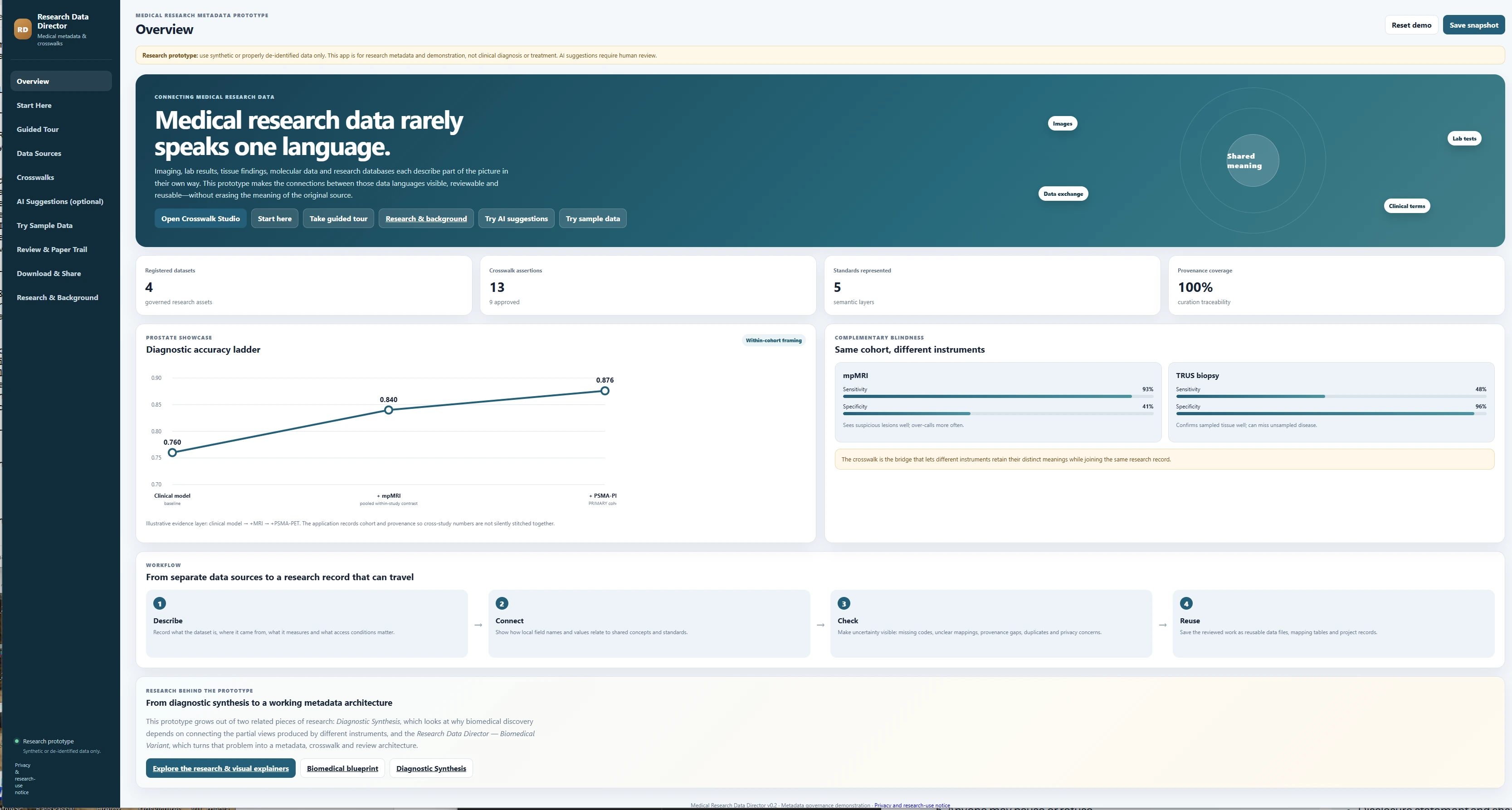
Figure 6. The Medical Research Data Director overview (detail), an early-stage prototype. Figures shown in it are illustrative. Click to see the full screen.
11Presentations, videos, and podcasts
Building a Persona-Based Agentic AI Research Data Director
RDA Artificial Intelligence and Data Visitation (AIDV) Working Group, 13 July 2026.
Each overview approaches the project from a different angle and introduces a specific paper. They were generated with Notebook LM from the source papers and are designed as accessible introductions for undergraduates, advanced high school students, and colleagues new to the subject. A good place to start: Diagnosing the invisible, then the three-minute overview of metadata and corporations.
Video, 8:13 How an epidemiological dataset meets the synthesis bottleneck, and how the Research Data Director’s crosswalks and review steps address it.
Biomedical research and the Research Data Director
The four-vocabulary problem: enabling cross-modal discovery in medicine
Video, 7:39 Why medical data sources describe the same patient in different vocabularies, and how governed crosswalks make discovery across them possible.
The Microsoft/RDA Data Director Capabilities Blueprint (Further Background)
The Data Director: a blueprint for scientific interoperability
Video A simplified overview of the capabilities model.
Architecting agentic AI for FAIR research data
Video An advanced overview of the capabilities model.
Podcasts
Two longer, conversational audio discussions introducing ideas regarding scientific research and possibilities with the Research Data Director. They suit listening on a commute or a walk. Choose a playback speed, or download a file to listen on your phone or computer in any audio app.
Fixing scientific data silos with agentic AI
Audio, 30:58 Why research data stays siloed, and how agentic AI can connect it.
This work originated in, and builds on, the RDA Global Agentic AI Initiative Data Director cohort, sponsored by RDA and Microsoft. Between April and June 2026, the initiative convened some 90 participants worldwide in an eight-week programme, consolidating into two regional cohorts of about 16 data librarians, research scientists, metadata specialists, and agentic AI developers, whose community brought together the domain expertise and multidisciplinary perspectives underlying research-data lifecycle workflows. The author continues to participate in the RDA capabilities implementation group.
Many of the ideas also took shape through the University of California, Riverside, Orbach Science Library GIS and AI Literacy Series, a set of workshops on AI, GIS, data, and drones organized by Janet Reyes, and through the RDA Agentic AI US Cohort meeting in Washington, which sparked much of their coalescence.
With gratitude to Connie Clare (Community Coordinator, Research Data Alliance, UK); Becky Grady and Maria Praetzellis (California Digital Library, US); and AIDV and VANTAGE colleagues Patricia Buendia, Seonyoung Kim, and Francis Crawley for their support of this project.
13How to cite
Uzwyshyn, R. J. (2026, October 6). The Research Data Director: A persona-based agentic AI blueprint and application for FAIR research data, metadata, and schema and crosswalk workflows [Poster presentation]. Research Data Alliance 27th Plenary Meeting, London, United Kingdom. https://rayuzwyshyn.net/rda-p27/